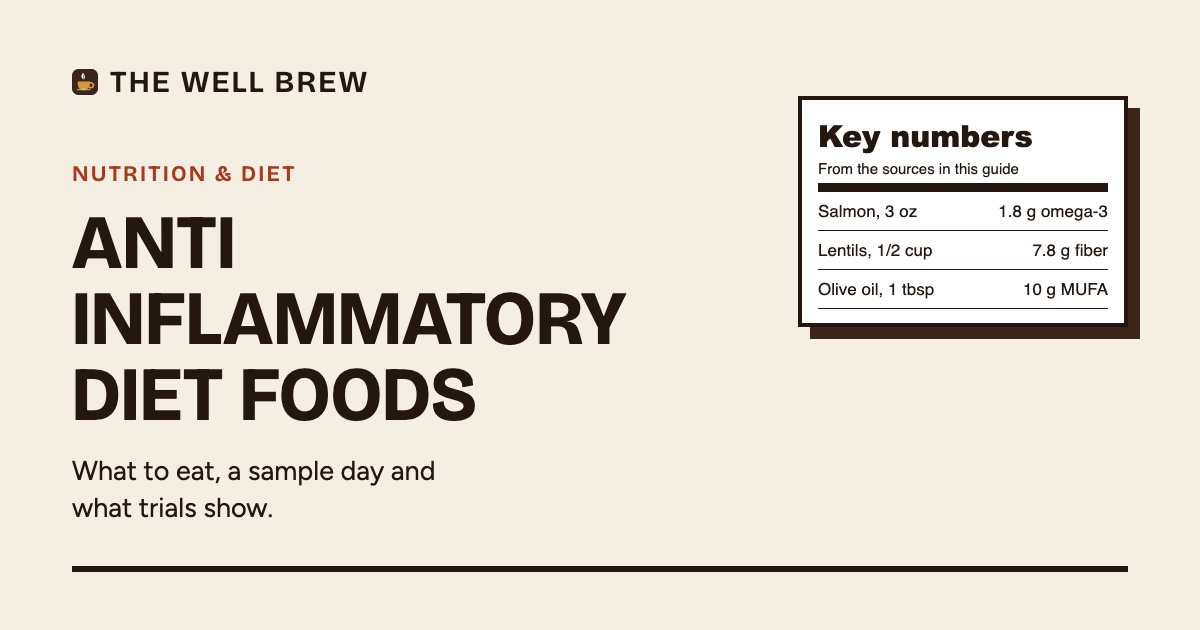
An anti-inflammatory diet looks much like the Mediterranean diet: fish twice a week, nuts and seeds, olive oil, legumes, whole grains, berries and vegetables, with less red meat, sweets and trans fat. Across 17 trials with 2,300 adults, this pattern lowered the inflammation marker hs-CRP by about 1 mg/L. Changes take at least 12 weeks, and diet supports medical treatment without replacing it.
On this page
- What is an anti inflammatory diet?
- What are the best anti inflammatory foods?
- Which inflammatory foods should you limit?
- Does an anti-inflammatory diet actually work?
- What does a low inflammation diet look like for one day?
- How do you reduce inflammation in the body?
- Are natural anti-inflammatory supplements worth it?
- Who should be careful, and what do doctors use first?
- Anti-inflammatory grocery checklist
- Bottom line
- FAQ
An anti inflammatory diet is a way of eating built on plants, fish, whole grains and olive oil, with less red meat, sweets and fried or processed food. To write this guide we read the National Cancer Institute and MedlinePlus pages on inflammation, CRP testing, fats and the Mediterranean diet, NCCIH’s pages on omega-3s and turmeric, three meta-analyses, the PREDIMED trial and USDA FoodData Central records for every food in our table. Our method is on the how we review page.
The short answer: in a pooled analysis of 17 trials with 2,300 people, a Mediterranean-style diet lowered the blood marker hs-CRP by about 1 mg/L more than control diets, and it is the eating pattern with the most consistent results.[6][5]
| What it is | A food pattern close to the Mediterranean diet: mostly plants, fish and seafood, whole grains, nuts, legumes and olive oil as the main fat.[3] |
|---|---|
| Used for | Lowering long-running, low-grade inflammation, the kind that does not switch off when it should.[1] |
| Typical amounts | At least 8 ounces of seafood a week for adults, plus daily vegetables, fruit, whole grains and legumes.[10][3] |
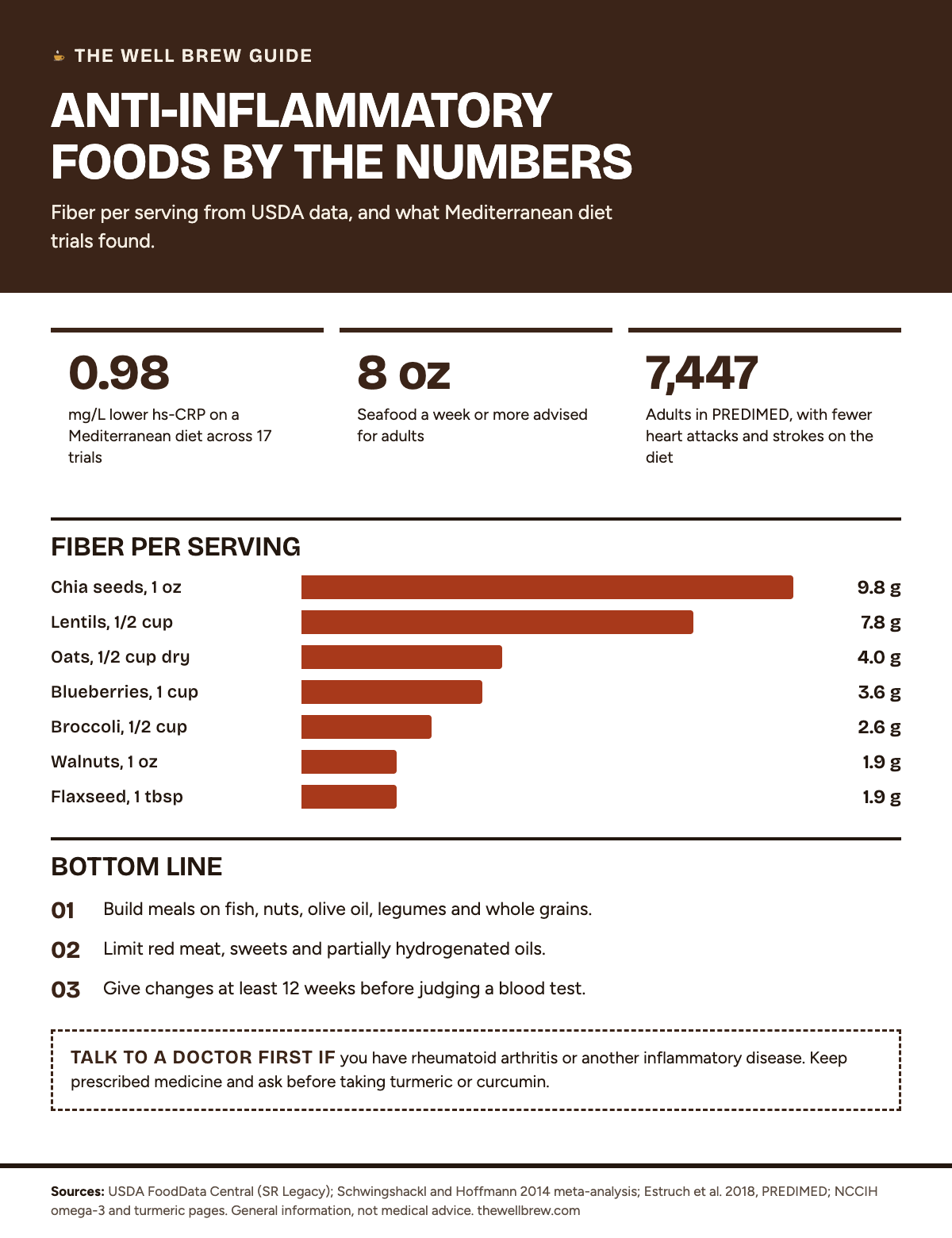
| Best evidence | Mediterranean diet trials: hs-CRP down 0.98 mg/L and IL-6 down 0.42 pg/mL across 17 trials of 12 weeks or more.[6] |
| Foods to limit | Red meat, sweets and desserts, butter, and foods made with partially hydrogenated oils.[3][4] |
| Safety | Safe for most people. Watch iron and calcium if you cut meat and dairy, and choose lower-mercury fish in pregnancy.[3][10] |
| Who should check first | Anyone with rheumatoid arthritis or another inflammatory disease should keep taking prescribed medicine and treat diet as an add-on.[10] |
What is an anti inflammatory diet?
An anti inflammatory diet is an eating pattern that favors foods linked to lower inflammation markers and cuts back on foods linked to higher ones. It has no single official menu. In research, the pattern that keeps coming out ahead is the Mediterranean diet.[5]
Short bursts of inflammation help you heal. When you cut your skin, the area swells and turns red while the body fights germs and heals.[2] In chronic inflammation, the process can start without an injury and keep going after it should have stopped. Infections that linger, immune reactions against your own tissue and obesity can all keep it running.[1]
Doctors usually measure it with a C-reactive protein (CRP) blood test. Your liver makes CRP in response to inflammation, and a high-sensitivity version (hs-CRP) picks up the small rises used to estimate heart disease risk.[2] Most diet trials in this guide report hs-CRP or a related marker called interleukin-6 (IL-6).
MedlinePlus describes the Mediterranean pattern as plant-based meals with small amounts of lean meat, more whole grains, fruit, vegetables, nuts and legumes, plenty of fish and seafood, and olive oil as the main cooking fat.[3] For this guide, we use that description as the working definition of anti-inflammatory eating.
What are the best anti inflammatory foods?
The best anti inflammatory foods are fatty fish, nuts and seeds, extra-virgin olive oil, legumes, whole grains, berries and leafy or cruciferous vegetables. They supply omega-3 fats, monounsaturated fat and fiber, the parts of the Mediterranean pattern that trials have tested.[3][7] The table below gives real amounts per serving.
| Food and serving | Key nutrient per serving | Easy way to use it |
|---|---|---|
| Salmon, farmed, cooked, 3 oz | About 1.8 g omega-3 (EPA plus DHA)[12] | Bake on a sheet pan with vegetables |
| Sardines, canned in oil, 3 oz | About 0.8 g omega-3 (EPA plus DHA)[12] | On whole grain toast or in a salad |
| Walnuts, 1 oz | 2.6 g plant omega-3 (ALA), 1.9 g fiber[12] | A handful as a snack |
| Chia seeds, 1 oz | 5.0 g ALA, 9.8 g fiber[12] | Stir into yogurt or overnight oats |
| Ground flaxseed, 1 tbsp | 1.6 g ALA, 1.9 g fiber[12] | Sprinkle on cereal or blend into a smoothie |
| Olive oil, 1 tbsp | About 10 g monounsaturated fat[12] | Main oil for cooking and dressings |
| Lentils, cooked, 1/2 cup | 7.8 g fiber[12] | Soups, stews and grain bowls |
| Oats, dry, 1/2 cup | 4.0 g fiber[12] | Oatmeal or overnight oats |
| Blueberries, 1 cup | 3.6 g fiber, 14 mg vitamin C[12] | Fresh or frozen on breakfast |
| Broccoli, cooked, 1/2 cup | 2.6 g fiber, 51 mg vitamin C[12] | Roast with olive oil and garlic |
We converted the USDA values per 100 grams into common servings, so treat the numbers as close estimates.[12] Fish gives the long-chain omega-3s EPA and DHA directly. Walnuts, chia and flax give ALA, the plant form. The PREDIMED trial gave its two Mediterranean groups free extra-virgin olive oil or mixed nuts, which is why those two foods sit near the top of most lists.[7]
Which inflammatory foods should you limit?
The foods most anti-inflammatory plans limit are red meat, sweets and desserts, butter, and fried or packaged foods made with partially hydrogenated oils. These are the foods the Mediterranean pattern keeps small, plus the trans fats that MedlinePlus advises avoiding.[3][4]
MedlinePlus lists red meats, sweets and other desserts, eggs and butter as foods eaten in small amounts or not at all in a Mediterranean diet.[3] Its page on dietary fats says saturated fat should stay under 6% of daily calories. Butter, cheese, whole milk, ice cream, fatty meats and coconut or palm oil are the main sources.[4]
Trans fats form when vegetable oil is hydrogenated so it stays solid. They raise LDL cholesterol, and MedlinePlus advises avoiding foods made with hydrogenated and partially hydrogenated oils and reading the label.[4]
Researchers have also scored whole diets for how pro-inflammatory they are, using a tool called the dietary inflammatory index. In 15 cohort studies, people with the most pro-inflammatory scores had a 41% higher risk of heart disease than those with the lowest.[9] These studies only observed people, so they show a link and cannot prove that the food caused the difference.
Does an anti-inflammatory diet actually work?
Trials show that a Mediterranean-style diet lowers inflammation markers by a modest amount, and one large trial found fewer heart attacks and strokes. Effects on symptoms such as joint pain are smaller and less certain.[6][7][8]
| Study | Who and how many | Length and diet | Result |
|---|---|---|---|
| Schwingshackl meta-analysis, 2014 | 17 trials, 2,300 adults | 12 weeks or more, Mediterranean diet | hs-CRP 0.98 mg/L lower, IL-6 0.42 pg/mL lower[6] |
| Koelman meta-analysis, 2022 | 22 randomized trials | Several patterns compared | Mediterranean diet cut IL-6 by 1.07 pg/mL; no clear effect for DASH, vegetarian or vegan diets[5] |
| PREDIMED trial, 2018 | 7,447 adults aged 55 to 80 at high heart risk | Median 4.8 years, Mediterranean diet plus olive oil or nuts | Major heart events 3.8% and 3.4% versus 4.4% on a low-fat control diet[7] |
| Schonenberger meta-analysis, 2021 | 7 trials, 326 people with rheumatoid arthritis | Mediterranean, vegetarian, vegan or ketogenic diets | Pain 9.22 mm lower on a 100 mm scale; very low certainty[8] |
In PREDIMED, the hazard ratio was 0.69 for the olive oil group and 0.72 for the nuts group, roughly 30% fewer major events than the control group.[7] The authors withdrew their 2013 report after finding randomization problems at some sites and published revised estimates in 2018, so the trial is strong evidence but not flawless.[7]
For rheumatoid arthritis, the review authors rated every included study at high risk of bias.[8] NCCIH reports a similar picture for omega-3-rich diets and joint pain: a possible benefit, low-quality evidence, and diet as an addition to drug treatment rather than a substitute.[10]
What does a low inflammation diet look like for one day?
A low inflammation diet day uses whole grains and fruit at breakfast, legumes and vegetables at lunch, nuts as a snack and fish at dinner, with olive oil as the cooking fat. The sample below uses only foods from our table, so every amount traces back to USDA data.[12]
| Meal | What to eat | What it adds |
|---|---|---|
| Breakfast | 1/2 cup oats cooked with water or milk, topped with 1 cup blueberries and 1 tbsp ground flaxseed | 9.5 g fiber, 1.6 g ALA[12] |
| Lunch | Lentil and spinach bowl: 1/2 cup cooked lentils, raw spinach, chopped vegetables, 1 tbsp olive oil and lemon | 7.8 g fiber from the lentils, about 10 g monounsaturated fat[12] |
| Snack | 1 oz walnuts and a piece of fruit | 2.6 g ALA, 1.9 g fiber from the nuts[12] |
| Dinner | 3 oz baked salmon, 1/2 cup roasted broccoli, a small serving of brown rice or whole grain bread | About 1.8 g EPA plus DHA, 2.6 g fiber from the broccoli[12] |
Counting only the measured foods above, the day gives about 22 g of fiber, 4.2 g of plant omega-3 and 1.8 g of fish omega-3.[12] The spinach, fruit and whole grain at dinner add more fiber on top.
Repeat fish on at least two days a week and you reach the 8 ounces of seafood a week that the Dietary Guidelines, as cited by NCCIH, suggest for adults.[10] On other nights, swap the salmon for beans, chickpeas or sardines.
The same pattern also fits people watching their blood sugar. MedlinePlus notes that Mediterranean-style eating may lead to more stable blood sugar and lower triglycerides.[3] If your last lab test came back borderline, our guide to the prediabetes A1C range and how to lower your numbers covers the targets and the trial that cut diabetes risk with lifestyle change.
How do you reduce inflammation in the body?
To reduce inflammation in the body, deal with the causes doctors know about: ongoing infections, autoimmune disease, obesity and smoking, then build meals around the foods above. Food choices work best once those causes are being handled.[1][2]
NCI lists infections that do not go away, abnormal immune reactions and obesity as common drivers of chronic inflammation.[1] MedlinePlus adds tissue that is repeatedly irritated, for example by smoking or chemicals in the environment.[2] That makes quitting smoking and reaching a healthier weight two of the most direct steps you can take.
On the food side, the trials that lowered CRP lasted at least 12 weeks.[6] Expect to keep a new pattern for months before a blood test shows any change. A one-week cleanse is far shorter than any of those trials.
Small swaps add up. Cook with olive oil instead of butter, keep a jar of walnuts on the counter, buy frozen berries and broccoli so they never run out, and plan two fish dinners a week.[3][10] More ideas sit in our nutrition and diet guides.
Are natural anti-inflammatory supplements worth it?
For most people, natural anti-inflammatory supplements such as turmeric and fish oil have weaker evidence than food, and some carry real risks. NCCIH says there is not enough evidence to conclude that turmeric or curcumin helps any health condition.[11]
Early studies of oral turmeric or curcumin for knee osteoarthritis look positive, but NCCIH says higher-quality trials are needed.[11] It also warns that some high-absorption curcumin products have been linked to liver damage. Plain turmeric can cause nausea, acid reflux and diarrhea.[11]
Fish oil has its own mixed record. NCCIH’s omega-3 page covers many uses, and for rheumatoid arthritis it describes diets rich in omega-3s as possibly helpful but backed by low-quality evidence.[10] Eating fish gives you the omega-3s along with protein and other nutrients, which is why the guidelines frame the advice around seafood.[10]
Turmeric used as a spice in curries and soups is a normal part of cooking. NCCIH’s warnings are about concentrated capsules.
Who should be careful, and what do doctors use first?
An anti-inflammatory diet is safe for most adults, but people with inflammatory diseases, pregnant people and anyone cutting out whole food groups should plan it with a clinician. Diet supports treatment and does not replace it.[10][3]
Safety and side effects
MedlinePlus lists a few concerns with Mediterranean-style eating. The calories in olive oil and nuts can lead to weight gain. Eating less meat can lower iron intake, so pair beans and greens with vitamin C foods. Eating less dairy can mean less calcium.[3]
If you are pregnant or breastfeeding, eat 8 to 12 ounces of seafood a week from choices lower in mercury.[10] Wine is often part of Mediterranean menus, but MedlinePlus says to skip it if you are pregnant, prone to alcohol overuse or at risk for breast cancer.[3]
What doctors use first
For a raised CRP, the first step is finding the cause. High CRP can point to an infection, inflammatory bowel disease or an autoimmune condition such as lupus or rheumatoid arthritis, and each has its own treatment.[2] For rheumatoid arthritis, standard medical treatment can slow joint damage, and NCCIH advises against changing prescribed medicine without talking to your provider.[10]
See a doctor right away if
- A joint becomes hot, red and very swollen, especially with a fever.
- You have ongoing diarrhea, blood in the stool or weight loss you cannot explain.
- You notice tiredness, nausea, poor appetite or dark urine while taking a turmeric or curcumin supplement.[11]
- You have chest pain, shortness of breath or sudden weakness on one side.
Anti-inflammatory grocery checklist
- Fish for two dinners: salmon, sardines or another lower-mercury option.[10]
- One bag of walnuts and one of chia seeds or ground flaxseed.[12]
- Extra-virgin olive oil as the main cooking oil.[3]
- Dried or canned lentils, beans or chickpeas for at least three meals.
- Oats and one other whole grain, such as brown rice or whole wheat bread.
- Frozen berries and frozen broccoli as backups for fresh produce.
- Check labels and skip anything listing partially hydrogenated oil.[4]
- Skip high-absorption curcumin capsules unless your doctor has approved them. Our review standards explain how we judge supplement claims.[11]
Bottom line
An anti-inflammatory diet is, in practice, a Mediterranean diet. The trials show modest drops in CRP and IL-6 and, in PREDIMED, fewer heart attacks and strokes.[6][7] The benefit comes from the whole pattern, and no single food in the trials carried it alone.
For most people, the better first step is changing the oil, adding fish twice a week and putting legumes on the menu, before spending money on turmeric or fish oil capsules. If you have an inflammatory disease, keep your treatment plan and bring this food list to your next appointment.[10][11]
Frequently asked questions
What are some easy anti inflammatory recipes?
Good starting recipes use the foods trials tested: overnight oats with chia and berries, a lentil and spinach soup finished with olive oil, and salmon baked on a sheet pan with broccoli. All three use the foods from the table in this guide, and none needs special ingredients or equipment.
How long does it take for diet to lower inflammation?
The trials that showed lower CRP and IL-6 lasted at least 12 weeks. Plan on keeping the new pattern for three months or more before a repeat blood test, and expect a modest change, about 1 mg/L for hs-CRP on average.
Is the Mediterranean diet the same as an anti-inflammatory diet?
They overlap almost completely. There is no official anti-inflammatory diet, and the Mediterranean diet is the pattern with the most trial data on inflammation markers. Vegetarian, vegan and DASH diets showed no clear effect on those markers in a 2022 review of 22 trials.
Can an anti-inflammatory diet help arthritis pain?
It may help a little. In rheumatoid arthritis, a 2021 review of 7 trials found pain about 9 mm lower on a 100 mm scale, but every study had a high risk of bias. Keep taking prescribed medicine and treat diet as an add-on.
Do I need a blood test to know if I have inflammation?
A CRP blood test is the usual check. Your liver makes CRP when there is inflammation, and the high-sensitivity version, hs-CRP, is used to estimate heart disease risk. Ask your doctor whether testing makes sense for you before and after changing your diet.
Sources
- Risk Factors: Chronic Inflammation. National Cancer Institute
- C-Reactive Protein (CRP) Test. MedlinePlus, National Library of Medicine, 2025
- Mediterranean diet. MedlinePlus Medical Encyclopedia, 2024
- Dietary fats explained. MedlinePlus Medical Encyclopedia, 2024
- Effects of Dietary Patterns on Biomarkers of Inflammation and Immune Responses: A Systematic Review and Meta-Analysis of Randomized Controlled Trials. Koelman et al., Advances in Nutrition, 2022
- Mediterranean dietary pattern, inflammation and endothelial function: a systematic review and meta-analysis of intervention trials. Schwingshackl and Hoffmann, Nutrition, Metabolism and Cardiovascular Diseases, 2014
- Primary Prevention of Cardiovascular Disease with a Mediterranean Diet Supplemented with Extra-Virgin Olive Oil or Nuts. Estruch et al., PREDIMED, New England Journal of Medicine, 2018
- Effect of Anti-Inflammatory Diets on Pain in Rheumatoid Arthritis: A Systematic Review and Meta-Analysis. Schonenberger et al., Nutrients, 2021
- Dietary inflammatory index and cardiovascular risk and mortality: A meta-analysis of cohort studies. Ji et al., Medicine, 2020
- Omega-3 Supplements: What You Need To Know. National Center for Complementary and Integrative Health, 2024
- Turmeric. National Center for Complementary and Integrative Health, 2025
- FoodData Central, SR Legacy food records. USDA Agricultural Research Service

Maya Ellison is the Reviews Editor at The Well Brew, a slow, plain-language supplement review blog for everyday adults. Maya reads each label in full, sets every dose beside the amounts used in human studies, grades the research with sources such as the NIH Office of Dietary Supplements and NCCIH, and works out the real cost and refund fine print. Maya has no medical credentials and is not a doctor, dietitian, nurse or pharmacist. Reviews give pros, cons and who a product suits, never scores. How we review supplements.
This article is general information, not medical advice. Dietary supplements are not reviewed by the FDA for safety or effectiveness before they are sold. Talk to your doctor before you start any supplement, especially if you are pregnant, nursing, take medication or have a health condition.