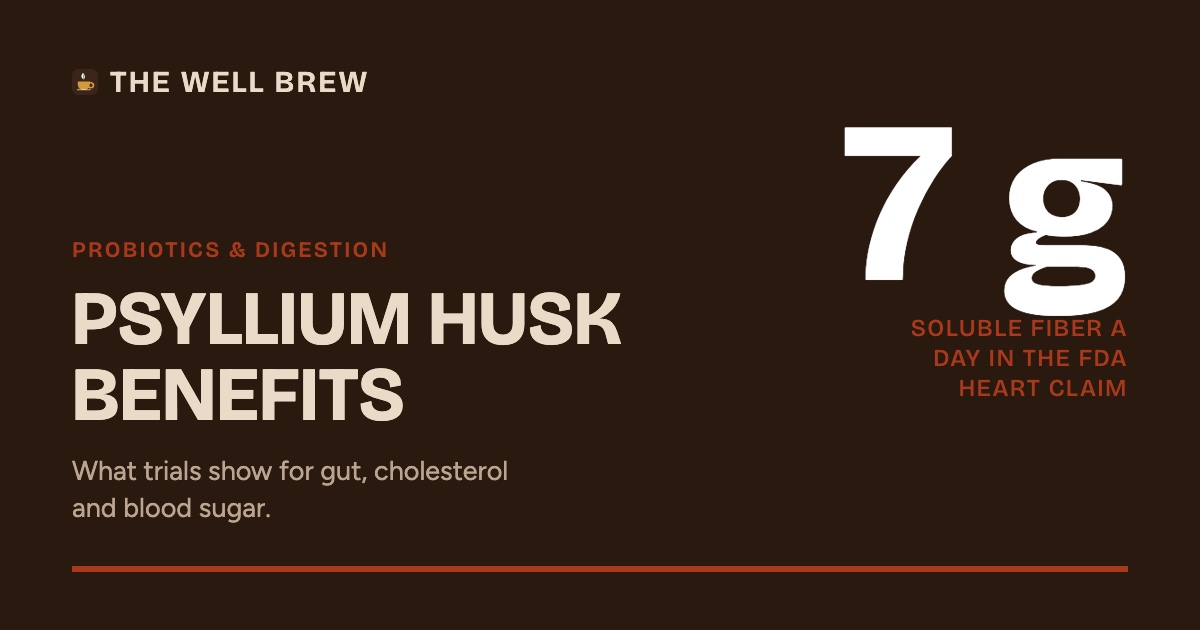
Psyllium husk is a soluble fiber from Plantago ovata seeds. Its best evidence is for constipation and for lowering LDL cholesterol, by about 13 mg/dL in 28 trials at around 10 grams a day. Effects on IBS, blood sugar and blood pressure are smaller or less certain. Take each dose with at least 8 ounces of liquid, and ask your doctor first if you take daily medicine.
On this page
- What is psyllium husk?
- What are the main psyllium husk benefits?
- Does psyllium help digestion, constipation and IBS?
- Can psyllium fiber lower cholesterol?
- Does psyllium husk help blood sugar?
- How much psyllium husk a day?
- What are psyllium husk side effects?
- What do doctors use first?
- Bottom line: is psyllium husk worth trying?
- FAQ
Psyllium husk is a soluble fiber from the seed coat of the Plantago ovata plant, and this guide explains its benefits for digestion, cholesterol and blood sugar, how much to take and who should skip it. We read the MedlinePlus psyllium and fiber pages, two NIDDK treatment pages, the FDA health claim rules in the federal code, a 2023 gastroenterology guideline and five meta-analyses of randomized trials. Our method is on the how we review page.
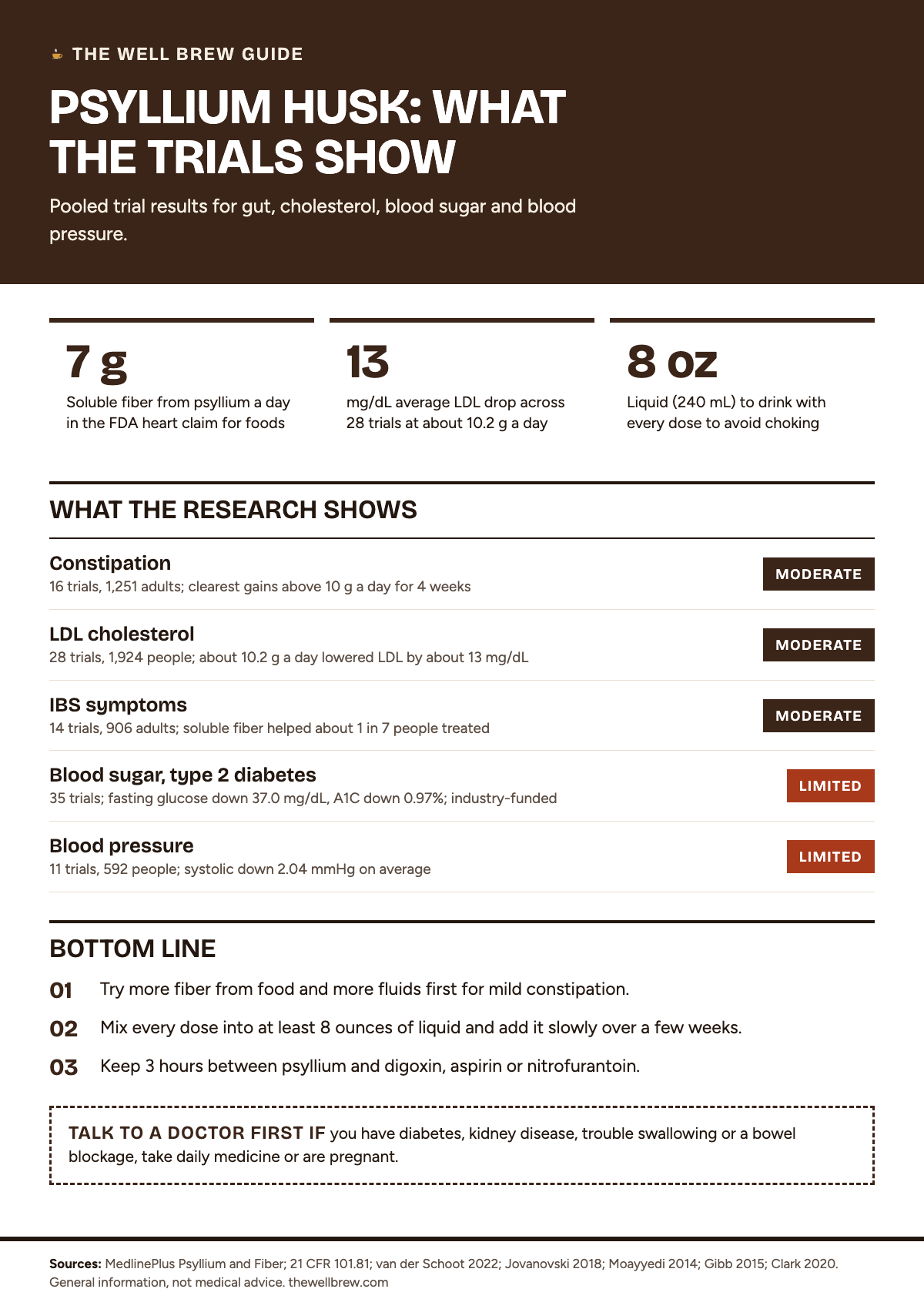
The short answer: psyllium has its best evidence for constipation and for lowering LDL cholesterol, where 28 trials found a drop of about 13 mg/dL at a median of 10.2 grams a day, and it needs a full glass of liquid with every dose.[7][1]
| What it is | The dried seed coat of Plantago ovata, also called blond or Indian psyllium.[5] |
|---|---|
| Used for | A bulk-forming laxative for constipation; doctors may also suggest it for diarrhea or high cholesterol.[1] |
| Typical amounts | Taken one to three times a day as the label directs. The FDA heart claim uses 7 grams or more of soluble fiber from psyllium a day.[1][5] |
| Best evidence | Constipation and LDL cholesterol, each backed by pooled randomized trials.[10][7] |
| Main safety point | Mix with at least 8 ounces (240 mL) of liquid. Too little liquid can cause choking.[1][6] |
| Who should check first | People with trouble swallowing, bowel blockage, rectal bleeding, kidney disease or diabetes, and anyone pregnant.[1] |
What is psyllium husk?
Psyllium husk is the outer coat of the seed of Plantago ovata, a plant also known as blond psyllium or Indian psyllium.[5] It is sold as a powder, granules, capsules and wafers, and it is the active fiber in brands such as Metamucil and Konsyl.[1] In India the same plant is called isabgol.[13]
Psyllium works by holding water. MedlinePlus says it absorbs liquid in the intestines, swells and forms a bulky stool that is easy to pass.[1] That same gel is what links it to cholesterol and blood sugar research.
For a food label to carry the FDA heart claim, the husk must be at least 95 percent pure.[5] A label that lists soluble fiber per serving gives you more to go on.
You can read more about fiber and gut health in our probiotics and digestion guides.
Is psyllium husk soluble fiber?
Yes, mostly. Soluble fiber attracts water and turns into a gel during digestion, which slows digestion.[2] The FDA rule names psyllium seed husk as an eligible source of soluble fiber, next to whole oats and barley.[5] A 2015 review describes psyllium as a soluble, gel-forming fiber that gut bacteria do not ferment. Most of its bulk stays intact as it moves through the gut.[8]
What are the main psyllium husk benefits?
The best-supported benefits of psyllium are easier bowel movements and a modest drop in LDL cholesterol. Smaller or less certain effects show up for IBS symptoms, blood sugar in type 2 diabetes and systolic blood pressure. The pooled results below are averages, so your own response may differ.
| Review | Trials and people | Dose and length | Main result |
|---|---|---|---|
| Constipation, van der Schoot 2022[10] | 16 trials, 1,251 adults (all fiber types) | Best response above 10 g a day for at least 4 weeks | Psyllium raised stool frequency and response; results varied a lot between trials |
| LDL cholesterol, Jovanovski 2018[7] | 28 trials, 1,924 people | Median about 10.2 g a day, at least 3 weeks | LDL down 0.33 mmol/L (about 13 mg/dL); moderate-quality evidence |
| IBS, Moayyedi 2014[9] | 14 trials, 906 adults (all fiber types) | Varied | Soluble fiber helped about 1 in 7 people treated; bran did not |
| Blood sugar, Gibb 2015[8] | 35 trials | Taken before meals, several weeks | In type 2 diabetes, fasting glucose down 37.0 mg/dL and A1C down 0.97%; no change with normal glucose |
| Blood pressure, Clark 2020[12] | 11 trials, 592 people | Varied | Systolic pressure down 2.04 mmHg on average |
One caution on the blood sugar review: its authors worked for Procter and Gamble, which makes Metamucil, and it drew partly on the company’s own trial records.[8] We treat it as useful but limited.
Does psyllium help digestion, constipation and IBS?
Psyllium is a bulk-forming laxative, and constipation is its main use.[1] A 2023 guideline from the American Gastroenterological Association and the American College of Gastroenterology suggests fiber supplements for chronic constipation and says that among the fibers studied, only psyllium appears to be effective.[11]
Constipation
The 2022 review of 16 trials found that psyllium and pectin improved constipation. Doses above 10 grams a day and at least 4 weeks of use gave the clearest gains, though the trials differed a lot from one another.[10] The guideline calls fiber a reasonable first step, especially for people who eat little fiber, and rates the recommendation as conditional.[11]
NIDDK lists fiber supplements such as Metamucil and Citrucel among the over-the-counter options a provider may suggest for a short time, along with more fiber from food and more fluids.[3]
Irritable bowel syndrome
In a 2014 review of 14 trials with 906 adults, soluble fiber, mostly psyllium, eased IBS symptoms, while wheat bran did not.[9] NIDDK says doctors may recommend fiber supplements for IBS with constipation when more fiber in the diet has not helped.[4]
Diarrhea
Because the gel holds water, MedlinePlus notes that a doctor may also prescribe psyllium for diarrhea.[1] More fiber topics sit in our ingredient guides.
Can psyllium fiber lower cholesterol?
Yes, by a modest amount: pooled trials show psyllium lowers LDL cholesterol by about 13 mg/dL on average. The 2018 review of 28 trials with 1,924 people used a median of about 10.2 grams a day. LDL fell 0.33 mmol/L, non-HDL cholesterol fell 0.39 mmol/L and apolipoprotein B fell as well.[7] The authors graded the LDL result as moderate quality.
The FDA lets qualifying foods say that soluble fiber from psyllium, as part of a diet low in saturated fat and cholesterol, may reduce the risk of heart disease. The rule ties that claim to 7 grams or more of soluble fiber from psyllium seed husk a day, and each serving must supply at least 1.7 grams.[5] That is a label claim for foods within a heart-healthy diet. It does not mean psyllium replaces a statin or other cholesterol medicine.
For scale, MedlinePlus says research has shown that soluble fiber lowers cholesterol, which may help heart health.[2] A 13 mg/dL drop is real but modest.
What about blood pressure?
A 2020 review of 11 trials with 592 people found systolic blood pressure fell by 2.04 mmHg on average, with larger drops in people who started higher.[12] That change is too small to justify altering a blood pressure plan.
Does psyllium husk help blood sugar?
Psyllium may lower blood sugar in people with type 2 diabetes, but it did little for people with normal blood sugar. In the 2015 review of 35 trials, taking psyllium before meals for several weeks lowered fasting glucose by 37.0 mg/dL and A1C by 0.97% in type 2 diabetes. The effect in prediabetes was modest, and there was no clear drop in people with normal glucose.[8]
The authors said more study is needed on how psyllium fits with glucose-lowering medicine.[8] MedlinePlus asks people with diabetes to tell their doctor before starting psyllium.[1] MedlinePlus also notes your doctor may need to change your medicine doses or watch you closely for side effects.[1] That matters most if you take medicine that lowers blood sugar. Know the signs of low blood sugar and what to do right away before you start.
If your concern is a borderline lab result, our guide to prediabetes A1C ranges and how to lower your numbers covers the steps with the strongest trial data. Fiber can be one part of that plan.
How much psyllium husk a day?
Follow the product label, which usually means one dose one to three times a day, each mixed into at least 8 ounces (240 mL) of liquid.[1] MedlinePlus advises not using psyllium for constipation for longer than 1 week unless a doctor tells you to.[1] Trials for longer-term goals used larger daily totals, so the table below shows what research used, not a personal dose.
| Goal | Amount used in research | Time studied |
|---|---|---|
| Constipation | More than 10 g of fiber a day gave the clearest response[10] | At least 4 weeks |
| LDL cholesterol | Median about 10.2 g of psyllium a day[7] | 3 weeks or more |
| FDA heart claim (foods) | 7 g or more of soluble fiber from psyllium a day[5] | Daily, as part of a low saturated fat diet |
| Total fiber from all foods | 22 to 34 g a day for adults, by age and sex[3] | Every day |
Most Americans eat about 16 grams of fiber a day, while advice for adults runs from 21 to 38 grams.[2] Psyllium can help close that gap, but beans, oats, fruit and vegetables bring other nutrients too.
Psyllium husk powder or capsules?
Powder and capsules contain the same fiber. Powder lets you take a full dose in one glass, while capsules hold less per pill, so check the label for how many make one dose. Either way, MedlinePlus says you must drink at least 8 ounces of liquid with each dose.[1] Powder has one extra risk: breathing it in while mixing can cause an allergic reaction.[1]
How to start psyllium without the bloating
- Check with your doctor first if you take any daily medicine or have a condition on the safety list below.
- Start with a small amount, such as half a label dose, once a day.
- Stir it into a full 8-ounce (240 mL) glass of water or juice and drink it right away, before it thickens.[1]
- Drink another glass of fluid soon after, and keep fluids up through the day.[2]
- Raise the amount slowly over a few weeks, since adding fiber fast causes gas, bloating and cramps.[2]
- Keep at least 3 hours between psyllium and digoxin, aspirin or nitrofurantoin.[1]
- For constipation, stop after 1 week and call your doctor if it has not helped.[1]
What are psyllium husk side effects?
The most common side effects of psyllium, including Metamucil, are gas, bloating and cramps, and the most serious risk is choking or blockage when it is taken without enough liquid. MedlinePlus notes that eating a lot of fiber in a short time causes gas, bloating and cramps, which often settle as your gut adjusts.[2] In the constipation trials, flatulence was more common with fiber than with control.[10]
Federal labeling rules for psyllium foods require a warning to eat them with at least a full glass of liquid, because too little liquid may cause choking, and to avoid them if you have trouble swallowing.[6] Very high fiber intake can also reduce how well you absorb iron, zinc, magnesium and calcium.[2]
Who should avoid it or ask first
- People with difficulty swallowing, a history of intestinal blockage or rectal bleeding.[1]
- People with diabetes, heart disease, high blood pressure or kidney disease.[1]
- Anyone pregnant, planning a pregnancy or breastfeeding.[1]
- People on a low-sugar or low-sodium diet, since some products add sugar or sodium.[1]
- Anyone allergic to psyllium.[1]
Call a doctor right away if you have
- Trouble breathing or swallowing after a dose.[1]
- Stomach pain, nausea or vomiting.[1]
- A skin rash or itching.[1]
What do doctors use first?
For constipation, doctors usually start with more fiber from food, more fluids, regular activity and bowel habits, then add a fiber supplement or another laxative. NIDDK lists those home steps first. If they fail, a doctor may suggest osmotic laxatives or prescription drugs such as lubiprostone, linaclotide or prucalopride.[3] The 2023 guideline gives its strong recommendations to drugs like polyethylene glycol, and a conditional one to fiber.[11]
For IBS, NIDDK lists diet changes such as the low FODMAP plan, medicines matched to the IBS type and mental health therapies.[4] For high cholesterol or type 2 diabetes, psyllium is an add-on to the diet, activity and medicine your doctor sets.
Checklist before you buy psyllium
- Look for the grams of soluble fiber per serving on the label, so you know what a dose gives you.[5]
- Check for added sugar, sweeteners and sodium if you watch those.[1]
- Read the liquid and choking notice and follow it every time.[6]
- List every medicine you take and plan the 3-hour gap where it applies.[1]
- Choose powder for a full dose in one glass, or capsules if taste is a barrier.
- See how we judge supplement labels on our review methods page.
Bottom line: is psyllium husk worth trying?
Psyllium is one of the better-studied fiber supplements. It has solid support for constipation and a modest, consistent effect on LDL cholesterol. The effects on IBS, blood sugar and blood pressure are smaller or less certain, and the blood sugar data lean on an industry-funded review.
For most people with mild constipation, eating more fiber from food and drinking more fluids is the better first step, because it is free and brings other nutrients. If that falls short, psyllium is a reasonable next try, as long as each dose goes down with a full glass of liquid and your doctor knows about any medicines you take.
Frequently asked questions
Is isabgol the same as psyllium husk?
Yes. Isabgol is the common name in India for Plantago ovata, the plant whose seed coat is sold as psyllium husk. US rules call the same husk blond psyllium or Indian psyllium, so the names point to one fiber.
Is Metamucil the same as psyllium?
Metamucil is a brand of psyllium fiber, and MedlinePlus lists it with Konsyl and other psyllium products. Products differ in sweeteners, flavors and serving size, so compare the grams of soluble fiber and the other ingredients on each label.
Can I take psyllium husk every day?
Many people use it daily under a doctor's advice, and the cholesterol trials lasted weeks. For constipation, MedlinePlus says not to use it longer than 1 week unless your doctor tells you to. Ask your doctor before making it a daily habit.
Can psyllium help with diarrhea?
It can. Psyllium soaks up water and forms a gel, and MedlinePlus notes doctors may prescribe it for diarrhea as well as constipation. Get medical advice for diarrhea that is severe, bloody or lasting, rather than treating it yourself.
When is the best time to take psyllium?
Follow the label, which usually means one to three doses a day. In the blood sugar trials, psyllium was taken before meals. Keep it at least 3 hours apart from digoxin, aspirin and nitrofurantoin, and always take it with a full glass of liquid.
Sources
- Psyllium. MedlinePlus Drug Information, National Library of Medicine, 2024
- Fiber. MedlinePlus Medical Encyclopedia, National Library of Medicine, 2026
- Treatment for Constipation. National Institute of Diabetes and Digestive and Kidney Diseases
- Treatment for Irritable Bowel Syndrome. National Institute of Diabetes and Digestive and Kidney Diseases, 2017
- 21 CFR 101.81: Health claims, soluble fiber from certain foods and risk of coronary heart disease. Electronic Code of Federal Regulations, FDA rule
- 21 CFR 101.17: Food labeling warning, notice and safe handling statements (psyllium husk). Electronic Code of Federal Regulations, FDA rule
- Effect of psyllium fiber on LDL cholesterol and alternative lipid targets (Jovanovski et al.). American Journal of Clinical Nutrition, 2018
- Psyllium fiber improves glycemic control proportional to loss of glycemic control (Gibb et al.). American Journal of Clinical Nutrition, 2015 (authors from Procter and Gamble)
- The effect of fiber supplementation on irritable bowel syndrome (Moayyedi et al.). American Journal of Gastroenterology, 2014
- The effect of fiber supplementation on chronic constipation in adults (van der Schoot et al.). American Journal of Clinical Nutrition, 2022
- AGA-ACG Clinical Practice Guideline: Pharmacological Management of Chronic Idiopathic Constipation. Gastroenterology, 2023
- The effect of psyllium supplementation on blood pressure (Clark et al.). Korean Journal of Internal Medicine, 2020
- Induced mutation breeding in medicinal and aromatic crops at CSIR-CIMAP (Lal et al.). International Journal of Radiation Biology, 2020

Maya Ellison is the Reviews Editor at The Well Brew, a slow, plain-language supplement review blog for everyday adults. Maya reads each label in full, sets every dose beside the amounts used in human studies, grades the research with sources such as the NIH Office of Dietary Supplements and NCCIH, and works out the real cost and refund fine print. Maya has no medical credentials and is not a doctor, dietitian, nurse or pharmacist. Reviews give pros, cons and who a product suits, never scores. How we review supplements.
This article is general information, not medical advice. Dietary supplements are not reviewed by the FDA for safety or effectiveness before they are sold. Talk to your doctor before you start any supplement, especially if you are pregnant, nursing, take medication or have a health condition.