Osteoporosis is a silent bone disease that thins bone until it breaks easily, often with no symptoms first. A DXA scan T-score of -2.5 or lower points to it. Doctors start with medicines such as bisphosphonates, plus exercise and fall prevention. You still need daily calcium and vitamin D, but low-dose supplements did not prevent fractures in healthy postmenopausal women.
On this page
- What is osteoporosis?
- Osteopenia vs osteoporosis: what is the difference?
- What T-score means osteoporosis, and who needs a DEXA scan?
- What are osteoporosis symptoms?
- What osteoporosis treatment do doctors use first?
- Do osteoporosis supplements like calcium and vitamin D work?
- How much calcium and vitamin D do you need, and is it safe?
- How do exercise and fall prevention lower fracture risk?
- Bottom line: what protects bones from osteoporosis?
- FAQ
Osteoporosis is a bone disease that makes bones thin and weak enough to break easily, and most people find out only after a fracture. For this guide we read the NIAMS pages on osteoporosis and bone density tests, the MedlinePlus entry, two U.S. Preventive Services Task Force (USPSTF) statements, the NIH fact sheets on calcium and vitamin D, and the WHI, VITAL and Cochrane reports. We followed the steps on our how we review page.[1][4][5][6]
Medicine and exercise, along with steps to avoid falls, protect bones the most. Calcium and vitamin D are a daily base, yet in the WHI trial of 36,282 women, 1,000 mg of calcium plus 400 IU of vitamin D did not significantly lower hip fractures.[6][9]
| What it is | A bone disease where bone density, mass or structure declines, so bones break more easily.[1] |
|---|---|
| How it is found | A DXA (also called DEXA) scan of the hip and spine. A T-score of -2.5 or lower points to osteoporosis.[2][3] |
| Who should be screened | Women 65 and older, and younger postmenopausal women at higher risk.[5] |
| How common | 12.6% of U.S. adults 50 and older, and 27.1% of women 65 and older.[5] |
| What doctors use first | Bisphosphonates are the main medicines, along with diet, exercise and fall prevention.[2][4] |
| Calcium and vitamin D | Needed every day, but low-dose supplements did not prevent fractures in healthy postmenopausal women.[6][7] |
| Safety note | Calcium plus vitamin D raised the risk of kidney stones by 17% in the WHI trial.[9] |
What is osteoporosis?
Osteoporosis is a bone disease that develops when bone mineral density and bone mass fall, or when the structure of bone changes, so bones grow weaker and break more easily. NIAMS calls it a silent disease because most people have no symptoms until a bone breaks. Breaks happen most often in the hip, the spine and the wrist.[1]
Risk rises with age because old bone is lost faster than new bone is made. For many women, the disease starts a year or two before menopause. Men are at risk too, especially after age 70.[1]
NIAMS lists these risk factors:[1]
- being female, older, or slender with a small frame
- a parent with osteoporosis or a hip fracture
- low estrogen after menopause, or low testosterone in men
- a diet low in calcium and vitamin D, or very strict dieting
- long-term use of glucocorticoid steroids, some seizure medicines, proton pump inhibitors or hormone-based cancer drugs
- little physical activity, heavy drinking and smoking
About 1.8 million Medicare members had a new osteoporotic fracture in 2016.[5] Within a year of a hip fracture, 20% to 30% of patients die, and many can no longer walk on their own.[6]
Osteopenia vs osteoporosis: what is the difference?
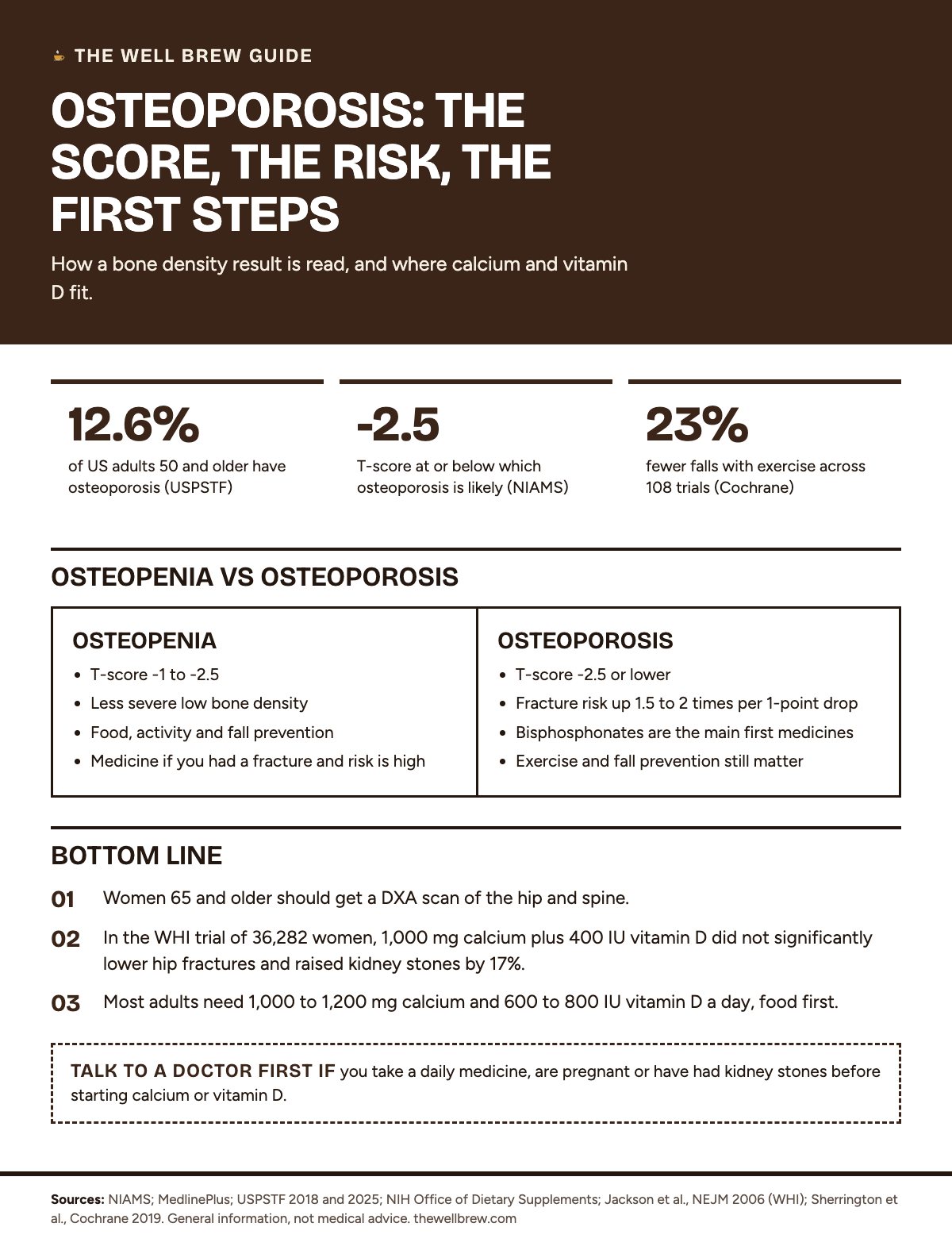
Osteopenia means your bone density is lower than normal but not low enough to be called osteoporosis. On a DXA scan, osteopenia is a T-score between -1 and -2.5. Osteoporosis is a T-score of -2.5 or lower. NIAMS describes osteopenia as a less severe form of low bone mineral density.[3]
| Result | T-score | What it means | Usual next step |
|---|---|---|---|
| Healthy | -1 or higher | Bone density in the normal range[3] | Keep up food, activity and screening on schedule[5] |
| Osteopenia | -1 to -2.5 | Low bone density, less severe[3] | Lifestyle steps; medicine if you have had a fracture and fracture risk is high[4] |
| Osteoporosis | -2.5 or lower | You might have osteoporosis[3] | Lifestyle steps plus medicine when fracture risk is high[4] |
The USPSTF notes that age predicts broken bones even more strongly than bone density does, because bone quality declines and falls become more likely.[5] That is why your doctor reads the score together with your age, past fractures and other risk factors.[3]
What T-score means osteoporosis, and who needs a DEXA scan?
A T-score compares your bone density with that of a healthy young adult, which is set at 0. A T-score of -2.5 or lower means you might have osteoporosis. Each 1-point drop in the score raises the risk of a broken bone by 1.5 to 2 times.[3]
The test itself is a central DXA scan. It is quick and painless, uses low-dose x-rays, and is the most reliable way to diagnose the disease and predict fracture risk when it measures the hip and spine.[2] A heel ultrasound does not measure bone mineral density, so a low result still needs a DXA to confirm it.[2] When you are on medicine, the scan is often repeated every 2 years or longer to see how it is working.[4]
T-scores apply to postmenopausal women and men 50 and older. Premenopausal women and men under 50 get a Z-score instead, and -2.0 or less counts as low.[3]
The USPSTF screening advice, updated in 2025:[5]
- Women 65 and older: screen (grade B).
- Postmenopausal women under 65 with one or more risk factors: use a risk tool such as FRAX first, then screen those at higher risk (grade B).
- Men: not enough evidence to say (grade I), so clinicians use their judgment.
What are osteoporosis symptoms?
Osteoporosis usually causes no symptoms until a bone breaks. The first sign is often a fracture from a minor fall, such as a fall from standing height. In weak bones, a break can even come from bending, lifting or coughing.[1]
Spine fractures, called compression fractures, are easy to miss because they often happen without any injury.[4] Signs include:
- back pain that starts suddenly or builds slowly[1][4]
- loss of height over time, as much as 6 inches[4]
- a stooped or hunched posture, called kyphosis[1]
Ask your doctor about a bone density test if you break a bone from a small fall, notice that you are shorter, or develop new back pain with no clear cause. Mention any past fractures, long-term steroid use and your family history at the visit.[1][2]
What osteoporosis treatment do doctors use first?
Bisphosphonates are the main medicines used to prevent and treat osteoporosis in postmenopausal women. Doctors pair medicine with nutrition, exercise and fall prevention. The goals are to slow or stop bone loss and to prevent fractures.[2][4]
The FDA has approved several classes of osteoporosis medications. Your doctor chooses based on your age, sex, general health and how much bone you have lost.[2]
| Class | How it works | Usually used for |
|---|---|---|
| Bisphosphonates (pill or IV) | Slow bone loss[2] | The main first choice for postmenopausal women[4] |
| RANK ligand inhibitor (denosumab, shot) | Slows bone loss and raises density[2][4] | High fracture risk, bone loss from some cancer drugs, or when other drugs fail[2] |
| PTH and PTHrP analogs (teriparatide, abaloparatide) | Build new bone[2][4] | High fracture risk or severe disease with past fractures[2] |
| Sclerostin inhibitor (romosozumab) | Builds bone and slows loss[2] | Severe osteoporosis[2][4] |
| Estrogen agonist/antagonist (raloxifene) | Estrogen-like effect on bone[2] | Postmenopausal women[2] |
| Estrogen or hormone therapy | Prevents bone loss[2] | Prevention in postmenopausal women, lowest dose for the shortest time[2] |
| Calcitonin | Hormone from the thyroid gland[2] | Women who cannot take other drugs; mainly pain from a spine fracture[2][4] |
How long you stay on medicine depends on your risk. MedlinePlus gives about 5 years of pills or 3 years of IV therapy for lower risk, and 10 years of pills or 6 years of IV therapy for high risk.[4] If another drug is thinning your bones, your doctor may lower the dose or switch it.[2] NIAMS adds that whatever medicine you take, you still need your daily calcium and vitamin D.[2]
Do osteoporosis supplements like calcium and vitamin D work?
Calcium and vitamin D supplements are not a treatment for osteoporosis, and in healthy adults they have not reliably prevented fractures. The USPSTF recommends against daily use of 400 IU or less of vitamin D with 1,000 mg or less of calcium to prevent fractures in postmenopausal women who live at home (grade D).[6]
For higher doses, and for men and premenopausal women, the task force found the evidence too thin to judge (grade I).[6] The largest studies are summed up below.
| Study | Who and how many | Dose and length | Result |
|---|---|---|---|
| WHI trial, 2006 | 36,282 postmenopausal women[9] | 1,000 mg calcium plus 400 IU vitamin D, about 7 years[7][9] | Hip density 1.06% higher; no significant drop in hip fractures; 17% more kidney stones[9] |
| VITAL trial, 2022 | 25,871 men 50+ and women 55+[10] | 2,000 IU vitamin D3, median 5.3 years[10] | No effect on total, nonvertebral or hip fractures[10] |
| Pooled analysis of 8 trials | 30,970 adults over 50[7] | 500 to 1,200 mg calcium plus 400 to 800 IU vitamin D, 1 to 7 years[7] | 15% fewer total fractures and 30% fewer hip fractures[7] |
| Review of 11 trials | 51,419 adults 50+[7] | Calcium plus vitamin D, 2 to 7 years[7] | No effect on total or hip fractures[7] |
The one positive pooled analysis came from the National Osteoporosis Foundation, and other reviews did not repeat its result.[7] The NIH vitamin D fact sheet says supplements may raise bone density in some postmenopausal women and older men, but it is not clear whether they reduce falls or fractures.[8]
VITAL did not pick people for low vitamin D, low bone mass or osteoporosis, so it says little about people who are truly deficient.[10] We found no NIH-level evidence for other popular bone supplements, so we left them out.
How much calcium and vitamin D do you need, and is it safe?
Most adults need 1,000 to 1,200 mg of calcium and 600 to 800 IU of vitamin D a day, counting food and supplements together. Women 51 and older and everyone over 70 need 1,200 mg of calcium, and adults over 70 need 800 IU of vitamin D. Our vitamin D benefits and dosage guide lists the amounts for every age group.[2][8]
| Group | Calcium target / upper limit | Vitamin D target / upper limit |
|---|---|---|
| Adults 19 to 50, including pregnancy | 1,000 mg / 2,500 mg[2][7] | 600 IU / 4,000 IU[8] |
| Men 51 to 70 | 1,000 mg / 2,000 mg[2][7] | 600 IU / 4,000 IU[8] |
| Women 51 to 70 | 1,200 mg / 2,000 mg[2][7] | 600 IU / 4,000 IU[8] |
| Everyone over 70 | 1,200 mg / 2,000 mg[2][7] | 800 IU / 4,000 IU[8] |
Try to get most of your calcium from food. Good sources include low-fat dairy, bok choy, collards, broccoli, canned sardines or salmon with bones, and fortified soymilk, tofu, orange juice and cereals.[2] Calcium carbonate antacid chews also count, at about 270 to 400 mg each.[7]
On supplement labels, calcium carbonate is 40% calcium by weight and calcium citrate is 21%. The body absorbs calcium best in doses of 500 mg or less, about 36% of a 300 mg dose compared with 28% of a 1,000 mg dose.[7]
Side effects and who should be careful
- Kidney stones: the WHI trial found 17% more kidney stones with calcium plus vitamin D.[9]
- Stomach upset: gas, bloating and constipation, more often with carbonate in older adults.[7]
- Heart and prostate: some studies link high calcium intakes to these risks, though not all studies agree.[7]
- Medicines: calcium can interact with levothyroxine, quinolone antibiotics, lithium and dolutegravir.[7]
Talk to your doctor before you start, especially if you are pregnant, take a daily medicine or have had kidney stones. Your doctor may check your vitamin D blood level and suggest a specific amount.[2]
How do exercise and fall prevention lower fracture risk?
In a Cochrane review of 108 trials with 23,407 older adults, exercise cut the rate of falls by 23%. It also reduced the number of people who fell by 15%, and the reviewers rated both results high certainty.[11] Falls raise the chance of breaking a hip, a wrist or the spine.[2]
More than one in four people 65 and older fall each year.[12] The USPSTF recommends exercise to prevent falls in older adults at higher risk, and it recommends against vitamin D supplements for preventing falls in adults 65 and older.[6]
Strength or resistance training is the best activity for bones. In older adults, exercise no longer adds bone mass, but it builds muscle, balance and coordination. If you have osteoporosis, skip high-impact moves and ask a physical therapist for a plan.[2] Yoga, Pilates and tai chi can improve balance and strength.[12]
Some fall risks can be fixed. They include taking four or more prescription medicines, poor vision, and sleeping pills, sedatives or blood pressure pills that cause dizziness.[2] Getting your eyes and hearing checked and making your home safer also help.[12]
A bone health checklist
- Ask about a DXA scan if you are a woman 65 or older, or postmenopausal with risk factors.[5]
- Write down your T-score and the site measured, and ask what it means for your fracture risk.[3]
- Add up the calcium you get from food before you buy a supplement.[2]
- Check the Supplement Facts panel for elemental calcium, and take 500 mg or less at a time.[7]
- Keep vitamin D under 4,000 IU a day unless your doctor sets a different amount.[8]
- Ask a pharmacist to review your medicines for bone loss and fall risk.[1][2]
- Do strength and balance exercise, and make your home safer.[12]
- Quit smoking, and keep alcohol to one drink a day for women or two for men.[2]
- See how we read supplement labels on our supplement review method page.
Bottom line: what protects bones from osteoporosis?
What protects bones most is a DXA scan at the right age, medicine when your fracture risk is high, and regular exercise with fall prevention. Calcium and vitamin D matter as daily nutrients, but the large trials do not show that supplements on their own prevent fractures in healthy adults.[5][6][9][10]
If your T-score is -2.5 or lower, a talk with your doctor about medication is the better first step, because no supplement has been shown to do that job. Meet your calcium target from food where you can, and read more in our bone health guides.[2][3]
Frequently asked questions
What is the best treatment for osteoporosis?
There is no single best option. Bisphosphonates are the main first medicines for postmenopausal women, and stronger bone-building drugs are used when risk is high. Every plan also includes calcium and vitamin D from food, exercise and fall prevention, chosen with your doctor.
Can men get osteoporosis?
Yes. Men start with larger bones and more bone mass than women, but risk rises after age 70 and with low testosterone, steroid use or heavy drinking. About 5.7% of U.S. men 65 and older have it. The USPSTF leaves screening men to clinical judgment.
Is calcium carbonate or calcium citrate better?
Both work. Carbonate packs more calcium per pill, 40% by weight versus 21% for citrate, but it causes more gas, bloating and constipation in some older adults. Whichever you choose, take 500 mg or less at a time for better absorption.
How often should you have a bone density test?
It depends on your results and treatment. When a DXA scan is used to track how an osteoporosis medicine is working, MedlinePlus says it is most often repeated every 2 years or longer. Your doctor sets the timing based on your risk.
Do you still need calcium if you take an osteoporosis medicine?
Yes. NIAMS says that whichever medicine you take, you still need the recommended amounts of calcium and vitamin D. For most adults over 50 that means 1,000 to 1,200 mg of calcium and 600 to 800 IU of vitamin D a day.
Sources
- Osteoporosis. NIAMS, National Institutes of Health
- Osteoporosis: Diagnosis, Treatment, and Steps to Take. NIAMS, National Institutes of Health
- Bone Mineral Density Tests: What the Numbers Mean. NIAMS, National Institutes of Health, 2025
- Osteoporosis. MedlinePlus Medical Encyclopedia
- Osteoporosis to Prevent Fractures: Screening. U.S. Preventive Services Task Force, 2025
- Vitamin D, Calcium, or Combined Supplementation for the Primary Prevention of Fractures in Adults. U.S. Preventive Services Task Force, 2018
- Calcium: Fact Sheet for Health Professionals. NIH Office of Dietary Supplements, 2026
- Vitamin D: Fact Sheet for Health Professionals. NIH Office of Dietary Supplements
- Calcium plus vitamin D supplementation and the risk of fractures. Jackson et al., N Engl J Med, 2006
- Supplemental Vitamin D and Incident Fractures in Midlife and Older Adults. LeBoff et al., N Engl J Med, 2022
- Exercise for preventing falls in older people living in the community. Sherrington et al., Cochrane Database Syst Rev, 2019
- Falls and Fractures in Older Adults: Causes and Prevention. National Institute on Aging

Maya Ellison is the Reviews Editor at The Well Brew, a slow, plain-language supplement review blog for everyday adults. Maya reads each label in full, sets every dose beside the amounts used in human studies, grades the research with sources such as the NIH Office of Dietary Supplements and NCCIH, and works out the real cost and refund fine print. Maya has no medical credentials and is not a doctor, dietitian, nurse or pharmacist. Reviews give pros, cons and who a product suits, never scores. How we review supplements.
This article is general information, not medical advice. Dietary supplements are not reviewed by the FDA for safety or effectiveness before they are sold. Talk to your doctor before you start any supplement, especially if you are pregnant, nursing, take medication or have a health condition.