Vitamin D helps your body absorb calcium and keep bones strong, and that is where its benefits are best proven. Most people age 1 to 70 need 600 IU (15 mcg) a day and adults over 70 need 800 IU. A blood level of 20 ng/mL is enough for most people. Large trials of 2,000 IU a day found no drop in cancer, heart events or fractures.
On this page
- What is vitamin D and what does it do?
- Vitamin D benefits: what do the big trials show?
- Does vitamin D help your bones?
- Does vitamin D support the immune system?
- How much vitamin D should you take daily?
- What vitamin D levels are normal?
- Vitamin D3 vs D2: what are the vitamin D3 benefits?
- Are vitamin D benefits different for men and women?
- How much vitamin D is too much?
- Who should take a vitamin D supplement?
- Safety: who should talk to a doctor first
- What doctors use first for low vitamin D
- Vitamin D checklist
- Bottom line
- FAQ
Vitamin D benefits are best proven for bones and calcium, and this guide covers what the research shows across the body, how much you need at each age, which blood levels count as enough, D2 versus D3, and the upper limit. We read the NIH Office of Dietary Supplements fact sheet, two MedlinePlus pages, the 2024 Endocrine Society guideline and the main reports from the VITAL, D2d and D-Health trials, plus meta-analyses on infections and on the D2 versus D3 question. Our method is on the how we review page.
The short answer: most people age 1 to 70 need 600 IU (15 mcg) a day and adults over 70 need 800 IU, a blood level of 20 ng/mL is enough for most people, and large trials in people who were not deficient found few benefits beyond bone health.[1][4]
| What it is | A fat-soluble vitamin found in a few foods, added to others, and made by the skin in sunlight.[1] |
|---|---|
| Main job | Helps the gut absorb calcium and keeps calcium and phosphate high enough for bone mineralization.[1] |
| Daily amount | 400 IU for infants, 600 IU for ages 1 to 70, 800 IU over 70.[1] |
| Enough in blood | A 25(OH)D level of 20 ng/mL (50 nmol/L) or more is sufficient for most people.[1] |
| Best evidence | Bone health. Trials of 2,000 IU a day in mostly healthy adults found no drop in cancer, heart events or fractures.[4][5] |
| Upper limit | 4,000 IU (100 mcg) a day for anyone 9 or older, including during pregnancy.[1] |
| Who should be careful | People taking thiazide diuretics, statins, steroids or orlistat, and people with kidney disease.[1][3] |
What is vitamin D and what does it do?
Vitamin D is a fat-soluble vitamin that helps your gut absorb calcium and keeps blood calcium and phosphate at the levels bones need. Your skin makes it in sunlight, and you also get it from a few foods and from supplements. The liver turns it into 25-hydroxyvitamin D, or 25(OH)D, and the kidney then makes the active form.[1]
Without enough vitamin D, bones can become thin, brittle or misshapen. In children that shows up as rickets, and in adults as osteomalacia, a softening of the bones.[1]
The vitamin has other jobs too. The NIH fact sheet lists a role in lowering inflammation and in cell growth, nerve and muscle function, immune function and glucose metabolism. Many tissues carry vitamin D receptors.[1] Those roles led researchers to test supplements for many conditions, and most of those trials have been disappointing.
Few foods are good natural sources. A 3-ounce serving of cooked sockeye salmon has about 570 IU, farmed rainbow trout about 645 IU, and a cup of fortified milk about 120 IU. One large egg has about 44 IU.[1] In the US, fortified foods supply most of the vitamin D people eat.[1]
Vitamin D benefits: what do the big trials show?
The clearest vitamin D benefits are for bone and calcium balance; for most other conditions, large trials in people who were not deficient found little or no effect. The expert committee that set US intake levels found the evidence too weak or mixed to link vitamin D to outcomes other than bone health, and a federal review of about 250 studies reached the same conclusion.[1]
The biggest US test was VITAL. It gave 25,871 adults age 50 and older 2,000 IU of vitamin D3 a day or a placebo for a median of 5.3 years. Cancer rates and major heart events were about the same in both groups.[4] In Australia, the D-Health trial gave 21,315 people age 60 and older 60,000 IU once a month for 5 years and saw no drop in deaths from any cause.[12]
A few results leaned positive. A pooled analysis of 10 trials found vitamin D lowered cancer death rates by 13%, mostly with daily dosing, though it did not lower how often cancer was diagnosed.[1] In VITAL, cancer deaths were lower in the vitamin D group, but the difference was not statistically significant.[4]
Trials have not shown that vitamin D helps with depression, multiple sclerosis symptoms or weight loss. A review of 9 trials in 4,923 adults with depression or depressive symptoms found no clear drop in symptoms.[1] Most people in these trials already had enough vitamin D, so the results say little about people who are truly deficient.[1]
| Study | Who and how long | Dose | Result |
|---|---|---|---|
| VITAL, 2019 | 25,871 US adults 50 and older, 5.3 years | 2,000 IU D3 daily | No drop in cancer (HR 0.96) or major heart events (HR 0.97).[4] |
| VITAL fractures, 2022 | Same 25,871 adults, 5.3 years | 2,000 IU D3 daily | No drop in total fractures (HR 0.98) or hip fractures.[5] |
| VITAL autoimmune, 2022 | Same 25,871 adults, 5.3 years | 2,000 IU D3 daily | Confirmed autoimmune disease 22% lower (123 vs 155 people).[6] |
| D2d, 2019 | 2,423 adults with prediabetes, 2.5 years | 4,000 IU D3 daily | Diabetes risk 12% lower, not statistically significant (HR 0.88).[7] |
| D-Health, 2022 | 21,315 Australians 60 and older, 5 years | 60,000 IU monthly | No drop in deaths from any cause (HR 1.04).[12] |
| Respiratory infection review, 2021 | 46 trials, 75,541 people | Varied | Small drop in one or more infections (61.3% vs 62.3%).[9] |
Does vitamin D help your bones?
Vitamin D is needed to build and keep bone, and getting enough guards against rickets in children and osteomalacia in adults. Together with calcium, it also helps protect older adults from osteoporosis, according to the NIH fact sheet.[1]
For people who already get enough, the evidence is weaker. Vitamin D and calcium may raise bone density in some postmenopausal women and older men, but it is not clear that they cut falls or fractures.[1] In VITAL, 2,000 IU a day did not lower total, nonvertebral or hip fractures in healthy adults who were not chosen for low vitamin D or low bone mass.[5] We cover calcium, bone density scans and osteoporosis medicines in our osteoporosis guide to calcium, vitamin D and bone density.
Does vitamin D support the immune system?
Vitamin D plays a part in immune function, and trials suggest a small drop in respiratory infections plus a possible drop in autoimmune disease. A 2021 review of 46 trials with 75,541 people found that 61.3% of those taking vitamin D had at least one acute respiratory infection, compared with 62.3% on placebo. The authors called the risk reduction small.[9]
The benefit showed up mainly with daily doses of 400 to 1,000 IU, and in children age 1 to 15. Large single doses did not show the same effect, and serious side effects were no more common than on placebo.[9]
In VITAL, 123 people taking vitamin D and 155 taking placebo developed a confirmed autoimmune disease such as rheumatoid arthritis, psoriasis or autoimmune thyroid disease over 5.3 years. The researchers reported a 22% lower rate.[6] This is one trial in older adults, so it needs to be repeated. More guides on this topic sit in our immune support section.
How much vitamin D should you take daily?
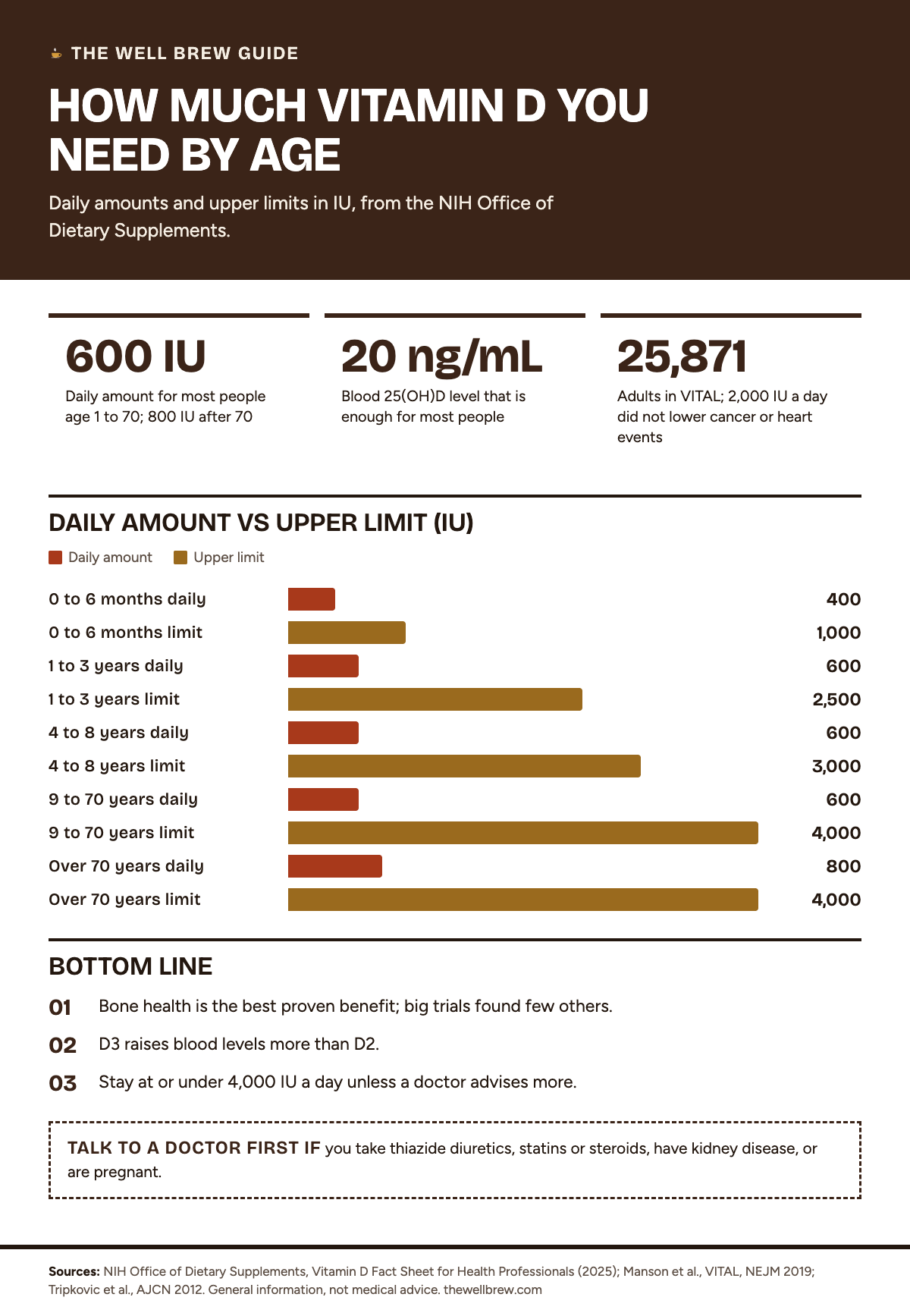
Most people age 1 to 70 need 600 IU (15 mcg) of vitamin D a day, adults over 70 need 800 IU (20 mcg), and infants need 400 IU (10 mcg). These amounts come from the Food and Nutrition Board and assume you get little sun. They count food, fortified drinks and supplements together. One mcg equals 40 IU.[1]
| Age or stage | Daily amount | Upper limit |
|---|---|---|
| 0 to 6 months | 400 IU (10 mcg) | 1,000 IU (25 mcg) |
| 7 to 12 months | 400 IU (10 mcg) | 1,500 IU (38 mcg) |
| 1 to 3 years | 600 IU (15 mcg) | 2,500 IU (63 mcg) |
| 4 to 8 years | 600 IU (15 mcg) | 3,000 IU (75 mcg) |
| 9 to 70 years | 600 IU (15 mcg) | 4,000 IU (100 mcg) |
| Over 70 years | 800 IU (20 mcg) | 4,000 IU (100 mcg) |
| Pregnancy and breastfeeding | 600 IU (15 mcg) | 4,000 IU (100 mcg) |
Source for every row: the NIH Office of Dietary Supplements, citing the Food and Nutrition Board.[1]
Many Americans fall short from food alone. National survey data show that 92% of men and more than 97% of women get less than 400 IU a day from food and drinks.[1] Still, blood tests show most people have enough, partly because of sun exposure.[1] The Endocrine Society suggests healthy adults under 75 should not take more than these amounts to lower disease risk.[11]
What vitamin D levels are normal?
A blood 25(OH)D level of 20 ng/mL (50 nmol/L) or higher is enough for most people, under 12 ng/mL (30 nmol/L) signals deficiency, and over 50 ng/mL (125 nmol/L) may cause harm. The 25(OH)D test is the standard vitamin D blood test because it reflects vitamin D from sun, food and supplements.[1][3]
| 25(OH)D level | What it means |
|---|---|
| Under 12 ng/mL (under 30 nmol/L) | Deficiency; can lead to rickets or osteomalacia |
| 12 to under 20 ng/mL (30 to under 50 nmol/L) | Generally too low for bone and overall health |
| 20 ng/mL or more (50 nmol/L or more) | Enough for most healthy people |
| Over 50 ng/mL (over 125 nmol/L) | Linked to possible harm, especially over 60 ng/mL |
Source: NIH Office of Dietary Supplements, Table 1.[1]
Results vary between labs, so a single number can read falsely high or low.[1] In US data from 2011 to 2014, 18% of people were at risk of too-low levels and 5% were at risk of deficiency. The risk of deficiency was 17.5% among non-Hispanic Black people, though whether lower levels harm their health is not clear.[1] Routine testing is not advised for everyone, and the Endocrine Society suggests against it in healthy people.[3][11]
Vitamin D3 vs D2: what are the vitamin D3 benefits?
Vitamin D3 (cholecalciferol) raises blood vitamin D more and keeps it higher for longer than vitamin D2 (ergocalciferol), so D3 is usually the better pick. Both forms are well absorbed, both raise 25(OH)D, and they seem equally able to cure rickets.[1]
A 2012 meta-analysis of trials that compared the two head to head found D3 was more effective at raising 25(OH)D. The gap was clear with large single doses but was lost when both were taken daily.[10]
D2 is made from yeast, and D3 usually comes from lanolin in sheep’s wool. A vegan D3 made from lichen is also sold.[1] If you avoid animal products, read the label or ask the maker. For other supplement ingredients we have checked, see our ingredient guides.
Are vitamin D benefits different for men and women?
No. Men and women have the same daily target, 600 IU through age 70 and 800 IU after, and the main trials did not find that the effects differed by sex. VITAL enrolled about equal numbers of men and women, and its fracture results did not change by sex, age, race or starting vitamin D level.[1][5]
For women, the amount during pregnancy and breastfeeding stays at 600 IU, with the same 4,000 IU upper limit.[1] The Endocrine Society suggests vitamin D during pregnancy because it may lower the risk of preeclampsia, preterm birth and some other problems, though the best dose is unclear.[11] In the Women’s Health Initiative, 36,282 postmenopausal women took 1,000 mg of calcium plus 400 IU of vitamin D or a placebo, and the supplement group had 17% more kidney stones over 7 years.[1]
In both sexes, the skin makes less vitamin D with age, and older adults tend to spend more time indoors.[1]
How much vitamin D is too much?
The upper limit is 4,000 IU (100 mcg) a day for anyone age 9 or older, and too much vitamin D raises blood calcium, which can harm the kidneys and heart. Toxicity almost always comes from supplements, not sun or food.[1]
Signs of high blood calcium include nausea, vomiting, constipation, poor appetite, weakness, weight loss, confusion and kidney stones.[2] In extreme cases it can cause kidney failure, calcium deposits in blood vessels, an irregular heartbeat and death.[1]
The experts who set the limit said symptoms are unlikely below 10,000 IU a day, but even intakes under the limit might cause harm over time. They advised keeping blood levels below about 50 to 60 ng/mL.[1] Manufacturing errors and doses taken wrongly have caused real cases of toxicity.[1] About 3.2% of US adults took 4,000 IU or more a day in 2013 to 2014.[1]
Who should take a vitamin D supplement?
Supplements make the most sense for breastfed infants, children, adults over 75, pregnant people, people with high-risk prediabetes and anyone who cannot get enough from food and sun. The Endocrine Society suggests vitamin D for ages 1 to 18, adults 75 and older, pregnancy and high-risk prediabetes, and not above the daily amounts for other healthy adults under 75.[11]
| If this describes you | What the sources say |
|---|---|
| Baby who is breastfed or partly breastfed | 400 IU a day starting soon after birth, per the American Academy of Pediatrics.[1] |
| Child or teen age 1 to 18 | Supplement suggested; daily amount is 600 IU.[11][1] |
| Adult 75 or older | Supplement suggested, taken daily rather than as large doses.[11] |
| Pregnant | Supplement suggested; stay within 4,000 IU a day.[11][1] |
| Adult with high-risk prediabetes | Supplement suggested; ask your doctor about the dose.[11] |
| Little sun, dark skin, obesity, gastric bypass or a gut condition that limits fat absorption | Higher risk of low levels; ask about a supplement or a test.[1][3] |
| Healthy adult under 75 who eats fortified foods | Extra vitamin D above 600 IU is not suggested to lower disease risk.[11] |
The prediabetes evidence is mixed. D2d gave 2,423 adults with prediabetes 4,000 IU a day, and diabetes was 12% less common, but the result was not statistically significant.[7] When three similar trials were pooled, vitamin D lowered diabetes risk by 15%, a 3.3% absolute drop over 3 years.[8] Our guide to prediabetes A1C ranges and how to lower your numbers covers the lifestyle steps with the strongest trial data.
Safety: who should talk to a doctor first
Vitamin D at the daily amounts is safe for most people, and VITAL found no extra cases of high blood calcium at 2,000 IU a day.[4] Talk to a doctor before taking it if any of these apply:[1]
- You take a thiazide water pill, such as hydrochlorothiazide. Together with vitamin D it can push blood calcium too high, especially in older adults.[1]
- You take atorvastatin, lovastatin or simvastatin. High vitamin D intakes might make these statins work less well.[1]
- You take a steroid such as prednisone, which can lower calcium absorption and affect vitamin D.[1]
- You take orlistat for weight loss, which can cut vitamin D absorption.[1]
- You have kidney or liver disease, which can change how your body uses vitamin D.[3]
- You also take calcium pills, which add to the kidney stone risk seen in the Women’s Health Initiative.[1]
- You use tanning beds often, which can push vitamin D levels well above the safe range.[1]
See a doctor soon if you take vitamin D and develop:[2][3]
- nausea, vomiting or constipation that will not go away
- confusion or unusual weakness
- weight loss you cannot explain
- a kidney stone
What doctors use first for low vitamin D
A doctor usually orders a 25(OH)D blood test only when there is a reason, such as bone pain, muscle weakness, low bone density, weight-loss surgery, Crohn’s disease, celiac disease, kidney or liver disease, or a medicine that lowers vitamin D.[3] The test needs no special preparation, but tell your provider about every supplement you take.[3]
If your level is low, your provider may recommend a higher dose and a repeat test to check that it is rising.[2][3] For adults over 50 who need vitamin D, the Endocrine Society suggests daily doses rather than large doses spaced weeks apart.[11] Food comes first where it can: fatty fish, fortified milk and plant milks, fortified cereal and UV-treated mushrooms.[1]
Vitamin D checklist
- Add up what you get from fortified milk, cereal and fish before you add a pill.[1]
- Check the label for IU and mcg. 600 IU is 15 mcg, and 4,000 IU is 100 mcg.[1]
- Choose D3 if you have the choice, and take it with a meal that has some fat.[1][10]
- Count the vitamin D in your multivitamin and calcium pill so the total stays at or under 4,000 IU.[1]
- Take a modest daily dose rather than large weekly or monthly doses unless your doctor says otherwise.[9][11]
- Ask about a blood test only if you have a risk factor or symptoms.[3]
- Before you buy, run the label checks on our review standards page and skip any product that promises to cure a disease.
Bottom line
Vitamin D matters for bones, and most people need 600 to 800 IU a day from food, fortified drinks, sun and, if needed, a supplement. A blood level of 20 ng/mL is enough for most people.[1]
For most healthy adults under 75, meeting the daily amount is the better goal than taking high doses, because VITAL and D-Health found that extra vitamin D did not lower cancer, heart disease, fractures or deaths in people who already had enough.[4][12] The groups with the best case for a supplement are infants, children, adults over 75, pregnant people and anyone with a diagnosed low level.[11]
Frequently asked questions
Can you get enough vitamin D from the sun?
Many people get some of their vitamin D from sunlight, but the amount varies a lot. Cloudy days, shade, darker skin and living somewhere with little sun all cut it, and MedlinePlus advises against more than a few minutes of sun without sunscreen.
Which foods have the most vitamin D?
Cod liver oil leads with about 1,360 IU per tablespoon. Farmed rainbow trout has about 645 IU and sockeye salmon about 570 IU per 3 ounces. UV-treated mushrooms, fortified milk, plant milks and cereals add smaller amounts, per the NIH fact sheet.
Should I take vitamin D with food?
Yes, if you can. The NIH fact sheet says fat in the gut improves vitamin D absorption, although some is absorbed without it. Taking your supplement with a meal that contains some fat, such as eggs, fish or yogurt, is a simple habit.
Do I need a vitamin D blood test?
Usually not. MedlinePlus says routine testing is not recommended for everyone, and the Endocrine Society suggests against it in healthy people. A test makes sense if you have bone problems, a gut or kidney condition, weight-loss surgery or a medicine that lowers vitamin D.
Is 2,000 IU of vitamin D a day safe?
For most adults, yes. It is half the 4,000 IU upper limit for people 9 and older, and the VITAL trial found no extra cases of high blood calcium at 2,000 IU a day over about 5 years. Check with a doctor if you take thiazides or have kidney disease.
Does vitamin D help with weight loss?
No good evidence says it does. People with obesity often have lower vitamin D levels, but the NIH fact sheet says clinical trials do not support taking vitamin D supplements to lose weight. Losing weight itself tends to raise blood vitamin D.
Sources
- Vitamin D: Fact Sheet for Health Professionals. NIH Office of Dietary Supplements, 2025
- Vitamin D. MedlinePlus, National Library of Medicine
- Vitamin D Test. MedlinePlus, National Library of Medicine
- Vitamin D Supplements and Prevention of Cancer and Cardiovascular Disease (Manson et al., VITAL). New England Journal of Medicine, 2019
- Supplemental Vitamin D and Incident Fractures in Midlife and Older Adults (LeBoff et al., VITAL). New England Journal of Medicine, 2022
- Vitamin D and marine omega 3 fatty acid supplementation and incident autoimmune disease (Hahn et al., VITAL). BMJ, 2022
- Vitamin D Supplementation and Prevention of Type 2 Diabetes (Pittas et al., D2d). New England Journal of Medicine, 2019
- Vitamin D and Risk for Type 2 Diabetes in People With Prediabetes: Individual Participant Data Meta-analysis (Pittas et al.). Annals of Internal Medicine, 2023
- Vitamin D supplementation to prevent acute respiratory infections: systematic review and meta-analysis (Jolliffe et al.). Lancet Diabetes and Endocrinology, 2021
- Comparison of vitamin D2 and vitamin D3 supplementation in raising serum 25-hydroxyvitamin D status (Tripkovic et al.). American Journal of Clinical Nutrition, 2012
- Vitamin D for the Prevention of Disease: An Endocrine Society Clinical Practice Guideline (Demay et al.). Journal of Clinical Endocrinology and Metabolism, 2024
- The D-Health Trial: a randomised controlled trial of the effect of vitamin D on mortality (Neale et al.). Lancet Diabetes and Endocrinology, 2022

Maya Ellison is the Reviews Editor at The Well Brew, a slow, plain-language supplement review blog for everyday adults. Maya reads each label in full, sets every dose beside the amounts used in human studies, grades the research with sources such as the NIH Office of Dietary Supplements and NCCIH, and works out the real cost and refund fine print. Maya has no medical credentials and is not a doctor, dietitian, nurse or pharmacist. Reviews give pros, cons and who a product suits, never scores. How we review supplements.
This article is general information, not medical advice. Dietary supplements are not reviewed by the FDA for safety or effectiveness before they are sold. Talk to your doctor before you start any supplement, especially if you are pregnant, nursing, take medication or have a health condition.