Prediabetes means an A1C of 5.7% to 6.4%, a fasting glucose of 100 to 125 mg/dL, or a 2-hour glucose tolerance result of 140 to 199 mg/dL. Most people have no symptoms, so a lab test is the only way to know. In the largest US trial, losing about 7% of body weight and walking 150 minutes a week cut the chance of type 2 diabetes by 58%.
On this page
- What is prediabetes?
- What is the prediabetes A1C range?
- What is the prediabetes range on each blood test?
- What are the symptoms of prediabetes?
- How to reverse prediabetes: what does the evidence show?
- Prediabetes treatment: your weight-loss target by starting weight
- What is the best prediabetes diet?
- Are there prediabetes pills? What about metformin for prediabetes?
- Do prediabetes supplements work?
- Safety: who should talk to a doctor first
- What doctors use first for prediabetes
- Prediabetes checklist
- Bottom line
- FAQ
Prediabetes means your blood sugar sits above normal but below the type 2 diabetes cutoff, and this guide covers the prediabetes A1C range, the other test ranges, the few symptoms it can cause and the steps with the strongest trial data. We read the NIDDK and MedlinePlus pages on prediabetes and the A1C test, the CDC prevention page, the USPSTF screening advice, NCCIH’s review of diabetes supplements, and three trials: the Diabetes Prevention Program, the D2d vitamin D trial and a cinnamon trial in prediabetes. Our method is on the how we review page.
The short answer: an A1C of 5.7% to 6.4% is the prediabetes range, most people feel nothing, and in the largest US trial a 7% weight loss goal plus 150 minutes of weekly activity cut the chance of type 2 diabetes by 58%.[1][8]
| What it is | Blood sugar higher than normal but not high enough for a type 2 diabetes diagnosis.[1] |
|---|---|
| A1C range | 5.7% to 6.4%. Below 5.7% is normal; 6.5% or higher is diabetes.[2] |
| Fasting glucose range | 100 to 125 mg/dL after at least 8 hours without food.[2] |
| How common | About 97.6 million US adults had it in 2021.[1] |
| Symptoms | Usually none. Some people get darkened skin on the neck or in the armpits.[1][4] |
| Best evidence | A lifestyle program lowered diabetes risk by 58% over about 3 years; metformin lowered it by 31%.[7] |
| Supplements | Only weak evidence of a possible benefit for a few, such as cinnamon, chromium and berberine.[10] |
What is prediabetes?
Prediabetes is a blood sugar level that is higher than normal but not yet high enough to be called type 2 diabetes. It usually starts with insulin resistance, where muscle, fat and liver cells stop responding well to insulin, so glucose builds up in the blood.[1] Many people can bring their numbers back down from this stage.
MedlinePlus says about 1 in 3 adults has it, and the CDC puts the figure at more than 2 in 5 American adults.[4][6] Most people who have it do not know.
Risk goes up with overweight or a large waist, age 35 or older, a parent or sibling with diabetes, low activity, smoking, past gestational diabetes, PCOS and sleep apnea. Some medicines taken over time, such as glucocorticoids, also raise it.[1]
Prediabetes matters because people with it have a high chance of developing type 2 diabetes within 5 to 10 years, and it raises the risk of heart disease and stroke.[1][4] Not everyone with prediabetes goes on to get diabetes, though, and that gap is where lifestyle changes do their work.[1]
What is the prediabetes A1C range?
The prediabetes A1C range is 5.7% to 6.4%. An A1C below 5.7% is normal, and 6.5% or higher points to diabetes.[2][3] The A1C test shows your average blood sugar over about the past 3 months, because glucose sticks to hemoglobin in red blood cells, which live about that long.[5]
You can eat and drink before an A1C test, which is one reason doctors like it.[2] A single result is not the final word. If you have no symptoms, the test should be repeated on another day, using A1C or a glucose test, to confirm the diagnosis.[3]
Small swings are normal. NIDDK gives the example that a result of 6.8% on one test could read anywhere from 6.4% to 7.2% on a repeat test of the same blood sample.[3] So a 5.7% and a 5.8% are not meaningfully different.
The A1C can mislead in some people. Pregnancy, some types of anemia and certain hemoglobin variants can make it inaccurate, and some opioids and HIV medicines may affect it.[2][5] If your A1C and your glucose results do not match, your doctor may lean on the glucose tests instead.[2]
What is the prediabetes range on each blood test?
The prediabetes range is an A1C of 5.7% to 6.4%, a fasting glucose of 100 to 125 mg/dL, or a 2-hour glucose tolerance result of 140 to 199 mg/dL. Doctors use any one of these three tests, and the cutoffs below come from the American Diabetes Association, as published by NIDDK.[2]
| Result | A1C | Fasting glucose | 2-hour glucose tolerance test |
|---|---|---|---|
| Normal | Below 5.7% | 99 mg/dL or below | 139 mg/dL or below |
| Prediabetes | 5.7% to 6.4% | 100 to 125 mg/dL | 140 to 199 mg/dL |
| Diabetes | 6.5% or above | 126 mg/dL or above | 200 mg/dL or above |
A fasting result of 100 to 125 mg/dL is often called impaired fasting glucose. The fasting test is done in the morning after at least 8 hours with nothing but sips of water.[2]
The glucose tolerance test checks your blood 2 hours after a sugary drink. It takes longer and costs more, so it is used less often.[1] A home glucose meter cannot diagnose prediabetes or diabetes; you need a lab test.[2]
What are the symptoms of prediabetes?
Most people with prediabetes have no symptoms at all. NIDDK says people with insulin resistance and prediabetes usually feel nothing, and the CDC notes that you can have it for years without clear signs.[1][6] A blood test is the only way to find it.
The one visible sign MedlinePlus lists is darkened skin in the armpits or on the back and sides of the neck, sometimes with many small skin growths in the same areas.[4]
Some people with prediabetes may have symptoms like those of diabetes.[1] Those signs of pre diabetes moving into diabetes include:[15]
- peeing more often and feeling very thirsty
- feeling very hungry even after eating
- blurred vision and fatigue
- sores that do not heal and frequent infections, such as urinary tract, skin or yeast infections
If you notice these, ask for a test soon rather than waiting for a routine checkup. The USPSTF advises screening adults aged 35 to 70 who have overweight or obesity, even with no symptoms.[9]
How to reverse prediabetes: what does the evidence show?
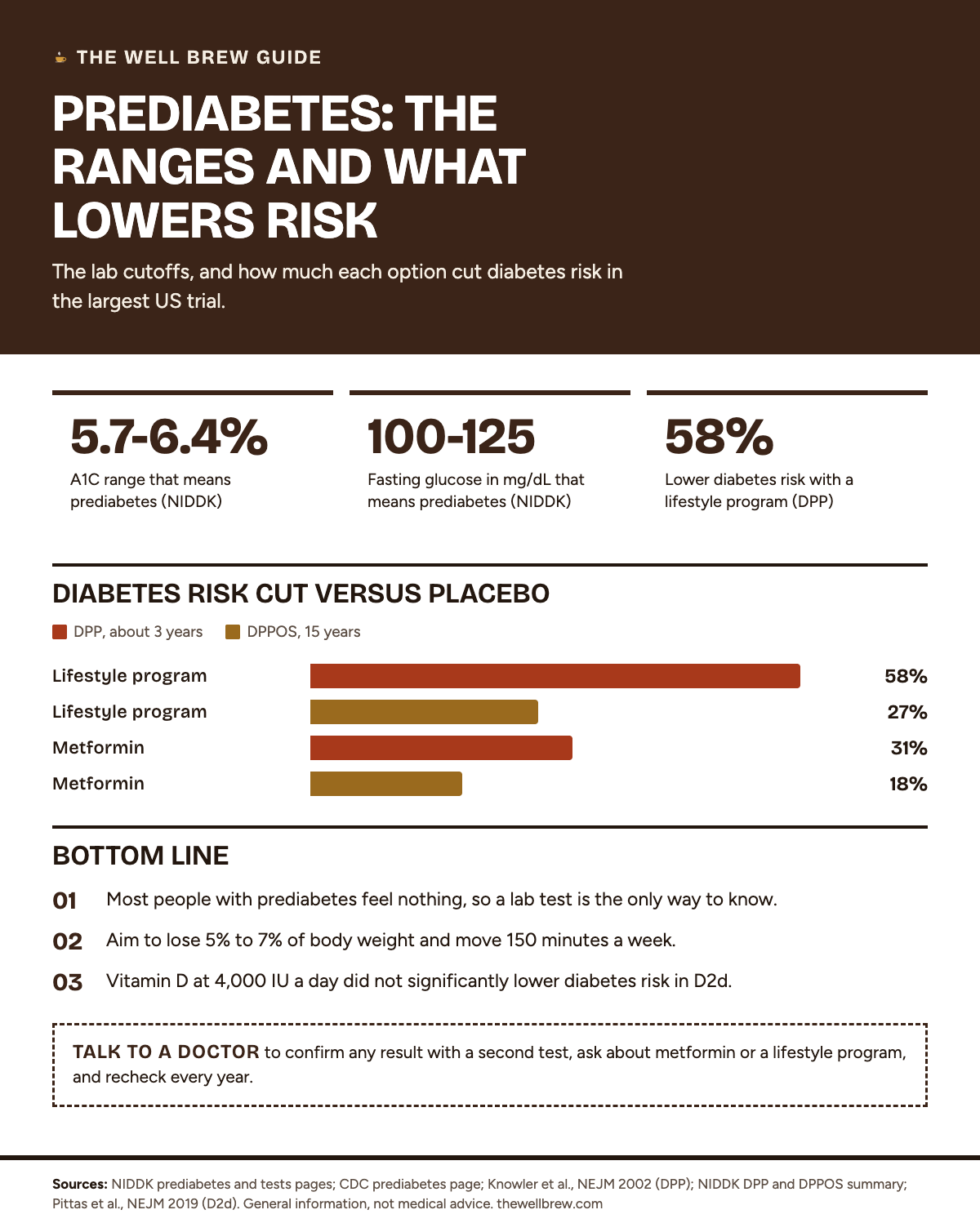
The best-tested way to reverse prediabetes or delay type 2 diabetes is modest weight loss plus regular activity. In the Diabetes Prevention Program, a goal of 7% weight loss and 150 minutes of activity a week lowered diabetes risk by 58% compared with placebo, and by 71% in people aged 60 and older.[7]
The DPP enrolled 3,234 adults at 27 US centers from 1996 to 2001.[7] Over an average of 2.8 years, new diabetes cases ran at 11.0 per 100 person-years on placebo, 7.8 on metformin and 4.8 with the lifestyle program.[8] Put another way, about 7 people needed the lifestyle program to prevent one case over 3 years, compared with about 14 for metformin.[8]
| Study | Who and how long | What was tested | Result |
|---|---|---|---|
| DPP, NEJM 2002 | 3,234 adults at high risk, average 2.8 years | Lifestyle program vs metformin 850 mg twice a day vs placebo | Risk down 58% with lifestyle and 31% with metformin[8] |
| DPPOS follow-up | Most DPP participants, 15 years | Same groups followed over time | Delay of 27% with lifestyle and 18% with metformin[7] |
| D2d, NEJM 2019 | 2,423 adults with prediabetes, median 2.5 years | Vitamin D3 4,000 IU a day vs placebo | No significant drop in diabetes (hazard ratio 0.88)[11] |
| Cinnamon trial, 2020 | 54 adults with prediabetes, 12 weeks | Cinnamon 500 mg three times a day vs placebo | Fasting glucose 5 mg/dL lower than placebo; small and short[12] |
The benefit shrank over time. At 15 years, 55% of the lifestyle group and 56% of the metformin group had developed diabetes, compared with 62% on placebo.[7]
Prediabetes treatment: your weight-loss target by starting weight
For most people with prediabetes and overweight, the first treatment target is losing 5% to 7% of starting weight. The CDC says that is about 10 to 14 pounds for a 200-pound person, paired with at least 150 minutes a week of brisk walking or similar activity, such as 30 minutes on 5 days.[6]
We worked out the same 5% and 7% figures for other starting weights so you can find your own number. Ask your care team whether weight loss suits you before you start.[1]
| Starting weight | 5% goal | 7% goal |
|---|---|---|
| 160 lb | 8 lb | 11 lb |
| 180 lb | 9 lb | 13 lb |
| 200 lb | 10 lb | 14 lb |
| 220 lb | 11 lb | 15 lb |
| 250 lb | 12.5 lb | 17.5 lb |
Your test result points to the next step:
| Your result | What it means | Sensible next step |
|---|---|---|
| A1C below 5.7%, risk factors present | Normal for now | Retest at least every 3 years[1] |
| A1C 5.7% to 6.4%, no symptoms | Prediabetes range | Confirm with a repeat test, then test for diabetes every year[1][3] |
| Prediabetes plus overweight | Highest payoff from change | Aim for 5% to 7% weight loss and ask about a CDC-recognized lifestyle program[6] |
| A1C 6.5% or above, or symptoms | Possible diabetes | See your doctor promptly for confirmation and a care plan[2] |
The yearlong National Diabetes Prevention Program is built on the DPP lifestyle model, and Medicare has covered it for eligible people since 2018.[7]
What is the best prediabetes diet?
No single prediabetes diet is required; the goal is a reduced-calorie eating plan you can keep up, built mostly from vegetables, high-fiber carbs and lean protein. MedlinePlus lists a healthy, reduced-calorie plan alongside weight loss and activity as the ways to delay or prevent type 2 diabetes.[4]
A simple way to plan meals is the plate method, which NIDDK describes using a 9-inch plate:[14]
- Half the plate: nonstarchy vegetables such as leafy greens, peppers, carrots or green beans.
- One quarter: high-fiber carb foods such as brown rice, whole grains, beans or fruit.
- One quarter: protein such as lean meat, fish, dairy or tofu.
A sample prediabetes diet plan for one day on the plate model could be eggs with spinach and a slice of whole-grain toast at breakfast, a big salad with beans and grilled chicken at lunch, and baked fish with green beans and a small portion of brown rice at dinner. Water is the default drink.
In the DPP, the lifestyle group aimed to eat less fat and fewer calories.[7] A 2019 review of 7 studies with 4,090 people found that lifestyle programs aimed at weight loss, more activity and a diet lower in saturated fat and higher in fiber reduced the risk of diabetes.[10] Getting enough sleep is also part of the healthy-living advice from NIDDK.[1]
Are there prediabetes pills? What about metformin for prediabetes?
Metformin is the main pill doctors may prescribe for prediabetes, and in the DPP it lowered the chance of type 2 diabetes by 31%, about half the effect of the lifestyle program. Participants took 850 mg twice a day.[7] NIDDK says metformin worked best for women with past gestational diabetes, younger adults and people with obesity.[1]
In the DPP, metformin was most effective in people aged 25 to 44 and in people with a body mass index of 35 or higher.[7] Over 15 years, people who kept taking it still had an 18% delay in diabetes compared with placebo.[7]
Metformin is a prescription medicine used to treat type 2 diabetes.[13] Common side effects include diarrhea, nausea, stomach discomfort and gas. Rarely it causes a serious condition called lactic acidosis, so tell your doctor about any kidney, liver or heart disease.[13]
Your doctor may also prescribe other medicines for problems that travel with prediabetes, such as high blood pressure or high triglycerides.[1] In the DPP the lifestyle route gave the bigger benefit. Whether a pill also makes sense for you is a question for your doctor.
Do prediabetes supplements work?
No supplement has been shown to reliably lower the chance of type 2 diabetes in people with prediabetes. NCCIH says there is only weak evidence of a possible benefit for a few products, such as chromium, cinnamon and berberine, and that most studies are small and inconsistent.[10]
- Vitamin D: the D2d trial gave 2,423 adults with prediabetes 4,000 IU a day or placebo. After a median 2.5 years, diabetes rates did not differ significantly.[11]
- Cinnamon: a 2019 review of 16 studies with 1,098 people found lower fasting glucose, but doses and products varied widely.[10] A 12-week trial in 54 people found a 5 mg/dL difference in fasting glucose, and its authors called for longer, larger studies.[12]
- Berberine: a 2021 review of 46 studies with 4,158 people was mostly in Chinese patients with type 2 diabetes, and some studies were poor quality.[10]
- Magnesium: a 2021 review of 13 studies with 957 high-risk people suggested it may improve insulin sensitivity. Supplements should stay under the 350 mg daily upper limit unless a doctor advises more.[10]
The FDA warns about products that claim to be a natural diabetes cure or to replace diabetes medicine. NCCIH says these are marketed illegally.[10]
Safety: who should talk to a doctor first
Lifestyle changes are safe for most people, but some situations need a doctor’s input first.
- Berberine can interact with some medicines and should not be used during pregnancy or breastfeeding.[10]
- Kidney damage has been linked to some supplements, which matters because diabetes is the leading cause of kidney disease.[10]
- Large doses of magnesium can cause diarrhea and cramping.[10]
- Pregnancy changes the test cutoffs, and the A1C is not used to diagnose gestational diabetes.[2][5]
- Before a child starts a weight-loss plan, talk with their health care professional.[1]
See a doctor right away if you have:[15]
- constant thirst and frequent urination
- blurred vision
- sores that will not heal or repeated infections
- weight loss you cannot explain
What doctors use first for prediabetes
Standard care starts with a confirmed lab diagnosis, then lifestyle change. NIDDK advises healthy food and drinks, physical activity, weight management and enough sleep, and suggests a National Diabetes Prevention Program lifestyle program.[1] The USPSTF tells clinicians to offer or refer people with prediabetes to effective preventive programs.[9]
Metformin may be added for some people, and weight-loss medicines or surgery are options in some cases.[1] People with prediabetes should be tested for type 2 diabetes every year.[1] Supplements are not part of standard care, and NCCIH stresses that they should never replace medical treatment.[10] More plain-language guides sit in our prediabetes and type 2 diabetes section.
Prediabetes checklist
- Get a lab A1C or fasting glucose test if you are 35 or older or have risk factors.[1]
- Confirm any abnormal result with a second test on another day.[3]
- Work out your 5% to 7% weight-loss goal from the table above.
- Build up to 150 minutes of brisk activity a week.[6]
- Use the plate method for most meals.[14]
- Ask your doctor about a CDC-recognized lifestyle program and whether metformin fits you.[1]
- Recheck your numbers every year.[1]
- Before buying a blood sugar supplement, read the label checks on our review standards page and skip anything that promises a cure.[10]
Bottom line
An A1C of 5.7% to 6.4% or a fasting glucose of 100 to 125 mg/dL means prediabetes. It rarely causes symptoms, so a lab test is the only reliable way to know.[2]
For most people, a structured lifestyle program is the better first step than a pill or supplement, because it cut diabetes risk by 58% in the DPP, almost double metformin’s 31%, while supplements like vitamin D failed or remain unproven.[7][11]
Frequently asked questions
Is borderline diabetes the same as prediabetes?
Yes. Borderline diabetes is an everyday name for prediabetes: blood sugar above normal but below the diabetes cutoff. On lab tests that means an A1C of 5.7% to 6.4% or a fasting glucose of 100 to 125 mg/dL, as NIDDK lists them.
What is impaired fasting glucose?
It is a fasting blood sugar of 100 to 125 mg/dL, measured after at least 8 hours without food. That range counts as prediabetes. A fasting result of 126 mg/dL or higher points to diabetes and is usually confirmed with a second test.
How often should I get my A1C checked if I have prediabetes?
NIDDK advises testing for type 2 diabetes every year once you have prediabetes. MedlinePlus, citing the CDC, gives a range of every 1 to 2 years. Ask your doctor which interval fits your risk factors and results.
Can a home glucose meter tell me if I have prediabetes?
No. NIDDK says over-the-counter blood glucose meters cannot diagnose diabetes, and the same holds for prediabetes. You need a lab A1C, fasting glucose or glucose tolerance test, usually repeated once to confirm the result.
Does Medicare cover a prediabetes program?
Yes, for people who qualify. NIDDK notes that since 2018 Medicare has covered the CDC National Diabetes Prevention Program, a yearlong lifestyle program based on the DPP that lowered diabetes risk by 58% in the original trial.
Sources
- Insulin Resistance & Prediabetes. National Institute of Diabetes and Digestive and Kidney Diseases, 2025
- Diabetes Tests & Diagnosis. National Institute of Diabetes and Digestive and Kidney Diseases, 2022
- The A1C Test & Diabetes. National Institute of Diabetes and Digestive and Kidney Diseases, 2018
- Prediabetes. MedlinePlus, National Library of Medicine
- Hemoglobin A1C (HbA1c) Test. MedlinePlus, National Library of Medicine
- Prediabetes: Your Chance to Prevent Type 2 Diabetes. Centers for Disease Control and Prevention, 2024
- Diabetes Prevention Program (DPP). National Institute of Diabetes and Digestive and Kidney Diseases
- Reduction in the incidence of type 2 diabetes with lifestyle intervention or metformin (Knowler et al.). New England Journal of Medicine, 2002
- Screening for Prediabetes and Type 2 Diabetes. US Preventive Services Task Force, 2021
- Diabetes and Dietary Supplements. National Center for Complementary and Integrative Health, 2023
- Vitamin D Supplementation and Prevention of Type 2 Diabetes (Pittas et al., D2d). New England Journal of Medicine, 2019
- Influence of Cinnamon on Glycemic Control in Individuals With Prediabetes (Romeo et al.). Journal of the Endocrine Society, 2020
- Metformin. MedlinePlus Drug Information
- Diabetes Diet, Eating, & Physical Activity. National Institute of Diabetes and Digestive and Kidney Diseases
- Symptoms & Causes of Diabetes. National Institute of Diabetes and Digestive and Kidney Diseases

Maya Ellison is the Reviews Editor at The Well Brew, a slow, plain-language supplement review blog for everyday adults. Maya reads each label in full, sets every dose beside the amounts used in human studies, grades the research with sources such as the NIH Office of Dietary Supplements and NCCIH, and works out the real cost and refund fine print. Maya has no medical credentials and is not a doctor, dietitian, nurse or pharmacist. Reviews give pros, cons and who a product suits, never scores. How we review supplements.
This article is general information, not medical advice. Dietary supplements are not reviewed by the FDA for safety or effectiveness before they are sold. Talk to your doctor before you start any supplement, especially if you are pregnant, nursing, take medication or have a health condition.