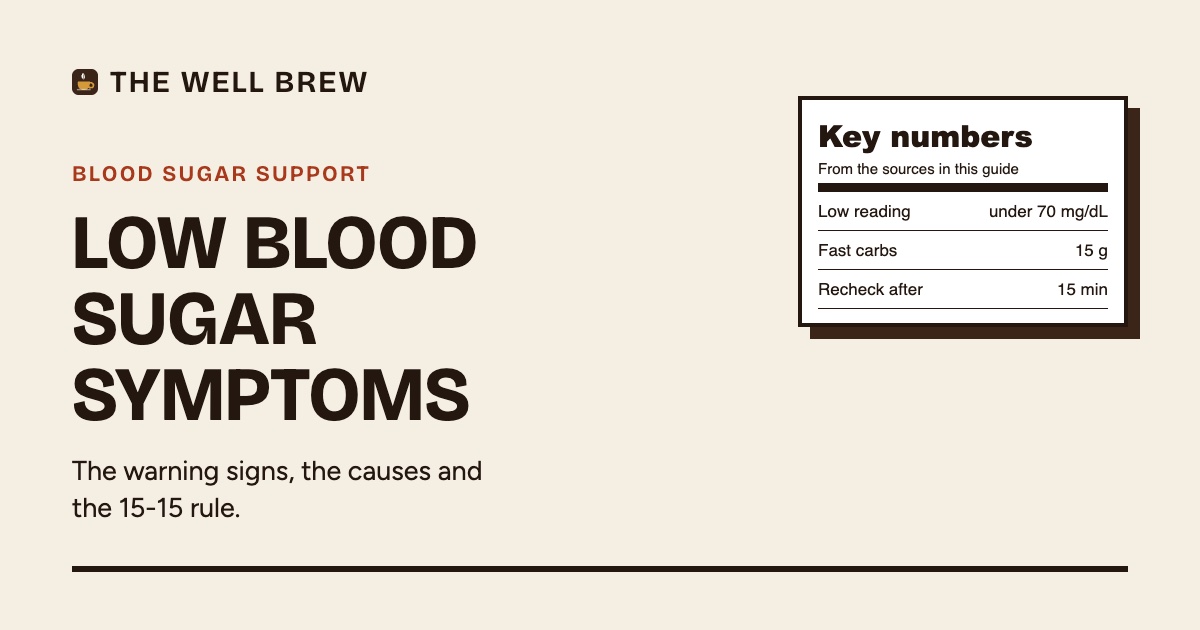
Low blood sugar symptoms include shakiness, sweating, hunger, a fast heartbeat, dizziness and confusion, and they can start within minutes. For many people with diabetes, low means a reading under 70 mg/dL. Treat it with 15 grams of fast sugar, such as 4 glucose tablets, and recheck in 15 minutes. Passing out or a seizure needs glucagon and a 911 call.
On this page
- What are low blood sugar symptoms?
- What is hypoglycemia, and what number counts as low?
- What causes low blood sugar?
- Are low blood sugar symptoms different in women?
- What should you do right away for low blood sugar?
- When should you call 911 or see a doctor right away?
- How do doctors diagnose and treat hypoglycemia?
- How can you prevent low blood sugar?
- Bottom line
- FAQ
Low blood sugar symptoms usually start fast: shakiness, sweating, hunger, a racing heart and trouble thinking clearly. For this guide we read the NIDDK and MedlinePlus pages on hypoglycemia, the American Diabetes Association 2026 Standards of Care, the Endocrine Society guideline and a 2026 review on sex differences, and we followed the method on our how we review page.[1][3][6]
For most people with diabetes, a reading below 70 mg/dL is low, and the first step is 15 grams of fast sugar, then a recheck after 15 minutes.[1][5]
| What it is | Blood glucose that drops below what is healthy for you. The medical name is hypoglycemia.[1][3] |
|---|---|
| Number that counts as low | Below 70 mg/dL (3.9 mmol/L) for many people with diabetes. Below 55 mg/dL is the usual mark for people without diabetes.[2][3] |
| Very low | Below 54 mg/dL (3.0 mmol/L) needs action right away.[4][6] |
| Common early signs | Shaking, sweating, hunger, nervousness, fast heartbeat, headache.[3][4] |
| First step | 15 grams of fast-acting carbs, wait 15 minutes, check again.[4][5] |
| Emergency | Passing out or a seizure. Someone else gives glucagon and calls 911.[1][5] |
| Most likely in | People who take insulin or certain diabetes pills, adults 65 and older, and anyone who has had lows before.[1] |
What are low blood sugar symptoms?
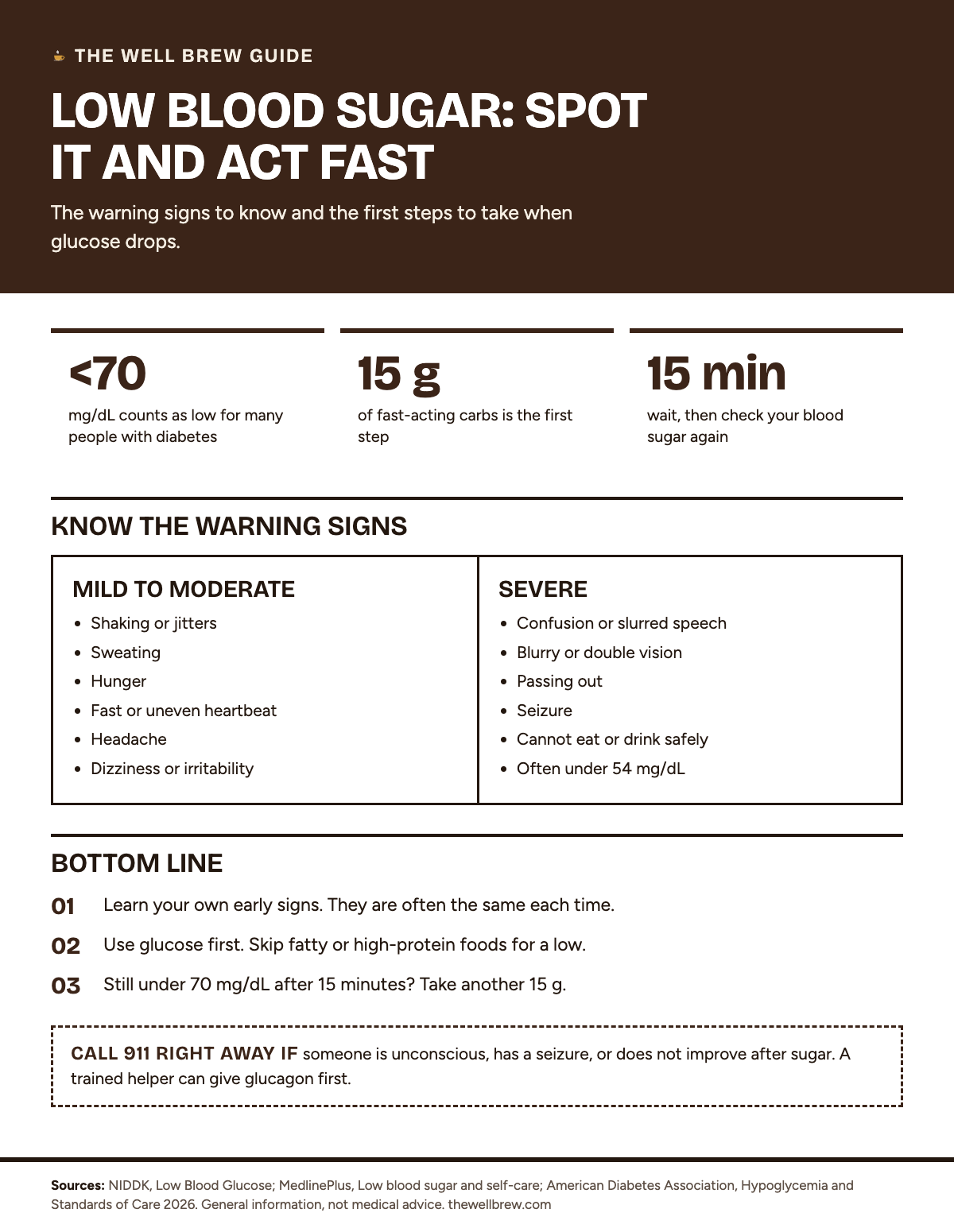
Low blood sugar symptoms are the warning signs your body sends when glucose falls too low to fuel your brain and muscles. The early ones include feeling shaky or jittery, sweating, hunger, tiredness, dizziness and a fast or uneven heartbeat. They tend to come on quickly and differ from person to person.[1][3]
NIDDK sorts them into two groups.[1] Mild to moderate signs include:
- shakiness, hunger and tiredness
- dizziness, lightheadedness, confusion or irritability
- a heartbeat that feels too fast or not steady
- headache
- blurry or double vision, or trouble speaking clearly[1][3]
Severe signs happen when the brain stops working as it should. A person may pass out or have a seizure. This is an emergency.[1]
MedlinePlus adds tingling or numbness of the skin, feeling cranky or aggressive, and trouble sleeping. Hunger and sweating often show up when sugar is only a little low. Unclear thinking and seizures are more likely below 54 mg/dL.[3]
Signs of low blood sugar during sleep
Glucose can drop at night and stay low for hours. Clues include crying out or nightmares, sweat that dampens pajamas or sheets, and waking up tired, irritable or confused.[1] Many people with diabetes notice the same pattern of symptoms each time, so it helps to learn your own early signs.[3]
What is hypoglycemia, and what number counts as low?
Hypoglycemia is the medical word for low blood glucose. For many people with diabetes, it means a reading under 70 mg/dL (3.9 mmol/L). For people without diabetes, it typically means a level under 55 mg/dL. Your own target may differ, so your care team sets the number that is low for you.[1][2][3]
The American Diabetes Association grades lows in three levels.[6]
| Level | Glucose | What it means |
|---|---|---|
| Level 1 | Under 70 mg/dL and at least 54 mg/dL | Clinically important even without symptoms; treat it[6] |
| Level 2 | Under 54 mg/dL | Brain symptoms begin; needs action right away[6] |
| Level 3 | Any number | A severe event where another person must help you recover[6] |
The ADA also notes that 70 mg/dL is roughly where the body starts its stress response, which drives the sweating and shakiness.[6] If you reach level 2 without feeling anything, that suggests impaired awareness and is a reason to review your plan with your doctor.[6]
What causes low blood sugar?
In people with diabetes, the most common cause is insulin or a pill that makes the pancreas release more insulin. Two pill types can do this: sulfonylureas, which raise insulin over several hours, and meglitinides, taken before meals. The Endocrine Society guideline also names insulin and these drugs as the most common cause of hypoglycemia.[1][7]
Other triggers listed by NIDDK and MedlinePlus include:[1][4]
- skipping or delaying a meal, or eating too few carbs after taking medicine
- taking too much insulin, or taking it at the wrong time
- more exercise than usual, which can lower glucose for up to 24 hours afterward
- alcohol without food, which can also hide the first warning signs
- being sick and unable to eat or keep food down
Low blood sugar without diabetes
It is rare. The causes include alcohol, a rare insulin-making tumor of the pancreas called an insulinoma, a lack of cortisol, growth hormone or thyroid hormone, severe heart, kidney or liver failure, and serious infection.[2][3] Some weight-loss surgeries can cause lows, usually 5 or more years later.[3] After stomach surgery, late dumping syndrome can bring shakiness, sweating and a fast heartbeat 1 to 3 hours after a meal because of low glucose.[9] Certain antibiotics and heart medicines can also lower glucose.[2]
Are low blood sugar symptoms different in women?
The sources we read describe the same low blood sugar symptoms for women and men. A 2026 meta-analysis of 24 studies in adults on insulin found no clear difference in hypoglycemia risk between the sexes in outpatient care (risk ratio 1.08, 95% CI 0.61 to 1.89). The authors rated that evidence low certainty.[11]
A few life stages matter for women with diabetes. NIDDK says glucose can drop very quickly after delivery, so medicines often need changes and frequent checks in the first few days.[8] Breastfeeding raises the risk of low glucose at night, so plan for it with your care team.[8]
Alcohol is another factor. MedlinePlus advises people at risk for lows to never drink without food, and suggests women limit alcohol to 1 drink a day and men to 2.[4] If your symptoms seem to change with your cycle or a new medicine, write them down with your readings and bring the log to your next visit.
What should you do right away for low blood sugar?
Use the 15-15 rule: eat or drink 15 grams of fast-acting carbs, wait 15 minutes, then check again. The ADA and MedlinePlus both teach it for anyone awake and able to swallow with a reading under 70 mg/dL. NIDDK gives a range of 15 to 20 grams.[1][4][5]
- Check your blood sugar if you can. If it is under 70 mg/dL or you feel symptoms, act now.[4]
- Take about 15 grams of fast sugar. Pure glucose is the preferred first choice.[4][6]
- Wait about 15 minutes. Do not keep eating while you wait, since too much can push sugar high.[4]
- Check again. If you are still under 70 mg/dL, take another 15 grams.[1][4]
- Repeat until you are back in your target range.[1]
- If your next meal is more than 1 hour away, have a snack such as crackers or fruit.[1]
| Option | Amount | Note |
|---|---|---|
| Glucose tablets | 4 tablets | Or one tube of glucose gel[1] |
| Fruit juice | 1/2 cup (4 ounces) | Not low-sugar juice. With kidney disease, skip orange juice[1] |
| Regular soda | 1/2 can (4 to 6 ounces) | Not diet soda[1] |
| Sugar, honey or syrup | 1 tablespoon | Sugar can be dissolved in water[1][4] |
Skip chocolate, peanut butter or cheese for the first step. The ADA says foods high in fat or protein slow the rise, and protein should not be used to treat a low.[6] If you take a medicine that slows carb digestion, such as acarbose, only glucose tablets or gel will work fast enough.[1][6]
When should you call 911 or see a doctor right away?
A person who has passed out, is having a seizure, or cannot safely eat or drink needs emergency help. The ADA says to call 911 right away if someone is unconscious and glucagon is not on hand or no one knows how to use it.[5]
Call 911 or get emergency care right away if:
- the person is unconscious, has a seizure, or cannot be woken up[3][5]
- the person is becoming less alert or confused[3]
- symptoms do not improve after a sugary snack; get a ride to the ER and do not drive yourself[3]
- glucagon was given; call 911 right after[1]
Never put food or drink in the mouth of someone who is not awake. A trained helper can give glucagon, then turn the person on their side in case they vomit. Most people wake within 15 minutes.[1][10]
Book a prompt visit with your doctor if you have lows often, have a reading below 54 mg/dL without symptoms, or have low readings and do not have diabetes.[6][7]
How do doctors diagnose and treat hypoglycemia?
Doctors confirm hypoglycemia with Whipple’s triad: symptoms, a low glucose reading taken at that time, and relief once glucose is raised. The Endocrine Society guideline recommends working up only cases where all three are documented.[7]
For people with diabetes, the care team reviews medicines, meal timing and exercise. A continuous glucose monitor (CGM) is recommended for anyone at high risk, and it can sound an alarm when glucose falls.[1][6] A doctor may also have you wear a monitor that reads glucose every 5 minutes for 3 to 14 days to find lows you are not feeling.[3] The ADA goal for most adults is less than 4% of the day below 70 mg/dL.[6]
The ADA recommends a glucagon prescription for everyone who takes insulin or is at high risk. It comes as an injection or a nasal spray.[1][6] For people without diabetes, the guideline says to look first for drugs, serious illness, hormone problems and tumors, then test glucose, insulin and C-peptide during an episode.[7] An insulinoma is treated with surgery.[3]
A supplement is never a treatment for a low. Fast glucose comes first, and the cause is handled by your doctor.[6]
| Source | Who | Finding | Limits |
|---|---|---|---|
| Global study cited by NIDDK | Adults with diabetes on insulin, 4 weeks | 4 in 5 with type 1 and nearly half with type 2 reported a low[1] | Self-reported events[1] |
| U.S. data cited by NIDDK | Adults on insulin or insulin-releasing pills | 2 in 100 have a severe low each year[1] | Severe events only[1] |
| Liu et al., 2026 meta-analysis | 24 studies, adults on insulin | No clear sex difference in outpatient lows (RR 1.08)[11] | Low certainty, mixed results[11] |
| ADA Standards of Care 2026 | Expert guideline | Three levels; glucose first; glucagon for high risk[6] | Written for diabetes care[6] |
How can you prevent low blood sugar?
Most lows can be prevented by matching food, activity and medicine, and by checking glucose when things change. NIDDK and MedlinePlus give the same core advice for people who take insulin or pills that can cause lows.[1][4]
- Ask your care team which of your medicines can cause lows, and what number is low for you.[1]
- Do not skip or delay meals after taking insulin or a sulfonylurea.[4]
- Check glucose before, during and after exercise, and carry a snack.[1][4]
- Eat food whenever you drink alcohol.[1][4]
- Carry glucose tablets or a juice box at all times.[1]
- Ask whether you need a bedtime snack to prevent overnight lows.[4]
- Keep an unexpired glucagon kit, and teach family and coworkers how to use it.[1]
- Wear a medical alert bracelet or necklace.[1][4]
- Read labels on any product sold for blood sugar, and use our review method to judge its claims.
Repeated lows can blunt your warning signs, a condition called hypoglycemia unawareness, so preventing lows also helps keep those warning signs working.[1][3] For more on supplements and daily habits, see our blood sugar support guides.
Bottom line
Low blood sugar symptoms such as shaking, sweating, hunger and confusion mean you should check your glucose and act fast. Below 70 mg/dL, the 15-15 rule is the standard first step, and passing out or a seizure means glucagon and a 911 call.[1][5]
If you get lows often, ask your doctor which medicine or habit is behind them. Fixing the cause helps more than treating each episode as it comes. If you have lows and no diabetes, get checked, because the cause needs a diagnosis.[2][7]
Frequently asked questions
What does low blood sugar feel like?
Most people feel shaky, sweaty, hungry or anxious first. Some notice a pounding heart, a headache or blurry vision. As it drops further, thinking gets foggy and speech can slur. The pattern is often the same for one person each time.
What are the signs of hypoglycemia that other people notice?
Others may see sweating, pale skin, shaking, crankiness or odd behavior, confusion and slurred speech. At night, a person may cry out, have nightmares or soak the sheets. A person who will not wake up needs a 911 call.
What blood sugar level is dangerous?
Below 70 mg/dL is low and should be treated. Below 54 mg/dL needs action right away, since brain symptoms start there. Any low where a person needs help from someone else to recover is severe, whatever the number.
Can you have low blood sugar without diabetes?
Yes, but it is rare. Causes include alcohol, some medicines, hormone problems, liver or kidney disease, serious infection, some weight-loss surgeries and rare pancreas tumors. For people without diabetes, low usually means under 55 mg/dL. See a doctor to find the cause.
What is the fastest way to raise low blood sugar?
Pure glucose works fastest, such as 4 glucose tablets or a tube of glucose gel. Half a cup of regular juice or half a can of regular soda also works. Avoid fatty or high-protein foods for the first step.
Sources
- Low Blood Glucose (Hypoglycemia). NIDDK, National Institutes of Health
- Hypoglycemia. MedlinePlus, National Library of Medicine
- Low blood sugar. MedlinePlus Medical Encyclopedia, 2026
- Low blood sugar: self-care. MedlinePlus Medical Encyclopedia
- Low Blood Glucose (Hypoglycemia). American Diabetes Association
- Glycemic Goals, Hypoglycemia, and Hyperglycemic Crises: Standards of Care in Diabetes 2026. American Diabetes Association, Diabetes Care, 2026
- Evaluation and management of adult hypoglycemic disorders: an Endocrine Society Clinical Practice Guideline. Cryer et al., J Clin Endocrinol Metab, 2009
- Pregnancy if You Have Diabetes. NIDDK, National Institutes of Health
- Symptoms and Causes of Dumping Syndrome. NIDDK, National Institutes of Health
- Glucagon Injection. MedlinePlus Drug Information
- Sex differences in glycemic outcomes: a systematic review and meta-analysis of diabetes treatments. Liu et al., BMJ Open Diabetes Res Care, 2026

Maya Ellison is the Reviews Editor at The Well Brew, a slow, plain-language supplement review blog for everyday adults. Maya reads each label in full, sets every dose beside the amounts used in human studies, grades the research with sources such as the NIH Office of Dietary Supplements and NCCIH, and works out the real cost and refund fine print. Maya has no medical credentials and is not a doctor, dietitian, nurse or pharmacist. Reviews give pros, cons and who a product suits, never scores. How we review supplements.
This article is general information, not medical advice. Dietary supplements are not reviewed by the FDA for safety or effectiveness before they are sold. Talk to your doctor before you start any supplement, especially if you are pregnant, nursing, take medication or have a health condition.