Ginkgo biloba has not been shown to improve memory or lower dementia risk. In the GEM trial, 3,069 adults aged 75 or older took 120 mg twice a day for about six years and developed dementia at the same rate as people on placebo. A French trial of 2,854 adults agreed. It is fairly safe for most adults, but people on blood thinners or who are pregnant should avoid it.
On this page
- What is ginkgo biloba?
- What are the benefits of ginkgo biloba for memory?
- What did the GEM trial find?
- Does ginkgo biloba improve memory in healthy adults?
- Can ginkgo help people who already have dementia?
- What are ginkgo biloba side effects?
- Are ginkgo leaf, ginkgo nuts and a ginkgo biloba supplement the same thing?
- What do doctors use first for memory problems?
- Bottom line: is ginkgo biloba worth taking for memory?
- FAQ
Ginkgo biloba is one of the best-known memory supplements, and it is also one of the most tested. We read the NCCIH ginkgo page, the two main reports from the Ginkgo Evaluation of Memory (GEM) trial, the French GuidAge trial, a Cochrane review, a 2015 meta-analysis, a bleeding-risk review, a federal animal study and guidance from the National Institute on Aging. Our method is explained on the how we review page.
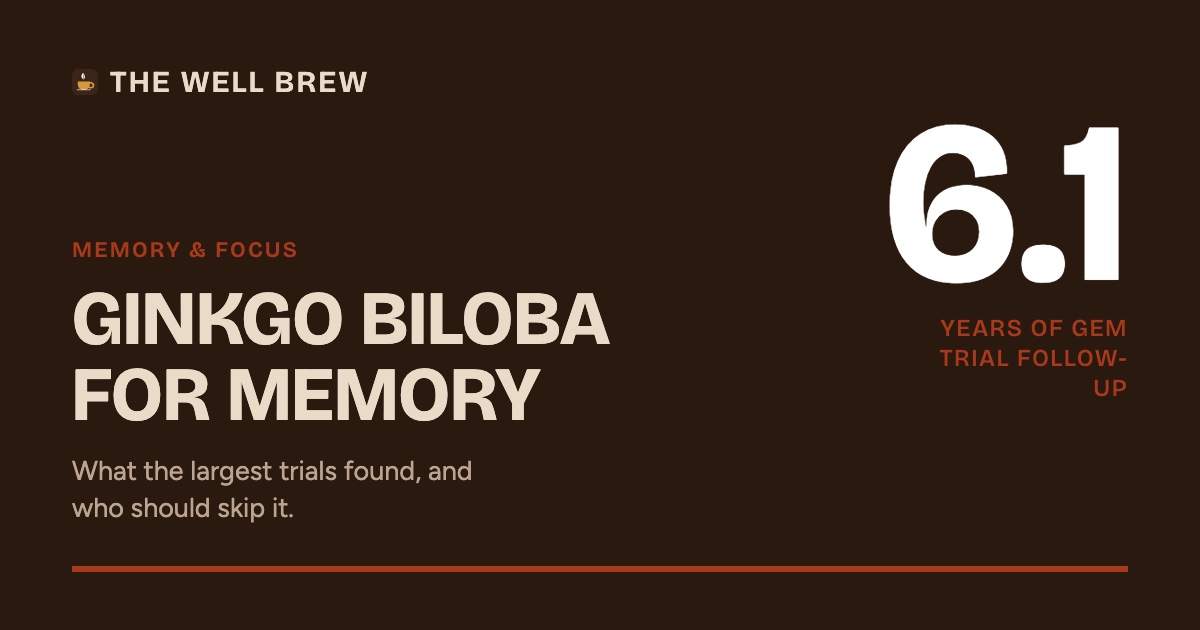
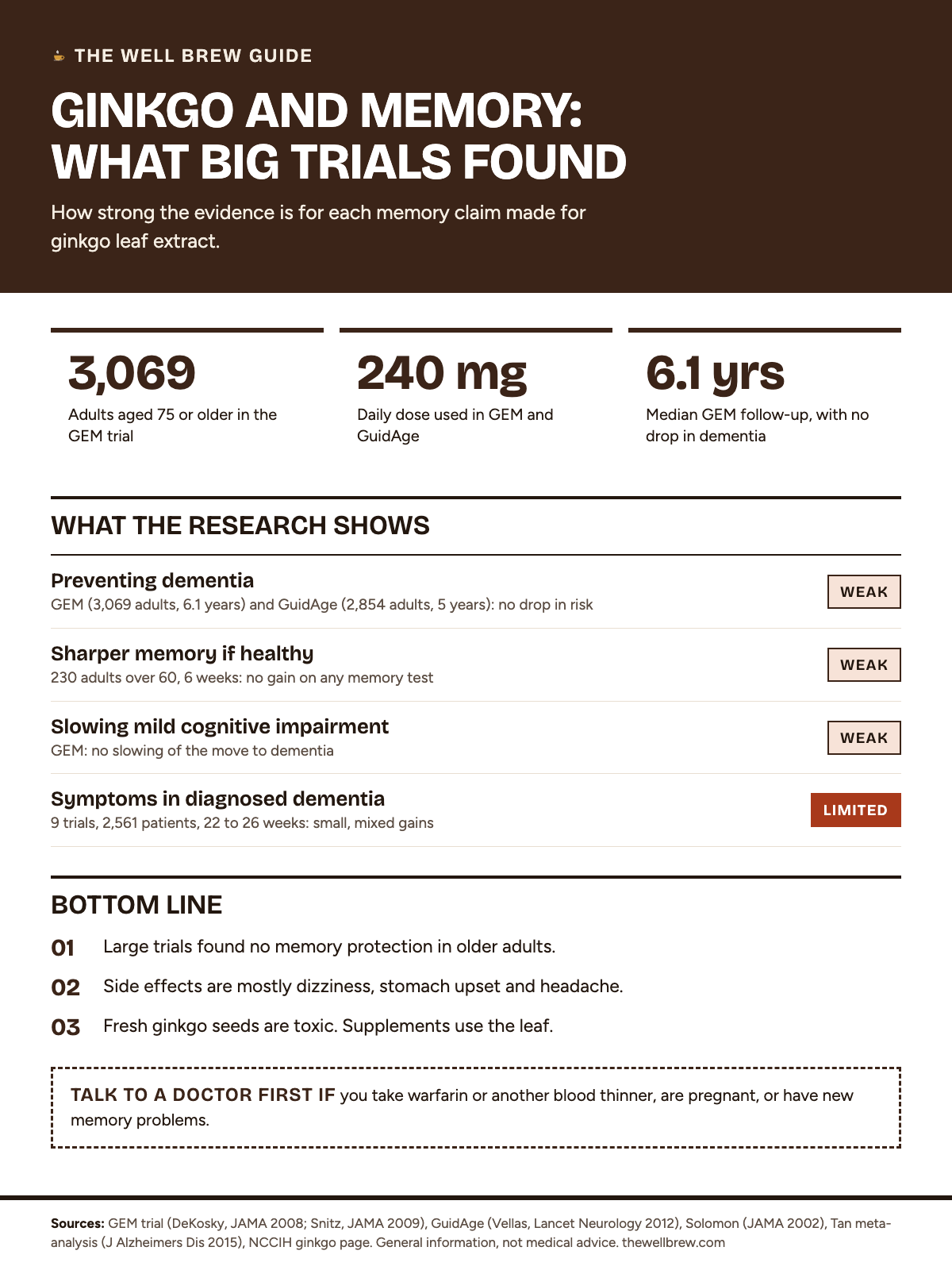
The short answer: in the GEM trial, 3,069 adults aged 75 or older took 120 mg of ginkgo extract twice a day for a median of 6.1 years, and they developed dementia at about the same rate as people on placebo.[2]
| What it is | An extract of leaves from the ginkgo tree, sold as a dietary supplement[1] |
|---|---|
| Marketed for | Memory, “brain health,” anxiety, tinnitus and many other uses[1] |
| Amount in large trials | 120 mg twice a day (240 mg a day) of a standardized extract[2][4] |
| Best evidence | Two large trials found no drop in dementia or Alzheimer’s risk[2][4] |
| Healthy memory | A 6-week trial in 230 healthy older adults found no benefit on any test[5] |
| Common side effects | Dizziness, stomach upset and headache[1] |
| Who should avoid it | People on blood thinners such as warfarin, and people who are pregnant[1] |
What is ginkgo biloba?
Ginkgo biloba is a supplement made from the leaves of the ginkgo tree, an ancient species often called a living fossil. The leaf extract is the most common form sold today. It has a long history in Chinese medicine, where it was used for cough and other problems.[1]
In the United States, ginkgo is sold as a dietary supplement. It is promoted for memory, dementia, anxiety, heart disease, tinnitus and many other conditions. Some products also claim it can sharpen thinking in healthy people.[1]
Most research uses a standardized leaf extract called EGb 761. A bottle on a store shelf may be made differently from the extract tested in trials.[6] Supplements do not go through FDA approval before they are sold, and makers are responsible for the safety and labeling of their own products.[1]
You can browse more plant extracts on our supplement ingredients guides.
What are the benefits of ginkgo biloba for memory?
The large trials of ginkgo biloba found no clear memory benefit for older adults who started with normal thinking or mild memory problems. NCCIH sums it up plainly: ginkgo has not been shown to work for any condition it has been studied for, including preventing or slowing dementia.[1]
The research falls into three groups. Prevention trials asked whether ginkgo keeps dementia away. Healthy-adult trials asked whether it sharpens normal memory. Treatment trials asked whether it helps people who already have dementia. The table below shows the main studies we read.
| Study | Who and how long | Dose | Result |
|---|---|---|---|
| GEM trial, JAMA 2008[2] | 3,069 adults aged 75+, median 6.1 years | 120 mg twice a day | No drop in dementia or Alzheimer’s rates |
| GEM cognitive decline, JAMA 2009[3] | Same 3,069 adults, aged 72 to 96 | 120 mg twice a day | Memory and attention declined at the same rate as placebo |
| GuidAge, Lancet Neurology 2012[4] | 2,854 adults aged 70+ with memory complaints, 5 years | 120 mg twice a day (EGb 761) | No significant drop in Alzheimer’s risk |
| Solomon trial, JAMA 2002[5] | 230 healthy adults over 60, 6 weeks | 40 mg three times a day | No difference on any memory test |
| Cochrane review 2009[6] | 36 trials in people with cognitive impairment | Varied | Benefit “inconsistent and unreliable” |
| Tan meta-analysis 2015[7] | 9 trials, 2,561 patients, 22 to 26 weeks | Mostly 240 mg a day | Small score gains in people with dementia |
The biggest and longest trials, all in people without dementia, found no benefit. The few positive results came from shorter trials in people who already had dementia.
What did the GEM trial find?
The Ginkgo Evaluation of Memory (GEM) trial found that ginkgo did not lower the rate of dementia or Alzheimer’s disease in adults aged 75 and older. It is the largest ginkgo trial run in the United States, and NCCIH and the National Institute on Aging helped fund it.[1][2]
The trial ran at five academic medical centers between 2000 and 2008. Of the 3,069 volunteers, 2,587 had normal thinking and 482 had mild cognitive impairment. Half took 120 mg of ginkgo extract twice a day. The other half took a placebo. Only 6.3% dropped out or were lost to follow-up, which is low for a study this long.[2]
By the end, 277 people in the ginkgo group and 246 in the placebo group had developed dementia. That works out to 3.3 cases per 100 person-years on ginkgo and 2.9 on placebo. The gap was not statistically significant, so the trial showed no effect either way. Ginkgo also did not slow the move from mild cognitive impairment to dementia.[2]
A second GEM report tracked memory, attention, language and planning skills over the same years. Those skills declined at the same pace in both groups, and the result held across age, sex, race and education.[3]
Does ginkgo biloba improve memory in healthy adults?
In a 6-week JAMA trial of 230 healthy adults over 60, ginkgo did not improve memory, attention or word recall on any test. Family members and friends also saw no difference, and the people taking it did not rate their own memory any better.[5]
That trial, led by Paul Solomon at Williams College, used 40 mg three times a day, which followed the package directions of the product at the time. The researchers wrote that ginkgo “provides no measurable benefit” for memory in people whose thinking is healthy.[5]
The GEM data point the same way over a much longer period. People who started with normal thinking and took ginkgo for about six years lost memory at the same yearly rate as those on placebo.[3]
NCCIH adds that much of the research on brain performance in healthy people is low quality, so it is unclear whether ginkgo changes thinking at all in this group.[1] For a sharper memory at work or in school, ginkgo has little evidence behind it.
Can ginkgo help people who already have dementia?
Ginkgo extract may give a small benefit on symptom scores in people who already have dementia, but the results conflict from trial to trial. NCCIH describes a possible modest effect, mostly at higher doses, and calls the evidence inconsistent.[1]
The 2009 Cochrane review pooled 36 trials. Most were small and lasted under three months. Nine ran for six months and included 2,016 patients. Of the four newest trials, three found no difference from placebo and one found very large effects. In 925 people with Alzheimer’s disease, there was no consistent benefit. The reviewers judged the evidence “inconsistent and unreliable.”[6]
A 2015 meta-analysis of nine trials with 2,561 patients found small gains on thinking and daily-living scores after 22 to 26 weeks. The gains were mainly at 240 mg a day, and they were stronger in people with behavior and mood symptoms.[7] That pattern comes from one review and does not prove a higher dose works better.
Where you stand: a quick decision table
| If you are | What large trials found | Sensible next step |
|---|---|---|
| Healthy and want a sharper memory | No benefit in 230 adults over 6 weeks[5] | Focus on sleep, exercise and blood pressure[10] |
| Over 70 and hoping to lower your dementia risk | No drop in risk in two trials of about 3,000 people each[2][4] | Ask about health screenings and chronic conditions[10] |
| Living with mild cognitive impairment | No slowing of progression in GEM[2] | See a doctor for testing and a care plan[11] |
| Living with diagnosed dementia | Small, inconsistent score gains[6][7] | Discuss with the treating doctor before adding it |
| Taking warfarin or another blood thinner | Possible higher bleeding risk[1] | Do not start ginkgo without medical advice |
What are ginkgo biloba side effects?
The most common ginkgo biloba side effects are dizziness, stomach upset and headache, and most adults tolerate the leaf extract well. NCCIH says moderate amounts of leaf extract are likely safe for most adults, and they have been used in studies lasting up to six years.[1]
In the trials, side effects looked much like placebo. The Cochrane review found no difference in the share of people with adverse events.[6] In GEM, the side effect profiles of the two groups were similar.[2] In GuidAge, strokes and bleeding events did not differ between groups.[4]
Bleeding and medicines
Ginkgo may raise bleeding risk in people who take anticoagulants such as warfarin, and it may interact with other medicines.[1] A 2011 review of 18 trials in 1,985 adults found no rise in bleeding risk based on lab measures of clotting.[8] Lab tests are not the same as real bleeding in people on blood thinners, so the NCCIH caution still applies.
Pregnancy and other cautions
Ginkgo may be unsafe in pregnancy. It might cause early labor or extra bleeding during delivery if taken near that time. Little is known about safety while breastfeeding.[1]
A National Toxicology Program study gave ginkgo extract to rats and mice for two years at doses up to 2,000 mg per kilogram of body weight. The animals developed liver tumors (mice) and thyroid tumors (rats).[9] Those doses are far above what people take, and the study does not show the same risk in humans. It is still a reason not to take more than labeled amounts.
Who should talk to a doctor first
- Anyone taking warfarin, other blood thinners or daily medicine[1]
- Anyone who is pregnant, planning a pregnancy or breastfeeding[1]
- Anyone with a surgery or dental procedure coming up, since bleeding is the main concern[1]
- Anyone with new or worsening memory problems, which need a proper checkup[11]
Are ginkgo leaf, ginkgo nuts and a ginkgo biloba supplement the same thing?
No: the supplements tested in trials are leaf extracts, while ginkgo nuts are the seeds, and fresh seeds are toxic. NCCIH warns that serious side effects have also occurred in people who ate roasted seeds or the crude plant.[1]
Search results often mix up the leaf, the nut and the supplement. They differ in these ways.
- Ginkgo leaf extract is the form used in nearly all memory trials, usually the standardized extract EGb 761.[6]
- Raw or crude leaves are not the same as an extract. NCCIH lists the crude plant among forms linked to serious side effects.[1]
- Among ginkgo nuts and seeds, fresh seeds are toxic, and roasted seeds have caused serious reactions too.[1]
- Brand-name memory pills vary in extract and dose. We did not test any brand for this guide.
If you do try a supplement, a product that names a standardized leaf extract and a dose close to the trials is the closest match to what was studied.[2][4]
What do doctors use first for memory problems?
Doctors start by finding the cause of memory problems, because forgetfulness can come from many treatable conditions. MedlinePlus lists depression, thyroid, kidney or liver problems, head injuries and reactions to medicines among the causes, alongside Alzheimer’s disease and other dementias.[11]
It is normal to forget a name or misplace your keys now and then. Forgetting how to use your phone or how to find your way home may point to a more serious problem. MedlinePlus advises seeing your health care provider if forgetfulness worries you.[11]
For keeping the brain healthy, the National Institute on Aging focuses on the basics: get recommended health screenings, manage high blood pressure, diabetes, depression and high cholesterol, and review your medicines with your provider for effects on memory and sleep. NIA also states that no vitamin or supplement is recommended for preventing Alzheimer’s or other forms of cognitive decline.[10]
A supplement does not replace that checkup. For more on this topic, see our memory and focus guides.
Checklist before you buy ginkgo
- Ask your doctor or pharmacist first if you take warfarin, any blood thinner or any daily medicine.[1]
- Check that the label names a leaf extract, ideally a standardized one, and the amount per capsule.[6]
- Compare the daily dose with the trials, which used 240 mg a day, and do not take more than the label says.[2][9]
- Never eat raw ginkgo seeds or use crude plant material.[1]
- Stop and call your doctor if you notice unusual bruising or bleeding.[1]
- Be wary of labels that promise to restore or protect memory, since large trials did not show that.[2][3]
- See how we judge evidence on our review standards page.
Bottom line: is ginkgo biloba worth taking for memory?
For most people, ginkgo biloba is not worth buying for memory, because the largest trials found no drop in dementia rates and no slowing of memory decline. GEM followed about 3,000 older adults for six years and GuidAge followed about 2,800 for five, and neither found a meaningful benefit.[2][4] It appears fairly safe for most adults, though it is a poor fit for anyone on blood thinners or who is pregnant.[1]
Our judgement: if you are worried about your memory, a visit to your doctor and attention to blood pressure, sleep and medicines is the better first step. People already living with dementia may want to raise ginkgo with their doctor, knowing the evidence for symptom relief is small and mixed.[6][7][10]
Frequently asked questions
Is Ginkoba good for memory?
Ginkoba is a brand name for a ginkgo product, and we did not test it. Large trials of standardized ginkgo leaf extract at 240 mg a day found no drop in dementia risk and no slowing of memory decline in older adults.
How long does ginkgo take to work?
There is no proven timeline because large trials found no lasting memory benefit. The GEM trial ran for a median of 6.1 years, and a 6-week trial in healthy adults over 60 found no change on any memory test.
Are ginkgo biloba benefits different for women?
The GEM trial checked whether results differed by sex, age, race or education and found no difference. Women and men on ginkgo lost memory at the same rate as those on placebo, so no special benefit for women has been shown.
What is ginkgo fruit?
The ginkgo fruit holds the seed, often sold as ginkgo nuts. It is a different part of the tree from the leaf extract used in supplements. NCCIH warns that fresh seeds are toxic and that roasted seeds have also caused serious side effects.
Can I take ginkgo with aspirin or warfarin?
Ask your doctor first. NCCIH warns that ginkgo may raise bleeding risk in people who take anticoagulants such as warfarin and may interact with other medicines. Some herb and drug combinations can be harmful, so get advice before mixing them.
Sources
- Ginkgo. NCCIH, National Institutes of Health
- Ginkgo biloba for prevention of dementia: a randomized controlled trial (GEM). JAMA, DeKosky et al., 2008
- Ginkgo biloba for preventing cognitive decline in older adults: a randomized trial. JAMA, Snitz et al., 2009
- Long-term use of standardised Ginkgo biloba extract for the prevention of Alzheimer's disease (GuidAge). Lancet Neurology, Vellas et al., 2012
- Ginkgo for memory enhancement: a randomized controlled trial. JAMA, Solomon et al., 2002
- Ginkgo biloba for cognitive impairment and dementia. Cochrane Database of Systematic Reviews, 2009
- Efficacy and adverse effects of ginkgo biloba for cognitive impairment and dementia: a systematic review and meta-analysis. Journal of Alzheimer's Disease, Tan et al., 2015
- Is there a risk of bleeding associated with standardized Ginkgo biloba extract therapy? A systematic review and meta-analysis. Pharmacotherapy, Kellermann and Kloft, 2011
- Toxicology and carcinogenesis studies of Ginkgo biloba extract in rats and mice. National Toxicology Program, 2013
- Cognitive Health and Older Adults. National Institute on Aging
- Memory. MedlinePlus, National Library of Medicine

Maya Ellison is the Reviews Editor at The Well Brew, a slow, plain-language supplement review blog for everyday adults. Maya reads each label in full, sets every dose beside the amounts used in human studies, grades the research with sources such as the NIH Office of Dietary Supplements and NCCIH, and works out the real cost and refund fine print. Maya has no medical credentials and is not a doctor, dietitian, nurse or pharmacist. Reviews give pros, cons and who a product suits, never scores. How we review supplements.
This article is general information, not medical advice. Dietary supplements are not reviewed by the FDA for safety or effectiveness before they are sold. Talk to your doctor before you start any supplement, especially if you are pregnant, nursing, take medication or have a health condition.