To improve gut health, eat 22 to 34 grams of fiber a day from many different plants, add fermented foods such as yogurt, kefir and sauerkraut slowly, exercise most days and sleep 7 to 9 hours. A Stanford trial found fermented foods raised gut diversity in 17 weeks. Probiotic pills help most during antibiotics, not as a daily habit.
On this page
- How to improve gut health: where should you start?
- How much fiber and how many plants does your gut need?
- Do fermented foods help? What the Stanford trial found
- Do gut health supplements work?
- How do antibiotics affect your gut?
- How to fix gut health: do sleep and exercise matter?
- When do gut symptoms need a doctor?
- Gut health checklist
- Bottom line
- FAQ
This guide on how to improve gut health is built from the NCCIH probiotics page, NIDDK fiber advice, a 2019 Cochrane review and five human studies on diet, antibiotics, exercise and sleep. We read each source and kept only what it actually measured.[1][2][7] Our review process explains how we grade evidence.
The short answer: eat more fiber from many different plants, add fermented foods slowly, move most days, sleep 7 to 9 hours, and use antibiotics only when you need them. The best food trial so far raised gut diversity in 36 adults over 17 weeks with about 6 servings of fermented food a day.[4][11]
| What it means | A gut that digests food comfortably, with a diverse community of microbes. Researchers have not agreed on one definition of a healthy microbiome.[1] |
|---|---|
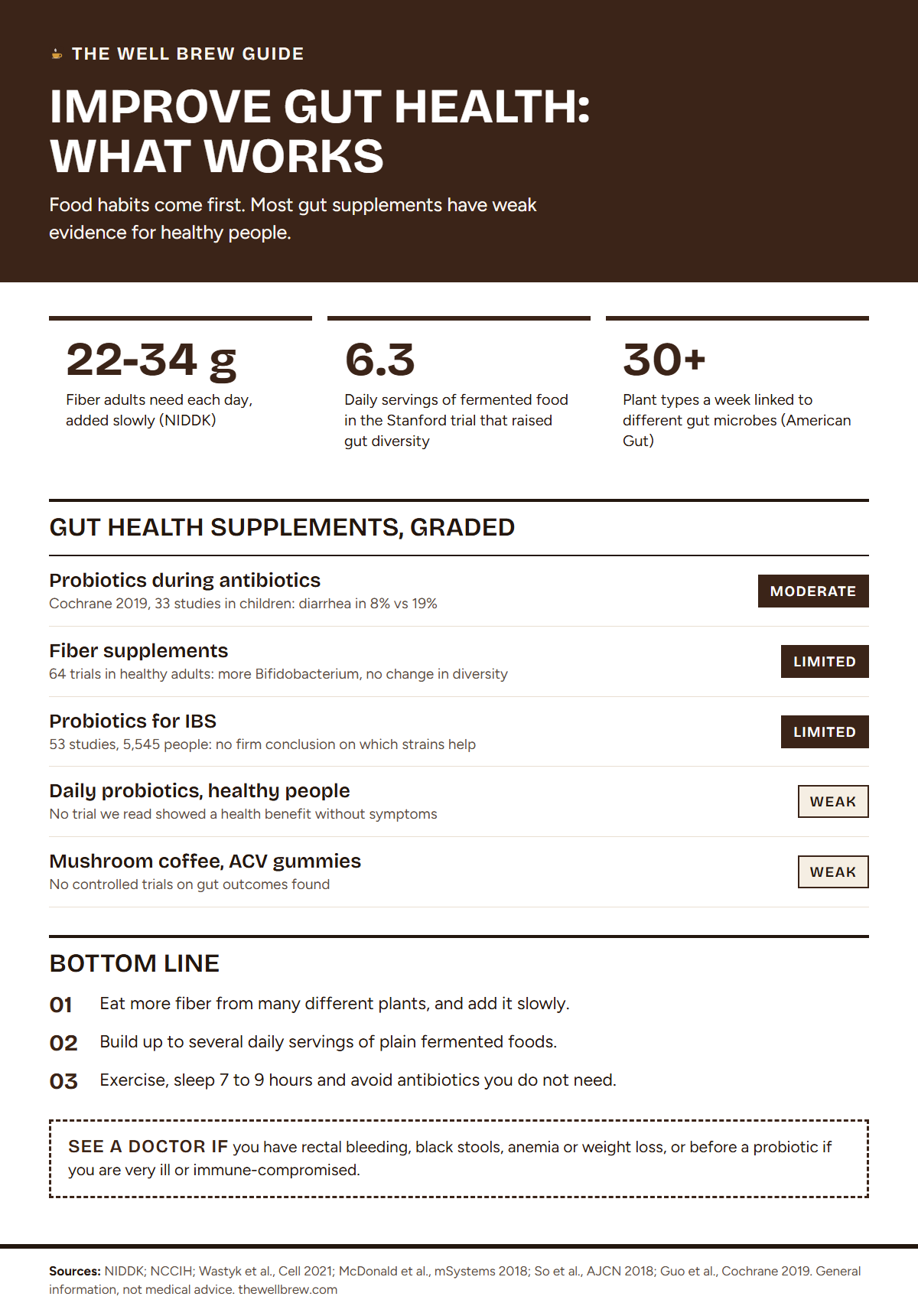
| Main food lever | Fiber: adults need 22 to 34 grams a day, and most Americans eat less.[2][3] |
| Best diet trial | Stanford, 2021: fermented foods raised microbiome diversity and lowered 19 of 93 inflammatory proteins in 17 weeks.[4] |
| Plant variety | People eating more than 30 plant types a week had different gut microbes than those eating 10 or fewer (observational).[5] |
| Probiotic supplements | Best evidence is for diarrhea during antibiotics, not for general gut health.[1][7] |
| Safety | Fiber added too fast causes gas and cramps. Probiotics carry more risk for very ill or immune-compromised people.[3][1] |
| Who should see a doctor first | Anyone with blood in the stool, black stools, anemia or weight loss they cannot explain.[12] |
How to improve gut health: where should you start?
Start with what you eat. Fiber from a wide range of plants feeds the gut bacteria that make short-chain fatty acids, and it is the step with the most support. Adults need 22 to 34 grams of fiber a day, and the NIDDK advises adding it a little at a time.[2] Fermented foods come next, then sleep, movement and careful antibiotic use.
Here is the order we would follow, based on the studies below:
- Add one high-fiber food a day for a week, such as oats, beans, lentils, berries or pears, and drink water with it.[2]
- Count the plant types you eat in a week. Aim to move toward 30, counting fruits, vegetables, grains, beans, nuts, seeds, herbs and spices.[5]
- Add one serving of a fermented food a day, such as 6 ounces of plain yogurt or kefir, or a quarter cup of sauerkraut or kimchi, then build up slowly.[4]
- Cut back on low-fiber processed foods such as chips, fast food and hot dogs.[2]
- Move most days. In one trial, 6 weeks of endurance exercise changed gut bacteria in previously inactive adults.[9]
- Protect your sleep and aim for 7 to 9 hours a night.[11]
- Take antibiotics only when a clinician prescribes them, and ask whether a probiotic makes sense during the course.[8][7]
- See a doctor for warning signs instead of trying another supplement.[12][1]
For a wider eating pattern that fits these steps, see our guide to anti-inflammatory diet foods and meal ideas. More guides sit in our gut health section.
How much fiber and how many plants does your gut need?
Adults need 22 to 34 grams of fiber a day, depending on age and sex.[2] MedlinePlus notes that most Americans do not eat enough, and that adding fiber too quickly can cause gas, bloating and cramps.[3] So the goal is a slow climb, with enough fluid to help the fiber work.[2]
Good sources named by the NIDDK include whole grains such as oatmeal and whole wheat bread, legumes such as lentils, black beans and chickpeas, fruits such as berries, apples with the skin and pears, vegetables such as carrots, broccoli and peas, and nuts such as almonds and peanuts.[2]
Variety may matter as much as volume. The American Gut Project collected stool samples from more than 10,000 citizen scientists. People who ate more than 30 types of plants a week had different gut bacteria than people who ate 10 or fewer, and fewer antibiotic resistance genes.[5] This was a self-selected, observational group, so it shows a link, not cause and effect.
Fiber trials also have limits. A 2018 meta-analysis of 64 trials in 2,099 healthy adults found that fiber raised Bifidobacterium and Lactobacillus, two groups often seen as helpful, but did not change overall diversity.[6] So fiber feeds certain microbes, but on its own it has not been shown to reshape the whole community.
If food alone falls short, a fiber supplement can fill the gap. Our page on psyllium husk benefits for digestion covers how to use it. Water matters here too, and our guide on how much water you should drink a day gives amounts by age and activity.
Do fermented foods help? What the Stanford trial found
In a 2021 Stanford trial, a diet high in fermented foods steadily raised gut microbiome diversity and lowered markers of inflammation.[4] Researchers randomly assigned 36 healthy adults to a high-fermented-food diet or a high-fiber diet for 17 weeks, with 18 people in each group.[4]
The fermented group went from about 0.4 servings a day to 6.3 servings a day. One serving was 6 ounces of yogurt, kefir, kombucha or buttermilk, or a quarter cup of kimchi, sauerkraut or other fermented vegetables.[4] In that group, 19 of 93 inflammatory proteins in the blood went down, including interleukin 6 (IL-6).[4]
The fiber group raised intake from 21.5 to 45.1 grams a day. Their gut bacteria gained more enzymes for breaking down fiber, but overall diversity stayed stable over the study.[4]
This was a small study that measured blood and stool markers rather than illness. It does not show that fermented foods lower the risk of any disease. It does suggest that adding several daily servings of fermented foods is a reasonable, low-cost step for most healthy adults.
| Study | Who and how long | What changed | Limits |
|---|---|---|---|
| Wastyk, Stanford, 2021[4] | 36 healthy adults, 17 weeks | Fermented foods raised diversity; 19 of 93 inflammatory proteins fell | Small; markers only |
| So, meta-analysis, 2018[6] | 64 trials, 2,099 healthy adults | Fiber raised Bifidobacterium and Lactobacillus | No change in diversity |
| McDonald, American Gut, 2018[5] | More than 10,000 volunteers | 30 or more plant types a week linked to different microbes | Observational |
| Allen, 2018[9] | 32 inactive adults, 6 weeks of exercise | Short-chain fatty acids rose in lean adults | Effects faded after stopping |
| Dethlefsen, 2011[8] | 3 people, 10 months, 2 antibiotic courses | Diversity dropped within 3 to 4 days | Very small |
Do gut health supplements work?
Most gut health supplements have weak evidence for healthy people, and the clearest benefit is for probiotics taken during antibiotics. The NCCIH says that for most conditions, researchers still do not know which probiotics help, at what dose, or for whom.[1] Different strains can have different effects, so a result for one product does not carry over to another.[1]
Probiotics sold as dietary supplements do not need FDA approval before they are sold, and some products have been found to contain microbes not listed on the label.[1] We grade the evidence with four words, the same scale used in our review method:
- Moderate: several pooled trials, small consistent effect.
- Limited: some trials, small or low quality.
- Weak: pilot studies only, or reviews found no benefit.
- Avoid: no evidence plus a safety problem.
| Supplement and use | What the research shows | Grade |
|---|---|---|
| Probiotics during antibiotics | Diarrhea in 8% of children on probiotics vs 19% on control, across 33 studies; a 2017 adult review found about half the risk[7][1] | Moderate |
| Fiber supplements (psyllium, inulin) | Raise Bifidobacterium and Lactobacillus in 64 trials, but not diversity[6] | Limited |
| Probiotics for constipation | Some benefit in 14 studies of 1,182 adults, mostly Bifidobacterium lactis[1] | Limited |
| Probiotics for IBS | 53 studies of 5,545 people; no firm conclusion on which strains help[1] | Limited |
| Daily probiotics for healthy people | No trial we read showed a health benefit for people without symptoms[1] | Weak |
| Mushroom coffee, ACV gummies, gut detox blends | We found no controlled trials on gut outcomes; labels are not checked before sale[1] | Weak |
For most people, fermented foods and fiber are the better first step because they cost less, carry little risk and have direct trial data on the microbiome.[4][6]
How do antibiotics affect your gut?
Antibiotics can cut gut diversity within days, and recovery after the course may be incomplete. In a 2011 Stanford study, researchers followed 3 people for 10 months through two courses of ciprofloxacin. Diversity fell within 3 to 4 days of starting the drug, and the return after each course was often incomplete.[8]
You should still take an antibiotic you need. The concern is courses that were never needed, so ask your clinician whether an antibiotic is truly needed for a cough, cold or sore throat.
Probiotics taken with antibiotics have the strongest evidence of any gut supplement. A 2019 Cochrane review of 33 studies in 6,352 children found diarrhea in 8% of those given probiotics compared with 19% in control groups, with moderate certainty. About 9 children needed a probiotic to prevent one case.[7] In adults outside the hospital, a 2017 review of 17 studies with 3,631 people found about half the risk.[1]
The NCCIH adds that the best strain, dose and length of use are still uncertain, and that people who are very weak or have poor immune function face more risk.[1]
How to fix gut health: do sleep and exercise matter?
Exercise has better gut evidence than sleep, and both effects seem to last only while the habit continues. In a 2018 trial, 32 previously inactive adults did supervised endurance exercise 3 days a week, building from 30 to 60 minutes per session over 6 weeks.[9]
Short-chain fatty acids in stool rose in lean participants but not in those with obesity. When people stopped exercising for 6 weeks, most of the changes went away.[9]
Sleep data are thinner. In a small 2016 study, 9 young men slept about 4 hours a night for 2 nights. Some bacterial groups shifted and insulin sensitivity fell, but overall diversity did not change. The authors called the effects on gut microbes subtle.[10] Adults should still aim for 7 to 9 hours of sleep a night for general health.[11] Our guide to magnesium glycinate and sleep covers one common sleep supplement.
The studies moved on different timelines. Antibiotic changes appeared in 3 to 4 days, exercise changes in 6 weeks, and the fermented food effect built up over 17 weeks.[8][9][4] Expect it to take months of steady habits.
When do gut symptoms need a doctor?
Gut symptoms with bleeding, black stools, anemia or weight loss need a medical check, because they can point to a problem other than a sensitive gut. The NIDDK lists these as signs that suggest something other than irritable bowel syndrome.[12]
Your doctor will also want to know about a family history of celiac disease, colon cancer or inflammatory bowel disease, recent infections, the medicines you take and what you eat.[12]
See a doctor right away if you have
- Bleeding from the rectum or bloody stools.[12]
- Black, tarry stools.[12]
- Anemia or weight loss you cannot explain.[12]
- Diarrhea during or after antibiotics that is severe or will not stop, since C. difficile infection can follow antibiotic use.[1]
What doctors use first
For constipation, the first step is diet: more fiber, added slowly, with enough fluid.[2] For ongoing symptoms, doctors take a history, do an exam and may order blood or stool tests to rule out other conditions.[12] The NCCIH warns against using probiotics as a reason to delay seeing a health care provider.[1]
Side effects and who should be careful
Fiber added too fast causes gas, bloating and cramps.[3] Probiotics are riskier for premature infants, seriously ill hospital patients and people with weak immune systems, and the FDA has warned about severe infections in premature infants.[1] If you are pregnant, take regular medicines or have a long-term condition, ask your clinician before starting a supplement.[1]
Gut health checklist
- Track your fiber for 3 days and compare it with the 22 to 34 gram target.[2]
- Add fiber slowly and drink water with it.[2][3]
- Count plant types each week and add one new one at a time.[5]
- Build up to several servings of plain fermented foods a day.[4]
- Exercise most days and keep it going.[9]
- Aim for 7 to 9 hours of sleep.[11]
- If you buy a probiotic, check that the label lists the strain, not just the species, and ask your clinician about it first.[1]
- Book a visit for any warning sign listed above.[12]
Bottom line
The research on how to improve gut health points to ordinary habits. More fiber from more kinds of plants, daily fermented foods, regular exercise and fewer unneeded antibiotics all have human data behind them.[2][4][5][8][9]
For most people, food is the better first step than a gut health supplement, because the best diet trial showed changes in diversity and inflammation markers while probiotic evidence is strongest only during antibiotics.[4][7] If you have bleeding, black stools or weight loss, skip the experiments and see a doctor.[12]
Frequently asked questions
What is gut health?
Gut health usually means comfortable digestion plus a diverse community of gut microbes. Researchers have not agreed on one definition of a healthy microbiome, so no test or product can give you a single gut health score.
Are daily gut health supplements worth it?
For healthy people, the evidence is weak. Probiotics have the best support during antibiotics. Supplements do not need FDA approval before sale, and some labels list the wrong microbes, so food is usually the better first step.
What are the best gut health foods?
High-fiber foods such as oats, beans, lentils, berries, pears, broccoli and nuts, plus fermented foods such as plain yogurt, kefir, sauerkraut and kimchi. Variety counts, so aim for many different plant types each week.
Is mushroom coffee good for gut health?
We found no controlled trials showing that mushroom coffee improves gut outcomes. If you enjoy it, drink it for the taste. Fiber and fermented foods have far more human data behind them.
Do ACV gummies support gut health and digestion?
We found no controlled trials of apple cider vinegar gummies on gut bacteria or digestion. Gummies often contain added sugar. Spend the money on beans, vegetables and plain yogurt instead, which have trial data.
Sources
- Probiotics: Usefulness and Safety. National Center for Complementary and Integrative Health (NCCIH)
- Eating, Diet, and Nutrition for Constipation. NIDDK, National Institutes of Health
- Dietary Fiber. MedlinePlus, National Library of Medicine
- Gut-microbiota-targeted diets modulate human immune status (Wastyk et al.). Cell, 2021
- American Gut: an Open Platform for Citizen Science Microbiome Research (McDonald et al.). mSystems, 2018
- Dietary fiber intervention on gut microbiota composition in healthy adults: a systematic review and meta-analysis (So et al.). American Journal of Clinical Nutrition, 2018
- Probiotics for the prevention of pediatric antibiotic-associated diarrhea (Guo et al.). Cochrane Database of Systematic Reviews, 2019
- Incomplete recovery and individualized responses of the human distal gut microbiota to repeated antibiotic perturbation (Dethlefsen and Relman). PNAS, 2011
- Exercise Alters Gut Microbiota Composition and Function in Lean and Obese Humans (Allen et al.). Medicine and Science in Sports and Exercise, 2018
- Gut microbiota and glucometabolic alterations in response to recurrent partial sleep deprivation (Benedict et al.). Molecular Metabolism, 2016
- How Much Sleep Is Enough?. NHLBI, National Institutes of Health
- Diagnosis of Irritable Bowel Syndrome. NIDDK, National Institutes of Health

Maya Ellison is the Reviews Editor at The Well Brew, a slow, plain-language supplement review blog for everyday adults. Maya reads each label in full, sets every dose beside the amounts used in human studies, grades the research with sources such as the NIH Office of Dietary Supplements and NCCIH, and works out the real cost and refund fine print. Maya has no medical credentials and is not a doctor, dietitian, nurse or pharmacist. Reviews give pros, cons and who a product suits, never scores. How we review supplements.
This article is general information, not medical advice. Dietary supplements are not reviewed by the FDA for safety or effectiveness before they are sold. Talk to your doctor before you start any supplement, especially if you are pregnant, nursing, take medication or have a health condition.