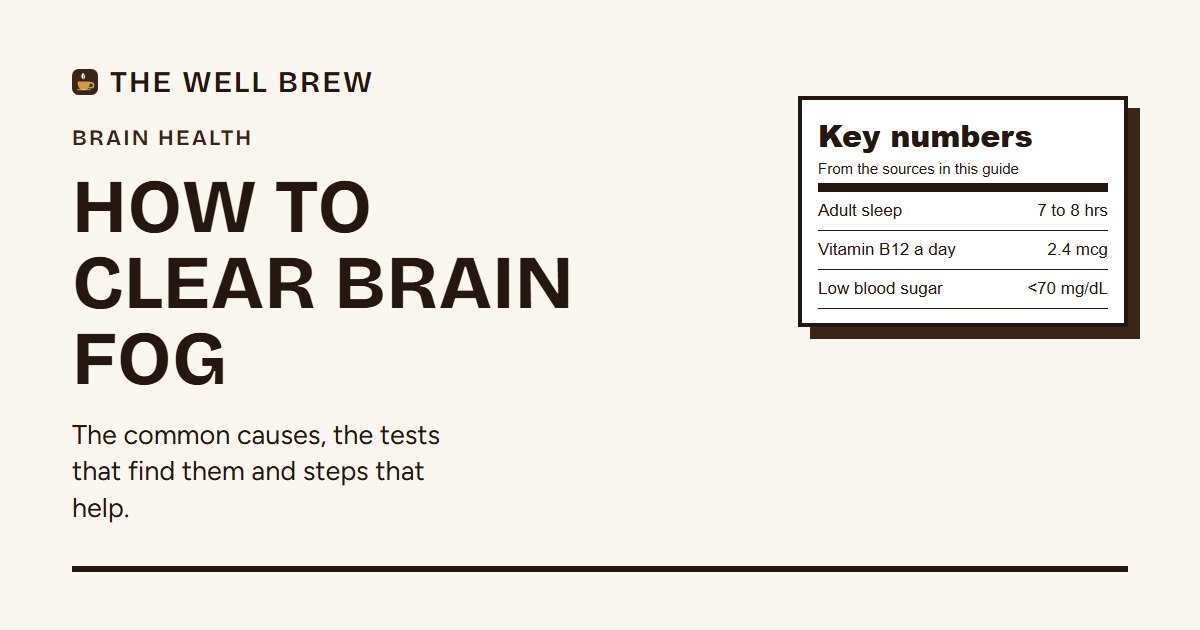
Brain fog is a symptom of something else, so it usually clears once you fix the cause. Start with seven to eight hours of sleep, cut back on alcohol and review your medicines. Low mood, anxiety, menopause and long COVID are common causes. If the fog lasts more than a few weeks, ask your doctor for thyroid and vitamin B12 blood tests.
On this page
- What is brain fog?
- Why do I have brain fog?
- Can poor sleep cause brain fog?
- Can depression, anxiety or medicines cause brain fog?
- Is brain fog a sign of menopause or long COVID?
- Can low B12, thyroid or blood sugar cause brain fog?
- How to get rid of brain fog: 8 steps that match the cause
- When should you see a doctor about brain fog?
- Bottom line on brain fog
- FAQ
How to get rid of brain fog depends on what is causing it. For this guide we read National Institute on Aging and NIMH pages on memory, depression and anxiety, NHLBI sleep pages, NIDDK pages on thyroid and blood sugar, the NIH vitamin B12 fact sheet, CDC long COVID guidance, and studies from the SWAN and NIH RECOVER cohorts.[2][3][5][9][10][11][12][14]
Brain fog is a symptom, so it lifts when you fix the cause. The usual causes are poor sleep, low mood or anxiety, medicine side effects, hormonal change, illness and a few problems a simple blood test can find.[1][2]
| What it is | A loose term people use for forgetfulness, poor focus, slow thinking and a fuzzy or detached feeling; it is not a diagnosis[1] |
|---|---|
| Most common causes | Sleep problems, depression and anxiety, medication side effects, alcohol, thyroid problems and low vitamin B12[2] |
| Sleep target | Generally seven to eight hours a night for adults[2] |
| Tests a doctor may order | Thyroid blood tests, a vitamin B12 level, a blood sugar check and, for loud snoring, a sleep study[4][11][12][14] |
| Long COVID link | Brain fog is one of the most commonly reported long COVID symptoms[10] |
| Supplements | Vitamin B12 helps only if you are low; most studies found low B12 levels did not change the risk of cognitive decline in older people[11] |
| See a doctor if | You get lost in familiar places, repeat the same questions or cannot follow directions[2] |
What is brain fog?
Brain fog is an everyday name for feeling slow, forgetful, unfocused or mentally cloudy, and doctors do not count it as a diagnosis. They handle it the way they handle tiredness or a headache, by looking for what sits underneath it.[1]
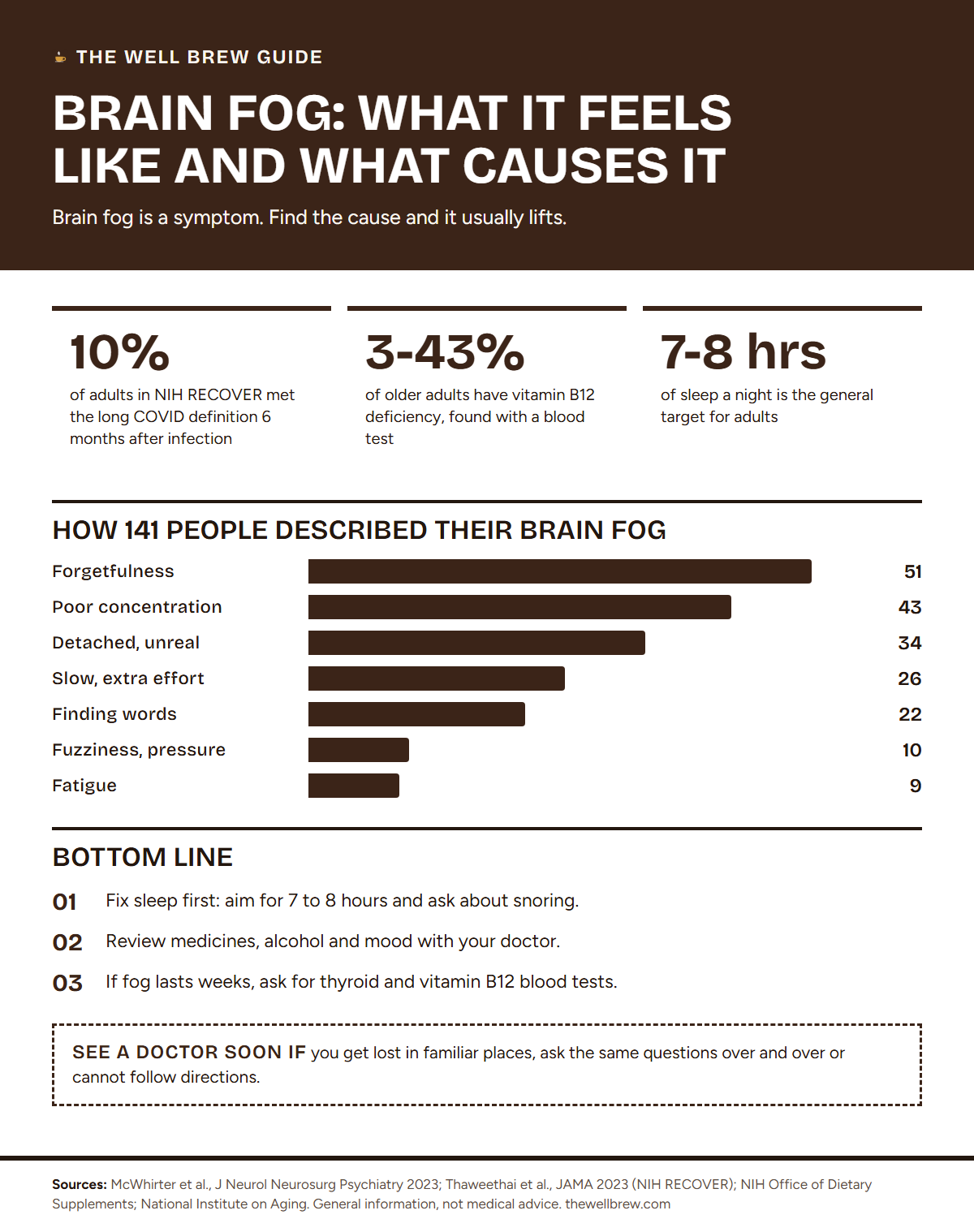
A 2023 study from the University of Edinburgh shows how wide the term is. Researchers pulled 1,663 Reddit posts that used the phrase and kept 717 for analysis. Of 141 first-person descriptions, 51 described forgetfulness, 43 difficulty concentrating, 34 a detached or unreal feeling, 26 slowness and extra effort, 22 trouble finding words, 10 fuzziness or pressure, and 9 fatigue.[1]
The same posts blamed many different things, from illness to drug use or stopping a drug. Long COVID was the most common cause people named, in 60 of 570 posts that gave one, or about 10%.[1] With causes that varied, one fix rarely works for everyone. Your own pattern, such as when it started, what makes it worse and what else you feel, points to the cause.
Why do I have brain fog?
The National Institute on Aging lists sleep problems, depression and anxiety, medication side effects, alcohol, thyroid, kidney or liver problems and low vitamin B12 among the common reasons for memory and thinking trouble. Stressful life events can do it too. Most of these causes can be checked, and many can be corrected.[2]
Use the table below as a starting map. It pairs each cause with the clues that point to it and the check a clinician is likely to use.
| Cause | Clues that point to it | How it is checked |
|---|---|---|
| Short or poor sleep | Trouble learning, focusing and reacting after short nights[3] | Sleep diary; talk with a doctor if 7 to 8 hours still leaves you tired[2] |
| Sleep apnea | Loud snoring, gasping, daytime sleepiness, morning headache[4] | Sleep study[4] |
| Depression | Low mood for weeks; memory and thinking problems can be prominent in severe cases[5] | Screening questions and an exam by a doctor or mental health professional[5] |
| Anxiety | Worry plus at least 3 of: restlessness, fatigue, trouble concentrating, irritability, muscle tension, poor sleep[6] | Clinical assessment[6] |
| Medicines or alcohol | Fog began after a new drug or dose change, or with regular drinking[2] | Medication review with a doctor or pharmacist[2] |
| Menopause transition | Forgetfulness and poor focus alongside hot flashes, poor sleep and period changes[7] | Symptom history; no single test[7] |
| Long COVID | Fog with fatigue and crashes after effort, months after infection[10] | Clinical history; no single test[10] |
| Low vitamin B12 | Tiredness, numb or tingly hands and feet, balance problems, poor memory[11] | Blood test[11] |
| Underactive thyroid | Fatigue, weight gain, feeling cold, dry skin, low mood[12] | Thyroid blood tests[12] |
| Low blood sugar | Shaky, hungry, sweaty, confused; most often in people on insulin or some diabetes pills[14] | Blood glucose reading below 70 mg/dL[14] |
Can poor sleep cause brain fog?
Yes, and it is the first thing to rule out: NHLBI says sleep deficiency can leave you with trouble learning, focusing and reacting. Sleep deficiency covers short sleep, sleep at the wrong time of day, broken sleep, and sleep disorders that spoil sleep quality.[3]
The NIA suggests about seven to eight hours a night for adults.[2] If you get that much and still wake up foggy, the problem may be the quality of your sleep, not the length.
Sleep apnea is the classic hidden cause. Breathing stops and starts during the night, often with loud snoring or gasping that a partner notices before you do. During the day it causes sleepiness and tiredness, which NHLBI says can lead to problems with learning, focusing and reacting. Headache, dry mouth and waking at night to urinate are other clues. A sleep study confirms it.[4]
If your fog is worst in the morning and eases as the day goes on, mention snoring or gasping to your doctor. It is one of the more fixable causes on this list. For sleep habits and supplements, see our brain health guides.
Can depression, anxiety or medicines cause brain fog?
Yes: trouble concentrating is a listed symptom of generalized anxiety disorder, and NIMH notes that memory and thinking problems can be prominent in severe depression. In older adults this can look like dementia, a pattern sometimes called pseudodementia.[5][6]
For a diagnosis of generalized anxiety disorder, a person has trouble controlling worry and has at least three of six symptoms, one of which is trouble concentrating.[6] Depression brings low mood or loss of interest that lasts for weeks.[5]
Thinking often improves as mood does. NIMH says antidepressants usually take 4 to 8 weeks to work, and problems with sleep, appetite and concentration often improve before mood lifts.[5] Cognitive behavioral therapy is the best-studied talk therapy for anxiety.[6]
Medicines are the other common culprit. The NIA lists medication side effects and alcohol or drug misuse among the causes of memory problems.[2] Sleep aids, some allergy pills, pain medicines and drugs for bladder or mood can all leave people feeling dull. Do not stop a prescription on your own. Bring every pill, including over-the-counter products and supplements, to a medication review.
Is brain fog a sign of menopause or long COVID?
It can be either: the NIA lists forgetfulness and difficulty concentrating among menopause symptoms, and CDC names brain fog as one of the most commonly reported long COVID symptoms. In both cases the fog usually comes with other clues, such as hot flashes or crashes after effort.[7][10]
The best data on menopause come from the SWAN study. It followed 2,362 women for 4 years and tested their thinking speed and memory. In late perimenopause, scores did not improve with practice the way they did in other stages. After menopause, the learning gain came back to premenopausal levels, which suggests the change is often time-limited.[8]
For long COVID, the NIH RECOVER study surveyed 9,764 adults. Brain fog was one of 12 symptoms that best set apart people with long COVID. Among 2,231 people first infected on or after December 1, 2021, about 10% met the long COVID definition at 6 months.[9] CDC notes that more than 200 long COVID symptoms have been identified, with fatigue, brain fog and post-exertional malaise among the most common.[10]
| Study | Who and how many | Length | Main finding |
|---|---|---|---|
| McWhirter, J Neurol Neurosurg Psychiatry, 2023 | 717 Reddit posts that mentioned brain fog | One week of posts, October 2021 | Forgetfulness and poor concentration were the most common descriptions; long COVID was the top cause people named (10%)[1] |
| SWAN, Greendale, Neurology, 2009 | 2,362 midlife women | 4 years | Learning gains stalled in late perimenopause and returned after menopause[8] |
| NIH RECOVER, Thaweethai, JAMA, 2023 | 9,764 adults with and without COVID-19 | 6 months or more after infection | Brain fog was one of 12 symptoms in the long COVID score; 10% met the definition at 6 months[9] |
| Samuels and Bernstein, Thyroid, 2022 | Narrative review of hypothyroidism studies | Not applicable | Fog in hypothyroidism involves fatigue, low mood and trouble with memory and planning[13] |
Can low B12, thyroid or blood sugar cause brain fog?
Yes: each is a recognized medical cause, and each is found with a routine blood test. The NIH vitamin B12 fact sheet lists confusion and poor memory among deficiency symptoms, a narrative review describes memory trouble in hypothyroidism, and NIDDK lists confusion as a sign of low blood glucose.[11][13][14]
Vitamin B12. Adults need 2.4 mcg a day, and deficiency affects between 3% and 43% of older adults. People at higher risk include vegans, people who had weight-loss or stomach surgery, and people with low stomach acid. Metformin and acid-reducing drugs such as omeprazole can lower absorption. Because the body stores a lot of B12, symptoms can take several years to appear.[11] Read more on the signs of vitamin B12 deficiency.
Thyroid. Nearly 5 in 100 Americans ages 12 and older have hypothyroidism, and women are much more likely to have it. Fatigue and depression are listed symptoms, and a blood test can confirm the diagnosis.[12] A 2022 review found that in hypothyroidism, fog symptoms often come before the diagnosis and some people on levothyroxine still report them.[13]
Blood sugar. Low blood glucose usually means a reading below 70 mg/dL for people with diabetes. It is most common in people who take insulin or medicines that make the pancreas release more insulin. Symptoms include feeling shaky, hungry, tired, dizzy, confused or irritable. Lows during sleep can leave you tired, irritable or confused after waking up.[14] See low blood sugar symptoms and what to do right away.
How to get rid of brain fog: 8 steps that match the cause
The fastest path is to fix sleep first, review your medicines and alcohol, then get the basic blood tests if the fog lasts more than a few weeks. These steps follow the order of the most common causes in NIH guidance, so the cheap and simple checks come before the specialist ones.[2][3]
- Protect seven to eight hours of sleep. Keep the same wake time every day for two weeks and note whether the fog eases.[2]
- Ask about snoring. Loud snoring, gasping or waking with a headache is a reason to ask for a sleep study.[4]
- Cut back on alcohol. The NIA advises avoiding or limiting it to protect memory.[2]
- List every medicine and supplement. Note any that started near the time the fog began, and review the list with your doctor or pharmacist.[2]
- Check your mood honestly. If you have felt low or worried most days for weeks, ask for help. Concentration often improves as mood improves.[2][5]
- Use memory tools. To-do lists, calendars and notes take load off your memory while you sort out the cause.[2]
- If you have diabetes, check your glucose when the fog hits. A reading below 70 mg/dL needs fast-acting carbs, such as four glucose tablets, and a recheck after 15 minutes.[14]
- Ask for blood tests if the fog lasts. A thyroid panel and a vitamin B12 level are simple, cheap and find two treatable causes.[11][12]
Practical checklist before your appointment
- Write down when the fog started and anything that changed around then, such as a new medicine, an illness or COVID-19.
- Track your sleep hours and ask a partner whether you snore or stop breathing at night.[4]
- Bring all medicines, including over-the-counter sleep aids and supplements.[2]
- Note other symptoms: hot flashes, feeling cold, numb feet, crashes after effort or shakiness before meals.[7][10][11][12][14]
- Ask directly for a thyroid test and a B12 level if they have not been done recently.[11][12]
When should you see a doctor about brain fog?
See a doctor if the fog lasts more than a few weeks, keeps getting worse or makes everyday tasks hard. The NIA says a doctor can do tests and assessments to find the source of memory problems, and many of the causes above are treatable once found.[2]
See a doctor right away if you or someone close to you notices:
- Asking the same questions over and over.[2]
- Getting lost in places you used to know well.[2]
- Trouble following recipes or directions.[2]
- Growing confusion about time, people and places.[2]
- Low blood sugar that does not come up with fast-acting carbs, or confusion so severe you cannot eat or drink; that needs emergency care.[14]
- Thoughts of suicide: call or text 988, the Suicide and Crisis Lifeline.[5]
Our guide to early signs of dementia compared with normal forgetfulness explains the difference.
What doctors check first
Standard care starts with a history and exam, then targets the likely cause. That usually means thyroid blood tests, with levothyroxine and a repeat test 6 to 8 weeks after starting if the thyroid is low.[12] It may include a vitamin B12 level, a sleep study when apnea is suspected, and screening for depression or anxiety, where talk therapy, medicine or both are the usual first steps.[4][5][6][11] For long COVID, care is built around the symptoms a person has, since there is no single test.[10]
Safety notes on supplements
A supplement will not find the cause for you. Vitamin B12 supplements correct a real deficiency, but most studies found low B12 levels did not change the risk of thinking decline in older people.[11] B12 supplements can also interact with some medicines, so tell your doctor before starting them.[11] If you are weighing herbal memory products, read what large trials found on ginkgo for memory first. Our how we review health evidence explains how we grade studies.
Bottom line on brain fog
Brain fog almost always has a cause behind it, and the likely ones are ordinary: short or broken sleep, low mood or worry, a medicine, alcohol, menopause or a recent infection.[1][2]
For most people, two weeks of steady sleep and a medicine review is the better first step than any supplement, because those address the most common causes at no cost. If the fog lasts past that, a thyroid test and a B12 level are worth asking for, since both find problems that respond well to treatment.[2][11][12]
Frequently asked questions
How do you fix brain fog fast?
A few nights of full sleep, skipping alcohol and eating regular meals often help within days. If you have diabetes, check your glucose, since a low reading below 70 mg/dL needs fast-acting carbs right away.
How long does brain fog last?
It depends on the cause. Fog from short sleep can lift within days of catching up, while fog linked to menopause or long COVID can last months. In the SWAN study, thinking changes in perimenopause eased after menopause.
Is brain fog a sign of dementia?
Usually not. Most brain fog comes from sleep, mood, medicines or illness. Warning signs that go beyond fog include getting lost in familiar places, asking the same questions repeatedly and trouble following directions. Those need a doctor visit.
Can vitamins help brain fog?
Only if you are low in one. Vitamin B12 corrects a true deficiency, which is common in older adults and vegans, but most studies found low B12 levels did not change the risk of thinking decline in older people. A blood test tells you whether you need it.
What blood tests check for brain fog?
No test diagnoses brain fog itself. Doctors usually check thyroid hormone levels, vitamin B12 and blood sugar, because each can cause foggy thinking. They may also screen for depression or order a sleep study if you snore loudly.
Sources
- What is brain fog?. McWhirter L et al., Journal of Neurology, Neurosurgery and Psychiatry, 2023
- Memory Problems, Forgetfulness, and Aging. National Institute on Aging, NIH
- What Are Sleep Deprivation and Deficiency?. National Heart, Lung, and Blood Institute, NIH
- Sleep Apnea: Symptoms. National Heart, Lung, and Blood Institute, NIH, 2025
- Depression. National Institute of Mental Health, NIH
- Generalized Anxiety Disorder: What You Need to Know. National Institute of Mental Health, NIH
- What Is Menopause?. National Institute on Aging, NIH
- Effects of the menopause transition and hormone use on cognitive performance in midlife women. Greendale GA et al., Neurology, 2009 (SWAN)
- Development of a Definition of Postacute Sequelae of SARS-CoV-2 Infection. Thaweethai T et al., JAMA, 2023 (NIH RECOVER)
- Long COVID Signs and Symptoms. Centers for Disease Control and Prevention
- Vitamin B12: Fact Sheet for Consumers. NIH Office of Dietary Supplements
- Hypothyroidism (Underactive Thyroid). National Institute of Diabetes and Digestive and Kidney Diseases, NIH
- Brain Fog in Hypothyroidism: What Is It, How Is It Measured, and What Can Be Done About It. Samuels MH, Bernstein LJ, Thyroid, 2022
- Low Blood Glucose (Hypoglycemia). National Institute of Diabetes and Digestive and Kidney Diseases, NIH

Maya Ellison is the Reviews Editor at The Well Brew, a slow, plain-language supplement review blog for everyday adults. Maya reads each label in full, sets every dose beside the amounts used in human studies, grades the research with sources such as the NIH Office of Dietary Supplements and NCCIH, and works out the real cost and refund fine print. Maya has no medical credentials and is not a doctor, dietitian, nurse or pharmacist. Reviews give pros, cons and who a product suits, never scores. How we review supplements.
This article is general information, not medical advice. Dietary supplements are not reviewed by the FDA for safety or effectiveness before they are sold. Talk to your doctor before you start any supplement, especially if you are pregnant, nursing, take medication or have a health condition.