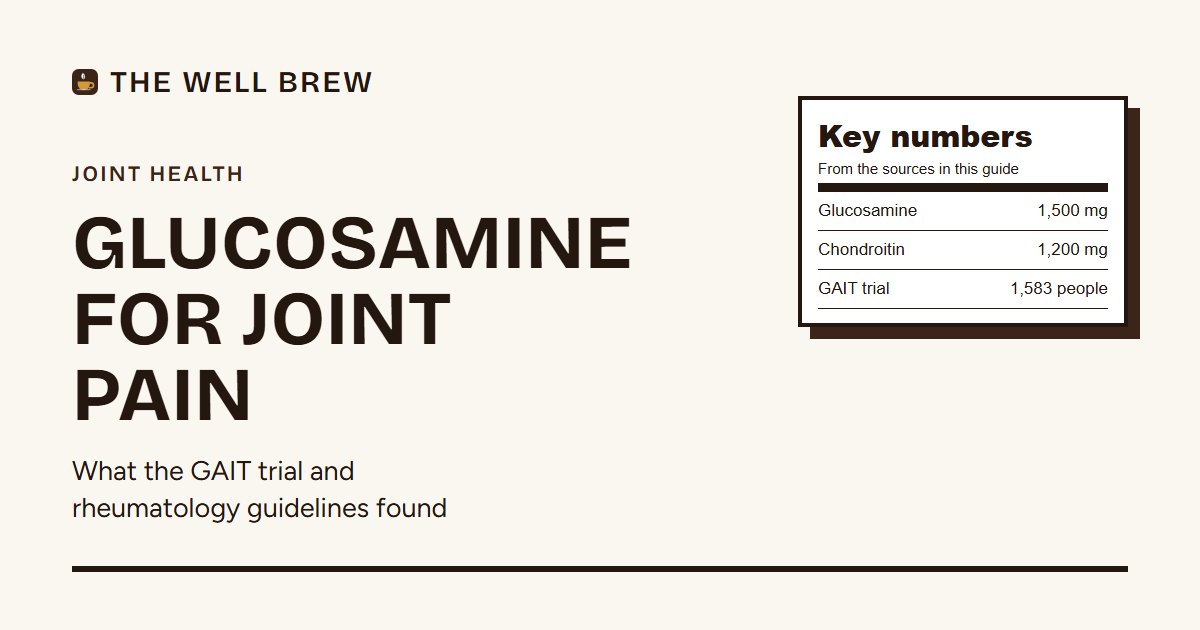
Glucosamine is a supplement made mostly from shellfish shells or produced synthetically. In GAIT, the largest US trial, 1,500 mg a day for 24 weeks eased knee pain no better than placebo, and adding chondroitin did not change that overall. The American College of Rheumatology strongly recommends against it. Exercise and weight loss come first, and anyone on warfarin should ask a doctor.
On this page
- Does glucosamine for joint pain actually work?
- What did the GAIT trial and other studies find?
- Is glucosamine sulfate better than glucosamine hydrochloride?
- Does glucosamine work better with chondroitin?
- What glucosamine and chondroitin dosage did trials use?
- How long does glucosamine take to work?
- What are the side effects of glucosamine, and who should avoid it?
- What do doctors recommend first for joint pain from osteoarthritis?
- Is glucosamine worth trying? The bottom line
- FAQ
To answer whether glucosamine for joint pain is worth taking, we read the NCCIH page on glucosamine and chondroitin, the 2019 American College of Rheumatology guideline, the GAIT trial and its two-year follow-up, a Cochrane review, a BMJ network meta-analysis, two more large trials and safety reports on warfarin and shellfish allergy. Our how we review page explains how we choose and weigh sources.
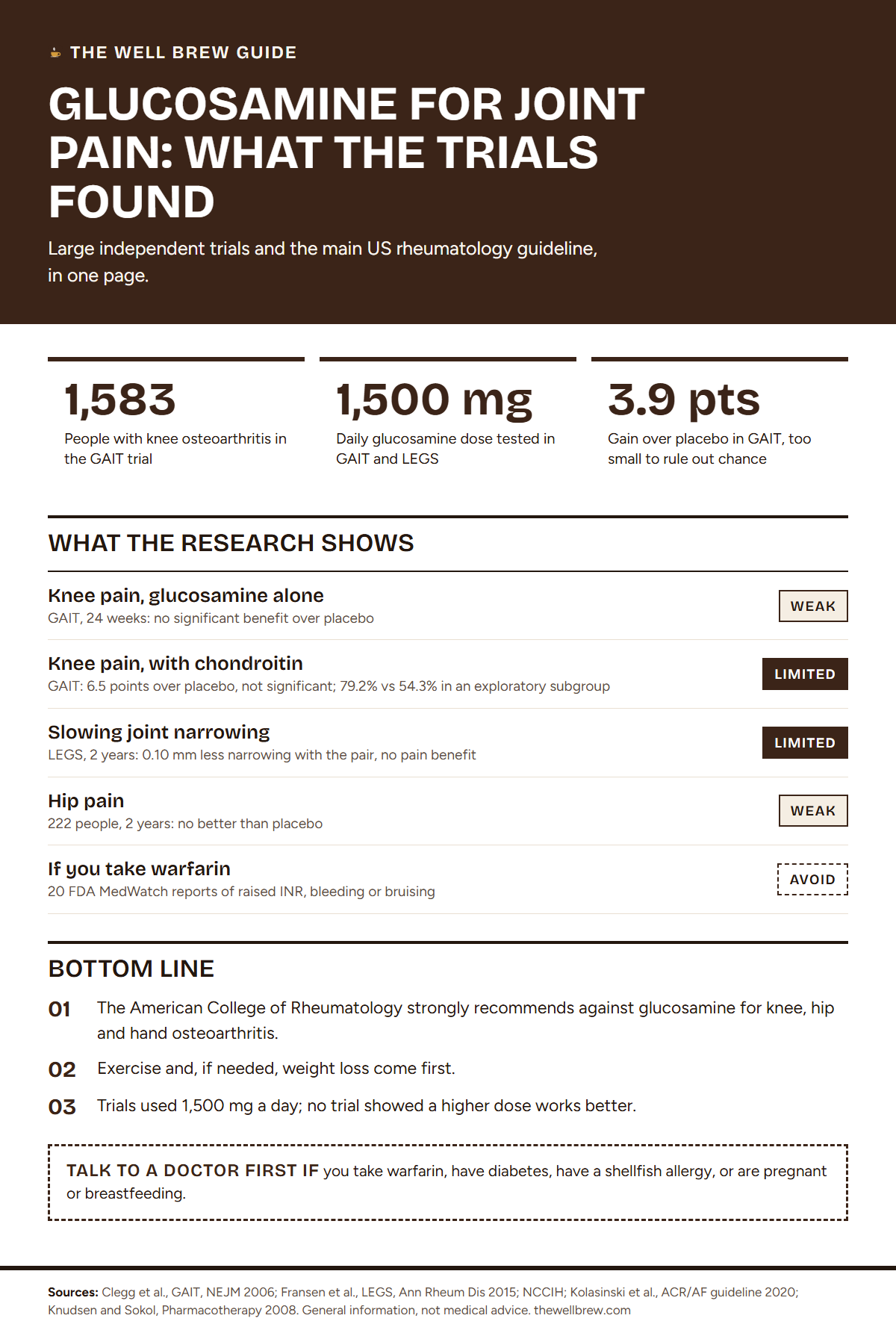
The short answer: in GAIT, a 1,583-person trial, 1,500 mg of glucosamine a day for 24 weeks eased knee pain in only 3.9 percentage points more people than a placebo did, a gap small enough to be chance.[3]
| What it is | A building block of cartilage molecules, sold in the US as a dietary supplement in sulfate or hydrochloride form[1]. Shrimp shells are a major commercial source.[11] |
|---|---|
| Studied for | Pain, stiffness and joint function in osteoarthritis, mostly of the knee[1] |
| Amounts used in trials | 1,500 mg of glucosamine a day, often with 800 to 1,200 mg of chondroitin[3][8] |
| Best evidence | GAIT, 1,583 people for 24 weeks: no significant benefit over placebo overall[3] |
| Guideline position | The American College of Rheumatology strongly recommends against it for knee, hip and hand osteoarthritis[5] |
| Safety | Mild side effects in trials; may raise blood sugar; linked to bleeding in people on warfarin[1][10] |
| Ask a doctor first | People on warfarin, people with diabetes, and anyone pregnant or breastfeeding[1] |
Does glucosamine for joint pain actually work?
In the best-run trials, glucosamine has not relieved knee osteoarthritis pain better than a placebo pill. The 2019 ACR guideline says the data with the lowest risk of bias “fail to show any important benefits over placebo.”[5] NCCIH calls the question uncertain because studies disagree.[1]
The Cochrane review pooled 20 trials with 2,570 patients. When it kept only the 8 trials with proper allocation concealment, glucosamine showed no benefit for pain or function.[6]
A 2010 BMJ network meta-analysis of 10 large trials with 3,803 people found glucosamine lowered pain by 0.4 cm on a 10 cm scale. The authors set the smallest change patients would notice at 0.9 cm, so the effect fell short. Trials run without industry money showed smaller effects than company-funded ones.[7]
Many people still feel better while taking it, and the trial data explain why: in GAIT, 60.1% of people on placebo reached the pain goal.[3] The ACR guideline points to “large placebo effects” as part of the story.[5]
What glucosamine is
Glucosamine is a building block for glycosaminoglycans, molecules that form part of cartilage. Chondroitin is another cartilage component that helps it resist compression.[1] The idea behind the supplement is that swallowing these building blocks might support worn joints. In a 2017 US survey, chondroitin, with or without glucosamine, was the supplement most used by people 35 and older with osteoarthritis.[1]
What did the GAIT trial and other studies find?
GAIT, the largest US trial, tested glucosamine, chondroitin and the pair in 1,583 people with knee osteoarthritis, and none beat placebo by a significant margin. Celecoxib, a prescription anti-inflammatory used as a check, did: it helped 10.0 percentage points more people than placebo.[3]
A subset of 662 GAIT patients kept taking their assigned pills for 2 years. No treatment produced a clinically important difference in pain or function compared with placebo.[4] That follow-up was funded by the NIH.[4]
| Study | Who and how long | Daily dose | Result |
|---|---|---|---|
| GAIT, 2006[3] | 1,583 adults with knee osteoarthritis, 24 weeks | Glucosamine 1,500 mg, chondroitin 1,200 mg, or both | No significant gain over placebo; the pair added 6.5 points (P=0.09) |
| GAIT 2-year, 2010[4] | 662 adults, 24 months | Glucosamine hydrochloride 500 mg three times a day; chondroitin 400 mg three times a day | No clinically important difference in pain or function |
| LEGS, 2015[8] | 605 adults aged 45 to 75, 2 years | Glucosamine sulfate 1,500 mg; chondroitin 800 mg; or both | No pain benefit over placebo; the pair slowed joint narrowing by 0.10 mm |
| MOVES, 2016[9] | 606 adults with moderate to severe knee pain, 6 months | Chondroitin 400 mg plus glucosamine hydrochloride 500 mg, three times a day, vs celecoxib | Pain fell 50.1% vs 50.2%; no placebo group; funded by the product maker |
| BMJ network meta-analysis, 2010[7] | 10 trials, 3,803 people | Varied | Pain gap vs placebo below what patients notice |
| Cochrane review, 2005[6] | 20 trials, 2,570 people | Varied | No benefit in the 8 trials with sound allocation concealment |
For the hip, NCCIH describes one high-quality 2-year study of 222 people. Glucosamine sulfate was no better than placebo for pain, function or joint space.[1]
Is glucosamine sulfate better than glucosamine hydrochloride?
No trial we read compared the two forms head to head, so there is no direct proof that sulfate works better than hydrochloride. The case for sulfate rests mostly on older trials of one prescription product sold outside the US, and those trials carry a high risk of bias.[1][6]
The Cochrane review found that 10 trials of the Rotta prescription preparation favored glucosamine for pain, while trials of other preparations showed no significant effect.[6] A 2014 analysis of 25 studies with 3,458 people saw the same split. NCCIH notes that most of the prescription-product studies were more than 20 years old, poorly designed and funded by the drug company.[1]
Guideline groups read this differently. A European bone and joint society, ESCEO, recommends prescription crystalline glucosamine sulfate and discourages other forms.[1] The ACR says there is no clear biological reason the salt type should change results.[5]
| Form | Main trials | What they found |
|---|---|---|
| Glucosamine hydrochloride | GAIT 2-year, MOVES[4][9] | No clinically important benefit over placebo in GAIT; MOVES had no placebo arm |
| Glucosamine sulfate supplement | LEGS[8] | No pain benefit over placebo over 2 years |
| Prescription crystalline glucosamine sulfate | Older Rotta trials[6] | Favorable results, but high risk of bias and company funding[1] |
LEGS used 1,500 mg of glucosamine sulfate once a day, the form people often call better, and still found no pain benefit over placebo.[8]
Does glucosamine work better with chondroitin?
Glucosamine and chondroitin taken together have not clearly beaten placebo for knee pain in independent trials. In GAIT, the pair produced the largest gain of any supplement group, 6.5 percentage points, yet it still missed statistical significance (P=0.09).[3]
In a smaller group of 354 people with moderate to severe pain, 79.2% responded to the pair versus 54.3% on placebo.[3] The authors called this exploratory, so it is a lead for future trials and has not been confirmed. Over 2 years, the pair did no better than placebo.[4]
A 2018 analysis of 29 studies with 6,120 people found that each supplement alone reduced pain, but the combination did not.[1] In LEGS, the pair slowed joint space narrowing by 0.10 mm, with no pain benefit.[8] MOVES found the pair matched celecoxib, but it had no placebo group and was funded by the maker of the product it tested.[9]
The ACR strongly recommends against combination products for knee and hip osteoarthritis. It does conditionally recommend chondroitin on its own for hand osteoarthritis.[5]
What glucosamine and chondroitin dosage did trials use?
Most trials used 1,500 mg of glucosamine a day, taken once or split into three 500 mg doses. Chondroitin doses ranged from 800 mg to 1,200 mg a day.[3][4][8] No trial we read showed that a higher dose works better, and none of these doses clearly beat placebo for pain.
| Trial | Glucosamine | Chondroitin | Schedule |
|---|---|---|---|
| GAIT[3] | 1,500 mg a day | 1,200 mg a day | 24 weeks |
| GAIT 2-year[4] | 500 mg hydrochloride, three times a day | 400 mg, three times a day | 24 months |
| LEGS[8] | 1,500 mg sulfate, once a day | 800 mg, once a day | 2 years |
| MOVES[9] | 500 mg hydrochloride, three times a day | 400 mg, three times a day | 6 months |
A decision table: should you try it?
Use these rows as a starting point for a talk with your doctor.
| If | Then |
|---|---|
| You take warfarin | Do not start glucosamine without your prescriber. Reports link it to a higher INR and bleeding.[10] |
| You have diabetes | Ask first and watch your readings. Glucosamine may raise blood glucose in some people.[1][5] |
| You are pregnant or breastfeeding | Skip it. Little is known about its safety in pregnancy or breastfeeding.[1] |
| You have a shellfish allergy | Talk to an allergist first. One small trial found no reactions, but allergic reaction reports exist.[11][12] |
| You have knee or hip osteoarthritis and have not tried exercise or weight loss | Start there. The ACR strongly recommends both.[5] |
| You have hand osteoarthritis | Glucosamine is strongly recommended against; chondroitin alone is conditionally recommended.[5] |
How long does glucosamine take to work?
There is no proven timeline, because glucosamine never clearly separated from placebo in the main trials. GAIT judged results after 24 weeks. LEGS and the GAIT follow-up ran for 2 years and still found no meaningful pain benefit over placebo.[3][4][8]
In LEGS, all four groups, including placebo, reported less knee pain over the first year.[8] Pain from osteoarthritis rises and falls, so improvement after starting a pill is easy to credit to the pill.
For jaw joint osteoarthritis, NCCIH describes a review of 8 studies with 538 people. It could not reach firm conclusions, though use for 3 months or more was linked to less pain.[1]
Our reading of the data: if you and your doctor agree to try it, keep a weekly pain score for about 6 months, the length of GAIT. If nothing has changed by then, the 2-year results give little reason to expect a change later.[3][4]
What are the side effects of glucosamine, and who should avoid it?
Glucosamine caused mostly mild side effects in large trials, at rates close to placebo. In GAIT, adverse events were mild, infrequent and evenly spread across groups, and the Cochrane review found glucosamine as safe as placebo for reported reactions.[3][6] The bigger concerns are bleeding in people on warfarin, allergic reactions and higher blood sugar.
Warfarin and bleeding
Two FDA reviewers found 20 MedWatch reports of glucosamine, alone or with chondroitin, linked to a higher INR, bleeding or bruising in people on warfarin. The WHO database held 21 reports of a raised INR, and 17 resolved after glucosamine was stopped.[10] NCCIH also lists this bleeding risk.[1] Tell your prescriber about every supplement you take with a blood thinner. Our guide to nattokinase benefits and risks covers another supplement people ask about in this context.
Shellfish allergy
Shrimp shells are a major source of glucosamine. In a small trial, 15 adults with confirmed shrimp allergy took 1,500 mg of shrimp-derived or synthetic glucosamine with no reactions.[11] The authors limited that finding to products from specific makers. In Australia, 263 of 366 reported reactions to glucosamine and chondroitin products were allergic-type, and 43 were severe.[12]
Blood sugar, pregnancy and when to call a doctor
Glucosamine may raise blood glucose in some people, and little is known about its safety during pregnancy or breastfeeding.[1][5] Contact a doctor promptly if any of these happen while you take it:
- You take warfarin and notice unusual bruising or bleeding.[10]
- You get hives, lip swelling, wheezing or chest tightness after a dose.[12]
- Your blood sugar readings climb after you start it.[1]
What do doctors recommend first for joint pain from osteoarthritis?
Exercise, plus weight loss for people who carry extra weight, comes first in osteoarthritis care. MedlinePlus says treatment usually begins with exercises for strength, flexibility and balance, weight loss if needed, and braces or shoe inserts.[2] The ACR strongly recommends exercise and weight loss.[5]
The ACR also strongly recommends tai chi, a cane, topical anti-inflammatory gels for the knee, oral anti-inflammatory pills and steroid injections for the knee.[5] Over-the-counter pain relievers and creams can help, and a provider may add prescription pain relievers or joint injections. Surgery is an option when these are not enough.[2]
Food choices that support steady weight loss help here. Our anti-inflammatory diet foods and meal ideas guide is a practical place to start. Joint pain from osteoarthritis is a different problem from bone thinning; if bone strength is your worry, read our guide to osteoporosis supplements like calcium and vitamin D. More guides sit in our joint health section.
Checklist before you buy glucosamine
- Ask your doctor or pharmacist first if you take warfarin or another blood thinner.[10]
- Check the form on the label, sulfate or hydrochloride, and compare the daily amount with the 1,500 mg used in trials.[3][8]
- If you are allergic to shellfish, check whether the glucosamine is shellfish-derived or synthetic, and ask an allergist.[11]
- For combination products, check the chondroitin amount; trials used 800 to 1,200 mg a day.[3][8]
- If you have diabetes, check your blood sugar more often for the first weeks.[1]
- Keep up your exercise plan; the guideline treatments come first.[5]
- Write down a weekly pain score and set a stop date before you start.
Is glucosamine worth trying? The bottom line
Glucosamine is low risk for most people, but the best independent trials, led by GAIT, found it eased knee pain no more than placebo.[3][4] The American College of Rheumatology now strongly recommends against it for knee, hip and hand osteoarthritis.[5]
For most people, exercise and weight loss are the better first step, because they have the strongest guideline support and no bleeding or allergy risk.[5] If you still want to try glucosamine, clear it with your doctor, especially if you take warfarin, and stop if your pain log shows no change after about 6 months.
Frequently asked questions
Can glucosamine rebuild cartilage?
No trial we read showed that glucosamine rebuilds cartilage. In the LEGS trial, glucosamine alone did not slow joint space narrowing over 2 years, and the US GAIT follow-up found no difference from placebo. Only the combination with chondroitin showed a small 0.10 mm effect in LEGS.
Does glucosamine help hip pain?
The evidence says probably not. NCCIH describes one high-quality 2-year study of 222 people with hip osteoarthritis in which glucosamine sulfate did no better than placebo for pain, function or joint space. The ACR guideline strongly recommends against glucosamine for the hip.
Is it safe to take glucosamine every day?
Trials gave glucosamine daily for up to 2 years, and side effects were mild and similar to placebo. The main cautions are a possible rise in blood sugar, bleeding risk with warfarin and allergic reactions. Ask your doctor before long-term use.
What time of day should I take glucosamine?
No study we read tested timing. The LEGS trial gave 1,500 mg once a day, while the GAIT follow-up and MOVES split the dose into 500 mg three times a day. Taking it with a meal is a common habit, but timing has not been shown to matter.
Does glucosamine raise blood sugar?
It may in some people. Both NCCIH and the American College of Rheumatology note that glucosamine can raise blood glucose levels. If you have diabetes or prediabetes, talk to your doctor first and check your readings more often after you start.
Sources
- Glucosamine and Chondroitin for Osteoarthritis: What You Need To Know. NCCIH, National Institutes of Health
- Osteoarthritis. MedlinePlus, National Library of Medicine
- Glucosamine, chondroitin sulfate, and the two in combination for painful knee osteoarthritis (GAIT). New England Journal of Medicine, Clegg et al., 2006
- Clinical efficacy and safety of glucosamine, chondroitin sulphate, their combination, celecoxib or placebo taken to treat osteoarthritis of the knee: 2-year results from GAIT. Annals of the Rheumatic Diseases, Sawitzke et al., 2010
- 2019 American College of Rheumatology/Arthritis Foundation Guideline for the Management of Osteoarthritis of the Hand, Hip, and Knee. Arthritis Care and Research, Kolasinski et al., 2020
- Glucosamine therapy for treating osteoarthritis. Cochrane Database of Systematic Reviews, Towheed et al., 2005
- Effects of glucosamine, chondroitin, or placebo in patients with osteoarthritis of hip or knee: network meta-analysis. BMJ, Wandel et al., 2010
- Glucosamine and chondroitin for knee osteoarthritis: a double-blind randomised placebo-controlled clinical trial (LEGS). Annals of the Rheumatic Diseases, Fransen et al., 2015
- Combined chondroitin sulfate and glucosamine for painful knee osteoarthritis: a non-inferiority trial versus celecoxib (MOVES). Annals of the Rheumatic Diseases, Hochberg et al., 2016
- Potential glucosamine-warfarin interaction resulting in increased international normalized ratio. Pharmacotherapy, Knudsen and Sokol, 2008
- Do shrimp-allergic individuals tolerate shrimp-derived glucosamine?. Clinical and Experimental Allergy, Villacis et al., 2006
- Hypersensitive adverse drug reactions to glucosamine and chondroitin preparations in Australia between 2000 and 2011. Postgraduate Medical Journal, Hoban et al., 2020

Maya Ellison is the Reviews Editor at The Well Brew, a slow, plain-language supplement review blog for everyday adults. Maya reads each label in full, sets every dose beside the amounts used in human studies, grades the research with sources such as the NIH Office of Dietary Supplements and NCCIH, and works out the real cost and refund fine print. Maya has no medical credentials and is not a doctor, dietitian, nurse or pharmacist. Reviews give pros, cons and who a product suits, never scores. How we review supplements.
This article is general information, not medical advice. Dietary supplements are not reviewed by the FDA for safety or effectiveness before they are sold. Talk to your doctor before you start any supplement, especially if you are pregnant, nursing, take medication or have a health condition.