Most pink eye clears on its own. You can treat it at home with cold compresses, artificial tears, frequent hand washing and no contact lenses. Viral pink eye usually lasts 7 to 14 days and bacterial pink eye 2 to 5 days. Antibiotic drops help only some bacterial cases. See a doctor for eye pain, light sensitivity, blurred vision, or a newborn with discharge.
On this page
- How to treat pink eye at home
- Is your pink eye viral, bacterial or allergic?
- How long does pink eye last?
- Do you need antibiotic eye drops for pink eye?
- How do you treat allergic pink eye?
- How long is pink eye contagious?
- When should you see a doctor for pink eye?
- What do doctors use first for pink eye?
- Bottom line
- FAQ
To work out how to treat pink eye, we read the CDC’s pink eye pages, the National Eye Institute’s treatment guidance, a 2023 Cochrane review of 21 antibiotic trials, and three studies on who needs antibiotic drops.[1][2][9] Our method is on our how we review health evidence page.
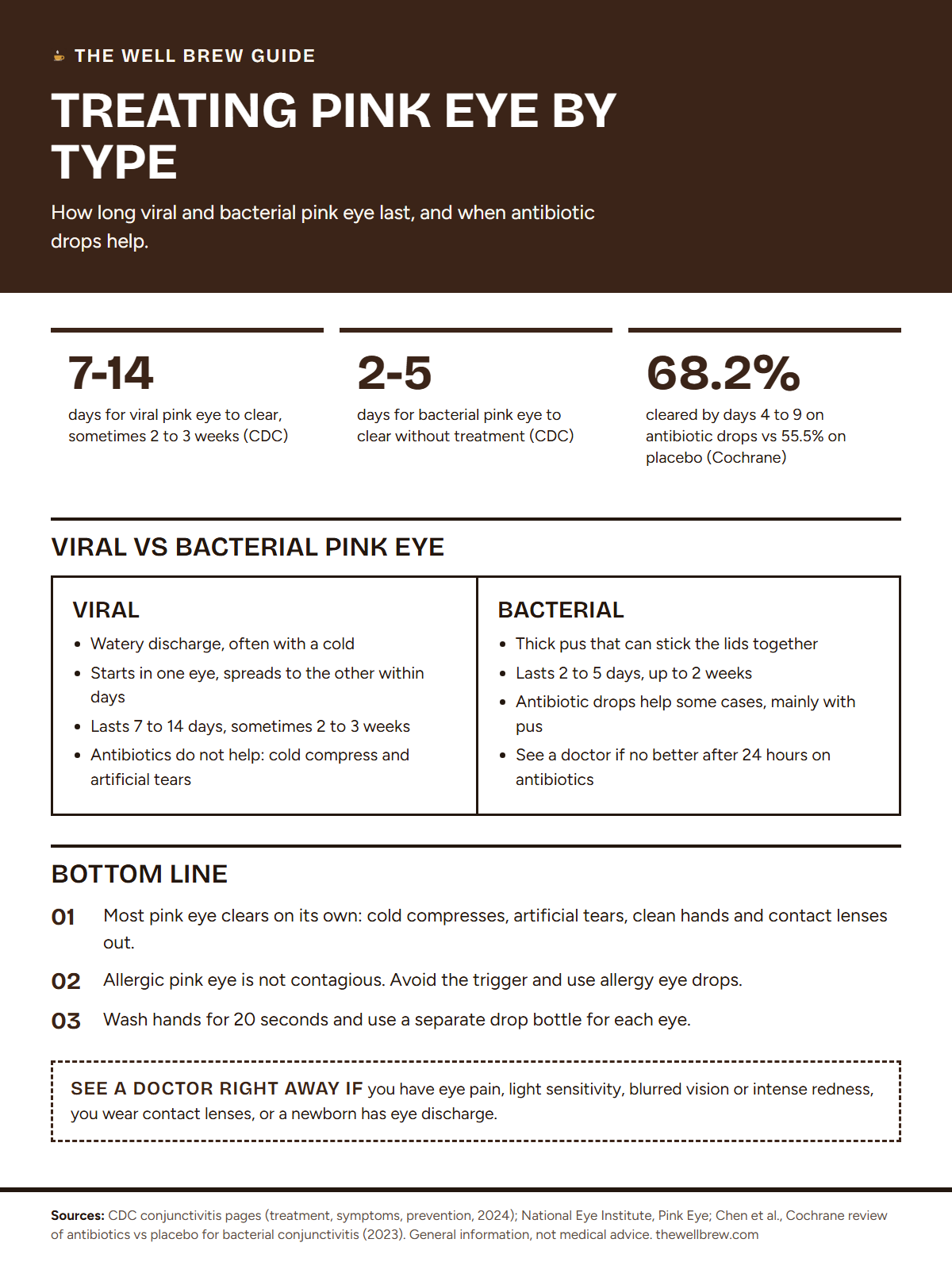
Most pink eye clears on its own, so care at home means cold compresses, artificial tears, clean hands and a break from contact lenses. Viral pink eye usually clears in 7 to 14 days and bacterial pink eye in 2 to 5 days, and antibiotic drops help only some bacterial cases.[1]
| What it is | Redness and swelling of the white of the eye or the inner eyelid, also called conjunctivitis[8] |
|---|---|
| Most common cause | Viruses; viral pink eye is the most common type[3] |
| Home care | Cold compresses and over-the-counter artificial tears[1] |
| How long it lasts | Viral: 7 to 14 days, sometimes 2 to 3 weeks or more. Bacterial: 2 to 5 days, up to 2 weeks[1] |
| When antibiotics help | Some bacterial cases, mainly with pus; never viral pink eye[1][9] |
| Contagious? | Viral and bacterial: very. Allergic: no[6][8] |
| See a doctor | Eye pain, light sensitivity, blurred vision, contact lens wear, a newborn, or a weak immune system[1][7] |
How to treat pink eye at home
Most pink eye is treated at home with cold compresses, artificial tears and careful hygiene, because the common viral type clears without medicine. The National Eye Institute says most cases go away on their own and you do not always need to see a doctor.[2] Here is what the CDC and NEI advise, step by step.
- Take out your contact lenses. Leave them out until your eye doctor says it is fine, or until all symptoms are gone if you did not see a doctor.[1]
- Use a cold compress. A clean washcloth soaked in cool water eases swelling and redness. Use a fresh one each time.[2]
- Add artificial tears. These over-the-counter lubricating drops ease dryness and the gritty feeling.[1]
- Clean off discharge 2 or 3 times a day. Wipe from around the eye with a clean, wet washcloth or a fresh cotton ball, then throw the cotton ball away.[3][5]
- Wash your hands for at least 20 seconds. Do it before and after you touch your eyes or put in drops. If there is no soap, use a hand sanitizer with at least 60% alcohol.[5]
- Keep one bottle per eye and share nothing. Do not use the same drop bottle for an infected and a healthy eye, and do not share towels, pillows or makeup.[5]
- Wash bedding and towels in hot water. Pillowcases, sheets, washcloths and towels go in hot water with detergent, and you wash your hands after handling them.[5]
- Watch the calendar. If symptoms do not ease after a few days of artificial tears and cold compresses, see a doctor.[2]
Once it clears, throw out any eye or face makeup, brushes and sponges you used while you were sick. Do the same with contact lenses, lens solution and lens cases you used during the infection.[3] A regular primary care doctor can treat most cases, so you may not need an eye specialist.[2] More eye guides sit in our eye health section.
Is your pink eye viral, bacterial or allergic?
Viral pink eye usually brings watery discharge and often comes with a cold, bacterial pink eye brings thick pus that glues the lids shut, and allergic pink eye causes intense itching in both eyes.[4] The three can look alike, so a doctor is the only one who can tell for sure.[3]
| Feature | Viral | Bacterial | Allergic |
|---|---|---|---|
| Discharge | Watery, not thick[4] | Thick pus, lids may stick together[4] | Teary eyes[4] |
| Eyes affected | Starts in one eye, spreads to the other within days[4] | One or both[4] | Usually both[4] |
| Other clues | Cold, flu or other respiratory infection[4] | Sometimes an ear infection[4] | Itchy nose, sneezing, scratchy throat[4] |
| Usual length | 7 to 14 days[1] | 2 to 5 days[1] | Improves once the allergen is gone[1] |
| Contagious | Very[6] | Very[6] | No[6] |
| Main treatment | Home care; antibiotics do not work[1] | Home care; antibiotic drops in some cases[1] | Avoid the trigger; allergy eye drops[1] |
A 2013 review in JAMA found the strongest signs of a bacterial cause were eyelids stuck together on waking, no itching, and no past history of pink eye.[10] Viral pink eye is the most common infectious type, and adenoviruses are among its most common causes.[6][10] Because viral pink eye so often travels with a cold, our guide to elderberry for colds and flu covers what the research says about the cold itself.
How long does pink eye last?
Viral pink eye usually clears in 7 to 14 days and bacterial pink eye in 2 to 5 days, though either one can hang on for 2 weeks or longer.[1] The NEI puts the overall figure at 7 to 10 days for many people.[3] How long yours lasts depends mostly on the cause.
- Viral pink eye lasts 1 to 2 weeks for most people, and sometimes 3 weeks or more. Antibiotics do not shorten it.[2]
- Bacterial pink eye lasts 2 to 5 days without treatment, but it can take 2 weeks to clear fully.[1] The JAMA review found most uncomplicated cases resolve within 1 to 2 weeks.[10]
- Allergic pink eye lasts as long as you are around the trigger and usually improves once the allergen is removed.[1]
- In newborns, irritation from the eye drops given at birth usually lasts only 24 to 36 hours.[7]
Antibiotics can shorten bacterial cases a little. In a 2006 trial of 307 patients in 30 English general practices, moderate symptoms lasted 4.8 days with no antibiotics and 3.3 days with immediate antibiotic drops.[12] If you start antibiotics for bacterial pink eye and see no improvement after 24 hours, the CDC says to go back to your doctor.[1]
Do you need antibiotic eye drops for pink eye?
Antibiotic drops do nothing for viral pink eye and give a modest benefit in bacterial pink eye, so many mild cases get better without them.[1][9] The CDC says mild bacterial pink eye may clear without antibiotics and without complications. When drops are used, they may shorten the infection, cut complications and reduce spread.[1]
| Study | Who and how many | Result | What it means |
|---|---|---|---|
| Cochrane review, 2023[9] | 21 trials, 8,805 people with bacterial pink eye | Cleared by days 4 to 9: 68.2% on antibiotic drops vs 55.5% on placebo | Drops help, but more than half got better without them |
| Jefferis pooled analysis, 2011[11] | 3 primary care trials, 622 patients | Cured at day 7: 80% with antibiotics vs 74% without | Small gain, mostly in people with pus |
| Everitt trial, 2006[12] | 307 adults and children, 30 practices | Moderate symptoms: 4.8 days with none, 3.3 days immediate, 3.9 days delayed | Waiting first gave a similar result with fewer prescriptions |
The Cochrane authors rated the gain in cure as moderate certainty, a 26% better chance of clearing than with placebo. People on antibiotics were also 27% less likely to have a lingering infection, and no serious side effects were reported.[9] In the Everitt trial, offering a delayed prescription cut antibiotic use to 53%, against 99% with an immediate one.[12]
The CDC lists the cases where antibiotics may be needed: pus in the eye, a weakened immune system, or when certain bacteria are suspected.[1] Contact lens wearers should get antibiotics.[6][10] Pink eye from chlamydia or gonorrhea needs antibiotics by mouth or injection as well as drops.[10] Pink eye from the herpes simplex or chickenpox (varicella-zoster) virus is treated with antiviral medicine.[1]
How do you treat allergic pink eye?
Allergic pink eye is treated by removing the trigger and using allergy eye drops, because it is not an infection and antibiotics play no part.[1] The CDC lists antihistamine and decongestant (vasoconstrictor) eye drops, some sold by prescription, and says a doctor may combine medicines when symptoms persist.[1]
Common triggers include pollen from trees, grasses and weeds, dust mites, animal dander, molds, cosmetics, and contact lenses or lens solution.[6] Allergic pink eye is more common in people with hay fever, asthma or eczema.[6] The JAMA review says it affects up to 40% of people, that itching is its most consistent sign, and that antihistamines and mast cell stabilizer drops ease symptoms.[10]
Irritants can cause a similar red eye. The NEI names chlorinated pool water, air pollution and makeup.[3] For these, removing the irritant and using cold compresses and artificial tears is the same first step as for allergies.[1][3] Allergic pink eye is not contagious, so you do not need to stay home from work or school for it.[6]
How long is pink eye contagious?
Viral and bacterial pink eye stay contagious while you have symptoms, and the CDC says to skip school or work with symptoms if your day involves close contact with others.[8] If you have no fever or other symptoms, you may be allowed back with your doctor’s approval.[8]
For doctors, the CDC advises staying home with viral or bacterial pink eye when there are signs of wider illness, especially if close contact cannot be avoided. People may return once a clinician approves and any needed treatment has started.[6] Schools and employers can set their own rules, so check yours.
Both infectious types spread mostly from hand to eye. The germs travel on hands and shared objects, and through tears, eye discharge and respiratory droplets.[6] The CDC also says not to use swimming pools while you have pink eye.[5]
No single vaccine guards against all pink eye. Vaccines against measles, rubella, chickenpox, shingles, pneumococcal disease and Hib cover some infections linked to it.[5]
When should you see a doctor for pink eye?
See a doctor for pink eye if you have eye pain, sensitivity to light, blurred vision that does not clear when you wipe away discharge, or intense redness.[1] The CDC lists them as complications of pink eye that can affect vision.[4]
See a doctor right away if:
- Your eye pain is moderate to severe[2]
- Light bothers you more than usual, or your vision is blurred[1]
- The redness is intense, or symptoms get worse[1]
- Bacterial pink eye has not improved after 24 hours of antibiotics[1]
- You have a weakened immune system, for example from HIV or cancer treatment[2]
- You wear contact lenses or recently scratched your eye[3]
- A newborn has discharge from the eye or puffy, red eyelids[3][8]
| If you notice | Then |
|---|---|
| Watery discharge, a cold, no pain, clear vision | Home care; expect 1 to 2 weeks[2] |
| Thick pus that sticks the lids together | Call a doctor and ask whether antibiotic drops make sense[1][4] |
| Itching in both eyes with sneezing | Avoid the trigger and try allergy eye drops[1] |
| Red eye while wearing contact lenses | Remove the lenses and get seen promptly[6] |
| Pain, light sensitivity or blurry vision | See a doctor right away[1] |
| Any eye discharge in a newborn | See a doctor right away[7] |
Contact lens wearers
Contact lens wearers with bacterial pink eye are at higher risk of bacterial keratitis, an infection of the cornea. The CDC tells doctors to have them remove their lenses, treat with antibiotic drops, and send them promptly to an ophthalmologist.[6] Throw away the lenses, solution and case you used while infected.[3]
Newborns
Newborns with any pink eye symptoms should see a doctor right away.[7] Gonococcal pink eye starts in the first 2 to 5 days of life, and chlamydial pink eye usually 5 to 12 days after birth. Untreated gonococcal infection can lead to corneal ulcers and blindness, so doctors give antibiotics by IV or injection.[7]
A red eye without discharge has other causes. A fluttering eyelid, for example, is covered in our guide to why your eye is twitching.
What do doctors use first for pink eye?
Doctors usually diagnose pink eye by looking at the eye and asking about your symptoms, and the first treatment depends on the cause.[1] Sometimes they take a sample from the eye and send it to a lab to find the type.[1]
For viral pink eye, care is supportive: compresses and artificial tears while it runs its course.[10] For bacterial pink eye, it is antibiotic drops or ointment when needed.[1] For allergic pink eye, it is antihistamine and mast cell stabilizer drops.[10] No supplement or home remedy replaces this care. Eye vitamins, such as the formula in our lutein and zeaxanthin AREDS2 guide, were studied for macular degeneration, not eye infections.
Pink eye care checklist
- Contact lenses out, and a fresh lens case once you recover[1][3]
- Cold compress and artificial tears for comfort[1]
- Discharge cleaned 2 or 3 times a day with a fresh cloth or cotton ball[3]
- Hands washed for 20 seconds before and after touching your eyes[5]
- Separate towels and pillowcases, washed in hot water[5]
- Old eye makeup thrown away[3]
- No pool swimming until it clears[5]
- A doctor visit if there is pain, light sensitivity, vision change, or no improvement after a few days[1][2]
Bottom line
Pink eye is one of the most common and treatable eye conditions, and most cases clear without a prescription.[8] Cold compresses, artificial tears, clean hands and no contact lenses cover the basics, while antibiotic drops help some bacterial cases by a modest margin.[1][9]
For most adults with watery, mildly crusty eyes and no pain, a week of home care is the better first step, because the most common type is viral and antibiotics cannot touch it.[1][3] Pain, light sensitivity, blurred vision, contact lens wear or a newborn with discharge all change the plan: see a doctor that day.[1][7]
Frequently asked questions
Can pink eye go away on its own?
Yes, usually. The National Eye Institute says most cases go away without treatment. Viral pink eye tends to clear in one to two weeks, and mild bacterial pink eye often clears in two to five days without antibiotics.
Can I wear contact lenses with pink eye?
No. The CDC says to stop wearing contacts until your eye doctor says it is fine, or until your symptoms are gone. Throw away the lenses, solution and case you used while your eye was infected.
Is a warm or cold compress better for pink eye?
Adult guidance from the CDC and NEI favors a cold compress, which eases swelling and redness. For newborns, the CDC notes a warm compress may relieve swelling and irritation. Use a clean cloth each time to avoid spreading germs.
Can I go swimming with pink eye?
The CDC advises against using swimming pools while you have pink eye, because viral and bacterial types spread easily. Chlorinated pool water can also irritate eyes and cause redness on its own, according to the National Eye Institute.
Should I throw away my makeup after pink eye?
Yes. The National Eye Institute advises throwing away eye and face makeup, brushes and sponges you used while you had pink eye, so the infection does not come back. Never share makeup or eye drops with anyone.
Sources
- How to Treat Pink Eye. CDC, 2024
- Treatment for Pink Eye. National Eye Institute, NIH, 2019
- Pink Eye. National Eye Institute, NIH, 2025
- Symptoms of Pink Eye. CDC, 2024
- How to Prevent Pink Eye. CDC, 2024
- Clinical Overview of Pink Eye (Conjunctivitis). CDC, 2024
- Pink Eye in Newborns. CDC, 2024
- About Pink Eye. CDC, 2024
- Antibiotics versus placebo for acute bacterial conjunctivitis (Chen et al.). Cochrane Database of Systematic Reviews, 2023
- Conjunctivitis: a systematic review of diagnosis and treatment (Azari, Barney). JAMA, 2013
- Acute infective conjunctivitis in primary care: who needs antibiotics? (Jefferis et al.). British Journal of General Practice, 2011
- A randomised controlled trial of management strategies for acute infective conjunctivitis (Everitt et al.). BMJ, 2006

Maya Ellison is the Reviews Editor at The Well Brew, a slow, plain-language supplement review blog for everyday adults. Maya reads each label in full, sets every dose beside the amounts used in human studies, grades the research with sources such as the NIH Office of Dietary Supplements and NCCIH, and works out the real cost and refund fine print. Maya has no medical credentials and is not a doctor, dietitian, nurse or pharmacist. Reviews give pros, cons and who a product suits, never scores. How we review supplements.
This article is general information, not medical advice. Dietary supplements are not reviewed by the FDA for safety or effectiveness before they are sold. Talk to your doctor before you start any supplement, especially if you are pregnant, nursing, take medication or have a health condition.