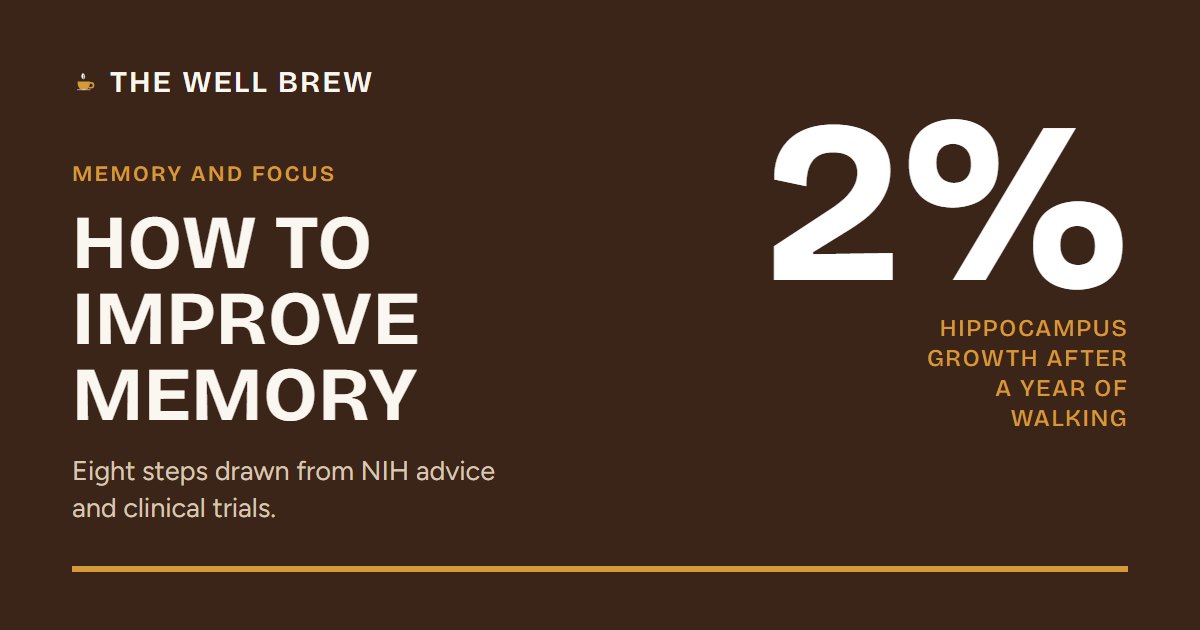
The best-tested ways to improve memory are regular aerobic exercise, 7 to 9 hours of sleep, testing yourself instead of rereading, staying social, and controlling blood pressure. In the FINGER and US POINTER trials, combining these habits gave older adults a small edge in thinking scores over 2 years. No supplement is recommended for preventing memory decline.
On this page
- How to improve memory: 8 steps backed by research
- How to improve memory retention when you study or learn?
- How to improve short term memory and concentration day to day?
- Does exercise improve memory?
- Can treating hearing loss and blood pressure protect your memory?
- What did the FINGER and POINTER trials find?
- Do memory loss supplements work?
- When should you see a doctor about memory loss?
- Where should you start? The bottom line
- FAQ
To work out how to improve memory with steps that hold up, we read the National Institute on Aging pages on cognitive health, forgetfulness and sleep, the NCCIH summary on memory supplements, MedlinePlus, and the published results of the FINGER, US POINTER, ACHIEVE and GEM trials, a one-year exercise trial and two landmark studies on how people learn. Our how we review page explains how we pick and weigh sources.
The short answer: the best-tested approach combines exercise, a healthy diet, mental challenge, social contact and control of blood pressure, and in the 1,260-person FINGER trial that mix gave a small but real edge in thinking scores over 2 years.[6]
| What memory is | The process of storing information and recalling it later; short-term memory holds it for a few seconds or minutes[4] |
|---|---|
| Best-tested approach | Combined lifestyle programs: exercise, diet, brain training and heart health checks, tested in FINGER and US POINTER[6][7] |
| Exercise target | At least 150 minutes of physical activity a week for adults[1] |
| Sleep target | Generally 7 to 9 hours a night for older adults[1] |
| Best study habit | Testing yourself beats rereading for long-term recall[10] |
| Supplements | The NIA recommends no vitamin or supplement for warding off Alzheimer’s or cognitive decline[1][5] |
| See a doctor if | You ask the same questions over and over, get lost in familiar places, or struggle with recipes or directions[2] |
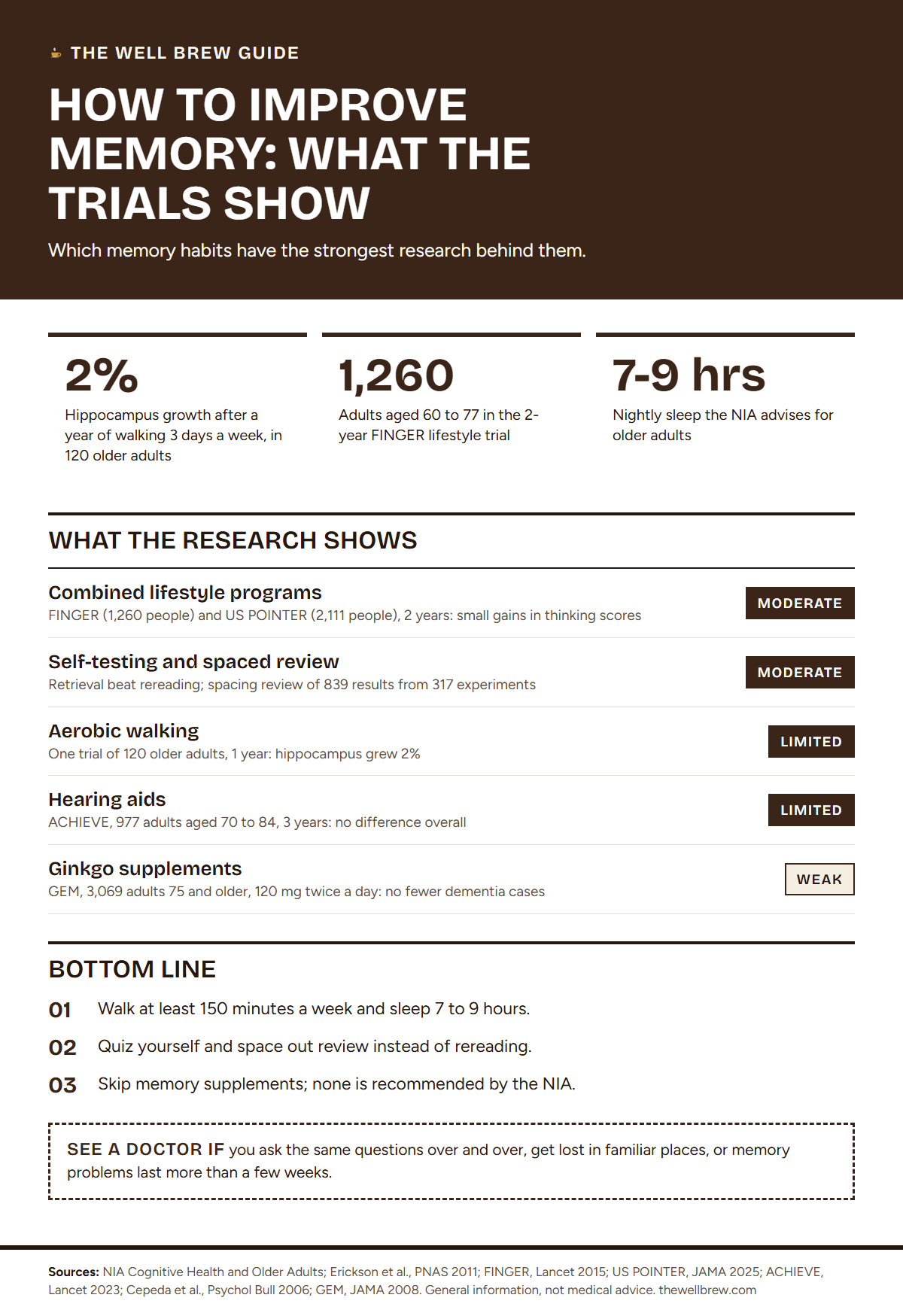
How to improve memory: 8 steps backed by research
The steps with the best support are moving more, sleeping 7 to 9 hours, testing yourself instead of rereading, staying social, and keeping blood pressure, hearing and medicines in check. Each one gives a small gain on its own, and the trials below found the clearest results when people kept up several habits together.[1][6][7]
We grade the evidence for each step in plain words. Moderate means several large trials or a large pooled review with a consistent effect. Limited means one or a few trials, or mixed results. Weak means trials found no benefit.
- Walk briskly most days. Work up to at least 150 minutes a week. In one trial, a year of walking 3 days a week grew the brain’s memory center by 2%.[1][8] Evidence: limited.
- Protect your sleep. Aim for 7 to 9 hours. Both deep sleep and dream sleep help you store memories.[1][3] Evidence: limited.
- Quiz yourself instead of rereading. Recall the material from memory, check it, and repeat. Repeated testing gave a large boost to later recall, while extra rereading did not.[10] Evidence: moderate.
- Space out your practice. Review over days, not in one sitting, and leave longer gaps when you need to remember for longer.[11] Evidence: moderate.
- Learn something hard and new. Older adults who learned quilting or digital photography had more memory gains than those who only socialized.[1] Evidence: limited.
- Stay in touch with people. Regular conversation and group activities were linked with better thinking in later life.[1] Evidence: limited.
- Get blood pressure and hearing checked. Treating high blood pressure lowered the risk of mild cognitive impairment in SPRINT MIND.[1] Hearing aids may help people at higher risk.[9] Evidence: limited.
- Review your medicines and alcohol. Allergy pills, sleep aids and several other drugs can cause confusion and memory loss in older adults.[1] Do not stop a prescription without talking to your doctor. Evidence: limited.
How to improve memory retention when you study or learn?
Retrieval practice, which means pulling information out of your memory instead of reading it again, is the most reliable way to make new learning stick. In a 2008 study in Science, students who kept testing themselves on foreign vocabulary remembered far more at a later test than students who kept restudying it.[10]
Students in the same study could not tell which method was working, since their own predictions of how much they would remember did not match their actual scores.[10] Self-testing can feel slower and still win.
Spacing is the second tool. A large review pooled 839 results from 317 experiments on spreading practice out over time.[11] It found that the best gap between study sessions grows with how long you need to keep the information. Cramming packs all the practice into one sitting, which leaves less time for that gap to work.
- Close the book and write down what you remember, then check it.
- Use flashcards and drop a card only after you get it right on several separate days.
- Review new material the next day, then a few days later, then a week or two later.
- Explain the idea out loud to someone else, which is another form of retrieval.
How to improve short term memory and concentration day to day?
Short-term memory holds information for only a few seconds or minutes, so the most useful daily fixes reduce how much you have to hold at once.[4] The National Institute on Aging suggests to-do lists, calendars and notes, a daily routine, and keeping your keys, wallet, phone and glasses in the same place every day.[2]
The NIA says both non-REM and REM sleep help you store memories, and poor sleep can lead to problems with memory.[3] Its cognitive health page sets the target at 7 to 9 hours a night.[1]
Big life changes, such as retiring or losing a spouse, can leave people confused or forgetful. The NIA notes these problems are usually temporary and ease as the stress fades.[2] It also advises getting help if you feel depressed for weeks at a time.[2]
A few daily habits help concentration:
- Do one task at a time and write the next step down before you switch.
- Say a new name out loud and use it once in the conversation.
- Limit alcohol, which the NIA lists among things that can affect memory.[2]
- Keep a single notebook or phone app for reminders instead of several.
If you also feel slow or foggy most days, a low vitamin B12 level is one of the causes the NIA lists.[2] Our guide to B12 deficiency symptoms and testing covers who is at risk.
Does exercise improve memory?
Aerobic exercise has some of the clearest trial evidence for memory: a year of brisk walking grew the hippocampus, the brain area that forms new memories, by about 2% in older adults.[8] The authors said that offset roughly 1 to 2 years of normal age-related shrinkage.[8]
The 2011 trial put 120 older adults without dementia into a walking group or a stretching group.[8] Walkers started at 10 minutes and built up to 40 minutes per session by week 7, 3 days a week, for a year.[8] Their spatial memory improved, while hippocampus volume fell in the stretching group.[8]
The NIA treats these results as encouraging but not final. It says more research is needed on what role exercise plays in preventing cognitive decline.[1] It still recommends at least 150 minutes of physical activity a week, and walking is a good start.[1] If you have not been active, check with your doctor before starting a vigorous program.[1]
Can treating hearing loss and blood pressure protect your memory?
Treating high blood pressure has trial support for lowering the risk of mild cognitive impairment, and hearing aids may help some older adults at higher risk. In SPRINT MIND, adults 50 and older who brought systolic blood pressure under 120 mmHg had a lower risk of mild cognitive impairment over five years of treatment.[1]
High blood pressure in midlife, from the 40s to the early 60s, is linked with more cognitive decline later on.[1] It often causes no symptoms you can see or feel, so a yearly check is the way to find it.[1] For the diet side, our guide to foods that lower blood pressure walks through the DASH trials.
The ACHIEVE trial gave 977 adults aged 70 to 84 with untreated hearing loss either hearing aids and counseling or health education sessions.[9] After 3 years, thinking scores fell by the same amount in both groups overall.[9] The researchers did see signs that hearing aids might slow decline in the subgroup at higher risk.[9] The NIA lists treating hearing and vision loss as part of caring for brain health.[1]
What did the FINGER and POINTER trials find?
Both large trials found that a structured mix of exercise, diet, brain training, social activity and heart health checks gave older adults at risk a small extra gain in thinking scores over 2 years. Neither tested a pill, and both measured thinking scores rather than dementia diagnoses.[6][7]
| Trial | Who and how long | What was tested | Result |
|---|---|---|---|
| FINGER, Finland, 2015 | 1,260 adults aged 60 to 77, 2 years | Diet, exercise, brain training and vascular checks vs general health advice | Small but significant gain in thinking scores; more side effects, mostly muscle and joint pain (7% vs 1%)[6] |
| US POINTER, 2025 | 2,111 adults aged 60 to 79, 2 years | Structured coached program vs self-guided program | Both groups improved; structured group gained 0.029 SD more per year[7] |
| Erickson, 2011 | 120 older adults, 1 year | Walking 3 days a week vs stretching | Hippocampus grew 2%; better spatial memory[8] |
| ACHIEVE, 2023 | 977 adults aged 70 to 84, 3 years | Hearing aids and counseling vs health education | No difference overall; possible benefit in higher-risk group[9] |
| GEM, 2008 | 3,069 adults 75 and older, median 6.1 years | Ginkgo 120 mg twice a day vs placebo | No reduction in dementia[12] |
In US POINTER, the self-guided group, who were encouraged to make the same changes on their own, also improved.[7] The structured group followed the MIND diet, moderate to high intensity exercise, mental challenges and social activities with more accountability, and gained a little more.[7]
Do memory loss supplements work?
The National Institute on Aging does not recommend any vitamin or supplement for warding off Alzheimer’s disease or cognitive decline.[1] The NCCIH says direct evidence is lacking that supplements protect against dementia, even though many are sold with claims that they boost memory.[5]
Here is what NCCIH found for the most common products:[5]
- Ginkgo biloba has no conclusive evidence that it stops or slows dementia or cognitive decline.
- Omega-3s show their most consistent link when measured as fish in the diet, but supplements have not been shown to help people who already have Alzheimer’s.
- Short-term B6, B12 and folic acid did not improve thinking in older adults, and too much B6 can cause serious side effects.
- Curcumin evidence is too limited and inconsistent, and most vitamin E findings have been negative.
The biggest test of a memory herb was GEM. It gave 3,069 adults aged 75 and older either 120 mg of ginkgo twice a day or a placebo for a median of 6.1 years.[12] Dementia developed in 277 people on ginkgo and 246 on placebo, so the herb did not help.[12] Our review of ginkgo biloba for memory covers that trial in more depth.
The NIA does note that recent trials found a daily multivitamin may improve memory and cognition in older adults.[1] The finding is modest and does not replace the habits above. The NCCIH also warns against using supplements as a reason to put off seeing a doctor about memory loss.[5]
When should you see a doctor about memory loss?
See a doctor when forgetfulness starts to get in the way of daily life, or when memory problems last more than a few weeks. Forgetting a name or misplacing keys now and then is a normal part of aging, but dementia is not.[2]
The NIA lists these signs that it is time to talk with a doctor:[2]
- Asking the same questions over and over
- Getting lost in places you used to know well
- Having trouble following recipes or directions
- Becoming more confused about time, people and places
- Not taking care of yourself, such as eating poorly, not bathing or behaving unsafely
Many causes of memory trouble can be treated. They include thyroid, kidney or liver problems, low vitamin B12, medicine side effects, depression and anxiety, sleep problems, alcohol misuse, and head injury.[2] Problems from conditions such as depression usually go away once the condition is treated.[2] MedlinePlus also lists stroke, blood clots and tumors in the brain among serious causes.[4]
Doctors usually start with tests and assessments to find the source of the problem, and may refer you to a neurologist.[2] If you take medicines such as antihistamines, sleep aids, muscle relaxants or bladder drugs, bring the full list, since these can affect thinking in older adults.[1] Our guide to the early signs of dementia vs normal forgetfulness explains how to tell the two apart.
Where should you start? The bottom line
For most adults, the best first step is a brisk walk on most days plus 7 to 9 hours of sleep, because those two habits have trial or NIH support and cost nothing.[1][8] If you are trying to learn something, swap rereading for self-testing spread over several days.[10][11] Add a yearly blood pressure check and a hearing test as you get older.[1][9]
We would skip memory supplements for now. The large ginkgo trial and the NCCIH review did not show that they protect memory, and they can delay a doctor visit for a cause that is treatable.[5][12] For more on brain health, see our memory and focus guides.
Frequently asked questions
Do brain training games improve memory?
In the ACTIVE trial, people trained in reasoning and speed of processing showed less decline over 10 years. The NIA says there is not enough evidence that commercial brain-training apps have the same effect, so treat app claims with caution.
Can stress or bottled-up emotions cause memory loss?
Stress and negative emotions can leave people confused or forgetful, especially after big life changes such as retirement or the death of a spouse. The NIA says these memory problems are usually temporary and improve as the stress and emotions fade.
Does the MIND diet improve memory?
Some observational studies link the Mediterranean and MIND diets with slower cognitive decline. But a clinical trial found people on the MIND diet had only small gains, similar to a control diet with mild calorie cuts, so the evidence is not conclusive.
Can low vitamin B12 cause memory problems?
Yes. The NIA lists low levels of important nutrients such as vitamin B12 among the factors that can cause memory problems. Memory problems from treatable conditions often improve once the cause is found and treated, so ask your doctor about testing.
How much sleep do you need for good memory?
The NIA advises older adults to get generally 7 to 9 hours of sleep a night. Both deep non-REM sleep and REM sleep help you store memories, and poor-quality sleep can lead to problems with memory.
Sources
- Cognitive Health and Older Adults. National Institute on Aging, NIH
- Memory Problems, Forgetfulness, and Aging. National Institute on Aging, NIH
- Sleep and Older Adults. National Institute on Aging, NIH
- Memory. MedlinePlus, National Library of Medicine
- 7 Things To Know About Dietary Supplements for Cognitive Function, Dementia, and Alzheimer's Disease. NCCIH, National Institutes of Health
- A 2 year multidomain intervention of diet, exercise, cognitive training, and vascular risk monitoring versus control to prevent cognitive decline in at-risk elderly people (FINGER). Ngandu et al., The Lancet, 2015
- Structured vs Self-Guided Multidomain Lifestyle Interventions for Global Cognitive Function: The US POINTER Randomized Clinical Trial. Baker et al., JAMA, 2025
- Exercise training increases size of hippocampus and improves memory. Erickson et al., PNAS, 2011
- Hearing intervention versus health education control to reduce cognitive decline in older adults with hearing loss (ACHIEVE). ACHIEVE Collaborative Research Group, The Lancet, 2023
- The critical importance of retrieval for learning. Karpicke and Roediger, Science, 2008
- Distributed practice in verbal recall tasks: A review and quantitative synthesis. Cepeda et al., Psychological Bulletin, 2006
- Ginkgo biloba for prevention of dementia: a randomized controlled trial (GEM). DeKosky et al., JAMA, 2008

Maya Ellison is the Reviews Editor at The Well Brew, a slow, plain-language supplement review blog for everyday adults. Maya reads each label in full, sets every dose beside the amounts used in human studies, grades the research with sources such as the NIH Office of Dietary Supplements and NCCIH, and works out the real cost and refund fine print. Maya has no medical credentials and is not a doctor, dietitian, nurse or pharmacist. Reviews give pros, cons and who a product suits, never scores. How we review supplements.
This article is general information, not medical advice. Dietary supplements are not reviewed by the FDA for safety or effectiveness before they are sold. Talk to your doctor before you start any supplement, especially if you are pregnant, nursing, take medication or have a health condition.