To prevent kidney stones, drink enough fluid, mostly water, to pass at least 2 liters of urine a day, about six to eight 8-ounce glasses. Keep sodium under 2,300 mg, eat less animal protein, and keep normal calcium from food. In a 5-year trial, more water cut repeat stones from 27 of 100 people to 12 of 99. Your stone type guides the rest.
On this page
- How to prevent kidney stones: 8 steps from NIH and trials
- How much water should you drink to prevent kidney stones?
- What foods cause kidney stones?
- Should you avoid calcium if you get kidney stones?
- How do you prevent each type of kidney stone?
- Does lemon juice or citrate help prevent kidney stones?
- Can vitamin C or calcium supplements cause kidney stones?
- What do doctors recommend first to prevent kidney stones?
- How do you treat kidney stones, and when should you see a doctor?
- Kidney stone prevention checklist and bottom line
- FAQ
How to prevent kidney stones depends partly on daily habits and partly on tests your doctor can run if you have already had a stone. We read the NIDDK kidney stone pages, the American College of Physicians (ACP) guideline, two Italian randomized trials and three large Harvard cohort studies to put this guide together. Our review process explains how we pick sources.
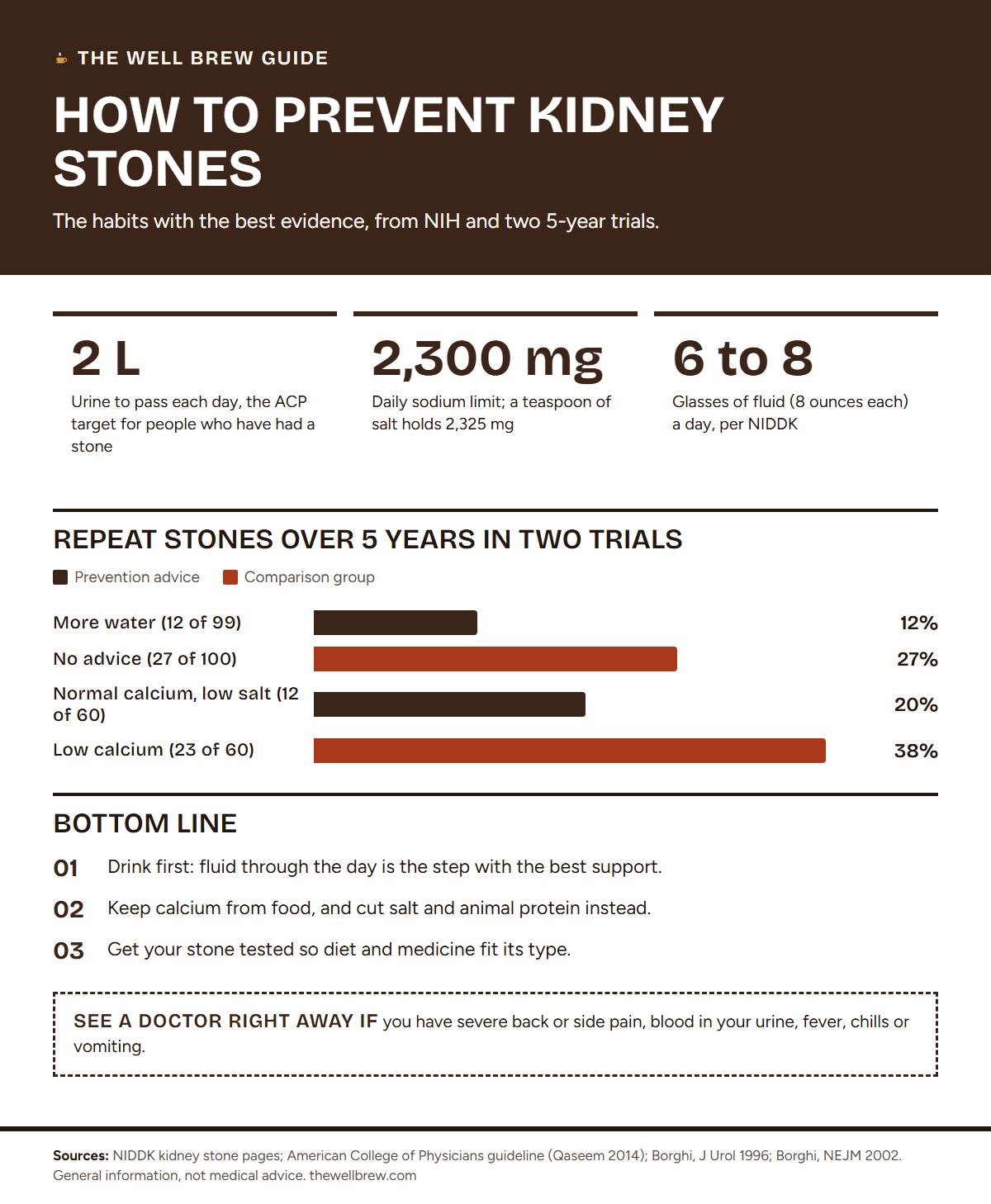
For most people, the answer is to drink enough fluid, mostly water, to make at least 2 liters of urine a day, keep sodium under 2,300 mg, and get normal amounts of calcium from food.[7][1]
| What a stone is | A hard, pebble-like piece of minerals that forms in the kidney when urine holds too much calcium, oxalate, uric acid or other substances[3] |
|---|---|
| How common | About 11% of US men and 6% of US women get at least one[3] |
| Main habit | Fluid spread through the day to pass at least 2 liters of urine; NIDDK suggests six to eight 8-ounce glasses[7][1] |
| Diet | Less sodium (under 2,300 mg a day), less animal protein, normal calcium from food, and less oxalate if you form calcium oxalate stones[1] |
| Best evidence | A 5-year trial: 12 of 99 people told to drink more water had a new stone, against 27 of 100 who were not[8] |
| Medicines | Thiazide diuretics, citrate or allopurinol when fluid alone does not work[7] |
| Caution | High-dose vitamin C supplements were linked to more stones in men[12] |
How to prevent kidney stones: 8 steps from NIH and trials
The steps that matter most are more fluid, less salt, less animal protein and normal food calcium, then a diet matched to your stone type. NIDDK calls fluid “the most important thing you can do,” and the ACP guideline puts it first for anyone who has had a stone.[1][7]
- Drink to a urine target. Aim to pass at least 2 liters of urine a day. For most people that means six to eight 8-ounce glasses of fluid, more in heat or with exercise.[7][2]
- Spread it out. The ACP advises fluid “spread throughout the day,” not all at once.[7]
- Cut sodium below 2,300 mg a day. One teaspoon of table salt holds 2,325 mg.[1]
- Trim animal protein. Swap some meat, eggs and fish for beans, dried peas and lentils.[1]
- Keep calcium in your meals. Food calcium binds oxalate in the gut, so cutting it can backfire.[1][9]
- Find out your stone type. Catch a passed stone so a lab can test it, and ask for a 24-hour urine test.[2]
- Eat in a DASH style. More fruit, vegetables, legumes and low-fat dairy was tied to fewer stones.[11]
- Check your supplements and medicines. High-dose vitamin C, calcium pills and some drugs can raise risk.[12][5][3]
These steps are general. If you have kidney failure or a bladder problem that limits fluid, ask your doctor for a target first.[2] You can browse more guides in our kidney and bladder health section.
How much water should you drink to prevent kidney stones?
Most adults should drink six to eight 8-ounce glasses of fluid a day, enough to pass at least 2 liters of urine. NIDDK gives the glass count, and the ACP sets the urine goal because urine output is what dilutes the minerals that form crystals.[1][7]
The best trial behind this advice ran in Parma, Italy. Researchers followed 199 people after their first calcium stone for 5 years. Half were told to drink more water, with no diet change. Stones came back in 12 of 99 people in the water group (about 12%) and 27 of 100 in the control group (27%).[8] The water group also went longer before a relapse.
Fluid needs rise in hot weather and with exercise, since sweat takes water that would otherwise become urine.[2] People who formed cystine stones may need even more.[2] Water is the best choice, but other drinks count. For a wider look at daily needs, see our guide on how much water you should drink a day.
The ACP rated its fluid advice as a weak recommendation based on low-quality evidence, mostly because few trials exist.[7] Even so, it costs little and is safe for most people, which is why it comes first.
What foods cause kidney stones?
No single food causes a stone, but diets high in sodium, animal protein and, for some people, oxalate raise the risk. NIDDK lists these as the main things to change, with the details depending on your stone type.[1] Large cohort studies point the same way.
In a study of 45,619 men followed for 4 years, those eating the most animal protein had a 33% higher risk of a first stone (relative risk 1.33), while those drinking the most fluid had a lower risk (relative risk 0.71).[10] This was an observational study, so it shows links rather than proof.
Here is what NIDDK suggests limiting:[1]
- Sodium: canned soups and vegetables, lunch meats, fast food, packaged snacks and many condiments.
- Animal protein: beef, chicken, pork (especially organ meats), eggs, fish, shellfish and dairy, within the protein you still need.
- High-oxalate foods (for calcium oxalate stones): nuts and nut products, peanuts, rhubarb, spinach and wheat bran.
You still need enough protein, so the aim is to shift some of it toward plants. Our guide to how much protein you should eat daily gives grams by body weight. On a food label, 5% of the Daily Value for sodium or less is low, and 20% or more is high.[1]
Should you avoid calcium if you get kidney stones?
No. Calcium from food does not raise the risk of calcium oxalate stones, and cutting it can make things worse. NIDDK says calcium in the right amounts “can block other substances in the digestive tract that may cause stones.”[3][1] It binds oxalate in the gut so less reaches the urine.
A 2002 trial in the New England Journal of Medicine tested this directly. It enrolled 120 men with repeat calcium oxalate stones and high urine calcium. One group ate a normal-calcium diet with less animal protein (52 g a day) and less salt. The other ate the old low-calcium diet. After 5 years, 12 of 60 men on the normal-calcium diet (20%) had a relapse, compared with 23 of 60 on the low-calcium diet (about 38%). The relative risk was 0.49.[9] Urine oxalate went up on the low-calcium diet and down on the other.
Earlier, the Harvard study of 45,619 men found that the highest calcium intake from food was tied to a lower stone risk than the lowest intake (relative risk 0.56).[10]
Adults need 1,000 to 1,200 mg of calcium a day, depending on age and sex.[5] NIDDK suggests low-oxalate sources such as calcium-fortified juices, cereals and breads, some vegetables and some beans.[1]
How do you prevent each type of kidney stone?
Prevention depends on what your stone is made of, so the first step after a stone is to have it tested. NIDDK describes four main types. Calcium stones, mostly calcium oxalate, are the most common.[3] Your doctor can send a passed or removed stone to a lab.[2]
| Stone type | What drives it | Diet and lifestyle | Medicines a doctor may use |
|---|---|---|---|
| Calcium oxalate | Too much calcium or oxalate in urine; often runs in families[3] | Fluid, less sodium and animal protein, food calcium, fewer high-oxalate foods[1] | Potassium citrate, thiazide diuretics[2] |
| Calcium phosphate | Too much calcium in urine[3] | Fluid, less sodium and animal protein, food calcium[1] | Potassium citrate, thiazide diuretics[2] |
| Uric acid | Urine that is too acidic; lots of meat, fish and shellfish[3] | Fluid, less animal protein, weight loss if overweight[1] | Allopurinol, potassium citrate[2] |
| Struvite | Follows a urinary tract infection; can grow fast[3] | Prompt care for urinary infections[3] | Antibiotics, acetohydroxamic acid[2] |
| Cystine | Cystinuria, an inherited disorder[3] | Fluid is the key change, often more than usual[1][2] | Mercaptopropionyl glycine, potassium citrate[2] |
Struvite antibiotics may run for 1 to 6 weeks or longer, while potassium citrate is often taken 1 to 3 times a day for months.[2]
Does lemon juice or citrate help prevent kidney stones?
Citrate in urine helps stop crystals from growing into stones, and citrus drinks add some. NIDDK notes that some studies show lemonade and orange juice protect against stones because they contain citrate, though it calls water the best drink.[2]
The stronger evidence is for prescription potassium citrate, which raises both citrate and pH in urine. The ACP lists citrate as one of the first-choice medicines when more fluid alone has not stopped new stones.[7][2] A doctor sets the dose after urine tests, so it is not something to replace with a store-bought product.
We could not find a reliable government source that gives a set amount of lemon juice to drink, so we do not suggest one. Sugary lemonade adds calories. If you like citrus, a squeeze of lemon in water can help you drink more, and drinking more has the best support.[1]
Can vitamin C or calcium supplements cause kidney stones?
High-dose vitamin C supplements were linked to more kidney stones in men, and calcium pills may raise risk in some people. The NIH Office of Dietary Supplements says high vitamin C intake can raise oxalate in urine, though study results conflict.[6]
The largest look came from Harvard cohorts with 156,735 women and 40,536 men followed for about 11 years, with 6,245 new stones. Men taking 1,000 mg or more of total vitamin C a day had a 43% higher risk (hazard ratio 1.43). For supplements alone at that dose, the hazard ratio was 1.19. Women showed no clear link, and vitamin C from food was not tied to stones.[12] The adult upper limit for vitamin C is 2,000 mg a day.[6]
Calcium works differently in pills than in food. In the Women’s Health Initiative, 1,000 mg of supplemental calcium a day for 7 years was linked to more kidney stones, though two later reviews of trials found no such link.[5] If you need calcium pills for bone health, ask your doctor how to take them; our calcium and vitamin D for osteoporosis guide covers the trade-offs.
Some medicines also raise risk over time, including diuretics, calcium-based antacids, the HIV drug indinavir and the seizure drug topiramate.[3] Never stop a prescribed medicine on your own.
What do doctors recommend first to prevent kidney stones?
Doctors start with more fluid, then add one medicine if stones keep forming. The ACP guideline, written for adults with at least one prior stone, recommends fluid to make at least 2 liters of urine a day. If that fails, it advises a single drug: a thiazide diuretic, citrate or allopurinol.[7]
Before choosing a drug, a doctor will usually test the stone and may order a 24-hour urine collection. That test measures how much urine you make and the minerals in it.[2] People with hyperparathyroidism, which raises blood calcium, may need surgery on the parathyroid gland.[2]
| Study | Who and how long | What was tested | Result |
|---|---|---|---|
| Borghi, J Urol 1996 (trial)[8] | 199 first-time calcium stone formers, 5 years | High water intake vs no advice | New stones in 12 of 99 vs 27 of 100 |
| Borghi, NEJM 2002 (trial)[9] | 120 men with repeat stones, 5 years | Normal calcium, less salt and protein vs low calcium | Relapse 12 of 60 vs 23 of 60; relative risk 0.49 |
| Curhan, NEJM 1993 (cohort)[10] | 45,619 men, 4 years, 505 stones | Food calcium, protein, fluid | Most food calcium: relative risk 0.56 |
| Taylor, JASN 2009 (cohort)[11] | Three cohorts, 5,645 stones | DASH-style eating | Relative risk 0.55 to 0.60 in top vs bottom fifth |
| Ferraro, AJKD 2016 (cohort)[12] | 156,735 women and 40,536 men, about 11 years | Vitamin C intake | Men at 1,000 mg or more: hazard ratio 1.43 |
Only the first two are randomized trials. The cohort studies show links, which is why we describe them as supporting evidence. The DASH study followed 45,821 men, 94,108 older women and 101,837 younger women; we explain the eating pattern in foods that lower blood pressure.[11] Kidney stone medicines can cause side effects, which grow more likely at higher doses and over longer use.[2]
How do you treat kidney stones, and when should you see a doctor?
Small stones often pass on their own with fluids and pain relief, while large or blocking stones need a urologist. Treatment depends on the stone’s size, location and type.[2] Options include shock wave lithotripsy, ureteroscopy and, for large stones, percutaneous nephrolithotomy through a small cut in the back.[2]
Untreated stones can lead to blood in the urine, severe pain, urinary infections and loss of kidney function, so do not wait out bad symptoms.[3] See a doctor right away if you have:[4]
- Extreme pain in your back or side that will not go away
- Blood in your urine
- Fever and chills
- Vomiting
- Urine that smells bad or looks cloudy
- A burning feeling when you urinate
If you are vomiting and dehydrated, you may need IV fluids in a hospital.[2] Pregnant people, those with one kidney and anyone with kidney disease should ask their doctor before changing fluid or diet targets. Having one stone raises the odds of another, and a family history raises risk too.[3]
Kidney stone prevention checklist and bottom line
- Drink six to eight 8-ounce glasses of fluid a day, more in hot weather or when you sweat.[1]
- Keep sodium under 2,300 mg a day and read the %DV on labels.[1]
- Replace some meat, eggs and fish with beans, dried peas and lentils.[1]
- Eat calcium-rich foods with meals instead of cutting calcium.[1][9]
- If your stones were calcium oxalate, go easy on spinach, rhubarb, nuts, peanuts and wheat bran.[1]
- Skip high-dose vitamin C pills unless a doctor advises them.[12]
- Save any stone you pass and ask about a 24-hour urine test.[2]
For most people, the best first step is simply drinking more water, spread through the day. It is the one habit with a 5-year trial behind it, and NIDDK advises it for every stone type.[8][1]
If you have had more than one stone, ask for stone and urine testing before trying diet changes on your own. A plan built on your stone type, plus a medicine if needed, is more likely to work than a general list.[7][2]
Frequently asked questions
How do you treat kidney stones at home?
Small stones often pass on their own. NIDDK says a doctor may advise plenty of fluids and pain medicine, and ask you to catch the stone for lab testing. Severe pain, fever, vomiting or blood in the urine needs care right away.
Can kidney stones come back after you pass one?
Yes. NIDDK says you are more likely to get another stone once you have had one. In a 5-year Italian trial, 27 of 100 people with no extra water advice had a new stone, which is why prevention starts after the first.
Is coffee or tea bad for kidney stones?
NIDDK does not list coffee or tea as drinks to avoid, and it says liquids other than water also count. Water is still the best choice. If you form calcium oxalate stones, ask a dietitian about your total oxalate intake.
Does losing weight lower kidney stone risk?
NIDDK says being overweight raises the risk of kidney stones, and that losing weight is especially important for people who have had uric acid stones. A dietitian can help you plan meals that also keep sodium and animal protein in check.
Do kidney stones run in families?
They can. NIDDK says a family history raises your risk, and that hypercalciuria, a family trait of high urine calcium, is the most common condition found in calcium stone formers. Cystine stones come from an inherited disorder called cystinuria.
Sources
- Eating, Diet, and Nutrition for Kidney Stones. NIDDK, NIH
- Treatment for Kidney Stones. NIDDK, NIH
- Definition and Facts for Kidney Stones. NIDDK, NIH
- Kidney Stones. MedlinePlus, National Library of Medicine
- Calcium: Fact Sheet for Health Professionals. NIH Office of Dietary Supplements
- Vitamin C: Fact Sheet for Health Professionals. NIH Office of Dietary Supplements
- Dietary and pharmacologic management to prevent recurrent nephrolithiasis in adults: a clinical practice guideline from the American College of Physicians. Qaseem A et al, Annals of Internal Medicine, 2014
- Urinary volume, water and recurrences in idiopathic calcium nephrolithiasis: a 5-year randomized prospective study. Borghi L et al, Journal of Urology, 1996
- Comparison of two diets for the prevention of recurrent stones in idiopathic hypercalciuria. Borghi L et al, New England Journal of Medicine, 2002
- A prospective study of dietary calcium and other nutrients and the risk of symptomatic kidney stones. Curhan GC et al, New England Journal of Medicine, 1993
- DASH-style diet associates with reduced risk for kidney stones. Taylor EN et al, Journal of the American Society of Nephrology, 2009
- Total, dietary, and supplemental vitamin C intake and risk of incident kidney stones. Ferraro PM et al, American Journal of Kidney Diseases, 2016

Maya Ellison is the Reviews Editor at The Well Brew, a slow, plain-language supplement review blog for everyday adults. Maya reads each label in full, sets every dose beside the amounts used in human studies, grades the research with sources such as the NIH Office of Dietary Supplements and NCCIH, and works out the real cost and refund fine print. Maya has no medical credentials and is not a doctor, dietitian, nurse or pharmacist. Reviews give pros, cons and who a product suits, never scores. How we review supplements.
This article is general information, not medical advice. Dietary supplements are not reviewed by the FDA for safety or effectiveness before they are sold. Talk to your doctor before you start any supplement, especially if you are pregnant, nursing, take medication or have a health condition.