The main way to reverse fatty liver is gradual weight loss. Losing 3% to 5% of your body weight can cut liver fat, and 7% to 10% may be needed to reduce inflammation and scarring. Exercise about 150 minutes a week, cut back on sugary drinks and alcohol, and get diabetes treated. Two drugs are approved only for the inflamed form with scarring.
On this page
- How to reverse fatty liver: 7 steps that have evidence
- Can fatty liver disease be reversed?
- How much weight do you need to lose to reverse fatty liver disease?
- What should you eat to reduce fatty liver naturally?
- How much exercise do you need to reduce fatty liver?
- Do you need to stop drinking alcohol if you have fatty liver?
- How does diabetes control help reverse fatty liver?
- What medicines do doctors use for fatty liver?
- Does coffee or any supplement help fatty liver?
- FAQ
To write this guide on how to reverse fatty liver, we read the NIDDK pages on fatty liver disease, the MedlinePlus health topic, the 2023 American Association for the Study of Liver Diseases (AASLD) practice guidance, two FDA drug approvals, and five clinical studies, from a 2010 vitamin E trial to a 2025 semaglutide trial. Our method is on the how we review page.
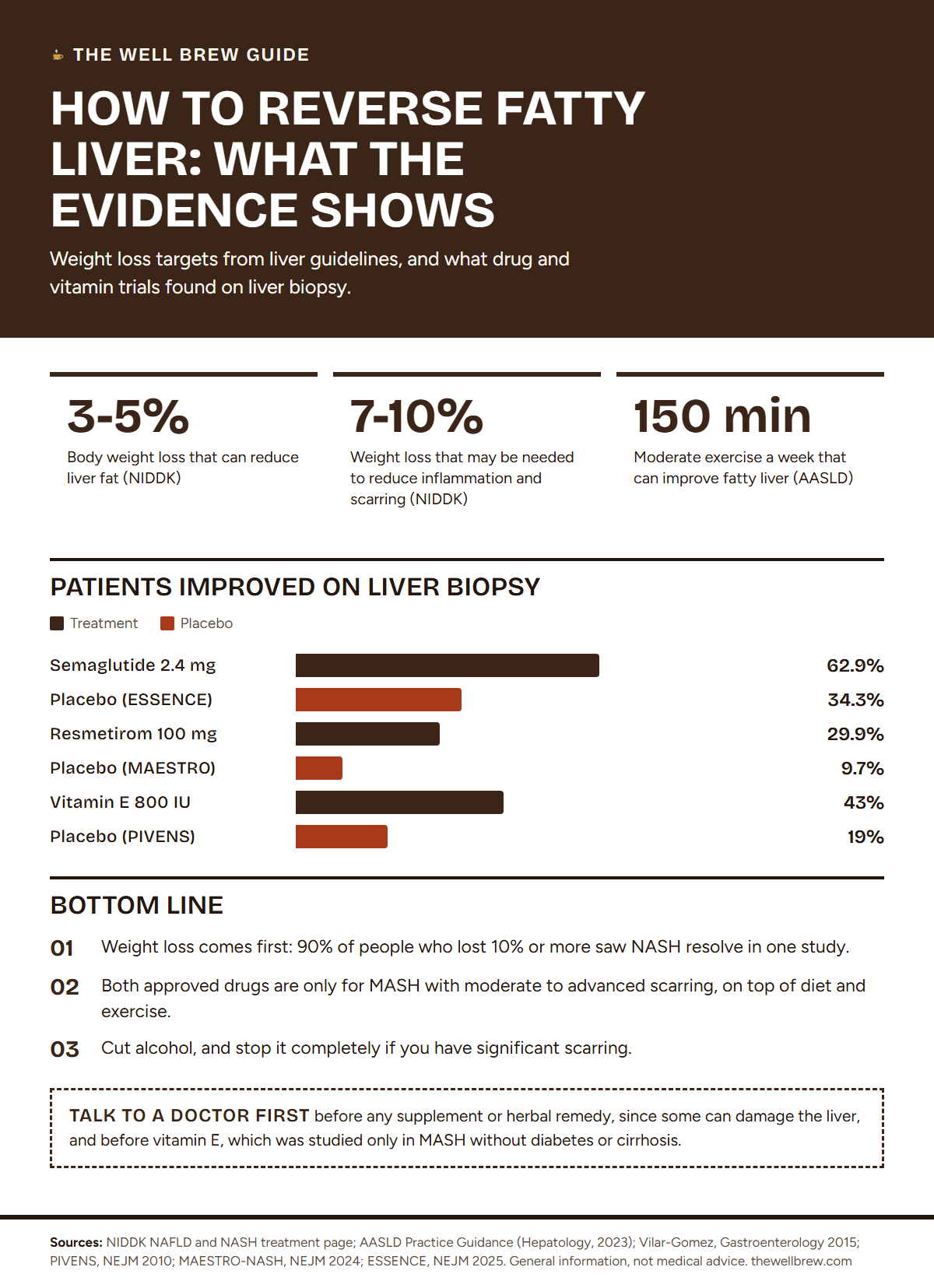
Gradual weight loss is the main way to reverse fatty liver: losing 3% to 5% of your body weight can reduce liver fat, and 7% to 10% may be needed to calm inflammation and scarring [1].
| What it is | Extra fat in the liver not caused by heavy drinking, now called MASLD (formerly NAFLD). The inflamed form is MASH [2] |
|---|---|
| How common | About 24% of U.S. adults have it, and 1.5% to 6.5% have the inflamed form [2] |
| First step | Weight loss through healthier food choices, smaller portions and activity [1] [4] |
| Weight loss targets | 3% to 5% to cut liver fat, 7% to 10% to improve inflammation and fibrosis [1] |
| Exercise | About 150 minutes of moderate activity a week; it helps even without weight loss [5] |
| Medicines | Resmetirom (2024) and semaglutide (2025) are FDA approved only for MASH with moderate to advanced scarring [8] [10] |
| Who should check first | Anyone with diabetes, scarring or cirrhosis, and anyone thinking about supplements, since some herbal remedies can harm the liver [1] [5] |
How to reverse fatty liver: 7 steps that have evidence
To reverse fatty liver, lose weight slowly, move most days, cut sugary drinks and alcohol, and get diabetes and cholesterol under control with your doctor. These are the steps the NIDDK and the AASLD guidance put first [1] [5]. The list runs roughly from the first visit to ongoing care.
- Get a baseline. Ask your doctor for liver blood tests and, if needed, an imaging test that checks for fat and scarring [4].
- Set a weight goal of 3% to 5% first, then 7% to 10% if you have inflammation or scarring [1].
- Lose it gradually. Rapid weight loss and malnutrition can make liver disease worse [1].
- Cut sweetened soft drinks, sports drinks, sweet tea and juice, which are major sources of fructose [3].
- Build up to 150 minutes of moderate exercise a week [5].
- Drink less alcohol, and stop completely if you have significant scarring [3] [5].
- Treat what feeds the liver fat: type 2 diabetes, high blood pressure, and high cholesterol or triglycerides [2] [4].
If you have prediabetes, our guide to the prediabetes A1C range and how to lower it covers the same habits from the blood sugar side.
Can fatty liver disease be reversed?
Yes, in many people. Simple fatty liver usually improves when fat leaves the liver, and even the inflamed form, MASH, can resolve with enough weight loss. Cirrhosis, the late stage, means the liver is scarred and permanently damaged [2].
Fatty liver disease has two main forms. In simple fatty liver there is fat but little or no inflammation, and it typically does not progress to liver damage [2]. In MASH there is inflammation and cell damage, which can cause fibrosis, or scarring [2] [4].
The best data on reversal come from a 2015 study of 293 people with biopsy-proven NASH in Havana, Cuba. After 52 weeks of lifestyle change, 90% of those who lost 10% or more of their weight had their NASH resolve, and 45% saw scarring regress [6].
Most people have no symptoms, so the condition is often found by chance on a blood test or scan, and acting at that stage gives you the most room to improve [4].
How much weight do you need to lose to reverse fatty liver disease?
Losing at least 3% to 5% of your body weight can reduce liver fat, and you may need to lose 7% to 10% to reduce inflammation and fibrosis. That is the NIDDK guidance [1]. The 2023 AASLD guidance says more than 10% is generally needed to improve MASH and scarring [5].
In the Cuban study, 58% of people who lost 5% or more saw their NASH resolve. Only 30% of the group reached that 5% mark, which shows how hard it is [6]. The AASLD guidance notes that 10% or fewer patients reach effective weight loss at 1 year [5].
A worked example: your weight loss targets
| Starting weight | 3% (less liver fat) | 5% | 7% to 10% (inflammation and scarring) |
|---|---|---|---|
| 180 lb | 5.4 lb | 9 lb | 12.6 to 18 lb |
| 220 lb | 6.6 lb | 11 lb | 15.4 to 22 lb |
| 260 lb | 7.8 lb | 13 lb | 18.2 to 26 lb |
Percentages follow the NIDDK targets [1].
How to reduce fatty liver quickly, and why slower is safer
The NIDDK says doctors recommend losing weight gradually, because rapid weight loss and malnutrition can make liver disease worse [1]. MedlinePlus also lists rapid weight loss as a risk factor for fatty liver [4]. Crash diets, juice fasts and liver detox products do not appear in any guideline we read.
What should you eat to reduce fatty liver naturally?
Eat fewer calories, fewer simple sugars and less saturated fat, and more fruit, vegetables, whole grains and unsaturated fats. The NIDDK lists these changes for people with fatty liver [3].
- Swap saturated and trans fats for unsaturated fats, especially omega-3 fats such as those in fish [3].
- Choose low-glycemic foods, such as most fruits, vegetables and whole grains, over white bread, white rice and potatoes [3].
- Avoid sweetened drinks and foods high in simple sugars, especially fructose. Table sugar breaks down into fructose too [3].
- Limit salt and sugar while eating lots of fruit, vegetables and whole grains [4].
Which diet is best? The AASLD guidance says low-carb, low-fat, intermittent fasting and Mediterranean diets appear comparable at improving fatty liver [5]. The Mediterranean diet is often recommended because it is sustainable and helps the heart [5]. Heart health deserves weight here, since heart disease is the most common cause of death in people with fatty liver [2].
For meal ideas built on the same foods, see our anti-inflammatory diet foods and meal ideas.
How much exercise do you need to reduce fatty liver?
Aim for about 150 minutes of moderate exercise a week, spread over at least 5 days. The AASLD guidance says this amount, or adding more than 60 minutes a week to what you do now, can prevent or improve fatty liver [5].
Exercise helps even if the scale does not move. The NIDDK says physical activity alone, even without weight loss, is beneficial [1], and the AASLD guidance says exercise has liver and heart benefits independent of weight loss [5].
More effort may be needed for the inflamed form. Some studies suggest more vigorous exercise is needed to improve MASH, and higher intensity still to reduce scarring [5]. Diet and exercise together cut liver fat in proportion to the weight lost [5]. Brisk walking, cycling, swimming and strength work all count, so choose the one you will keep doing.
Do you need to stop drinking alcohol if you have fatty liver?
Cut back in all cases, and stop completely if you have significant scarring. The NIDDK says people with fatty liver should minimize alcohol, which can further damage the liver [3]. The AASLD guidance says patients with clinically significant fibrosis (stage F2 or higher) should not drink at all [5].
Moderate drinking still carries risk. The AASLD guidance defines moderate as 21 to 39 grams a day for women and 31 to 59 grams for men, and says it raises the chance of advanced fibrosis, especially with obesity or type 2 diabetes [5]. Obesity and alcohol together raise the risk of cirrhosis, liver cancer and death from liver disease [5].
If you find it hard to cut back, MedlinePlus notes that counseling, recovery programs and medicines can help [4].
How does diabetes control help reverse fatty liver?
Type 2 diabetes and fatty liver often travel together, so better blood sugar control is part of liver care. One-third to two-thirds of people with type 2 diabetes have fatty liver [2], and the liver disease is more common with prediabetes, high blood pressure and high cholesterol or triglycerides [4].
The AASLD guidance lists several diabetes medicines with liver benefits. Pioglitazone improves liver fat and inflammation but can cause weight gain. Semaglutide, a GLP-1 drug, improves liver fat and helps weight loss [5]. Which one fits you is a decision for your doctor.
Our guide to normal blood sugar levels by age explains fasting and A1C targets in plain terms.
What medicines do doctors use for fatty liver?
Lifestyle change comes first for everyone. Two drugs are now FDA approved, but only for MASH with moderate to advanced scarring, not for simple fatty liver. The first step in treating MASLD is usually weight loss [4].
- Resmetirom (Rezdiffra) was approved March 14, 2024 for adults with MASH and moderate to advanced fibrosis without cirrhosis, used along with diet and exercise [8].
- Semaglutide (Wegovy) was approved in 2025 for the same group, also alongside lifestyle changes [10].
- Vitamin E and pioglitazone are used by some doctors in selected patients under the AASLD guidance, without an FDA approval for this use [5].
- Bariatric surgery is an option for people who qualify; NASH resolved in 80% of patients 1 year after surgery in one follow-up study [5].
What the trials found
| Study | Who and how long | Treatment | Result |
|---|---|---|---|
| Vilar-Gomez, 2015 | 293 adults with NASH, 52 weeks | Lifestyle weight loss | NASH resolved in 90% of those who lost 10% or more [6] |
| PIVENS, 2010 | 247 adults with NASH, no diabetes, 96 weeks | Vitamin E 800 IU a day | Improved in 43% vs 19% on placebo; no fibrosis benefit [7] |
| MAESTRO-NASH, 2024 | 966 adults with NASH and fibrosis | Resmetirom 80 or 100 mg | NASH resolved in 25.9% and 29.9% vs 9.7% on placebo [9] |
| ESSENCE, 2025 | 800 adults with MASH and fibrosis, 72 weeks | Semaglutide 2.4 mg weekly | Resolved in 62.9% vs 34.3%; weight down 10.5% [11] |
The drug trials were funded by the companies that make the drugs [9] [11]. Both approvals were accelerated, based on liver biopsy results, and longer studies are still checking real outcomes such as cirrhosis and death [8] [10].
Does coffee or any supplement help fatty liver?
Coffee is linked with less liver scarring in observational studies, but that does not prove it reverses fatty liver. A 2021 meta-analysis found that in 3,752 people with fatty liver, coffee drinkers had lower odds of fibrosis (odds ratio 0.67) [12]. In 147,875 people from the general population, coffee was not linked with less fatty liver [12].
Based on these studies, the AASLD guidance says 3 or more cups a day, caffeinated or not, could be recommended if there is no reason to avoid it [5]. Skip the sugar and syrups, which add the fructose you are trying to cut [3].
Vitamin E is the one supplement in the guidance, and only for a narrow group: 800 IU a day for MASH in people without diabetes or cirrhosis [5]. In the PIVENS trial it did not improve scarring [7], and the guidance lists possible risks of hemorrhagic stroke and prostate cancer [5]. Do not start it on your own.
Herbal products raise a separate concern. The NIDDK warns that some herbal remedies can actually damage your liver [1]. Our review of milk thistle for liver health and liver detox claims looks at the most popular one.
Who should be careful, and when to see a doctor
- Talk to your doctor before any supplement, vitamin or herbal product [1] [4].
- If you take a statin, ask about interactions before starting resmetirom [8].
- People with cirrhosis need cirrhosis care, and resmetirom should be avoided in decompensated cirrhosis [8].
- Ask about vaccines for hepatitis A and B, flu and pneumococcal disease, since liver disease raises infection risk [4].
- See a doctor soon if your skin or the whites of your eyes turn yellow (jaundice), or you have ongoing pain in the upper right belly [4].
Pregnant people and children need a plan from their own doctor; this guide is written for adults. Close to 10% of U.S. children ages 2 to 19 have fatty liver [2].
Your fatty liver checklist
- Get liver blood tests and ask whether you need a scan for scarring [4].
- Write down your weight and your 3%, 5% and 10% targets [1].
- Replace sweet drinks with water or unsweetened coffee or tea [3].
- Plan 150 minutes of activity for the week [5].
- Track your alcohol, and stop if you have been told you have fibrosis [5].
- Recheck blood sugar, blood pressure and cholesterol with your doctor [4].
- Bring every supplement bottle to your next appointment [1].
Bottom line
How to reverse fatty liver comes down to slow, steady weight loss, regular exercise, less sugar and less alcohol, with diabetes and cholesterol treated alongside. A 5% loss already helps, and 10% gives the best odds of clearing inflammation [1] [6].
For most people a sugary drink swap and a daily walk are a better first step than any pill, because they help at every stage of the disease [1] [3]. If you have scarring, ask whether resmetirom or semaglutide fits you; both are added on top of lifestyle change [8] [10]. Our liver health guides cover the rest.
Frequently asked questions
How to reverse fatty liver disease in 30 days?
No source we read supports a 30 day reversal. Doctors advise gradual weight loss, because rapid weight loss can make liver disease worse. Steady changes over months, such as cutting sugary drinks and walking most days, are the safer path.
Is fatty liver serious?
Simple fatty liver usually does not cause liver damage, but the inflamed form, MASH, can lead to scarring, cirrhosis and liver cancer. People with fatty liver also have a higher risk of heart disease, the most common cause of death in this group.
What are the symptoms of fatty liver?
Most people have few or no symptoms. Some feel tired or notice discomfort in the upper right side of the belly. It is often found through abnormal liver blood tests or an imaging scan done for another reason.
Can thin people get fatty liver?
Yes. Fatty liver is more common with obesity, but it is not limited to it. The NIDDK notes that Asian Americans with fatty liver have, on average, a lower BMI than non-Hispanic white adults with the condition.
Does milk thistle reverse fatty liver?
No guideline we read recommends milk thistle for fatty liver, and no supplement is approved for it. The NIDDK warns that some herbal remedies can damage the liver, so ask your doctor before trying any.
Sources
- Treatment for NAFLD and NASH. National Institute of Diabetes and Digestive and Kidney Diseases (NIH), reviewed 2021
- Definition and Facts of NAFLD and NASH. National Institute of Diabetes and Digestive and Kidney Diseases (NIH), reviewed 2021
- Eating, Diet, and Nutrition for NAFLD and NASH. National Institute of Diabetes and Digestive and Kidney Diseases (NIH), reviewed 2021
- Steatotic Liver Disease. MedlinePlus, National Library of Medicine, 2026
- AASLD Practice Guidance on the clinical assessment and management of nonalcoholic fatty liver disease. Rinella ME et al., Hepatology, 2023
- Weight Loss Through Lifestyle Modification Significantly Reduces Features of Nonalcoholic Steatohepatitis. Vilar-Gomez E et al., Gastroenterology, 2015
- Pioglitazone, vitamin E, or placebo for nonalcoholic steatohepatitis (PIVENS). Sanyal AJ et al., New England Journal of Medicine, 2010
- FDA Approves First Treatment for Patients with Liver Scarring Due to Fatty Liver Disease. U.S. Food and Drug Administration, 2024
- A Phase 3, Randomized, Controlled Trial of Resmetirom in NASH with Liver Fibrosis (MAESTRO-NASH). Harrison SA et al., New England Journal of Medicine, 2024
- FDA Approves Treatment for Serious Liver Disease Known as MASH. U.S. Food and Drug Administration, 2025
- Phase 3 Trial of Semaglutide in Metabolic Dysfunction-Associated Steatohepatitis (ESSENCE). Sanyal AJ et al., New England Journal of Medicine, 2025
- Coffee Consumption and Non-alcoholic Fatty Liver Disease: An Umbrella Review and a Systematic Review and Meta-analysis. Kositamongkol C et al., Frontiers in Pharmacology, 2021

Maya Ellison is the Reviews Editor at The Well Brew, a slow, plain-language supplement review blog for everyday adults. Maya reads each label in full, sets every dose beside the amounts used in human studies, grades the research with sources such as the NIH Office of Dietary Supplements and NCCIH, and works out the real cost and refund fine print. Maya has no medical credentials and is not a doctor, dietitian, nurse or pharmacist. Reviews give pros, cons and who a product suits, never scores. How we review supplements.
This article is general information, not medical advice. Dietary supplements are not reviewed by the FDA for safety or effectiveness before they are sold. Talk to your doctor before you start any supplement, especially if you are pregnant, nursing, take medication or have a health condition.