Melatonin side effects are usually mild and short-lived. Across 37 trials using 0.15 to 12 mg, the most common were daytime sleepiness (1.66%), headache (0.74%) and dizziness (0.74%). Doses above 5 mg showed no extra benefit for jet lag. Long-term safety is not well studied, many labels are inaccurate, and people with epilepsy, those on blood thinners and parents of young children should check with a doctor first.
On this page
- What are the most common melatonin side effects?
- Is melatonin safe to take?
- Is melatonin bad for you if you take it every night?
- How much melatonin should I take?
- Is 5 mg or 10 mg of melatonin too much?
- What are melatonin side effects in elderly people?
- Is melatonin safe for children?
- Do melatonin labels match what is in the bottle?
- What is melatonin’s drug class?
- What does the research on melatonin side effects show?
- Who should avoid melatonin?
- What do doctors recommend first for trouble sleeping?
- Checklist before you buy or take melatonin
- Bottom line
- FAQ
Melatonin side effects are usually mild and short-lived in adults, and the most common one is daytime sleepiness. For this guide we read the NCCIH melatonin page, two systematic reviews of adverse events, two lab tests of what is really inside melatonin products, the CDC report on child poisonings and the Cochrane review on dosing, using the method on our how we review page.[1][2][3]
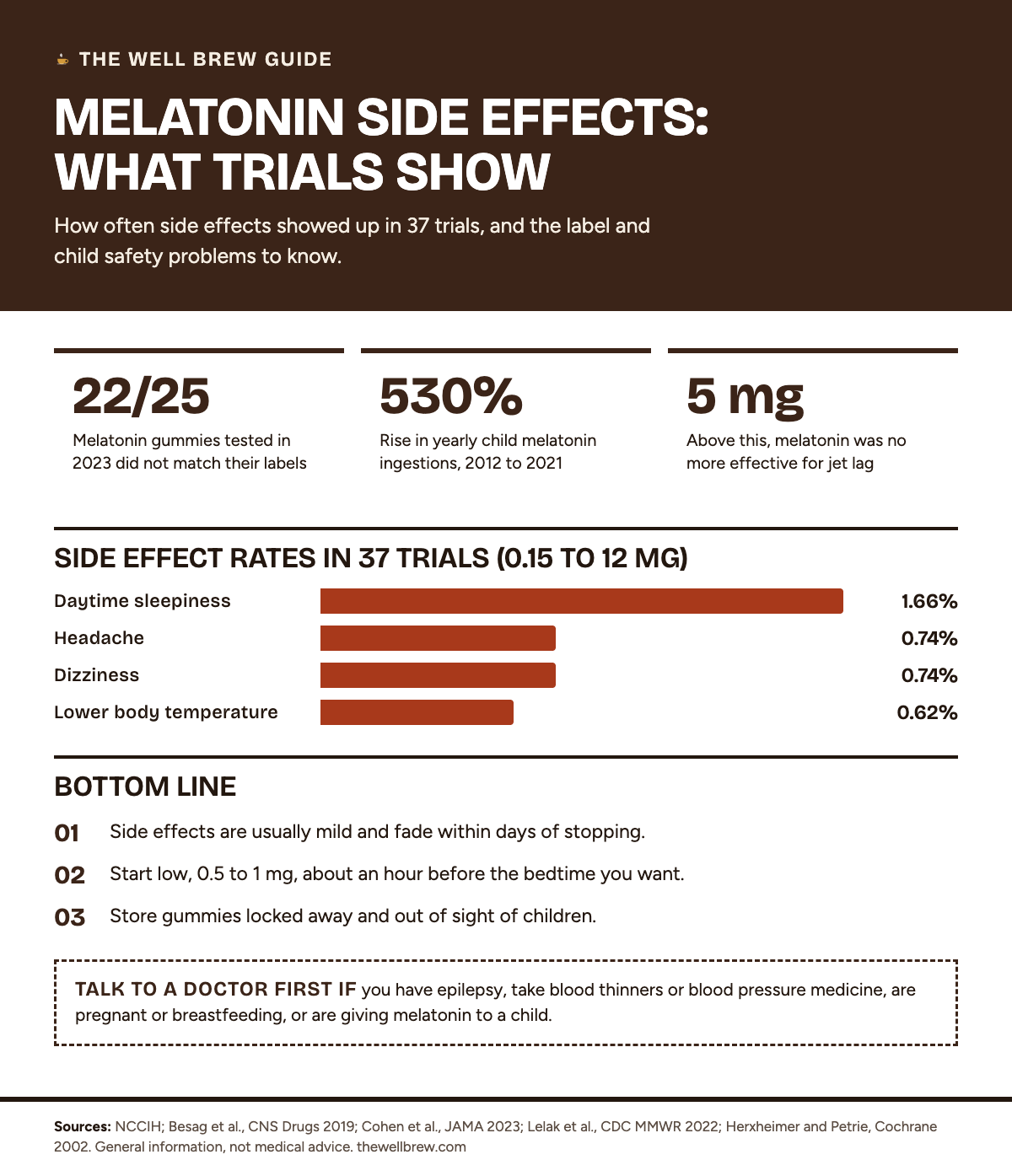
In 37 trials that used 0.15 to 12 mg, daytime sleepiness showed up in 1.66% of people, and headache and dizziness in 0.74% each. The bigger risks are long-term use, which has little research, and children getting into gummies at home.[2][1][6]
| What it is | A hormone the brain makes in response to darkness. It helps set the timing of the 24-hour body clock. Supplements are usually made synthetically.[1] |
|---|---|
| How it is sold in the US | As a dietary supplement, regulated less strictly than prescription or over-the-counter drugs. Several other countries sell it only by prescription.[1] |
| Doses in studies | 0.15 to 12 mg in safety trials. For jet lag, 0.5 to 5 mg worked about equally well.[2][9] |
| Most common side effects | Daytime sleepiness, headache, dizziness and nausea.[1][2] |
| Best evidence for use | Jet lag and delayed sleep-wake phase disorder. Evidence for chronic insomnia is not strong enough for guidelines to recommend it.[1][9] |
| Label accuracy | 22 of 25 gummy products tested in 2023 did not match their labels.[5] |
| Who should check first | People with epilepsy, people on blood thinners, pregnant or breastfeeding people, older adults with dementia and parents of children.[1] |
What are the most common melatonin side effects?
The most common melatonin side effect is daytime sleepiness, reported by 1.66% of people across 37 controlled trials. The same review found headache in 0.74%, dizziness in 0.74% and a drop in body temperature in 0.62%. Doses ran from 0.15 to 12 mg, for up to 29 weeks.[2]
NCCIH lists the same short list for adults: headache, dizziness, nausea and sleepiness. These were mild in short-term studies of adults, surgical patients and people in intensive care.[1]
Rarer effects in the trial review included agitation, fatigue, mood swings, nightmares, skin irritation and a racing heartbeat. Most went away within a few days or after people stopped taking melatonin.[2]
A second review looked at 50 controlled studies. In 24 of them, at least one notable side effect was reported. The authors called these “generally minor, short-lived and easily managed.” They also flagged fatigue, mood changes and slower reaction times, which matter if you drive or work early in the morning.[3]
Is melatonin safe to take?
Short-term use of melatonin appears to be safe for most adults, according to NCCIH, but there is little information on long-term safety. That gap matters more at doses well above what the body makes on its own, where there is not yet enough data for a clear safety picture.[1]
Only 8 of the 37 trials in the large adverse-event review were rated good quality, and long-term data were scarce. So “safe for most people” really means “safe for most people over weeks to a few months.”[2]
There is also a quality problem with the products themselves. A 2017 lab test of 31 melatonin supplements found that 26% contained serotonin, a hormone that can cause harm even at fairly low levels.[1][4]
Melatonin can also cause an allergic reaction in some people, though NCCIH describes this as a possible risk rather than a common one.[1]
Is melatonin bad for you if you take it every night?
No study shows nightly melatonin is harmful in the short term, but no long-term trial shows it is safe for years of nightly use either. NCCIH states plainly that the long-term side effects of melatonin are unclear.[1]
More adults now take it, and at higher doses. A study of 55,021 US adults found melatonin use rose from 0.4% in 1999 to 2000 to 2.1% in 2017 to 2018. Use of more than 5 mg a day rose from 0.08% to 0.28% over a similar span.[7]
For long-term trouble sleeping, guidelines from the American Academy of Sleep Medicine and the American College of Physicians say the evidence is not strong enough to recommend melatonin. The American College of Physicians recommends cognitive behavioral therapy for insomnia (CBT-I) first.[1]
If you have used melatonin most nights for more than a few weeks, that is a good reason to talk to a doctor about what is keeping you awake.[10]
How much melatonin should I take?
No US agency sets an official melatonin dose, but studies suggest more is not better: for jet lag, 0.5 mg worked about as well as 5 mg. The Cochrane review found that doses above 5 mg appear to be no more effective. A low dose taken at the right time is the usual starting point.[9]
Timing matters as much as amount. In a 4-week trial of 307 people with delayed sleep-wake phase disorder, melatonin taken 1 hour before the desired bedtime, along with a fixed bedtime, helped people fall asleep 34 minutes earlier on average.[1]
The Cochrane authors also warned that taking melatonin at the wrong time, early in the day, can cause sleepiness and slow the body clock’s adjustment.[9]
For ordinary trouble falling asleep, the effect is small. A meta-analysis of 19 studies with 1,683 people found melatonin helped people fall asleep 7.06 minutes faster and sleep 8.25 minutes longer.[8]
| Situation | Dose studied | What the research found |
|---|---|---|
| Jet lag | 0.5 to 5 mg | Similar benefit across this range; above 5 mg no more effective[9] |
| Safety trials, many sleep problems | 0.15 to 12 mg | Side effects mostly mild; daytime sleepiness 1.66%[2] |
| Delayed sleep-wake phase disorder | Taken 1 hour before desired bedtime | Fell asleep 34 minutes earlier with a fixed bedtime[1] |
| Primary sleep disorders | Varied across 19 studies | 7.06 minutes faster to sleep, 8.25 minutes more sleep[8] |
| Gummies bought in stores | 1.3 to 13.1 mg measured per serving | Real amount often differed from the label[5] |
Is 5 mg or 10 mg of melatonin too much?
A 10 mg dose is double the level at which the Cochrane review found no added benefit for jet lag, so it raises side-effect risk without a clear payoff. Trials have used up to 12 mg, and side effects were still mostly mild, but those trials were short.[9][2]
Labels also make the real dose hard to know. In a 2017 test of 31 products, actual melatonin ranged from 83% less to 478% more than the label said. Some lots of the same product varied by up to 465%.[4]
That means a bottle marked 5 mg could deliver far more. If you feel groggy, dizzy or foggy the next morning, the dose you are actually getting may be too high.[4][3]
Most people who want to try melatonin can start with a smaller amount, such as 0.5 to 1 mg, which falls within the range Cochrane found effective for jet lag.[9]
What are melatonin side effects in elderly people?
In older adults, melatonin may stay active in the body longer than in younger people, which can cause daytime drowsiness. That raises the chance of feeling groggy the next morning.[1]
The American Academy of Sleep Medicine recommended in 2015 against melatonin for people with dementia.[1]
Older adults are also more likely to take blood pressure medicine. The 50-study review found some effects on blood pressure and hormones, and a possible interaction with blood pressure drugs, with dose timing playing a role.[3]
If you are an older adult, or caring for one, bring the melatonin bottle to the next appointment so the doctor can check it against the full medicine list.[1]
Is melatonin safe for children?
Melatonin at normal doses appears safe for most children for short-term use, according to NCCIH, but there is little research on long-term effects. Because melatonin is a hormone, it might affect puberty, menstrual cycles or the hormone prolactin, though this has not been confirmed.[1]
Side effects reported in children have usually been mild: drowsiness, more bedwetting or evening urination, headache, dizziness and agitation. NCCIH advises parents to talk with a health care provider before giving melatonin to a child.[1]
Child poisonings from melatonin gummies
Accidental swallowing is the larger danger. A CDC report found yearly pediatric melatonin ingestions rose 530% from 2012 to 2021, totaling 260,435 cases. In 2021, melatonin made up 4.9% of all pediatric ingestions reported to poison centers, up from 0.6% in 2012.[6]
Poison center reports for people 19 and under went from 8,337 in 2012 to 52,563 in 2021. Of these, 94.3% involved children 5 and under, and 82.8% had no symptoms. Over the decade, 4,097 were hospitalized and 287 needed intensive care.[1]
Five children needed a breathing machine and two died, though the data could not show whether melatonin caused those deaths. A later CDC estimate counted about 11,000 emergency visits from 2019 to 2022 for children 5 and under, often involving flavored gummies.[6][1]
Do melatonin labels match what is in the bottle?
Often they do not: a 2023 JAMA study found 22 of 25 melatonin gummy products had a different amount than the label stated. Measured amounts ran from 74% to 347% of the label, and only 3 products were within 10% of the stated dose.[5]
One product in that study had no melatonin at all but contained 31.3 mg of CBD. Per serving, measured melatonin ranged from 1.3 to 13.1 mg.[5]
The earlier 2017 test of 31 supplements found that more than 71% missed their label by more than 10%, and 8 contained serotonin.[4]
This is one reason we treat a melatonin label as an estimate. It also explains why two bottles of the “same” dose can feel different. Our ingredient guides cover other supplements with similar label problems.[5]
What is melatonin’s drug class?
In the United States, melatonin is classed as a dietary supplement, not a drug. The FDA regulates supplements less strictly than prescription or over-the-counter medicines. In several other countries, melatonin is a prescription drug.[1]
In practice, no one checks each bottle’s dose before it reaches the shelf, and the label tests above show the result.[4][5]
Melatonin sales in the US rose about 150% from 2016 to 2020, which helps explain why more children are finding it at home.[1]
What does the research on melatonin side effects show?
Studies of melatonin side effects agree that short-term use is safe for most adults. What they lack is long-term data. Here are the main studies we used.
| Study | Who and how many | Dose and length | Main finding |
|---|---|---|---|
| Besag et al., 2019 | 37 randomized trials | 0.15 to 12 mg, up to 29 weeks | Sleepiness 1.66%, headache 0.74%, dizziness 0.74%[2] |
| Foley and Steel, 2019 | 50 controlled studies | Varied | 24 reported a notable side effect; mostly minor[3] |
| Ferracioli-Oda et al., 2013 | 19 studies, 1,683 people | Varied | 7.06 minutes faster to sleep; benign side effects[8] |
| Cochrane, Herxheimer and Petrie, 2002 | Travelers with jet lag | 0.5 to 5 mg | Above 5 mg no more effective[9] |
| Cohen et al., 2023 | 25 gummy products | Lab test | 22 of 25 mislabeled[5] |
| Lelak et al., 2022 (CDC) | 260,435 child ingestions | 2012 to 2021 | 530% rise in yearly cases[6] |
Who should avoid melatonin?
People with epilepsy and people taking blood thinners should use melatonin only under medical supervision, NCCIH says. The Cochrane review also noted case reports involving epilepsy and the blood thinner warfarin.[1][9]
- Pregnant or breastfeeding people: there is little research on safety, so ask your obstetric provider first.[1]
- People with dementia: sleep medicine guidelines recommend against it.[1]
- People on blood pressure medicine: there may be an interaction, and dose timing can matter.[3]
- Children and teens: talk to a pediatric provider first, and store all products out of reach.[1]
- Anyone with a past allergic reaction to a melatonin product.[1]
- Anyone who must drive, operate machinery or wake early, until you know how it affects you the next morning.[3]
See a doctor if sleep problems last a month or longer or if daytime sleepiness affects work or driving. An underlying cause may need its own treatment.[1][10]
What do doctors recommend first for trouble sleeping?
For long-term insomnia, doctors start with cognitive behavioral therapy for insomnia (CBT-I), not a supplement. The American College of Physicians strongly recommends CBT-I as the first treatment.[1]
MedlinePlus lists better sleep habits and lifestyle changes as the first step, along with treating any condition that causes the insomnia.[10]
Melatonin has a clearer role for timing problems, such as jet lag or a body clock that runs late. You can read more about these in our sleep guides. If you are comparing options, our guide to magnesium glycinate for sleep and how it compares covers another popular bedtime supplement and its evidence.[1][9]
Checklist before you buy or take melatonin
- Check whether your problem is timing (jet lag, late body clock) or long-term insomnia. Melatonin has better evidence for timing.[1]
- Start low. Doses of 0.5 to 1 mg are within the range that worked for jet lag.[9]
- Take it at the right time, about an hour before the bedtime you want, never in the morning.[1][9]
- Look for a third-party testing seal on the label, since many products do not match their stated dose. Our review method explains what we check on labels.[4][5]
- Avoid products that add CBD or other sleep herbs unless your doctor has approved them.[5]
- Store gummies locked away and out of sight of children.[1][6]
- Tell your doctor or pharmacist if you take blood thinners, seizure medicine or blood pressure medicine.[1][3]
- Stop and reassess if you have next-day grogginess, headaches or nightmares.[2]
Bottom line
Melatonin side effects in adults are usually mild: sleepiness, headache, dizziness and nausea, mostly gone within days of stopping. The real unknowns are long-term nightly use and what is actually in the bottle, since many labels are off by a wide margin.[1][2][5]
For most people with ongoing insomnia, CBT-I and better sleep habits are the better first step, because they have stronger evidence and no label problem. If you use melatonin for jet lag or a late body clock, a low dose at the right time is the sensible choice, and gummies belong locked away from children.[1][9][10]
Frequently asked questions
What does melatonin do in the body?
Melatonin is a hormone your brain releases when it gets dark. It helps time your 24-hour body clock and signals that it is time to sleep. Being exposed to light at night can block its release, so bright rooms late in the evening can work against it.
Can melatonin cause nightmares?
It can, but rarely. A review of 37 trials listed nightmares among the uncommon side effects, along with agitation, mood swings and skin irritation. Most of these went away within days or after people stopped taking melatonin.
What happens if a child eats melatonin gummies?
Most children have no symptoms: 82.8% of poison center cases had none. Some do get sick, and thousands were hospitalized over the decade studied. Call Poison Control or a doctor right away if a child swallows melatonin, even if the child seems fine.
Is melatonin 3 mg or 1 mg enough?
For many adults, a smaller dose is enough. The Cochrane review found doses from 0.5 to 5 mg worked about equally well for jet lag. Starting at 0.5 to 1 mg lowers the chance of next-day grogginess.
Can melatonin make you feel groggy the next day?
Yes. Daytime sleepiness is the most common side effect, reported by 1.66% of trial participants. It is more likely at higher doses, when taken late at night, and in older adults, in whom melatonin may stay active longer.
Sources
- Melatonin: What You Need To Know. NCCIH, National Institutes of Health
- Adverse Events Associated with Melatonin for the Treatment of Primary or Secondary Sleep Disorders: A Systematic Review. Besag et al., CNS Drugs, 2019
- Adverse events associated with oral administration of melatonin: a critical systematic review of clinical evidence. Foley and Steel, Complementary Therapies in Medicine, 2019
- Melatonin Natural Health Products and Supplements: Presence of Serotonin and Significant Variability of Melatonin Content. Erland and Saxena, Journal of Clinical Sleep Medicine, 2017
- Quantity of Melatonin and CBD in Melatonin Gummies Sold in the US. Cohen et al., JAMA, 2023
- Pediatric Melatonin Ingestions, United States, 2012-2021. Lelak et al., CDC Morbidity and Mortality Weekly Report, 2022
- Trends in Use of Melatonin Supplements Among US Adults, 1999-2018. Li et al., JAMA, 2022
- Meta-analysis: melatonin for the treatment of primary sleep disorders. Ferracioli-Oda et al., PLoS One, 2013
- Melatonin for the prevention and treatment of jet lag. Herxheimer and Petrie, Cochrane Database of Systematic Reviews, 2002
- Insomnia. MedlinePlus, National Library of Medicine

Maya Ellison is the Reviews Editor at The Well Brew, a slow, plain-language supplement review blog for everyday adults. Maya reads each label in full, sets every dose beside the amounts used in human studies, grades the research with sources such as the NIH Office of Dietary Supplements and NCCIH, and works out the real cost and refund fine print. Maya has no medical credentials and is not a doctor, dietitian, nurse or pharmacist. Reviews give pros, cons and who a product suits, never scores. How we review supplements.
This article is general information, not medical advice. Dietary supplements are not reviewed by the FDA for safety or effectiveness before they are sold. Talk to your doctor before you start any supplement, especially if you are pregnant, nursing, take medication or have a health condition.