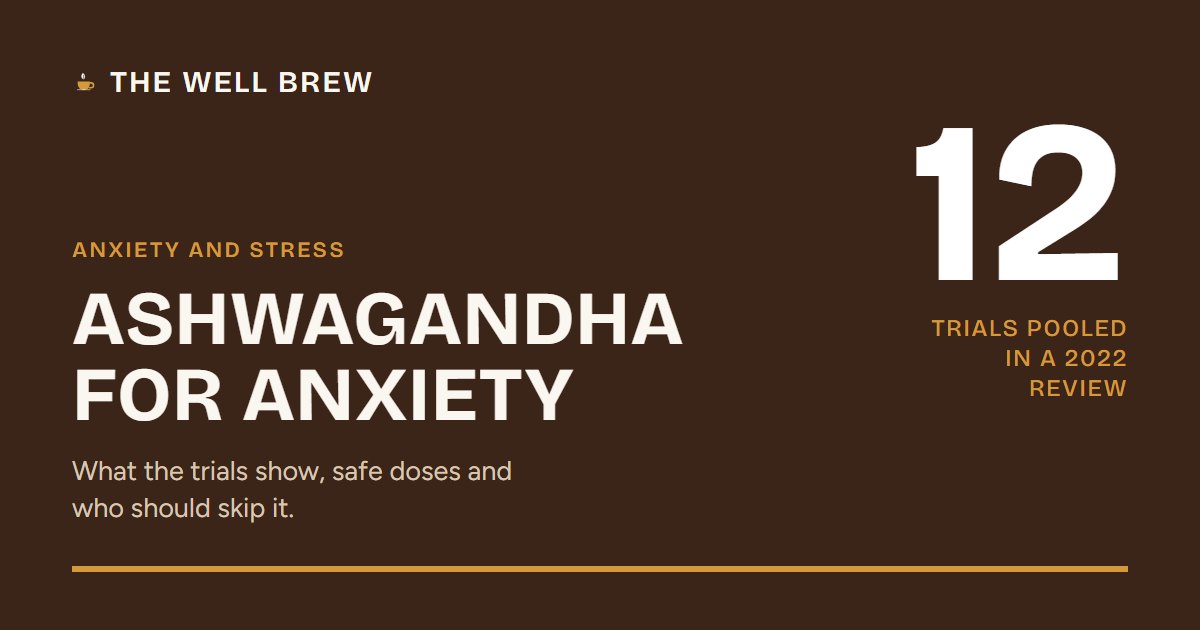
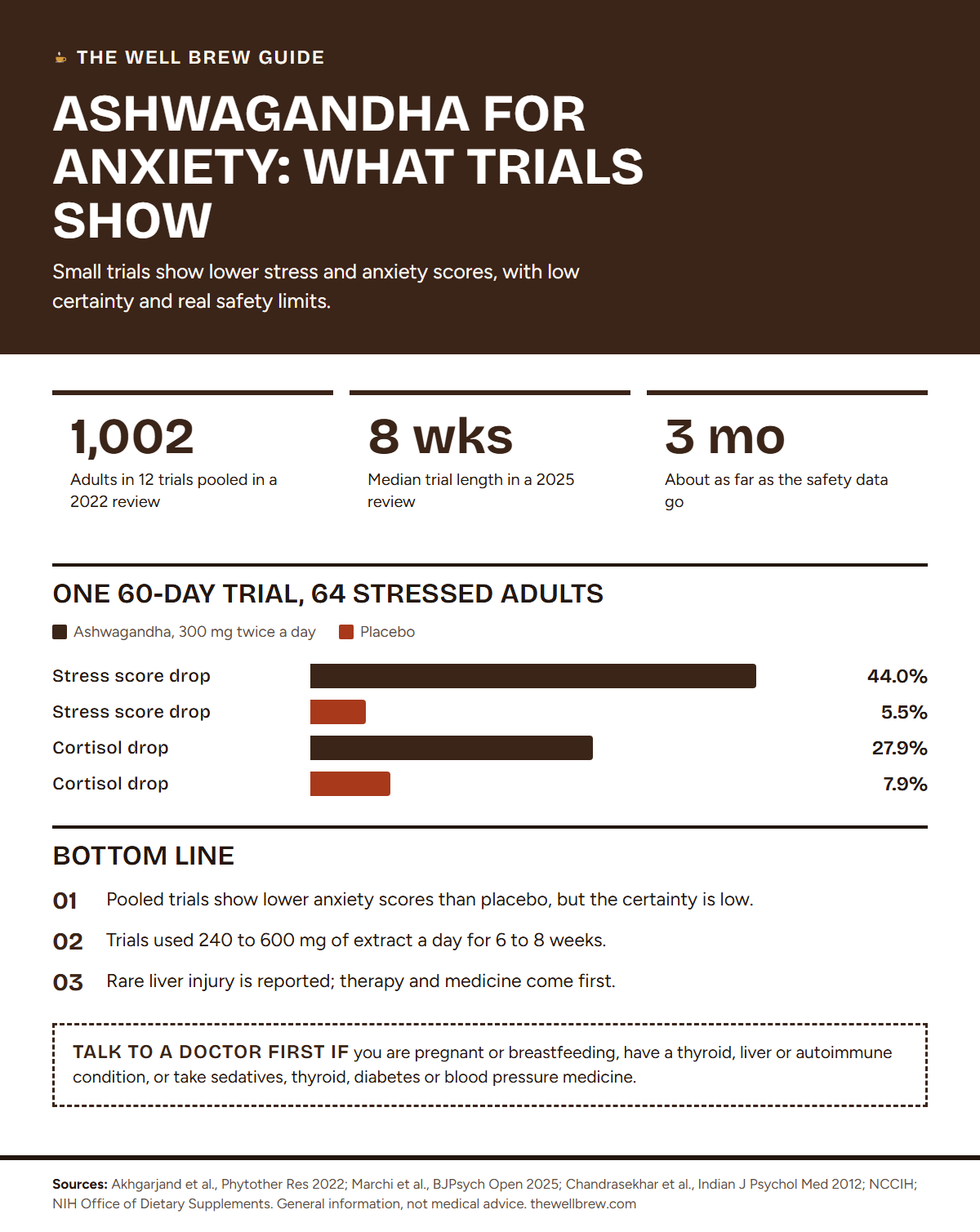
Ashwagandha may modestly lower anxiety and stress scores. A 2022 review of 12 trials with 1,002 adults found less anxiety than with placebo, but rated the evidence low certainty. Trials used 240 to 600 mg of extract a day for 6 to 8 weeks. It seems safe for about 3 months, but rare liver injury is reported, and therapy and medicine remain the first-line care.
On this page
- Does ashwagandha help with anxiety?
- What does the research on ashwagandha for anxiety show?
- How much ashwagandha should I take for anxiety?
- How long does ashwagandha take to work for anxiety?
- Is ashwagandha safe? Side effects and who should avoid it
- Should you try ashwagandha for anxiety? A decision table
- What do doctors use first for anxiety?
- How do I choose an ashwagandha supplement?
- Bottom line
- FAQ
To find out whether ashwagandha for anxiety is worth trying, we read the NCCIH and NIH Office of Dietary Supplements fact sheets, four meta-analyses, three placebo-controlled trials, a liver injury case series, and the NIMH and MedlinePlus pages on how anxiety is treated.[1][2][11][12]
The short answer: a 2022 meta-analysis of 12 trials with 1,002 people found lower anxiety scores with ashwagandha than with placebo, but its authors rated the certainty of that evidence as low.[3]
| What it is | An extract of the root, and sometimes the leaf, of Withania somnifera, an evergreen shrub long used in Ayurvedic medicine[1] |
|---|---|
| Studied for | Stress, anxiety and sleep[1][2] |
| Amounts used in trials | 240 to 1,250 mg of extract a day, usually for 6 to 8 weeks[2] |
| Best evidence | Meta-analyses of small trials that found lower anxiety scores than placebo, with low certainty[3][5] |
| Safety | Mostly mild side effects in use up to about 3 months; rare cases of liver injury[1][2] |
| Who should avoid it | People who are pregnant or breastfeeding, have thyroid or autoimmune disorders, have surgery coming up, or have hormone-sensitive prostate cancer[1] |
Does ashwagandha help with anxiety?
Ashwagandha may modestly lower anxiety scores in adults who feel stressed, but the evidence comes from small, short trials and is rated low certainty. NCCIH says some ashwagandha preparations may help with stress and insomnia, yet it calls the evidence on anxiety itself unclear.[1]
The NIH Office of Dietary Supplements is a little more positive. It says research suggests ashwagandha extracts may lower stress, anxiety and cortisol, a stress hormone.[2] It also points out that most trials were small, short and run in India, so the results may not apply to everyone.[2]
Most of these trials enrolled healthy adults who said they felt stressed, not people with a diagnosed anxiety disorder. A 2025 meta-analysis in BJPsych Open filled part of that gap. It pooled 14 studies of people with mental disorders, mostly anxiety disorders, with 360 people on ashwagandha and 353 controls.[5] Anxiety symptoms improved, but the authors noted the small number of studies and large differences between them.[5]
Ashwagandha is a dietary supplement. The FDA does not approve supplements before they are sold, so product quality and dose vary.[1] You can browse more of our anxiety and stress guides for related topics.
What does the research on ashwagandha for anxiety show?
Four meta-analyses all found lower anxiety or stress scores with ashwagandha than with placebo, but every one flagged small trials, mixed products or wide differences between studies. The table sums up what each review and trial tested and found.[3][4][5][6]
| Study | Who and how many | Dose and length | Result |
|---|---|---|---|
| Akhgarjand, 2022 meta-analysis[3] | 12 trials, 1,002 adults aged 25 to 48 | Various extracts and doses | Less anxiety and stress than placebo; low certainty |
| Arumugam, 2024 meta-analysis[4] | 9 trials, 558 people | Various formulas | Lower Hamilton anxiety scores, stress scores and cortisol; 4 trials reported mild to moderate side effects |
| Marchi, 2025 meta-analysis[5] | 14 studies of people with mental disorders, mostly anxiety disorders | Median 600 mg a day, median 8 weeks | Anxiety improved; few studies, large differences between them |
| Fatima, 2024 meta-analysis[6] | 5 trials, 254 people with anxiety or insomnia | Various extracts | Lower Hamilton anxiety scores; results varied widely between trials |
| Chandrasekhar, 2012 trial[7] | 64 adults with chronic stress | 300 mg root extract twice a day, 60 days | Stress scores fell 44.0% vs 5.5% on placebo; cortisol fell 27.9% vs 7.9% |
| Lopresti, 2019 trial[8] | 60 stressed, healthy adults | 240 mg once a day, 60 days | Lower Hamilton anxiety scores than placebo; no adverse events |
| Salve, 2019 trial[9] | 60 stressed adults | 250 or 600 mg a day, 8 weeks | Stress fell at both doses; anxiety scores fell only at 600 mg |
Most trials lasted 6 to 8 weeks, and many tested one branded extract, such as KSM-66, Shoden or Sensoril.[2] A result for one extract may not carry over to a different product on a store shelf.
Results also depend on how anxiety was measured. Most trials used rating scales such as the Hamilton Anxiety Rating Scale or the Perceived Stress Scale, which rely on how people describe their symptoms.[2][4] In the Lopresti trial, the Hamilton score improved, but a second questionnaire, the DASS-21, only came close to a significant change.[8]
The Fatima review found very high variation between trials, which makes its pooled number less reliable.[6] The 2022 review also concluded that more high-quality studies are needed before the effect can be called firmly established.[3]
How much ashwagandha should I take for anxiety?
Trials used 240 to 1,250 mg of extract a day, and an international psychiatry taskforce provisionally suggested 300 to 600 mg of root extract standardized to 5% withanolides for generalized anxiety disorder. That 2022 suggestion came with a note that more data are needed before it can be stronger.[2]
The taskforce was set up by the World Federation of Societies of Biological Psychiatry and the Canadian Network for Mood and Anxiety Treatments.[2] The table below lines up the doses used in the trials we read with what happened at each one.
| Daily dose | Study | What happened |
|---|---|---|
| 240 mg once a day | Lopresti, 2019, 60 days[8] | Hamilton anxiety scores fell more than with placebo |
| 225 or 400 mg a day | Florida trial, 60 adults, 30 days[2] | Better stress and anxiety scores than placebo at both doses |
| 250 mg a day | Salve, 2019, 8 weeks[9] | Stress fell; anxiety scores were not significantly lower |
| 600 mg a day (300 mg twice) | Chandrasekhar, 2012 and Salve, 2019[7][9] | Stress and anxiety scores fell more than with placebo |
| 300 to 600 mg of 5% withanolide root extract | WFSBP and CANMAT taskforce, 2022[2] | Provisional suggestion for generalized anxiety disorder |
In several studies, 500 to 600 mg a day seemed to work better than lower doses.[2] That comes from a handful of small trials and does not show that more is always better. The NIH Office of Dietary Supplements says the mix of extracts and doses makes it hard to name a recommended amount.[2]
Higher doses raise safety questions. Reported liver injury cases involved 450 to 1,350 mg a day, and one case of an overactive thyroid involved 1,950 mg a day for more than 2 months.[2] Stay within the dose on a standardized product label, and ask a pharmacist to check it against any medicines you take.
How long does ashwagandha take to work for anxiety?
Most anxiety and stress trials measured results after 6 to 8 weeks of daily use, and the shortest trials that reported a benefit lasted 30 days. No trial we read tested whether ashwagandha eases anxiety within hours or days, so it should not be used like a fast-acting calming pill.[2][5]
The Florida trial checked results after 30 days, while the Chandrasekhar and Lopresti trials ran for 60 days.[2][7][8] The 2025 meta-analysis found a median follow-up of 8 weeks across its studies.[5]
Safety data run out at about 3 months, so a fair trial fits inside that window.[1] It helps to write down your symptoms once a week. If nothing has changed by week 8, ashwagandha is probably not doing much for you, and that is a good time to talk with your clinician.
For comparison, standard medicines also take time. NIMH says SSRI and SNRI antidepressants may take several weeks to start working, and buspirone needs 3 to 4 weeks to be fully effective.[11] Those medicines also start slowly, and they have far more evidence behind them.
Is ashwagandha safe? Side effects and who should avoid it
Ashwagandha seems to be well tolerated for up to about 3 months, with mostly mild side effects, but rare cases of liver injury have been reported. Long-term safety is not known.[1][2] Some groups should skip it entirely, and anyone taking prescription medicine should check first.
Common side effects
NCCIH lists drowsiness, stomach upset, diarrhea and vomiting.[1] The NIH Office of Dietary Supplements adds loose stools and nausea and says these are usually mild.[2]
Liver injury
A 2020 case series from Iceland and the US Drug-Induced Liver Injury Network described five people who developed jaundice 2 to 12 weeks after starting ashwagandha supplements.[10] None developed liver failure, and liver tests returned to normal within 1 to 5 months in four of them.[10] Some people in other reports already had liver disease.[2] Our milk thistle for liver health guide covers what liver supplements can and cannot do.
Thyroid
In a small trial of 50 people with mildly underactive thyroid, 300 mg of root extract twice a day for 8 weeks changed thyroid hormone levels.[2] Three case reports describe an overactive thyroid in women taking ashwagandha.[2] NCCIH advises against it for people with thyroid disorders.[1]
Pregnancy, surgery and other conditions
Avoid ashwagandha during pregnancy and while breastfeeding.[1] Denmark banned it in 2023 after a risk review that raised concerns about pregnancy and hormones.[2] NCCIH also advises against it before surgery and for people with autoimmune disorders or hormone-sensitive prostate cancer.[1]
Medicines
Ashwagandha might interact with medicines for diabetes and high blood pressure, immunosuppressants, sedatives, anti-seizure medicines and thyroid hormone.[1] Benzodiazepines, a common anxiety medicine, are sedatives, so that combination needs a prescriber’s review.[11]
See a doctor right away if you notice any of these while taking ashwagandha:[10][11]
- Yellow skin or yellow eyes
- Itching that does not go away
- Nausea with tiredness or belly discomfort
- Thoughts of harming yourself (call or text 988 any time)
Should you try ashwagandha for anxiety? A decision table
Ashwagandha is most reasonable as a short, tracked trial for mild, stress-related anxiety in healthy adults who take no interacting medicines. For anyone with a diagnosed anxiety disorder, a thyroid or liver condition, or a pregnancy, the risks or the evidence point elsewhere first.[1][2][11]
| If this is you | Then |
|---|---|
| You feel stressed, take no medicines and have no long-term conditions | A trial of a standardized extract at label dose, for no more than about 3 months, is a reasonable option to discuss with your clinician[1][2] |
| You worry most days, find it hard to control, and it has lasted 6 months or more | Get checked for generalized anxiety disorder; therapy and medicine come first[11] |
| You are pregnant or breastfeeding | Do not take it[1] |
| You have a thyroid or autoimmune disorder | Avoid it unless your doctor says otherwise[1] |
| You have had liver problems | Avoid it; some people with liver injury already had liver disease[2] |
| You take sedatives, anti-seizure, diabetes, blood pressure or thyroid medicines | Ask your prescriber before starting[1] |
| You have surgery coming up | Do not take it, and tell your surgical team about any supplements[1] |
What do doctors use first for anxiety?
The main treatments for anxiety disorders are psychotherapy, medicine, or both, and ashwagandha is not a replacement for either. MedlinePlus lists cognitive behavioral therapy, exposure therapy and acceptance and commitment therapy among the talk therapies used, along with anti-anxiety medicines and certain antidepressants.[12]
NIMH calls cognitive behavioral therapy (CBT) the gold standard talk therapy for generalized anxiety disorder.[11] CBT teaches people to notice unhelpful automatic thoughts, question them, and change the habits that keep worry going.[11]
Medicines include SSRI and SNRI antidepressants, buspirone, and, for severe cases, benzodiazepines.[11] Benzodiazepines can calm anxiety quickly, but some people become dependent on them, so doctors often prescribe them only for short periods.[11]
Support groups and stress management techniques may also help.[12] If poor sleep is part of the picture, our guide to magnesium glycinate benefits for sleep looks at another supplement people often ask about.
If you already take anxiety medicine, do not stop or change it to try a supplement. Talk with the person who prescribed it first.[11]
How do I choose an ashwagandha supplement?
Choose a single-ingredient product that names the plant part, the extract and its withanolide content, because the trials tested specific standardized extracts. These label checks and habits follow what the trials and safety reports describe.[2]
- Check the plant part. Most products use root extract, and some use root and leaf, which differ chemically.[2]
- Look for a stated withanolide percentage, such as 5%, which matches the taskforce suggestion.[2]
- Match the dose per capsule to the trial range of roughly 240 to 600 mg a day.[2][8]
- Prefer a single-ingredient product. Some liver injury cases involved combination products.[2]
- Remember that the FDA does not approve supplements before sale, so the label is the maker’s claim.[1]
- Note your start date and plan to stop or review by about 3 months.[1]
- Tell every clinician you see, including before surgery, that you take it.[1]
You can read how we weigh studies and sources in how we review supplements.
Bottom line
Ashwagandha has a real but modest research record for stress and anxiety. Pooled trials show lower anxiety scores than placebo, yet the studies are small, short and mostly tied to a few branded extracts, and reviewers rate the certainty as low.[3][5]
For most people with anxiety that lasts or gets in the way of daily life, seeing a clinician about CBT or medicine is the better first step, because those treatments have far stronger evidence.[11][12] If your stress is mild and you are healthy, a 2 to 3 month trial of a standardized extract is a fair thing to raise with your doctor, as long as you watch for liver warning signs.[1][10]
Frequently asked questions
Does ashwagandha help with sleep?
NCCIH says some ashwagandha preparations may be effective for insomnia. In one trial of 150 adults with sleep problems, sleep quality improved in 72% of the ashwagandha group versus 29% on placebo. The studies are few and small.
Can you take ashwagandha every day long term?
Ashwagandha appears to be well tolerated for up to about 3 months of daily use. Its safety over longer periods is not known, so most experts suggest reviewing it with a clinician before going past that point.
Is ashwagandha FDA approved for anxiety?
No. Ashwagandha is sold as a dietary supplement, and the FDA does not approve supplements before they reach stores. Makers are responsible for the safety and labeling of their own products, so quality and dose can vary.
Is ashwagandha the same as Indian ginseng?
Ashwagandha is sometimes called Indian ginseng or winter cherry, but it is not part of the ginseng family. Its Latin name is Withania somnifera, and most supplements use an extract of its root.
Can I take ashwagandha with anxiety medicine?
Ask your prescriber first. NCCIH says ashwagandha might interact with sedatives, anti-seizure medicines and thyroid hormone, among others. Benzodiazepines are sedatives. Never stop or change a prescribed anxiety medicine to try a supplement.
Sources
- Ashwagandha: Usefulness and Safety. National Center for Complementary and Integrative Health (NCCIH)
- Ashwagandha: Fact Sheet for Health Professionals. NIH Office of Dietary Supplements, updated 2025
- Does Ashwagandha supplementation have a beneficial effect on the management of anxiety and stress? A systematic review and meta-analysis. Akhgarjand C et al., Phytotherapy Research, 2022
- Effects of Ashwagandha (Withania somnifera) on stress and anxiety: A systematic review and meta-analysis. Arumugam V et al., Explore, 2024
- The effect of Withania somnifera (Ashwagandha) on mental health symptoms in individuals with mental disorders: systematic review and meta-analysis. Marchi M et al., BJPsych Open, 2025
- Safety and efficacy of Withania somnifera for anxiety and insomnia: Systematic review and meta-analysis. Fatima K et al., Human Psychopharmacology, 2024
- A prospective, randomized double-blind, placebo-controlled study of a full-spectrum extract of ashwagandha root in reducing stress and anxiety in adults. Chandrasekhar K et al., Indian Journal of Psychological Medicine, 2012
- An investigation into the stress-relieving and pharmacological actions of an ashwagandha extract: A randomized, double-blind, placebo-controlled study. Lopresti AL et al., Medicine, 2019
- Adaptogenic and Anxiolytic Effects of Ashwagandha Root Extract in Healthy Adults: A Double-blind, Randomized, Placebo-controlled Clinical Study. Salve J et al., Cureus, 2019
- Ashwagandha-induced liver injury: A case series from Iceland and the US Drug-Induced Liver Injury Network. Bjornsson HK et al., Liver International, 2020
- Generalized Anxiety Disorder: When Worry Gets Out of Control. National Institute of Mental Health (NIMH)
- Anxiety. MedlinePlus, National Library of Medicine

Maya Ellison is the Reviews Editor at The Well Brew, a slow, plain-language supplement review blog for everyday adults. Maya reads each label in full, sets every dose beside the amounts used in human studies, grades the research with sources such as the NIH Office of Dietary Supplements and NCCIH, and works out the real cost and refund fine print. Maya has no medical credentials and is not a doctor, dietitian, nurse or pharmacist. Reviews give pros, cons and who a product suits, never scores. How we review supplements.
This article is general information, not medical advice. Dietary supplements are not reviewed by the FDA for safety or effectiveness before they are sold. Talk to your doctor before you start any supplement, especially if you are pregnant, nursing, take medication or have a health condition.