The early signs of dementia are memory and thinking changes that repeat and get in the way of daily life, such as asking the same questions, getting lost in familiar places or struggling with bills. Normal aging means occasional slips you recall later. Thyroid problems, medicines, depression and low vitamin B12 can look similar, so see a doctor if changes persist.
On this page
- What are the early signs of dementia?
- How is normal forgetfulness different from dementia?
- What are the signs of early onset dementia?
- Are early signs of dementia different in women and men?
- Is it mild cognitive impairment or early dementia?
- What treatable problems can look like dementia?
- How do doctors check for dementia and treat it?
- When should you see a doctor about memory problems?
- Bottom line
- FAQ
The early signs of dementia are memory and thinking changes that keep coming back and start to get in the way of daily life, such as asking the same question again and again or getting lost on a familiar route. For this guide we read the National Institute on Aging pages on forgetfulness, mild cognitive impairment, diagnosis and treatment, the CDC and MedlinePlus dementia pages, and the Alzheimer’s Association warning signs list, using the method on our how we review page.[1][4][5]
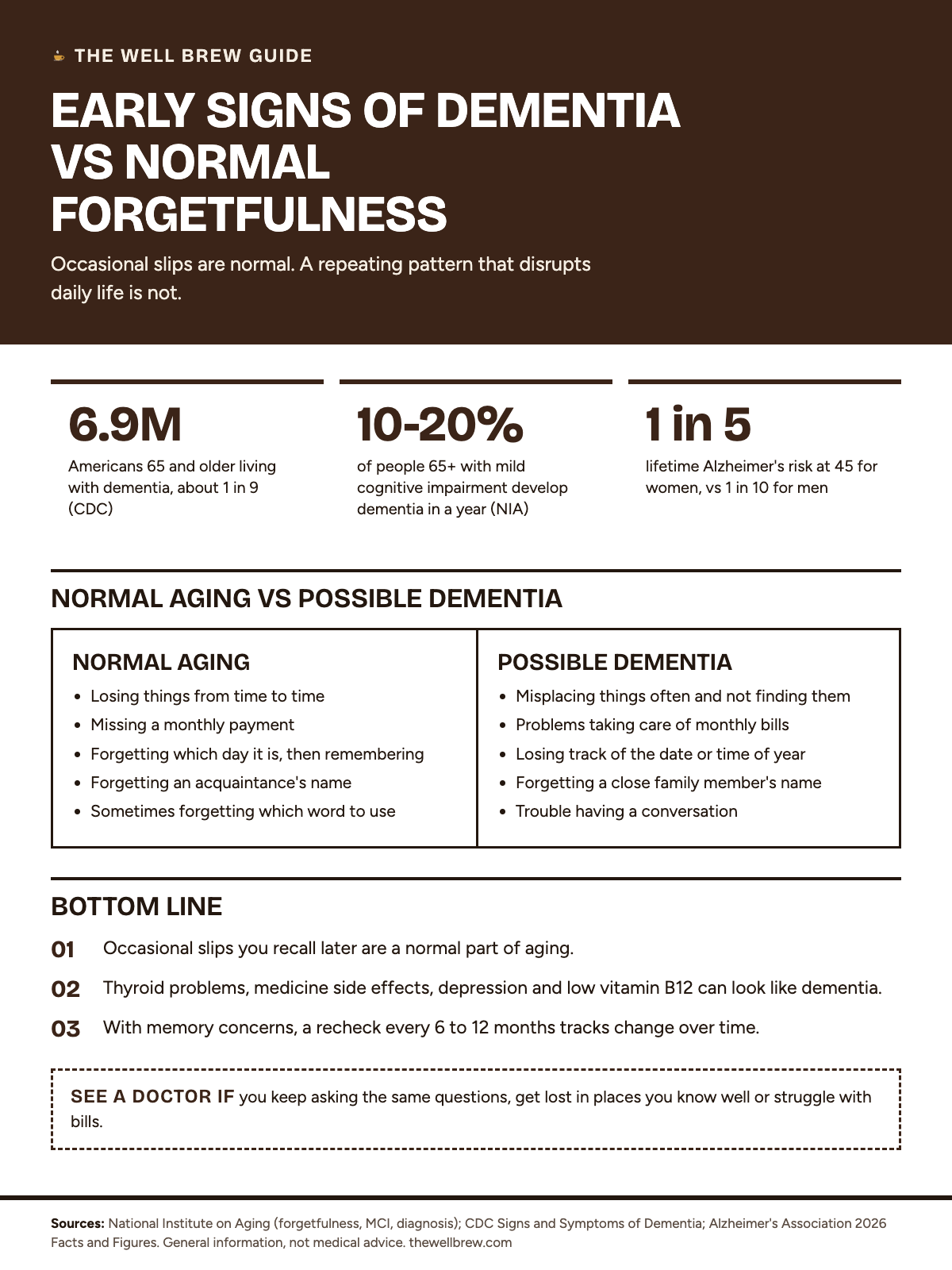
In short, occasional slips, like losing your keys and finding them later, are part of normal aging, while forgetting the name of a close family member or getting lost in your own neighborhood is a reason to see a doctor.[5]
| What dementia is | A loss of memory, thinking and reasoning that is serious enough to interfere with daily life. It is not a normal part of aging.[4][5] |
|---|---|
| Most common first sign | Forgetfulness, especially trouble holding on to new information.[2][4] |
| How common | About 6.9 million Americans aged 65 and older live with dementia, roughly 1 in 9 people (10.9%).[5] |
| Normal aging looks like | Forgetting where the car keys are sometimes, or struggling for a word and remembering it later.[5] |
| Usual age at onset | Mid-60s or later for most Alzheimer’s cases. Early onset means before 65, and in rare cases it starts in a person’s 30s.[2] |
| Can look like dementia | Medicine side effects, thyroid, kidney or liver problems, depression, sleep problems and low vitamin B12.[1] |
| Who to see | A primary care doctor first, then a recheck every 6 to 12 months if memory problems continue.[6][7] |
What are the early signs of dementia?
The early signs of dementia are repeated memory, language, planning or mood changes that are new for the person and make everyday tasks harder. Memory problems are usually among the first signs, but some types of dementia start with changes in behavior, language or vision.[2][4] The Alzheimer’s Association lists ten warning signs, and each one has a milder version that is common with age.[3]
- Memory loss that disrupts daily life, such as forgetting things you just learned.[3]
- Trouble planning or solving problems, like following a familiar recipe or keeping track of monthly bills.[3]
- Difficulty finishing familiar tasks at home, at work or while driving to a familiar place.[3]
- Confusion about time or place, including losing track of dates and seasons.[3]
- Trouble understanding images and space, which can affect balance, reading or driving.[3]
- New problems with words, such as calling a “watch” a “hand-clock”.[3]
- Putting things in odd places and being unable to retrace steps to find them.[3]
- Poor judgment, often with money.[3]
- Pulling back from work, hobbies or social plans.[3]
- Mood and personality changes, such as becoming confused, suspicious, depressed, fearful or anxious.[3]
A single sign is rarely enough for a diagnosis. Doctors look for a pattern that keeps showing up and gets worse over months.[1][3]
How is normal forgetfulness different from dementia?
Normal forgetfulness is occasional and you can usually recover the memory later, while dementia causes problems that happen a lot and make it hard to manage daily life. The National Institute on Aging puts it simply: making a bad decision once in a while is normal, but making poor judgments a lot of the time is not.[1] The table below lines up the two side by side.
| Normal aging | Possible sign of dementia |
|---|---|
| Making a bad decision once in a while[1] | Making poor judgments and decisions a lot of the time[1] |
| Missing a monthly payment[1] | Problems taking care of monthly bills[1] |
| Forgetting which day it is and remembering it later[1] | Losing track of the date or time of year[1] |
| Sometimes forgetting which word to use[1] | Trouble having a conversation[1] |
| Losing things from time to time[1] | Misplacing things often and being unable to find them[1] |
| Forgetting the name of an acquaintance[5] | Forgetting the name of a close family member or friend[5] |
| Forgetting names or appointments but remembering them later[3] | Getting lost in a familiar neighborhood[4][5] |
The CDC notes that normal changes can be frustrating, but they should not affect your ability to live on your own and do everyday tasks.[5] Aging is the biggest risk factor for dementia, yet many older adults never develop it.[4][5]
What are the signs of early onset dementia?
Early onset dementia means symptoms that begin before age 65, and the first signs are often changes in behavior, language or work performance rather than memory. Early-onset Alzheimer’s can begin as early as a person’s 30s, although this is rare.[2] For most people with Alzheimer’s, symptoms first appear in their mid-60s or later.[2]
Frontotemporal dementia (FTD) is a common cause in midlife. Roughly 60% of people with FTD are 45 to 64 years old.[8] Its behavioral form shows up as changes in personality, behavior and judgment, and the person may or may not have memory problems. Another form, primary progressive aphasia, affects language first, such as finding, saying or understanding words.[8]
Lewy body dementia usually begins at age 50 or older. Early symptoms can include changes in mood, vision, sleep and bowel movements, and most people with it have visual hallucinations, often early on.[9] Acting out dreams during sleep (REM sleep behavior disorder) and loss of smell are linked to a higher risk.[9]
In a younger adult, forgetfulness during a busy or stressful stretch can come from sleep problems, anxiety or depression, which are common causes of memory trouble at any age.[1] A doctor can sort out which is which.
Are early signs of dementia different in women and men?
The early signs of dementia are the same for women and men; what differs is how often each group develops it. None of the sources we read describe a separate list of symptoms by sex. The memory, language, judgment and mood changes above apply to everyone.[2][3]
The numbers on risk do differ. Almost two-thirds of Americans with Alzheimer’s are women, and the lifetime risk of Alzheimer’s at age 45 is 1 in 5 for women and 1 in 10 for men.[10] Age is still the biggest risk factor for both.[4]
Lewy body dementia shows the opposite pattern. It appears to affect slightly more men than women.[9] Risk also differs by background: older Black Americans are about twice as likely as older White Americans to have Alzheimer’s or another dementia.[10]
So if you are searching for early signs of dementia in women or in men, the list to watch is the same. The practical difference is that women may want to raise memory concerns early, since the odds over a lifetime are higher.
Is it mild cognitive impairment or early dementia?
Mild cognitive impairment (MCI) means more memory or thinking trouble than is usual for your age, but you can still handle daily life on your own. Dementia begins when those problems start to interfere with everyday tasks.[4][6] MCI can be an early warning, but it does not always lead to dementia.[6]
An estimated 10 to 20% of people age 65 or older with MCI develop dementia over a one-year period.[6] In many cases, though, the symptoms of MCI stay the same or even improve.[6] Problems with movement and with the sense of smell have also been linked to MCI.[6]
The brain changes behind Alzheimer’s, such as amyloid plaques and tau tangles, can start a decade or more before memory and thinking problems appear.[2] That is one reason doctors track memory over time instead of judging from a single visit. The NIA advises seeing a doctor or specialist every six to 12 months if you have MCI, and keeping a written record of any changes.[6]
What treatable problems can look like dementia?
Several common, treatable conditions can cause memory problems that look like early dementia, so a doctor checks for them first. The NIA lists medicine side effects, thyroid, kidney or liver problems, depression and anxiety, alcohol or drug misuse, sleep problems and low vitamin B12, along with head injuries, blood clots, tumors and brain infections.[1] Some of these problems may be treatable and possibly reversible.[7]
Use the table below to think through what to bring up with the doctor. It does not replace an exam.
| If you notice | Ask about |
|---|---|
| Memory got worse soon after starting a new medicine[1] | A full review of medicine side effects[1] |
| Low mood, loss of interest or worry along with forgetfulness[1] | Screening for depression or anxiety[1][7] |
| Poor sleep, snoring or daytime tiredness[1] | A sleep problem that could be affecting memory[1] |
| A known thyroid, kidney or liver condition, plus fuzzy thinking[1] | Thyroid, kidney and liver blood tests[1][7] |
| Not eating enough healthy foods[1] | A vitamin B12 level[1] |
| Memory trouble after a fall or a blow to the head[1] | A brain scan to look for injury or a blood clot[1][7] |
| Recent loss, retirement or major stress[1] | Grief and stress, which can affect memory for a time[1] |
If those checks come back normal and the changes continue, the next step is a closer look at dementia itself.[7]
How do doctors check for dementia and treat it?
No single test diagnoses dementia; doctors combine a memory and thinking assessment, a medical history, blood and urine tests and, in some cases, brain scans. They may also do a psychiatric evaluation to see whether depression or another condition is part of the picture.[7] Brain scans such as CT, MRI or PET help support an Alzheimer’s diagnosis or rule out other causes.[7]
Blood tests that measure beta-amyloid are now available from many doctors, but the NIA says blood test results alone should not be used to diagnose dementia.[7] A spinal tap to measure proteins in cerebrospinal fluid is another option in some cases.[7]
What doctors use first
There is no cure for most types of dementia, but treatment can help with symptoms.[4] Galantamine, rivastigmine and donepezil are cholinesterase inhibitors prescribed for mild to moderate Alzheimer’s symptoms, and they may help some memory and behavior symptoms.[11] Two newer drugs, lecanemab and donanemab, were studied in people with early Alzheimer’s or MCI. Their possible side effects include brain swelling or bleeding known as ARIA, so doctors monitor with MRI scans.[11]
| Study or source | Who | How long | Result |
|---|---|---|---|
| NIA review of MCI outcomes[6] | People 65 and older with MCI | 1 year | 10 to 20% developed dementia; many stayed the same or improved[6] |
| Lecanemab and donanemab trials[11] | People with early Alzheimer’s or MCI from Alzheimer’s | 18 months | Slowed the rate of decline in some participants and lowered brain amyloid[11] |
| GEM ginkgo trial[12] | More than 3,000 people age 75 or older | Median 6 years | No difference in dementia rates between ginkgo and placebo[12] |
Supplements are not a substitute for this care. In the GEM study, ginkgo did no better than a placebo at lowering dementia rates.[12] Ginkgo may also raise the risk of bleeding in people taking blood thinners such as warfarin.[12] If memory is slipping, start with a doctor’s visit before buying any memory product.
When should you see a doctor about memory problems?
See a doctor when memory or thinking changes happen often, are getting worse, or are making it harder to handle money, driving, cooking or self-care. The sooner you know the cause, the sooner a treatable problem can be fixed or planning can start.[1][5] Book a visit soon if you or someone close to you is:
- Asking the same questions over and over again[1]
- Getting lost in places you used to know well[1]
- Having trouble following recipes or directions[1]
- Becoming more confused about time, people and places[1]
- Not taking care of yourself, such as eating poorly or not bathing[1]
- Forgetting the name of a close family member or friend[5]
- Seeing things that are not there, or acting out dreams in sleep[9]
- Showing sudden personality or judgment changes in midlife[8]
Major life events, such as retiring or losing a spouse, can also affect memory for a while, and a doctor can tell you whether your changes fit that pattern.[1] Do not stop or change a prescribed medicine on your own because you suspect it is affecting memory. Ask first.[1]
Checklist before the appointment
- Write down the changes you have noticed, with rough dates and examples.[6]
- Bring a full list of medicines, vitamins and supplements, with doses.[1]
- Note sleep habits, mood, alcohol use and any recent falls or head injuries.[1]
- Bring a family member or friend who has seen the changes.[1]
- Ask which tests the doctor plans to run and what each one rules in or out.[7]
- Set a follow-up in 6 to 12 months if no clear cause is found.[6][7]
- Check any brain supplement claim against the sources on our how we check sources page before you buy.[12]
For more on memory and the aging brain, browse our cognitive aging guides.
Bottom line
Most forgetfulness in older adults is normal: a lost word or a misplaced pair of glasses that turns up later. The early signs of dementia are different because they repeat, they get worse, and they start to affect money, driving, conversations or self-care.[1][3][5]
If you see that pattern, the better first step for most people is a regular doctor’s visit rather than an online quiz or a supplement, because several causes, such as medicine side effects, thyroid problems, depression and low B12, can be found and treated.[1][7] If tests point to MCI or early dementia, knowing early gives you time to plan and to consider the treatments that exist today.[6][11]
Frequently asked questions
What is the first sign of dementia?
For most people the first sign is memory loss, especially forgetting new information and asking the same questions again. In frontotemporal dementia the first change is often behavior or language, and in Lewy body dementia it can be changes in mood, vision or sleep.
Can a blood test diagnose dementia?
Not on its own. Blood tests that measure beta-amyloid are now available, but the National Institute on Aging says results alone should not be used to diagnose dementia. Doctors combine them with memory tests, a medical history and sometimes brain scans.
Is forgetting names a sign of dementia?
Forgetting the name of an acquaintance, or a name you recall later, is common with age. Forgetting the name of a close family member or friend is different, and the CDC lists it as a sign that may point to dementia and is worth a doctor visit.
Does ginkgo help with memory loss or dementia?
The best evidence says no. In the GEM study, more than 3,000 people age 75 or older took ginkgo or a placebo for a median of 6 years, and there was no difference in dementia rates. Talk to a doctor before using it, since it can interact with medicines.
How often should memory be checked if I have mild cognitive impairment?
The National Institute on Aging advises seeing a doctor or specialist every six to 12 months. Keeping a written log of changes between visits helps the doctor see whether thinking skills are stable, improving or getting worse over time.
Sources
- Memory Problems, Forgetfulness, and Aging. National Institute on Aging, NIH
- What Are the Signs of Alzheimer's Disease?. National Institute on Aging, NIH
- 10 Early Signs and Symptoms of Alzheimer's and Dementia. Alzheimer's Association
- Dementia. MedlinePlus, National Library of Medicine
- Signs and Symptoms of Dementia. Centers for Disease Control and Prevention, 2024
- What Is Mild Cognitive Impairment?. National Institute on Aging, NIH
- How Is Alzheimer's Disease Diagnosed?. National Institute on Aging, NIH
- Frontotemporal Disorders: Causes, Symptoms, and Diagnosis. National Institute on Aging, NIH
- Lewy Body Dementia: Causes, Symptoms, and Diagnosis. National Institute on Aging, NIH
- 2026 Alzheimer's Disease Facts and Figures. Alzheimer's Association, 2026
- How Is Alzheimer's Disease Treated?. National Institute on Aging, NIH
- Ginkgo. NCCIH, NIH

Maya Ellison is the Reviews Editor at The Well Brew, a slow, plain-language supplement review blog for everyday adults. Maya reads each label in full, sets every dose beside the amounts used in human studies, grades the research with sources such as the NIH Office of Dietary Supplements and NCCIH, and works out the real cost and refund fine print. Maya has no medical credentials and is not a doctor, dietitian, nurse or pharmacist. Reviews give pros, cons and who a product suits, never scores. How we review supplements.
This article is general information, not medical advice. Dietary supplements are not reviewed by the FDA for safety or effectiveness before they are sold. Talk to your doctor before you start any supplement, especially if you are pregnant, nursing, take medication or have a health condition.