
Berberine may help with weight loss, but only a little. A 2026 analysis of 23 trials found about 0.88 kg (2 pounds) more loss than control groups, and a 337-person trial found no change in belly fat after 6 months at 1 g a day. It is not a natural Ozempic. Stomach upset is common, and it interacts with several medicines, so ask your doctor first.
On this page
- What is berberine and what does it do in the body?
- Does berberine help with weight loss?
- Is berberine for weight loss really nature’s Ozempic?
- What do the berberine weight loss trials show?
- How much berberine should one take per day for weight loss?
- What are the side effects of berberine, and who should avoid it?
- What do doctors use first for weight loss?
- What is the best berberine for weight loss?
- Bottom line
- FAQ
Berberine for weight loss has a small amount of real trial support, and this guide sets out how much weight people lost, how it compares with prescription drugs, the doses studied, and who should not take it. We read two NCCIH pages, the NIDDK page on weight loss medicines, three meta-analyses of randomized trials, a 337-person trial from 2026 and three studies on drug interactions. Our method is on the how we review page.
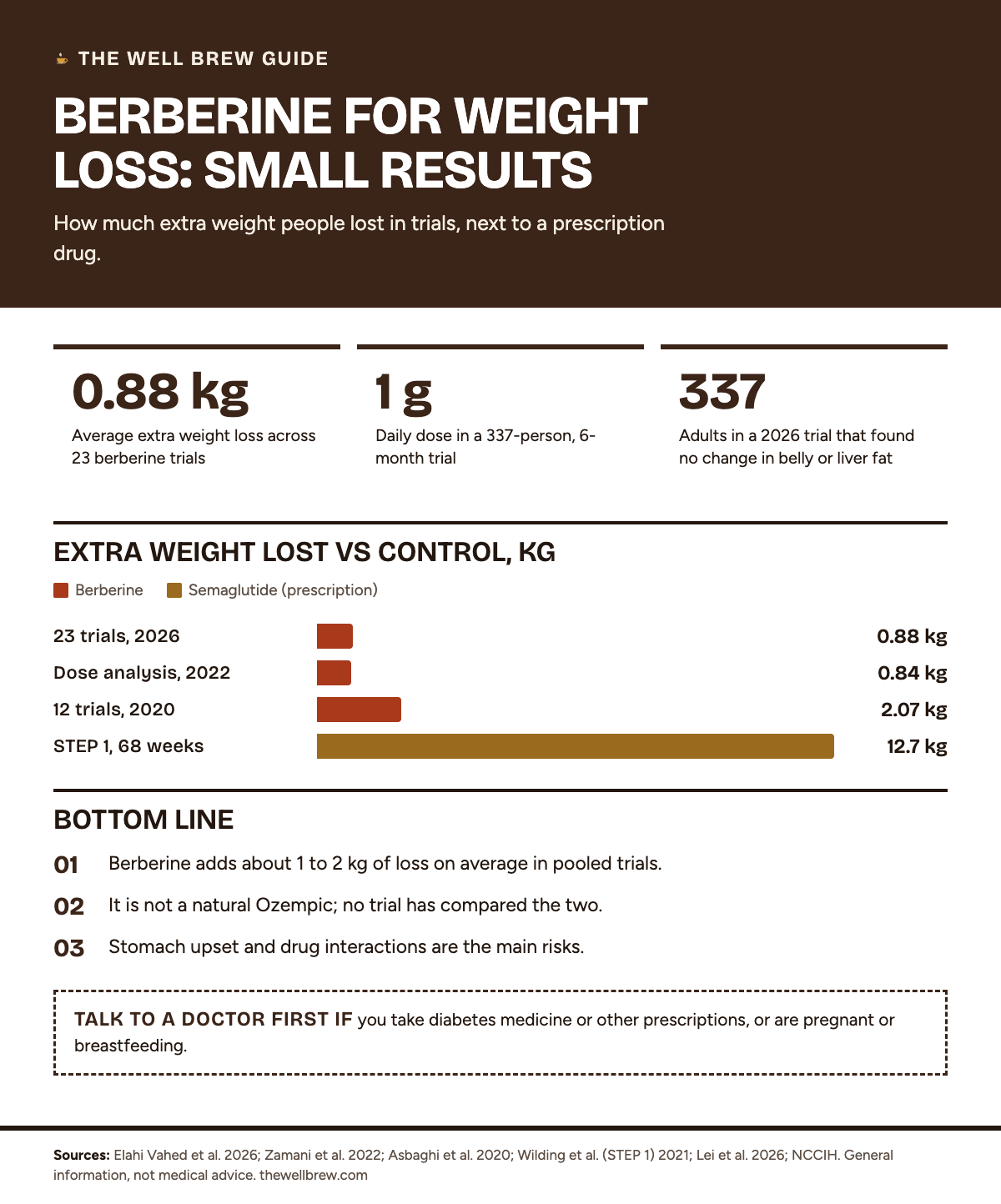
The short answer: in a 2026 pooled analysis of 23 trials, people taking berberine lost about 0.88 kg (roughly 2 pounds) more than people in the comparison groups, which is far less than prescription weight loss drugs produce.[3]
| What it is | A bitter plant compound found in barberry, goldenseal, goldthread, Oregon grape and tree turmeric.[1] |
|---|---|
| Studied for | Mainly blood sugar and cholesterol; weight is usually a secondary result in those trials.[1][4] |
| Average weight change | About 0.84 to 2.07 kg more than control groups, depending on the review.[2][3][4] |
| Amounts used in studies | 200 to 1,000 mg two to three times a day; many trials used about 1 g a day.[1][4] |
| Common side effects | Nausea, diarrhea, bloating and constipation.[1] |
| Who should avoid it | Pregnant or breastfeeding people and infants; ask a doctor first if you take any daily medicine.[1][10] |
What is berberine and what does it do in the body?
Berberine is a natural alkaloid, a bitter yellow compound, taken from the roots and bark of several plants. It has been used in traditional Chinese and Ayurvedic medicine, and today it is sold as a dietary supplement. Most modern research looks at its effects on blood sugar and blood fats rather than on weight itself.[1]
The NCCIH points to a 2021 review of 46 studies with 4,158 participants that found berberine may lower blood glucose. The same page warns that most of those studies were done in Chinese patients and some were of poor quality.[1]
A 2022 dose-response analysis also found small drops in triglycerides (about 23.70 mg/dL) and LDL cholesterol (about 9.63 mg/dL).[4] Weight loss, when it shows up, tends to be a side note to those blood sugar and cholesterol changes. If your main concern is your blood sugar numbers, our guide to prediabetes A1C ranges and how to lower them explains what the readings mean.
Does berberine help with weight loss?
Berberine may help a little: pooled trials show an average extra loss of about 1 to 2 kg (2 to 4.5 pounds) compared with control groups. The effect is small, and the trials differ a lot in quality, dose and who took part.[2][3]
Three reviews give a consistent picture. A 2020 meta-analysis of 12 randomized trials found an average drop of 2.07 kg in body weight and 0.47 points in body mass index (BMI).[2] A 2022 analysis found 0.84 kg.[4] The largest and newest, published in 2026 with 23 trials, found 0.88 kg, a BMI drop of 0.48 and a smaller waist, but no change in waist-to-hip ratio.[3]
The 2026 authors asked future trials to report the purity and strength of the berberine they used and to fix common problems such as weak blinding.[3] So the effect shows up across reviews, but it is small and comes from studies weaker than typical drug trials.
Is berberine for weight loss really nature’s Ozempic?
No. The “nature’s Ozempic” label is a social media nickname, and no trial we found has compared berberine with semaglutide or any other GLP-1 drug. The weight results are in a different range. Berberine trials show about 1 to 2 kg of extra loss. Semaglutide trials show double-digit percentages.[3][6]
In the STEP 1 trial, 1,961 adults with overweight or obesity took weekly semaglutide injections or a placebo for 68 weeks, along with a lifestyle program. The semaglutide group lost an average of 14.9% of body weight, compared with 2.4% on placebo. That came to about 15.3 kg versus 2.6 kg, a difference of about 12.7 kg.[6] Novo Nordisk, which makes the drug, funded the trial.
Semaglutide (Wegovy) and tirzepatide (Zepbound) are among six drugs the FDA has approved for long-term weight management.[7] Berberine is a supplement. It has not gone through that approval process, and supplement rules are less strict than drug rules.[12] Some online posts say berberine raises GLP-1, the gut hormone these drugs copy. We did not find a human trial that shows this leads to drug-like weight loss.
What do the berberine weight loss trials show?
The best trials show modest drops in weight and BMI, and one large, well-run 2026 trial found no change in belly fat or liver fat after 6 months. The table below sums up the main studies we read, from pooled reviews to single trials, with the comparison drug trial for scale.
| Study | Who and how long | Dose | Result |
|---|---|---|---|
| Elahi Vahed et al., 2026 meta-analysis[3] | 23 randomized trials in adults | Varied | Weight down 0.88 kg; BMI down 0.48; no change in waist-to-hip ratio |
| Asbaghi et al., 2020 meta-analysis[2] | 12 randomized trials | Varied | Weight down 2.07 kg; BMI down 0.47 |
| Zamani et al., 2022 dose-response analysis[4] | Randomized trials on heart risk factors | Best results near 1 g a day | Weight down 0.84 kg; LDL down 9.63 mg/dL |
| Lei et al., 2026 trial[5] | 337 adults with obesity and fatty liver, no diabetes, 6 months | 1 g a day vs placebo | No change in visceral (belly) fat or liver fat; LDL down 7.72 mg/dL |
| STEP 1, 2021, for comparison[6] | 1,961 adults with overweight or obesity, 68 weeks | Semaglutide 2.4 mg weekly | 14.9% weight loss vs 2.4% on placebo |
The 2026 trial was large and double-blind, with a placebo group, across 11 hospitals in China. Adherence was about 90% in both groups. Even so, berberine did not shrink the visceral fat that wraps around organs, which is the fat linked most closely to heart and metabolic risk.[5]
The trial did find small drops in LDL cholesterol and in a marker of inflammation, and side effects were about the same as placebo.[5] Berberine may move some blood test numbers more than it moves the scale.
How much berberine should one take per day for weight loss?
Studies have used 200 to 1,000 mg two to three times a day, and many weight and cholesterol trials used about 1 g (1,000 mg) a day split into doses. There is no official recommended dose for weight loss. The NCCIH describes this range as considered safe at the doses used in clinical settings.[1]
The 2022 dose-response analysis found the best results for weight and blood fats near 1 g a day.[4] That does not mean more is better. Going above the trial doses has not been shown to add weight loss, and stomach side effects were common at 1.5 g a day in one early trial.[8]
| Study or source | Dose | Daily total | Length |
|---|---|---|---|
| NCCIH safety range[1] | 200 to 1,000 mg, two to three times a day | 400 to 3,000 mg | Clinical use |
| Lei et al. trial[5] | 1 g a day | 1,000 mg | 6 months |
| Yin et al. trial[8] | 0.5 g three times a day | 1,500 mg | 3 months |
| Guo et al. drug-enzyme study[10] | 300 mg three times a day | 900 mg | 2 weeks |
Splitting the dose and taking it with meals is how most trials gave it. Because studies rarely lasted longer than 6 months, there is little data on taking berberine for years.[5][8]
A decision table before you buy
| If this is you | What to do first |
|---|---|
| You take metformin, insulin or another diabetes medicine | Talk to your doctor before starting; berberine also lowers blood sugar.[1][8] |
| You take cyclosporine, blood thinners or other prescription drugs | Ask a pharmacist to check for interactions; berberine slows enzymes that clear many drugs.[9][10] |
| You are pregnant, breastfeeding or trying to conceive | Skip berberine.[1] |
| Your BMI is 30 or more, or 27 or more with a weight-related condition | Ask about proven medical options, which can produce much larger losses.[6][7] |
| You are healthy, take no medicines and want a small extra push | Expect about 1 to 2 kg on average, and keep food and activity changes as the main plan.[2][3] |
What are the side effects of berberine, and who should avoid it?
The most common side effects of berberine are stomach problems: nausea, diarrhea, bloating and constipation. In one early trial, 20 of 48 adults (34.5%) had short-lived digestive side effects at 0.5 g three times a day.[1][8] In the 2026 trial at 1 g a day, side effects were about as common as on placebo.[5]
Some people should not take it at all. The NCCIH says berberine should not be used during pregnancy or breastfeeding and should not be given to infants, because it is linked to a harmful buildup of bilirubin in newborns.[1][11]
Drug interactions
Drug interactions are a larger worry than stomach upset. In a 2012 study of healthy men, 300 mg three times a day for 2 weeks slowed three liver enzymes (CYP2D6, CYP2C9 and CYP3A4) that break down many common drugs. Levels of the test drug midazolam rose by about 40%.[10]
In kidney transplant patients, berberine at 0.2 g three times a day raised blood levels of the anti-rejection drug cyclosporine by 29.3%.[9] Goldenseal, a plant that contains berberine, lowered metformin levels by about 25 percent in one study.[11]
Because berberine also lowers blood sugar, taking it with diabetes medicines could push glucose too low.[1][8] Tell your doctor and pharmacist about every supplement you take.[12]
What do doctors use first for weight loss?
Doctors start with a lifestyle program of healthier eating and more physical activity, and may add an FDA-approved medicine for adults with a BMI of 30 or more, or 27 or more with a weight-related health problem. NIDDK says medicines do not replace those habits and work best alongside them.[7]
On average, after 1 year, adults who take a prescription weight medicine as part of a lifestyle program lose 3% to 12% more of their starting weight than people in the lifestyle program alone.[7] The FDA has approved six drugs for long-term use, including orlistat, liraglutide, semaglutide and tirzepatide.[7]
If weight is affecting your health, a doctor can offer options with far stronger evidence than any supplement. Small, steady food changes help too; fiber is one example, and our guide to psyllium husk benefits for digestion, cholesterol and blood sugar covers one well-studied option. More appetite and metabolism guides are in our metabolism and appetite section.
What is the best berberine for weight loss?
No form of berberine has been shown in independent trials to cause more weight loss than another, so the best product is one with a clear dose and good quality checks. Most trials used plain berberine, often berberine hydrochloride, at around 1 g a day.[4][5] Newer forms are marketed as better absorbed, but we found no independent weight trial that backs that up.
Rules for supplements are less strict than rules for prescription drugs, and words like “standardized” do not guarantee quality.[12] Goldenseal products may contain very little berberine, and some contain herbs not listed on the label.[11] Use this checklist when you compare bottles. Our label checks are explained here, and more ingredient profiles are in our ingredients guides.
- Look for the amount of berberine per capsule in milligrams, not only the weight of the plant extract.
- Check that a full day’s serving stays within the 200 to 1,000 mg, two to three times a day range used in studies.[1]
- Prefer a third-party seal from USP, NSF or ConsumerLab, which tests for what is on the label.
- Skip blends that hide amounts behind a “proprietary blend” line.
- Avoid products that promise drug-like results or a set number of pounds.
- Bring the bottle to your pharmacist if you take any prescription medicine.[9][10]
- Stop and call your doctor if you get ongoing stomach upset or feel shaky or dizzy.
Bottom line
Berberine for weight loss is backed by a modest body of trials showing about 1 to 2 kg of extra loss over a few months, and a large 2026 trial found no effect on belly or liver fat.[2][3][5] It may help a little with blood sugar and cholesterol numbers, but it is not a natural version of Ozempic.
For most people, a food and activity plan, and a talk with a doctor about proven medicines if your BMI is high, is the better first step because those options have far stronger evidence. If you still want to try berberine, stay within studied doses and clear it with your doctor first if you take any medicine.[1][7]
Frequently asked questions
How long does berberine take to work for weight loss?
Most trials ran for about 3 to 6 months. Blood sugar changes appeared within the first week in one trial, but weight changes were small even by the end. Do not expect a visible change on the scale in the first few weeks.
Is berberine good for women?
Trials included both women and men, and the weight results were small for both. Women who are pregnant, breastfeeding or trying to conceive should not take berberine, because of the risk to newborns. Ask your doctor first if you take any medicine.
Can I take berberine with metformin or Ozempic?
Only with your doctor's advice. Berberine lowers blood sugar, so adding it to diabetes medicines could push glucose too low, and a berberine plant changed metformin levels in one study. We found no trials of berberine combined with semaglutide.
What is berberine good for besides weight loss?
Most research is on blood sugar and cholesterol. A review of 46 studies found it may lower blood glucose, and pooled trials show small drops in triglycerides and LDL cholesterol. The evidence is limited, and much of it comes from small studies.
Can you take berberine every day?
Trials gave berberine daily for up to 6 months at about 1 g a day, and side effects were mostly mild stomach problems. There is little data on daily use for years, so check in with your doctor if you plan to take it long term.
Sources
- Diabetes and Dietary Supplements. National Center for Complementary and Integrative Health
- The effect of berberine supplementation on obesity parameters, inflammation and liver function enzymes (Asbaghi et al.). Clinical Nutrition ESPEN, 2020
- The effect of berberine on obesity indices: a systematic review and meta-analysis (Elahi Vahed et al.). International Journal of Obesity, 2026
- Effects of berberine on cardiovascular risk factors: dose-response meta-analysis (Zamani et al.). Frontiers in Nutrition, 2022
- Berberine and Adiposity in Diabetes-Free Individuals With Obesity and MASLD: A Randomized Clinical Trial (Lei et al.). JAMA Network Open, 2026
- Once-Weekly Semaglutide in Adults with Overweight or Obesity (STEP 1, Wilding et al.). New England Journal of Medicine, 2021 (funded by Novo Nordisk)
- Prescription Medications to Treat Overweight and Obesity. National Institute of Diabetes and Digestive and Kidney Diseases
- Efficacy of berberine in patients with type 2 diabetes mellitus (Yin et al.). Metabolism, 2008
- Effects of berberine on the blood concentration of cyclosporin A in renal transplanted recipients (Wu et al.). European Journal of Clinical Pharmacology, 2005
- Repeated administration of berberine inhibits cytochromes P450 in humans (Guo et al.). European Journal of Clinical Pharmacology, 2012
- Goldenseal. National Center for Complementary and Integrative Health
- Using Dietary Supplements Wisely. National Center for Complementary and Integrative Health

Maya Ellison is the Reviews Editor at The Well Brew, a slow, plain-language supplement review blog for everyday adults. Maya reads each label in full, sets every dose beside the amounts used in human studies, grades the research with sources such as the NIH Office of Dietary Supplements and NCCIH, and works out the real cost and refund fine print. Maya has no medical credentials and is not a doctor, dietitian, nurse or pharmacist. Reviews give pros, cons and who a product suits, never scores. How we review supplements.
This article is general information, not medical advice. Dietary supplements are not reviewed by the FDA for safety or effectiveness before they are sold. Talk to your doctor before you start any supplement, especially if you are pregnant, nursing, take medication or have a health condition.