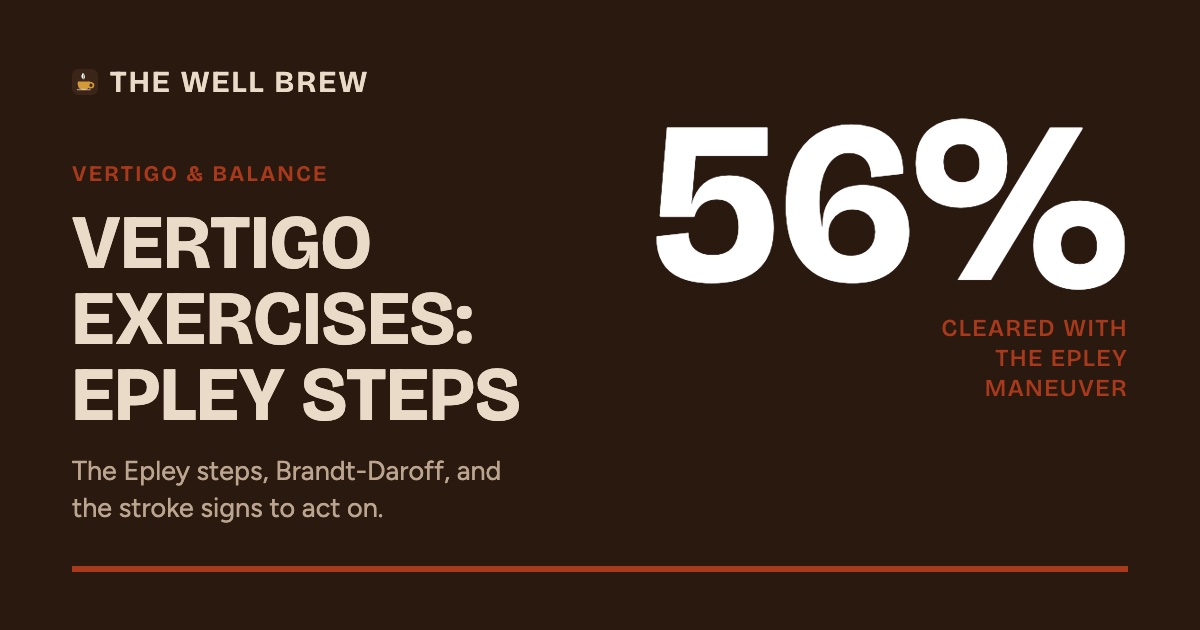
The Epley maneuver is the vertigo exercise with the best evidence for BPPV, the common inner-ear cause of spinning when you roll over or look up. In pooled trials it cleared symptoms in 56% of people versus 21% with sham moves. Brandt-Daroff exercises help less. Sudden dizziness with trouble walking, seeing or speaking needs 9-1-1, not exercises.
On this page
- How do you do the Epley maneuver for vertigo?
- Do vertigo exercises at home work?
- What are Brandt-Daroff exercises, and how do they work?
- Epley maneuver vs Brandt-Daroff: which BPPV exercises work best?
- What is BPPV, and why do head movements trigger vertigo?
- What are VOR exercises and vestibular therapy?
- How do you get rid of vertigo fast during an episode?
- Can vertigo be a sign of a stroke?
- When should you see a doctor for vertigo?
- Does vitamin D help stop BPPV from coming back?
- What doctors use first for positional vertigo
- Checklist before you try vertigo exercises at home
- Bottom line
- FAQ
We read the 2017 American Academy of Otolaryngology guideline on positional vertigo, two Cochrane reviews, an American Academy of Family Physicians review, four trials and the CDC stroke page to put together this guide to vertigo exercises. You can read how we review health sources before you start.
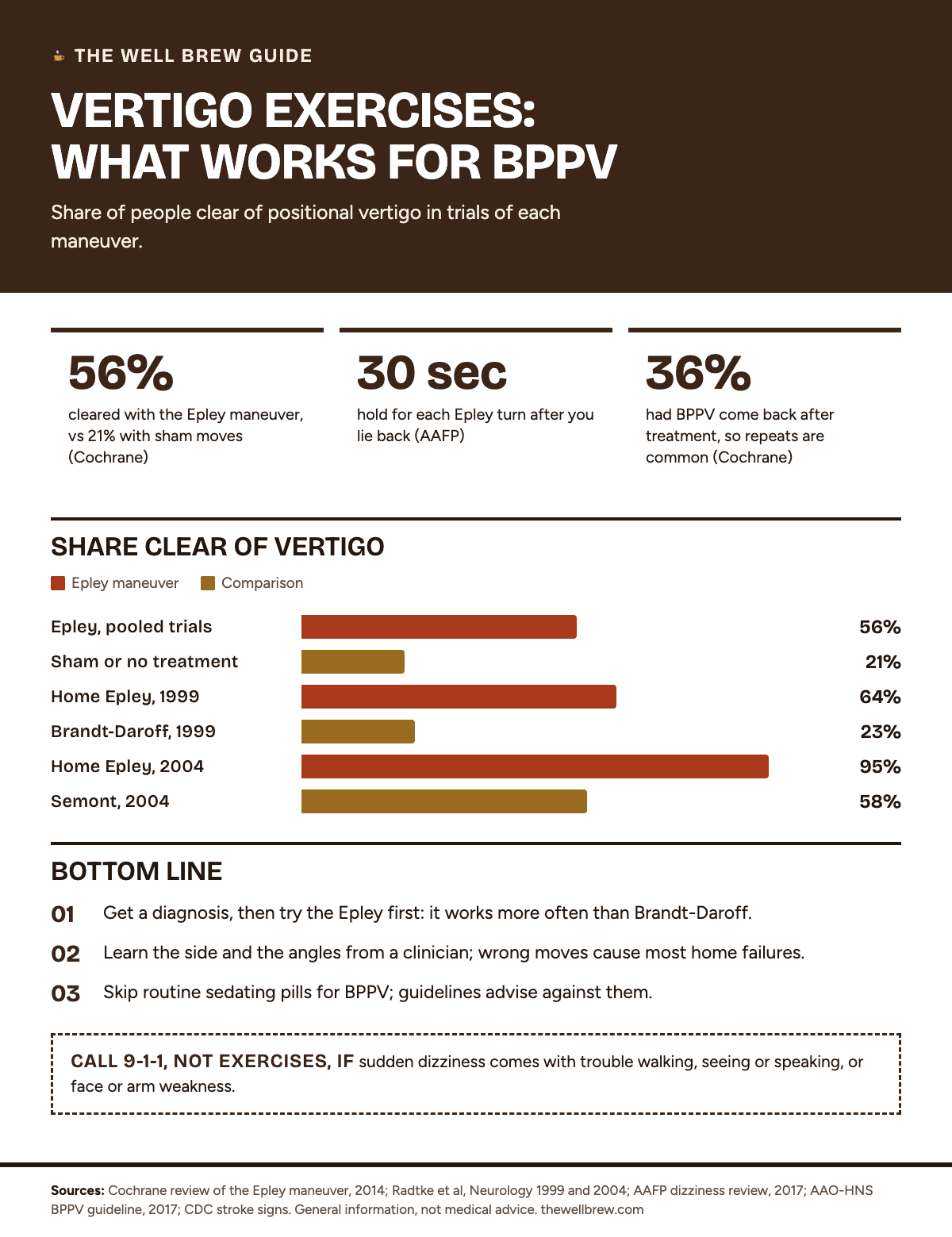
The short answer: for the common inner-ear type of positional vertigo, called BPPV, the Epley maneuver is the move with the best evidence. In pooled trials it cleared symptoms in 56% of people, compared with 21% after a sham move or no treatment[3].
| What they are | Head and body positions that move loose calcium crystals out of a balance canal in the inner ear[1] |
|---|---|
| Used for | BPPV: short spells of spinning when you roll over, bend down or look up[1] |
| Best-studied move | The Epley maneuver, tested in 11 trials with 745 people[3] |
| How well it works | About 70% on the first try in clinic, and nearly 100% after repeat attempts[4] |
| Home options | A self-applied Epley (95% response at 1 week in one trial) and Brandt-Daroff exercises[6][7] |
| Safety | No serious harms in the Cochrane review; nausea during the move in 16.7% to 32% of people[3] |
| Who should not self-treat | Anyone with sudden dizziness plus trouble walking, seeing or speaking, or face or arm weakness: call 911[10] |
How do you do the Epley maneuver for vertigo?
The Epley maneuver is a short series of head and body turns that guides loose crystals out of the back canal of the inner ear and into a spot where they stop causing spinning. The steps below follow the figure in the AAFP review for vertigo coming from the right ear[4]. For the left ear, mirror every turn.
- Sit on a bed or exam table with your legs out in front of you and your eyes open. Turn your head 45 degrees to the right[4].
- Lie back quickly so your head ends up hanging about 20 degrees past the end of the surface[4]. This is the same head position doctors use in the Dix-Hallpike test, so it can set off a burst of spinning[2]. Stay there while it settles.
- Turn your head 90 degrees to the left. Hold this position for 30 seconds[4].
- Turn your head another 90 degrees to the left while you roll your body onto your left side. Hold for 30 seconds[4].
- Sit up on the left side of the bed or table[4].
- Repeat the series if the spinning is still there. The AAFP review notes the move may be repeated until symptoms ease[4].
Have someone sit with you the first few times. Spinning and nausea are common during the move, and the NIDCD advises taking steps to lower your risk of falls when you are dizzy[1][3]. Once you are done, you do not need to sleep sitting up. The 2017 guideline made a strong recommendation against posture limits after a repositioning move[2].
Doing the turns toward the correct ear is part of the method. A clinician can confirm which ear is involved with the Dix-Hallpike test, which turns the head 45 degrees and tips the neck back 20 degrees with the affected ear down[2].
Do vertigo exercises at home work?
Home vertigo exercises can work well for BPPV of the back canal, as long as the moves are done correctly. In a 1999 trial of 54 adults, a home version of the Epley cleared symptoms within 1 week in 18 of 28 people (64%), against 6 of 26 (23%) who did Brandt-Daroff exercises[5].
A 2004 trial by the same Berlin group gave 70 adults a home routine. After 1 week, 95% of the home Epley group had no positional vertigo, compared with 58% using a different move called the Semont maneuver[6]. The authors linked most failures to people doing the move wrong[6].
For home use, getting the angles and the side right counts for more than the number of repeats. The 2017 guideline lists vestibular rehabilitation, done on your own or with a clinician, as an option for BPPV[2]. It still asks clinicians to treat with a repositioning move or refer you to someone who can[2].
What are Brandt-Daroff exercises, and how do they work?
Brandt-Daroff exercises are a home routine in which you move into the head position that sets off your vertigo over and over, on a regular schedule. The idea is that repeated movement loosens and spreads out the particles stuck in the back canal[7].
The method comes from a 1980 paper by Thomas Brandt and Robert Daroff. They treated 67 patients this way, and 66 had complete relief within 3 to 14 days[7]. Two people had the spinning come back, and a second course helped them[7]. The one person who did not improve turned out to have a different inner-ear problem, a perilymphatic fistula, that only looked like BPPV[7].
Later trials found weaker results. A single Epley beat a week of Brandt-Daroff done three times a day in the Cochrane review[3], and the 1999 home trial found 23% relief at 1 week with Brandt-Daroff[5]. We did not find a source we could read that gives exact hold times for each position, so ask a clinician or vestibular therapist to show you the routine. The AAFP review notes home treatment with Brandt-Daroff “can also be successful”[4].
Epley maneuver vs Brandt-Daroff: which BPPV exercises work best?
The Epley maneuver works faster and more often than Brandt-Daroff exercises in head-to-head trials. Brandt-Daroff is still a reasonable backup when the Epley is hard to do, or when a clinician suggests it. The table pulls together the main studies we read.
| Study | Who and how many | Compared | Result |
|---|---|---|---|
| Cochrane review, 2014[3] | 11 trials, 745 people | Epley vs sham or no treatment | Symptoms cleared in 56% vs 21% |
| Radtke, 1999[5] | 54 adults treating themselves | Home Epley vs Brandt-Daroff | 64% vs 23% clear at 1 week |
| Radtke, 2004[6] | 70 adults treating themselves | Home Epley vs Semont | 95% vs 58% clear at 1 week |
| Brandt and Daroff, 1980[7] | 67 patients, no control group | Brandt-Daroff only | 66 relieved in 3 to 14 days |
| AAFP review, 2017[4] | Clinic patients | Epley done by a clinician | About 70% first try, nearly 100% with repeats |
One caution from the Cochrane review: BPPV came back in about 36% of people after treatment[3]. Some people could not do the Epley because of neck problems[3]. If the spinning returns, the same move can be repeated.
What is BPPV, and why do head movements trigger vertigo?
BPPV, or benign paroxysmal positional vertigo, happens when tiny calcium crystals called otoconia come loose and tumble into one of the inner ear’s fluid-filled balance canals. They send the wrong message about where your head is, and your brain reads that as spinning[1].
The NIDCD describes the classic triggers: bending down to look under something, tilting your head up or over your shoulder, and rolling over in bed[1]. BPPV can follow a head injury or simply develop with age[1]. The AAFP review says it is most common between ages 50 and 70[4].
Dizziness in general is common. About 15 percent of American adults, or 33 million people, had a balance or dizziness problem in 2008[1]. Not all of it is BPPV, which is why the exercises in this guide fit only one kind of vertigo. You can find more on related conditions in our vertigo and balance guides.
What are VOR exercises and vestibular therapy?
Vestibular rehabilitation is exercise-based therapy that helps the brain adapt when one inner ear is not sending normal balance signals. VOR exercises train the vestibulo-ocular reflex. The 2022 APTA guideline describes gaze stabilization as head movement while keeping your eyes on a target, which may be still or moving[9].
The Cochrane review of 39 studies and 2,441 people found moderate to strong evidence that vestibular rehabilitation is safe and helps with inner-ear balance loss[8]. People were more likely to report less frequent dizziness, with an odds ratio of 2.67[8]. For BPPV, though, repositioning moves beat movement-based rehab in the short term[8]. Combining the two helped function over a longer stretch[8].
The APTA guideline gives starting doses for gaze exercises. It also advises against using eye-only exercises by themselves[9]. A vestibular therapist can build a plan for you, as the NIDCD notes[1].
| Stage of inner-ear loss | Gaze exercises | Balance exercises |
|---|---|---|
| Recent (acute or subacute), one side | 3 times a day, at least 12 minutes a day[9] | Set by the therapist |
| Long-standing (chronic), one side | 3 to 5 times a day, at least 20 minutes a day, for 4 to 6 weeks[9] | At least 20 minutes a day for 4 to 6 weeks[9] |
How do you get rid of vertigo fast during an episode?
For BPPV, the fastest fix is a repositioning move such as the Epley, and in many cases one session works. Some people need it several times before the dizziness clears[1]. Pills are a weaker choice for this kind of vertigo.
The 2017 guideline recommends against routinely treating BPPV with vestibular suppressant drugs such as antihistamines or benzodiazepines[2]. The AAFP review goes further. It says these drugs should be avoided in BPPV because they can slow the brain’s own adjustment and may raise the risk of falls[4]. The NIDCD adds that anti-vertigo drugs can make you drowsy[1].
While you wait for a spell to pass, keep yourself safe. The NIDCD suggests avoiding walking in the dark, wearing low-heeled shoes, using a cane or handrails if needed, and asking your doctor whether it is safe to drive[1].
Can vertigo be a sign of a stroke?
Yes. Sudden dizziness, loss of balance or trouble walking can be a stroke, and the CDC says to call 9-1-1 right away. Do not try vertigo exercises if any of the signs below appear together with the spinning[10].
The CDC lists these sudden signs of stroke[10]:
- Trouble walking, dizziness, loss of balance or lack of coordination
- Trouble seeing
- Numbness or weakness in the face, arm or leg, especially on one side
- Confusion, trouble speaking or trouble understanding speech
- A severe headache with no known cause
The CDC’s B.E. F.A.S.T. check starts with balance and eyes, then face, arms and speech, then time to call[10]. The stroke treatments that work best are open only if the stroke is diagnosed within 3 hours of the first symptoms[10].
The AAFP review estimates that brain-based causes are behind about 25% of dizziness[4]. Doctors use a bedside exam called HINTS to help tell a stroke apart from an inner-ear problem[4].
When should you see a doctor for vertigo?
See a doctor the first time you have vertigo, and again if it keeps coming back or the moves do not help. The NIDCD suggests talking to your doctor if you feel unsteady or feel the room spinning[1]. A diagnosis tells you which ear, which canal and whether the exercises fit at all.
- No improvement after repeated maneuvers. The AAFP review says another cause should then be considered[4].
- Symptoms still there at a recheck. The guideline asks clinicians to reassess within 1 month[2].
- Neck problems that make the head turns hard or painful[3].
- Poor mobility, poor balance, a nervous system disorder, little help at home or a high risk of falls. The guideline treats these as factors that change the plan[2].
- Hearing loss, ringing in the ear or vertigo that lasts for hours. These point away from BPPV, and the guideline asks clinicians to sort BPPV from other causes[2].
Does vitamin D help stop BPPV from coming back?
Vitamin D with calcium was studied for reducing repeat BPPV in people with low blood levels, with modest results. It is not a replacement for repositioning moves, and the evidence is limited[11][12].
A 2020 trial at 8 hospitals in Korea followed 1,050 people after a successful repositioning move. Those whose vitamin D level was below 20 ng/mL took 400 IU of vitamin D and 500 mg of calcium carbonate twice a day for 1 year[11]. Repeat BPPV hit 37.8% of that group, compared with 46.7% of the group that was only observed[11]. The yearly rate fell from 1.10 to 0.83 episodes per person[11]. The trial was rated Class III evidence[11].
A 2022 meta-analysis pooled 5 trials with 1,250 people and found fewer repeat episodes with vitamin D[12]. Four of the five trials were not randomized, and results varied widely between studies[12]. If your BPPV keeps coming back, ask your doctor whether a vitamin D blood test makes sense before you buy a supplement.
What doctors use first for positional vertigo
The 2017 guideline sets the standard path. A clinician confirms BPPV with the Dix-Hallpike test, then treats back-canal BPPV with a repositioning move or refers you to someone who can[2]. If that test shows a side-to-side eye movement or none, a supine roll test checks a different canal[2].
The same guideline advises against routine imaging and balance testing when the signs fit BPPV, and against routine sedating drugs[2]. The AAFP review says lab tests and imaging are usually not needed[4]. A repositioning move comes first. Supplements and pills are not substitutes.
Checklist before you try vertigo exercises at home
- Get a diagnosis first, so you know it is BPPV and which ear is involved[2].
- Rule out stroke signs: any trouble walking, seeing or speaking, or weakness, means 9-1-1, not exercises[10].
- Use a bed where your head can hang back about 20 degrees, and have a helper nearby[4].
- Hold each turn for the full 30 seconds[4].
- Expect some nausea during the move; it is common[3].
- Skip the move and ask a clinician if you have neck problems[3].
- Book a recheck if you are not better within about a month[2].
- Check how we grade studies on our review standards page.
Bottom line
For most people with BPPV, the Epley maneuver is the better first step than Brandt-Daroff exercises or pills, because it clears symptoms more often and faster in trials[3][5]. A home version can work well, but only once a clinician has confirmed the side and shown you the turns[6].
Treat new vertigo with care. Spinning that comes with trouble walking, seeing or speaking needs 9-1-1, not a maneuver[10]. For more on balance problems, browse our vertigo and balance section.
Frequently asked questions
Can I do the Epley maneuver on myself?
Yes, many people can. In a 2004 trial, 95% of adults using a home Epley had no positional vertigo after 1 week. Failures were mostly from doing the move wrong, so have a clinician confirm the side and show you the steps first.
Do I need to sleep upright after the Epley maneuver?
No. The 2017 guideline from the American Academy of Otolaryngology made a strong recommendation against posture limits after a repositioning move for back-canal BPPV. You can return to normal sleep and daily movement afterward.
How many times can I repeat the Epley maneuver?
The AAFP review says the move may be repeated until symptoms ease. It reports about 70% success on the first attempt and nearly 100% with repeat attempts. If repeats do not help, see a doctor, because another cause may be involved.
Is an Epley maneuver video safe to follow?
A video can help you see the turns, but trials link most home failures to doing the move wrong. Check that the video matches your affected ear, use the 45 degree head turn and 30 second holds, and ask a clinician to confirm the side.
Should I take anti-vertigo pills for BPPV?
Usually not as the main treatment. The 2017 guideline advises against routine vestibular suppressant drugs for BPPV, and the AAFP review says they may slow recovery and raise fall risk. A repositioning move works better for this type of vertigo.
Sources
- Balance Disorders. NIDCD, National Institutes of Health
- Clinical Practice Guideline: Benign Paroxysmal Positional Vertigo (Update). AAO-HNS Foundation, Otolaryngology-Head and Neck Surgery, 2017
- The Epley (canalith repositioning) manoeuvre for benign paroxysmal positional vertigo. Cochrane Database of Systematic Reviews, Hilton and Pinder, 2014
- Dizziness: Approach to Evaluation and Management. American Family Physician, AAFP, 2017
- A modified Epley's procedure for self-treatment of benign paroxysmal positional vertigo. Radtke et al, Neurology, 1999
- Self-treatment of benign paroxysmal positional vertigo: Semont maneuver vs Epley procedure. Radtke et al, Neurology, 2004
- Physical therapy for benign paroxysmal positional vertigo. Brandt and Daroff, Archives of Otolaryngology, 1980
- Vestibular rehabilitation for unilateral peripheral vestibular dysfunction. Cochrane Database of Systematic Reviews, McDonnell and Hillier, 2015
- Vestibular Rehabilitation for Peripheral Vestibular Hypofunction: An Updated Clinical Practice Guideline. APTA Academy of Neurologic Physical Therapy, Journal of Neurologic Physical Therapy, 2022
- Signs and Symptoms of Stroke. Centers for Disease Control and Prevention
- Prevention of benign paroxysmal positional vertigo with vitamin D supplementation: A randomized trial. Jeong et al, Neurology, 2020
- Prevention of recurrent benign paroxysmal positional vertigo with vitamin D supplementation: a meta-analysis. Jeong, Lee and Kim, Journal of Neurology, 2022

Maya Ellison is the Reviews Editor at The Well Brew, a slow, plain-language supplement review blog for everyday adults. Maya reads each label in full, sets every dose beside the amounts used in human studies, grades the research with sources such as the NIH Office of Dietary Supplements and NCCIH, and works out the real cost and refund fine print. Maya has no medical credentials and is not a doctor, dietitian, nurse or pharmacist. Reviews give pros, cons and who a product suits, never scores. How we review supplements.
This article is general information, not medical advice. Dietary supplements are not reviewed by the FDA for safety or effectiveness before they are sold. Talk to your doctor before you start any supplement, especially if you are pregnant, nursing, take medication or have a health condition.