Elderberry may shorten colds and flu slightly, but the evidence is weak and mixed. Small trials of Sambucus nigra extract found symptoms eased a few days sooner, while an 87-patient emergency room flu trial found no benefit. Short use of a commercial product looks low risk for most adults. Raw berries, leaves and stems are toxic, and nothing replaces standard care.
On this page
- What is elderberry good for?
- Does elderberry shorten colds and flu?
- What do the elderberry studies actually show?
- Is elderberry syrup better than gummies, tea or juice?
- How much elderberry did the trials use?
- Are raw elderberries poisonous?
- Is black elderberry the same as American elderberry or Sambucus?
- Elderberry vs zinc for colds: which has better evidence?
- Who should avoid elderberry?
- What do doctors use first for colds and flu?
- Elderberry checklist before you buy or take it
- Bottom line
- FAQ
Elderberry is one of the most popular supplements for colds and flu, and this guide checks whether it really shortens symptoms. We read the NCCIH pages on elderberry and on colds and flu, a 2021 systematic review, a 2019 meta-analysis, four clinical trials, a CDC poisoning report, the NIH zinc fact sheet and the standard care advice from MedlinePlus and CDC. Our method is on the how we review page.
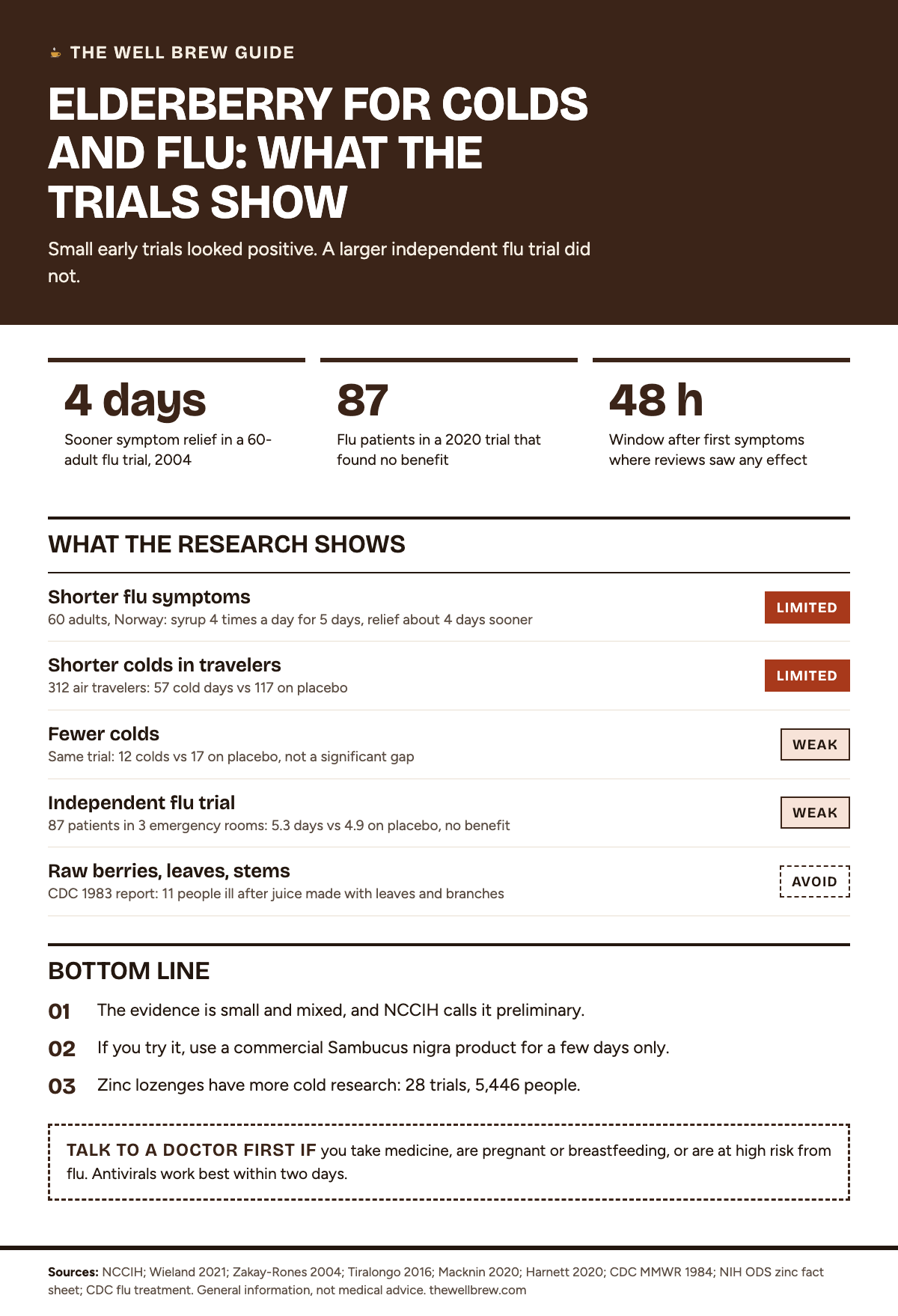
The short answer: a few small trials found that black elderberry extract eased cold and flu symptoms a few days sooner, but the largest independent flu trial, in 87 patients, found no benefit, and NCCIH calls the evidence preliminary.[1][3][7]
| What it is | The dark purple berry of the European or black elder tree, Sambucus nigra.[1] |
|---|---|
| Used for | Promoted for colds, flu and other upper respiratory infections.[1] |
| Amounts studied | 15 ml of syrup four times a day for 5 days in a flu trial; 600 to 900 mg of extract a day in a travel trial.[6][5] |
| Best evidence | A 2021 review of five randomized trials: it may shorten colds and flu, but the evidence is uncertain.[3] |
| Safety | Adverse events were rare in short trials. Raw or unripe berries, leaves and stems can cause vomiting and severe diarrhea.[8][1] |
| Who should check first | People who take any medicine, and anyone pregnant or breastfeeding, since safety there is unknown.[1] |
What is elderberry good for?
Elderberry is mainly studied for short-term relief of cold and flu symptoms, and that is the only use with any human trial data behind it. NCCIH says some preliminary research suggests it may relieve symptoms of flu, colds or other upper respiratory infections, and that there is not enough information on any other health purpose.[1]
The berry has a long history in European folk medicine for colds and flu. Today it is sold as syrups, capsules, lozenges and gummies, usually made from a standardized extract of Sambucus nigra.[1]
It was also heavily promoted for COVID-19. NCCIH says there is no good evidence for that use, and the FDA and Federal Trade Commission took action against companies that made unsupported COVID-19 claims for elderberry products.[1] A 2020 rapid review of clinical studies reached the same conclusion on COVID-19.[8]
If you are browsing the wider topic, our viral support guides cover other ingredients people reach for in cold and flu season.
Does elderberry shorten colds and flu?
Elderberry may shorten colds and flu by a few days, but the studies are small and the results do not agree. A 2021 systematic review by Wieland and colleagues found five randomized trials. It concluded that elderberry may not lower the chance of catching a cold, and that it may reduce how long colds and flu last, with uncertain evidence.[3]
The positive results come from a short list of trials. In a Norwegian study of 60 adults with flu, symptoms eased about 4 days sooner with elderberry syrup than with placebo.[6] A 2019 meta-analysis that pooled 180 people reported a large effect on upper respiratory symptoms.[4]
The strongest negative result came later. A 2020 trial at three emergency rooms gave elderberry extract or placebo to 87 people with lab-confirmed flu. Those on placebo reached mild symptoms in 4.9 days on average, compared with 5.3 days on elderberry, and the authors found no evidence of benefit.[7]
The early trials looked good, but a better-controlled trial did not confirm them, so the question is still open. NCCIH lists elderberry among flu approaches where there is not enough evidence to show it helps.[2]
What do the elderberry studies actually show?
Across the human studies, positive results came from small trials, often using one brand’s extract, while the largest independent flu trial was negative. The table below lists the main studies we read, with the size and result of each.
| Study | Who and how many | What was given | Result |
|---|---|---|---|
| Zakay-Rones, 2004[6] | 60 adults aged 18 to 54 with flu, Norway | 15 ml syrup four times a day for 5 days | Symptoms eased about 4 days sooner than placebo |
| Tiralongo, 2016[5] | 312 air travelers | 300 mg capsules, 600 mg a day before travel and 900 mg a day during it | No fewer colds; cold days 57 vs 117 on placebo |
| Hawkins, 2019[4] | Meta-analysis, 180 people in total | Various elderberry products | Large pooled effect on symptoms, from a small sample |
| Macknin, 2020[7] | 87 people with confirmed flu, ages 5 and up | 15 ml extract two or four times a day for 5 days | No benefit: 5.3 days vs 4.9 on placebo |
| Wieland, 2021[3] | Systematic review of five randomized trials | Several products | May shorten colds and flu; evidence uncertain |
In the travel trial, cold episodes were 17 on placebo and 12 on elderberry, a gap the authors said was not significant. The total symptom score over those days was 583 on placebo and 247 on elderberry.[5]
The Harnett rapid review of five clinical studies in 936 adults found possible benefits only when elderberry was started within 48 hours of the first symptoms, and the products were used for no more than 16 days.[8]
Is elderberry syrup better than gummies, tea or juice?
No form has been shown to beat another, because the trials tested specific syrups, extract capsules and lozenges, not gummies, teas or home juice. The flu trials used 15 ml doses of a liquid extract or syrup.[6][7] The travel trial used capsules of a filtered extract standardized to polyphenols.[5] The Harnett review covered extract and lozenge forms.[8]
When you shop, keep in mind that a gummy or tea may contain far less extract than the products studied, and many labels do not say how much. A product that is not the same extract at the same amount is not covered by those trial results.
Home-made syrups and juices raise a separate issue: the berries must be ripe and cooked, and stems and leaves must be removed. That safety point is covered below.[1][9]
If you compare labels across our ingredient guides, the same rule applies: look for the plant part, the extract amount per serving and a third-party testing seal.
How much elderberry did the trials use?
There is no official recommended dose for elderberry; the only guide is what the trials gave, for 5 to 16 days. The amounts below are the trial doses, not advice. A higher amount has not been shown to work better.[6][5][7][8]
| Situation in the trial | Form | Amount and length |
|---|---|---|
| Adults with flu, Norway[6] | Syrup | 15 ml four times a day for 5 days |
| Children 5 to 12 with flu[7] | Liquid extract | 15 ml twice a day for 5 days |
| People over 12 with flu[7] | Liquid extract | 15 ml four times a day for 5 days |
| Before a long flight[5] | 300 mg capsules | 600 mg a day |
| During travel and after arrival[5] | 300 mg capsules | 900 mg a day |
Note that the children’s dose comes from the trial that found no benefit.[7] In the reviews, any possible effect showed up when people started within 48 hours of the first symptoms.[8] Starting later has little trial support.
Are raw elderberries poisonous?
Yes. Raw or unripe elderberries, and the leaves and stems of the elder tree, contain substances that release cyanide and can cause nausea, vomiting and severe diarrhea. NCCIH says cooking removes this toxin, and that large amounts can cause serious illness.[1]
A CDC report shows how this happens. On August 26, 1983, in Monterey County, California, 11 people fell ill within 15 minutes of drinking juice made from wild elderberries. The berries had been crushed together with their leaves and branches. Eight people were flown to a hospital, and the person who drank five glasses was admitted overnight. All recovered.[9]
The report also noted that how sick people got matched how much juice they drank.[9] If you cook with elderberries at home, use only ripe berries, strip off every stem and leaf, and cook them fully. The trials all used commercial extracts, not home-made juice.
Is black elderberry the same as American elderberry or Sambucus?
Black elderberry, European elder and common elder all name one plant, Sambucus nigra, and that species is the one the cold and flu trials tested. NCCIH lists all three as common names for Sambucus nigra.[1]
Sambucus is the plant genus, so other species share the name. American elderberry and the western blue elder are different plants. The elder in the 1983 CDC poisoning case was a native western species.[9] The clinical evidence in this guide does not carry over to them.
On a label, look for “Sambucus nigra” and the plant part used, which should be the berry or fruit. If a product only says “elderberry” with no species, you cannot tell what you are buying.
Elderberry vs zinc for colds: which has better evidence?
Zinc lozenges have a larger body of cold research than elderberry, though no trial has compared the two directly. A 2021 meta-analysis summed up by the NIH Office of Dietary Supplements pooled 28 trials with 5,446 people. Symptoms cleared about 2 days sooner with zinc, with mixed effects on how bad they felt.[10]
| Point | Elderberry | Oral zinc |
|---|---|---|
| Size of evidence | Five randomized trials in one review[3] | 28 trials, 5,446 people[10] |
| NCCIH view on colds | Not listed among approaches that show promise[2] | Shows some promise in adults[2] |
| Main safety point | Raw berries and plant parts are toxic[1] | Upper limit of 40 mg a day for adults; nasal zinc linked to loss of smell[10][2] |
Zinc has costs of its own. NCCIH notes bad taste and nausea in some users, and long use of high doses can lower copper levels.[2] The lozenge trials often used 45 to 300 mg a day for up to 2 weeks, which is above the adult upper limit, so this is a short-term choice to discuss with a pharmacist.[10]
Vitamin D is another nutrient people try for respiratory infections. Our guide to Vitamin D benefits and how much you need covers what those trials found.
Who should avoid elderberry?
People who are pregnant or breastfeeding, and anyone taking regular medicine, should talk with a clinician before using elderberry. NCCIH says little is known about its safety in pregnancy and breastfeeding, and that some herbs and medicines interact in harmful ways.[1] The Harnett review also found no reliable evidence for use in pregnancy.[8]
In the short trials, side effects were uncommon, and they were reported more often in the comparison groups than with elderberry.[8] The Wieland review found no evidence that elderberry overstimulates the immune system.[3] That data covers only a few days to about two weeks of use.[8]
Never eat raw berries, leaves, bark or stems.[1] And do not use elderberry in place of medical care for COVID-19 or for flu in a high-risk person.[1][12]
See a doctor right away if you or your child have any of these:[11]
- Trouble breathing or fast breathing
- Signs of dehydration
- A fever that lasts longer than 4 days
- Symptoms that last more than 10 days without getting better
What do doctors use first for colds and flu?
For a cold, doctors recommend rest and symptom care, and for flu in higher-risk people, prescription antiviral drugs started early. MedlinePlus says there is no cure for the common cold, and it suggests rest, fluids, a clean humidifier, salt-water gargles, saline nose drops and over-the-counter symptom medicines.[11]
Colds are common. Adults average 2 to 3 a year, more than 200 viruses can cause them, and some symptoms last 10 to 14 days.[11] Antibiotics do not help, because colds are viral.[11]
For flu, CDC says antiviral drugs work best when started within two days of the first symptoms, and they can shorten illness by about a day. They need a prescription, and CDC advises early treatment for people at higher risk, such as those with asthma, diabetes or heart disease.[12]
If you use elderberry, use it alongside this care.
Elderberry checklist before you buy or take it
- Check that the label names Sambucus nigra and the berry or fruit as the plant part.[1]
- Find the extract amount per serving, and compare it with the trial doses above.[5][6]
- Start within 48 hours of the first symptoms if you are going to try it at all.[8]
- Keep use short, since trials lasted 5 to 16 days.[8]
- Skip any product that claims to cure, prevent or treat COVID-19.[1]
- Never make juice or syrup from raw berries with stems or leaves.[9]
- Ask a pharmacist first if you take medicine or are pregnant.[1]
- Read our guide to checking supplement labels and testing seals.
Bottom line
Elderberry has a few small trials suggesting it can ease cold and flu symptoms a few days sooner, but the best independent flu trial found nothing, and NCCIH rates the evidence as preliminary.[3][7][1] Short use of a commercial Sambucus nigra product appears low risk for most adults.[8]
For most people, rest and fluids for a cold, and a call to a doctor early for flu if you are high risk, are the better first steps, because those have stronger support. If you want a supplement for colds, zinc lozenges have more trials behind them than elderberry.[11][12][10]
Frequently asked questions
Do elderberry gummies work?
No trial has tested elderberry gummies. The studies used syrups, liquid extracts, capsules and lozenges at set amounts. A gummy may hold much less extract, so check the label for the amount of Sambucus nigra extract per serving before assuming it matches the research.
Is elderberry tea good for a cold?
Elderberry tea has not been studied in clinical trials for colds. A warm drink can be soothing and adds fluids, which MedlinePlus recommends for colds. Make sure any tea uses dried, processed berries, not raw berries, leaves or stems.
Can children take elderberry?
One flu trial gave children aged 5 to 12 a liquid extract twice a day for 5 days and found no benefit over placebo. Safety data in children is thin, so talk with your child's doctor before giving elderberry, especially to young children.
Does elderberry help with COVID-19?
No. NCCIH says there is no good evidence that elderberry helps prevent or treat COVID-19, and the FDA and FTC have acted against companies making those claims. Follow your doctor's advice and current testing and treatment guidance instead.
Can you take elderberry every day?
The trials used elderberry for short periods, from 5 to about 16 days, so there is little data on daily use for months. Taking it all season to avoid colds is not well supported, since a 2021 review found it may not lower the chance of catching one.
Sources
- Elderberry: Usefulness and Safety. National Center for Complementary and Integrative Health
- Colds, Flu, and Complementary Health Approaches. National Center for Complementary and Integrative Health
- Elderberry for prevention and treatment of viral respiratory illnesses: a systematic review. Wieland et al., BMC Complementary Medicine and Therapies, 2021
- Black elderberry supplementation effectively treats upper respiratory symptoms: a meta-analysis of randomized, controlled clinical trials. Hawkins et al., Complementary Therapies in Medicine, 2019
- Elderberry supplementation reduces cold duration and symptoms in air-travellers: a randomized, double-blind placebo-controlled clinical trial. Tiralongo et al., Nutrients, 2016
- Randomized study of the efficacy and safety of oral elderberry extract in the treatment of influenza A and B virus infections. Zakay-Rones et al., Journal of International Medical Research, 2004
- Elderberry extract outpatient influenza treatment for emergency room patients ages 5 and above: a randomized, double-blind, placebo-controlled trial. Macknin et al., Journal of General Internal Medicine, 2020
- The effects of Sambucus nigra berry on acute respiratory viral infections: a rapid review of clinical studies. Harnett et al., Advances in Integrative Medicine, 2020
- Poisoning from Elderberry Juice, California. CDC, Morbidity and Mortality Weekly Report, 1984
- Zinc: Fact Sheet for Health Professionals. NIH Office of Dietary Supplements
- Common Cold. MedlinePlus, National Library of Medicine
- Treating Flu with Antiviral Drugs. Centers for Disease Control and Prevention

Maya Ellison is the Reviews Editor at The Well Brew, a slow, plain-language supplement review blog for everyday adults. Maya reads each label in full, sets every dose beside the amounts used in human studies, grades the research with sources such as the NIH Office of Dietary Supplements and NCCIH, and works out the real cost and refund fine print. Maya has no medical credentials and is not a doctor, dietitian, nurse or pharmacist. Reviews give pros, cons and who a product suits, never scores. How we review supplements.
This article is general information, not medical advice. Dietary supplements are not reviewed by the FDA for safety or effectiveness before they are sold. Talk to your doctor before you start any supplement, especially if you are pregnant, nursing, take medication or have a health condition.