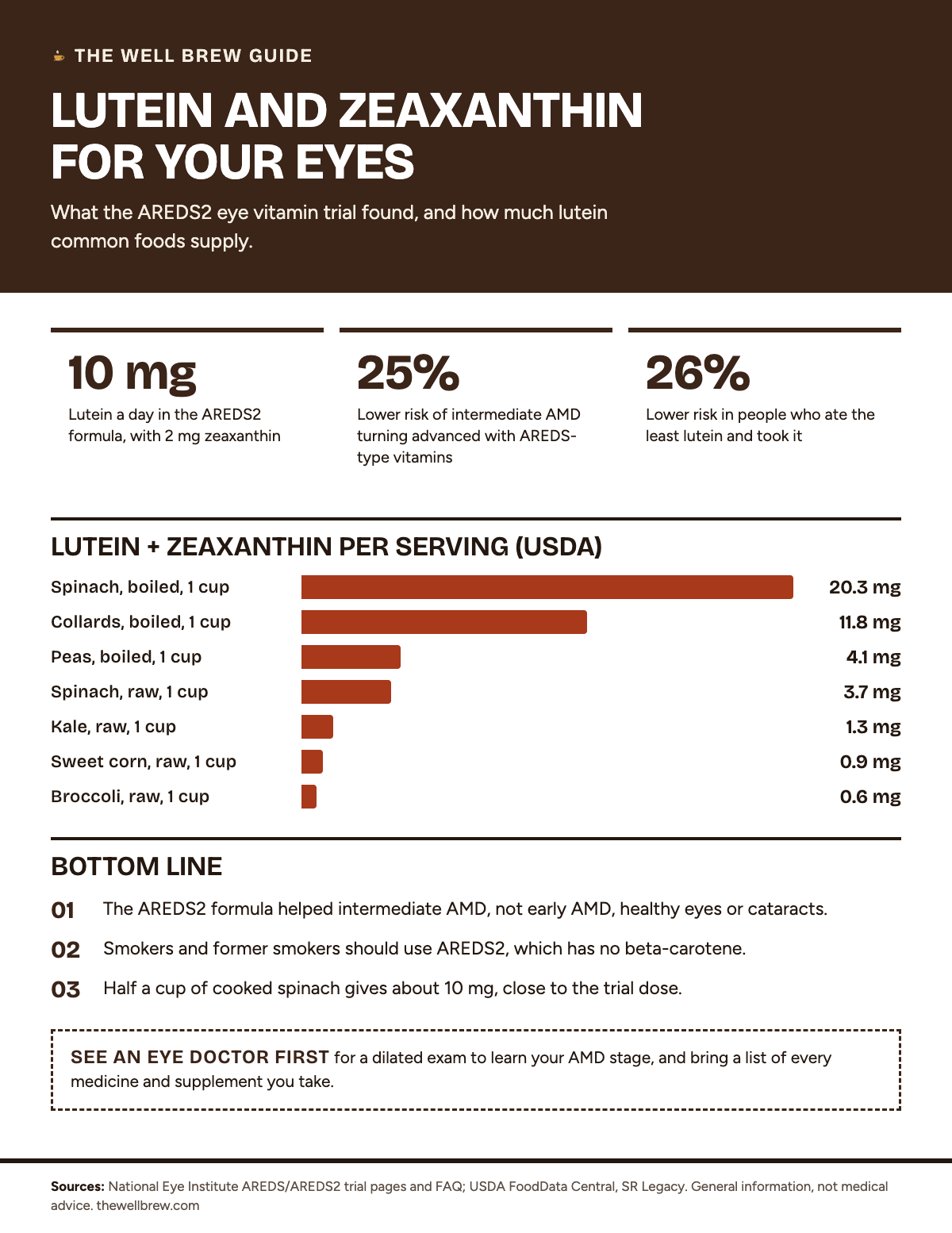
Lutein and zeaxanthin are plant pigments stored in the retina. The NEI's AREDS2 formula, with 10 mg of lutein and 2 mg of zeaxanthin plus vitamins C and E, zinc and copper, lowered the risk of intermediate macular degeneration turning advanced by about 25 percent. It did not help early AMD, healthy eyes or cataracts. Cooked spinach gives about 20 mg per cup.
On this page
- What is lutein?
- What do lutein and zeaxanthin do for the eyes?
- What did the AREDS2 trial find about lutein and zeaxanthin?
- Is lutein worth taking? What the 10-year follow-up showed
- Who should take a lutein supplement?
- What are the benefits of lutein beyond macular degeneration?
- Which foods have the most lutein and zeaxanthin?
- Is lutein a medication or a vitamin?
- How to choose based on your situation
- Is lutein safe? Side effects and who should check first
- What do eye doctors use first for macular degeneration?
- Practical checklist before you buy
- Bottom line
- FAQ
Lutein and zeaxanthin are two yellow plant pigments that collect in the back of the eye, and this guide explains what the AREDS2 trial found about them for macular degeneration, who the eye vitamin formula is meant for, and which foods supply the most. We read the National Eye Institute (NEI) trial pages and FAQ, the NIH Office of Dietary Supplements fact sheet on carotenoids, the main AREDS2 papers, a 2023 Cochrane review and USDA food data. Our method is on the how we review page.
The short answer: the AREDS2 formula with 10 mg of lutein and 2 mg of zeaxanthin lowered the chance of intermediate macular degeneration turning advanced by about 25 percent, but it showed no benefit for people with early AMD or healthy eyes.[1][2]
| What they are | Carotenoids, a family of plant pigments that also includes beta-carotene. The body does not turn them into vitamin A.[2][4] |
|---|---|
| Where they sit in the body | In the retina and lens, where they may act as antioxidants and absorb high-energy light.[2] |
| Studied amount | 10 mg lutein plus 2 mg zeaxanthin a day, inside the full AREDS2 formula.[1] |
| Best evidence | Slower progression from intermediate to advanced AMD with the AREDS2 formula. No effect on cataract.[1][7] |
| Top food sources | Cooked spinach has about 20 mg per cup and cooked collards about 12 mg.[9] |
| Safety | Not linked to higher cancer risk, unlike beta-carotene in former smokers.[2][6] |
| Who should ask first | Anyone on prescription medicine, since high-dose eye formulas can interfere with some drugs.[2] |
What is lutein?
Lutein is a yellow carotenoid pigment made by plants, found mostly in dark leafy greens and stored in the eye’s retina and lens. Zeaxanthin is its close chemical cousin, and the two usually travel together in food and in supplements. Both belong to the same nutrient family as beta-carotene.[2]
The body turns beta-carotene into vitamin A. It does not do that with lutein or zeaxanthin. The NIH calls them non-provitamin A carotenoids that “might have other important activities”.[4] Beta-carotene itself is not found in the eye, while lutein and zeaxanthin build up in the macula, the small central area of the retina that handles sharp, straight-ahead vision.[2][3]
Animal foods hold only small amounts, because animals store carotenoids from the plants they eat. Egg yolk is the best-known example.[2][9] You can browse other nutrients we have checked in our ingredient guides.
What do lutein and zeaxanthin do for the eyes?
In the eye, lutein and zeaxanthin may work as natural antioxidants and help absorb damaging high-energy light before it reaches the light-sensing cells. That is the reason researchers thought they might slow age-related macular degeneration (AMD), a disease of the macula.[2][4]
AMD blurs central vision. It does not cause complete blindness, but it can make it hard to read, drive or recognize faces. The NEI says about 11 million people in the United States have it, and risk rises after age 55, with a family history, and with smoking.[3]
Before AREDS2, several observational studies found that people who ate more of these carotenoids had a lower risk of advanced AMD.[2] Observational links like that cannot show cause and effect, so the NEI ran a randomized trial to test them directly.[1]
What did the AREDS2 trial find about lutein and zeaxanthin?
AREDS2 found that adding the two carotenoids to the original eye vitamin formula did not lower AMD progression overall, but swapping them in for beta-carotene worked at least as well and was safer. The trial enrolled 4,203 people aged 50 to 85 with intermediate or one-sided advanced AMD at 82 US sites.[1][5]
After a median of 5 years, 29 percent of eyes in the carotenoid group had progressed to advanced AMD, compared with 31 percent on placebo. That gap was not statistically significant.[5] Several subgroup results are worth knowing:
- People who ate the least of these carotenoids at the start had a 26 percent lower risk of advanced AMD when they took them.[2]
- A formula with lutein and zeaxanthin but no beta-carotene cut the risk of advanced AMD by 18 percent compared with the beta-carotene version.[2]
- Lung cancer showed up in 2 percent of people who took beta-carotene versus 0.9 percent of those who did not, and about 91 percent of those cases were in former smokers.[2]
Because of that lung cancer signal, the NEI replaced beta-carotene with lutein and zeaxanthin. The result is what stores sell as the AREDS2 formula.[1]
| Study | Who and how many | Length | Result |
|---|---|---|---|
| AREDS (original formula, beta-carotene) | 4,757 adults aged 55 to 80 | About 5 years, plus follow-up | About 25 percent lower risk of intermediate AMD turning advanced; 19 percent less central vision loss[1][2] |
| AREDS2 main trial | 4,203 adults aged 50 to 85 with intermediate AMD | Median 5 years | Adding 10 mg lutein and 2 mg zeaxanthin: 29 vs 31 percent progressed, not significant[5] |
| AREDS2 cataract report | 3,159 people with a natural lens | Median 4.7 years | No overall effect on cataract surgery (hazard ratio 0.96)[7] |
| AREDS2 10-year follow-up | 3,882 people | 10 years | Lower late AMD risk than beta-carotene (hazard ratio 0.85); lung cancer odds 1.82 with beta-carotene[6] |
| Cochrane review | 26 trials, 11,952 people | 6 months to 5 years | Lutein alone: similar or slightly reduced progression, low-certainty evidence[8] |
Is lutein worth taking? What the 10-year follow-up showed
For someone with intermediate AMD, the long-term data suggest the version with lutein is a better choice than the old beta-carotene formula. After the trial ended, all 3,882 remaining participants were offered the AREDS2 formula and followed for 5 more years.[6]
Over the full 10 years, people originally assigned the two carotenoids had a modestly lower risk of late AMD (hazard ratio 0.91), and a direct comparison against beta-carotene gave a hazard ratio of 0.85.[6] The NIH fact sheet describes this as an additional 20 percent reduced risk of progression compared with the beta-carotene supplement.[4]
Beta-carotene nearly doubled lung cancer odds (odds ratio 1.82), while the carotenoid swap showed no significant increase (odds ratio 1.15).[6] The 2023 Cochrane review reached a similar view: taken alone, these carotenoids may have little effect, but they look like a suitable replacement for beta-carotene in the AREDS formula.[8]
Who should take a lutein supplement?
The AREDS2 formula is meant for people whose eye doctor has found intermediate AMD in one or both eyes, or late AMD in one eye. In the trials, there was no benefit for people with early AMD or for people with no AMD at all.[2][3]
The NEI is direct about prevention: “Nutritional supplements cannot prevent AMD.”[2] The Cochrane authors put the scale of benefit in numbers. Among people with intermediate AMD, about 78 fewer per 1,000 progressed to late AMD with AREDS-type vitamins. Among people with early AMD, the figure was only about 4 per 1,000.[8]
Current and former smokers should use the AREDS2 version and avoid the original formula with beta-carotene.[1] The NEI does not make or endorse any brand, so compare labels against the trial amounts. More eye topics are collected in our vision support section.
What are the benefits of lutein beyond macular degeneration?
Outside of slowing intermediate AMD, the best trial data do not show clear benefits from lutein supplements, including for cataracts. In AREDS2, 24 percent of people not taking the carotenoids needed cataract surgery within 5 years, and the supplement did not change that overall (hazard ratio 0.96).[7]
One subgroup stood out. People with the lowest dietary intake had a lower rate of cataract surgery when supplemented (hazard ratio 0.68).[7] Subgroup findings need confirming in new trials, and the NEI summary still states that the AREDS formulas “do not have an effect on cataract”.[1]
Vision loss of 3 or more lines on an eye chart was also no different between groups.[7] Marketing claims about screen strain, sharper eyesight in healthy people or brain health go beyond what these sources tested, and we found no trial data to support them.
Which foods have the most lutein and zeaxanthin?
Dark leafy greens lead by a wide margin: one cup of cooked spinach has about 20 mg, roughly twice the AREDS2 daily amount. The American Academy of Ophthalmology names kale, spinach, collard greens and Swiss chard as ideal sources.[9][10]
| Food | Serving | Per serving | Per 100 g |
|---|---|---|---|
| Spinach, boiled | 1 cup (180 g) | About 20.3 mg | 11.3 mg[9] |
| Collard greens, boiled | 1 cup chopped (190 g) | About 11.8 mg | 6.2 mg[9] |
| Green peas, boiled | 1 cup (160 g) | About 4.1 mg | 2.6 mg[9] |
| Spinach, raw | 1 cup (30 g) | About 3.7 mg | 12.2 mg[9] |
| Kale, raw | 1 cup (21 g) | About 1.3 mg | 6.3 mg[9] |
| Sweet corn, raw | 1 cup (145 g) | About 0.9 mg | 0.6 mg[9] |
| Broccoli, raw | 1 cup chopped (44 g) | About 0.6 mg | 1.4 mg[9] |
| Egg, whole | 1 medium (44 g) | About 0.2 mg | 0.5 mg[9] |
Cooking shrinks greens, so a cup of cooked spinach holds far more leaves than a cup of raw. Eating them with some fat may help. In a small 2004 study of 7 people, carotenoids from a spinach salad were barely absorbed with fat-free dressing and absorbed much better with full-fat dressing.[11] Greens also feature in our guide to anti-inflammatory diet foods and meal ideas.
A worked example: reaching 10 mg from food
Half a cup of boiled spinach (90 g) works out to about 10 mg of lutein and zeaxanthin from the USDA figure, close to the trial dose.[9] A day with that side dish plus a cup of peas and an egg would land near 14 mg. The NEI notes, though, that the high vitamin and zinc levels in AREDS2 are difficult to reach from diet alone.[2]
Is lutein a medication or a vitamin?
Lutein is neither a prescription drug nor a vitamin; in the US it is sold as a dietary supplement ingredient. It is not converted to vitamin A, and no daily requirement for it was set in the sources we read.[4]
The FDA says supplement makers are responsible for evaluating the safety and labeling of their products before marketing, and the agency acts against unsafe or mislabeled products after they reach the market.[12]
The NEI also does not make the AREDS supplements and “cannot comment on the safety or effectiveness of any specific brand’s formulations.”[2] Read the panel and compare each amount with the trial formula below.
How to choose based on your situation
| If this describes you | What the evidence supports |
|---|---|
| No AMD, or early AMD only | Supplements showed no benefit. Eat leafy greens and fish, get regular dilated eye exams.[2][3] |
| Intermediate AMD in one or both eyes | Ask your eye doctor about the AREDS2 formula; this group benefited most.[1][8] |
| Late AMD in one eye | The AREDS2 formula may slow AMD in the other eye.[3] |
| Current or former smoker | Use AREDS2, not the beta-carotene formula.[1] |
| Already take a multivitamin | Keep it if you like; most trial participants took one alongside AREDS2, and it does not replace the formula.[2] |
| Wet AMD | Injections given by an eye doctor are the main treatment; supplements do not replace them.[3] |
Is lutein safe? Side effects and who should check first
In the large AREDS2 studies, lutein and zeaxanthin were not linked to higher cancer risk, and the Cochrane review found little or no effect on death rates. The Cochrane authors also warn that most trials were too small to detect rare side effects.[2][8]
Most safety questions come from the other parts of the AREDS2 formula:
- Zinc at 80 mg is far above food levels, so 2 mg of copper is added to prevent zinc-related copper deficiency.[1] Gut upset was the main side effect reported across zinc trials.[8]
- Vitamin E at 400 IU can interact with blood thinners, some chemotherapy drugs and cholesterol medicines.[2]
- The old formula’s beta-carotene raised lung cancer risk in former smokers.[4]
The NEI suggests bringing a full list of your medicines, supplements and over-the-counter drugs to your doctor before starting a high-dose formula.[2] If you are pregnant or breastfeeding, ask first; the AREDS trials enrolled only adults aged 50 and older.[1]
See an eye doctor promptly if straight lines start to look wavy, a blurry spot appears near the center of your vision, or colors look faded. These can be signs of late AMD.[3]
What do eye doctors use first for macular degeneration?
The first step is a dilated eye exam, often with an OCT scan, to find the type and stage of AMD. There is no treatment for early AMD, so doctors usually monitor it with regular exams.[3]
For intermediate AMD, eye doctors may suggest the AREDS2 supplements. For wet AMD, the main treatments are anti-VEGF medicines injected into the eye and photodynamic therapy, which combines an injection with a laser.[3] There is no current treatment for late dry AMD, though vision rehabilitation and low-vision devices can help.[3]
The NEI also lists everyday steps tied to lower AMD risk: not smoking, staying active, keeping blood pressure and cholesterol in a healthy range, and eating leafy greens and fish.[3] Supplements are used alongside these habits and the care an eye doctor gives.
Practical checklist before you buy
- Get a diagnosis first. Ask your eye doctor what stage of AMD you have, if any.[3]
- Match the label to the trial: 500 mg vitamin C, 400 IU vitamin E, 80 mg zinc, 2 mg copper, 10 mg lutein, 2 mg zeaxanthin.[1]
- Skip beta-carotene versions if you smoke now or used to.[1]
- Do not assume a multivitamin is enough; its doses are much lower than AREDS2.[2]
- Take it with a meal that has some fat, since carotenoids absorb poorly without it.[11]
- Share your full medicine list with your doctor or pharmacist.[2]
- Check how we judge product claims on our review standards page.
Bottom line
Lutein and zeaxanthin earned their place in the AREDS2 formula mainly as a safer swap for beta-carotene, and that formula can slow intermediate AMD by about a quarter.[1][6] Healthy eyes and early AMD showed no gain from the pills, and cataract risk did not change.[2][7]
For most people, a daily serving of cooked greens with a little oil is the better first step, because it supplies plenty of these carotenoids at almost no cost. If an eye doctor finds intermediate AMD, that is the point to talk about the full AREDS2 formula.[8][9]
Frequently asked questions
How much lutein should I take a day?
No official daily requirement exists in the sources we read. The amount tested in the NEI's AREDS2 trial was 10 mg of lutein with 2 mg of zeaxanthin a day, as part of the full formula. There is no trial evidence that more works better.
Are zeaxanthin and lutein the same thing?
No, but they are close relatives. Both are yellow carotenoids from plants that collect in the retina and lens, and they usually appear together in leafy greens. AREDS2 used them in a 5 to 1 ratio, 10 mg to 2 mg.
Can a multivitamin replace the AREDS2 formula?
No. The NEI says multivitamins contain much lower doses than the AREDS formulas. Most trial participants took a multivitamin as well, and the AREDS formula still gave a benefit on top of it, so the two are not swaps.
Should I take lutein with food?
Yes, a meal with some fat is sensible. A small 2004 study found carotenoids from a salad were barely absorbed with fat-free dressing. Taking the supplement with breakfast or dinner is an easy habit.
Why do smokers need the AREDS2 version?
The original formula contained beta-carotene, which raised lung cancer risk in smokers and former smokers. In AREDS2, lung cancer occurred in 2 percent of people on beta-carotene versus 0.9 percent without it. The AREDS2 version swaps it for lutein and zeaxanthin.
Sources
- AREDS/AREDS2 Clinical Trials. National Eye Institute, updated 2025
- AREDS/AREDS2 Frequently Asked Questions. National Eye Institute
- Age-Related Macular Degeneration (AMD). National Eye Institute
- Vitamin A and Carotenoids: Fact Sheet for Health Professionals. NIH Office of Dietary Supplements
- Lutein + zeaxanthin and omega-3 fatty acids for age-related macular degeneration: the AREDS2 randomized clinical trial. JAMA, 2013
- Long-term Outcomes of Adding Lutein/Zeaxanthin and Omega-3 Fatty Acids to the AREDS Supplements on AMD Progression: AREDS2 Report 28. JAMA Ophthalmology, 2022
- Lutein/zeaxanthin for the treatment of age-related cataract: AREDS2 randomized trial report no. 4. JAMA Ophthalmology, 2013
- Antioxidant vitamin and mineral supplements for slowing the progression of age-related macular degeneration (Evans and Lawrenson). Cochrane Database of Systematic Reviews, 2023
- FoodData Central, SR Legacy: lutein + zeaxanthin in spinach, collards, peas, kale, corn, broccoli and egg. USDA Agricultural Research Service
- Diet, Nutrition, and Eye Health Supplements. American Academy of Ophthalmology
- Carotenoid bioavailability is higher from salads ingested with full-fat than with fat-reduced salad dressings (Brown et al.). American Journal of Clinical Nutrition, 2004
- Dietary Supplements. US Food and Drug Administration

Maya Ellison is the Reviews Editor at The Well Brew, a slow, plain-language supplement review blog for everyday adults. Maya reads each label in full, sets every dose beside the amounts used in human studies, grades the research with sources such as the NIH Office of Dietary Supplements and NCCIH, and works out the real cost and refund fine print. Maya has no medical credentials and is not a doctor, dietitian, nurse or pharmacist. Reviews give pros, cons and who a product suits, never scores. How we review supplements.
This article is general information, not medical advice. Dietary supplements are not reviewed by the FDA for safety or effectiveness before they are sold. Talk to your doctor before you start any supplement, especially if you are pregnant, nursing, take medication or have a health condition.