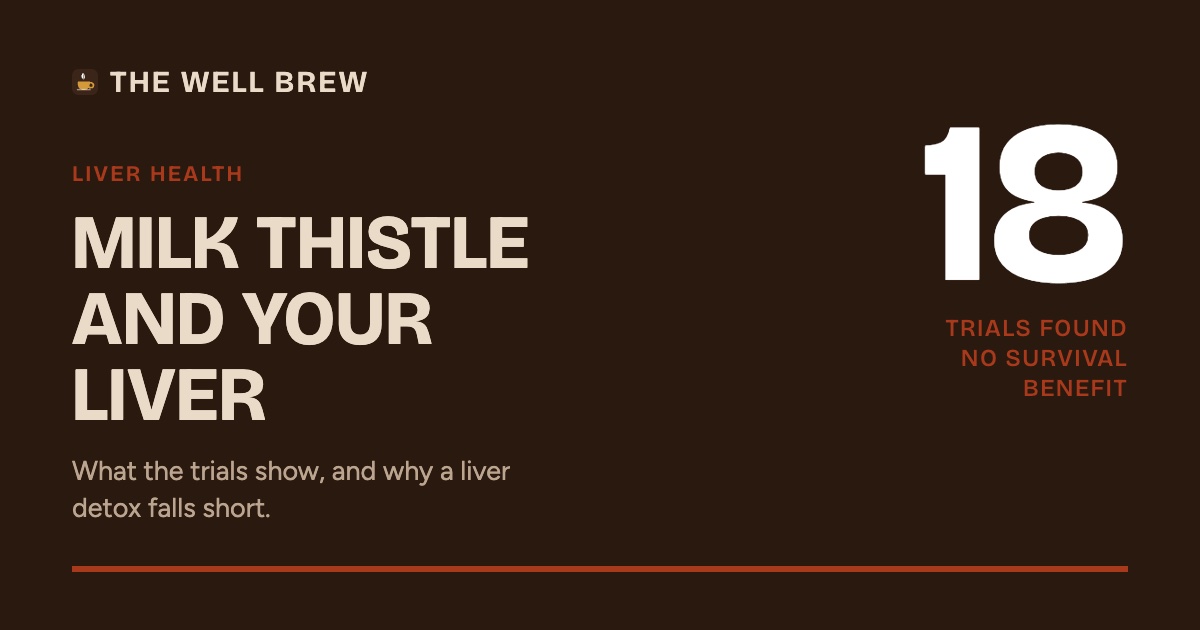
Milk thistle has not been shown to protect or repair the liver. A Cochrane review of 18 trials with 1,088 people with liver disease found no effect on deaths or liver damage, and two US trials at high doses found no clear benefit. It is usually safe, with mild stomach side effects. No research shows liver detox products remove toxins.
On this page
- What is milk thistle?
- Is milk thistle good for your liver?
- What the trials found: milk thistle and liver disease
- Does a liver detox work?
- Does milk thistle help fatty liver?
- What is milk thistle good for?
- What does milk thistle do in the body?
- What are milk thistle side effects?
- Safety: who should avoid milk thistle?
- What do doctors use first for liver health?
- How to decide on milk thistle: a simple decision table
- How do you pick a milk thistle supplement?
- Bottom line on milk thistle and liver detox
- FAQ
Milk thistle is the herb most often sold for liver health, so we read the NIH fact sheet on the herb, the National Cancer Institute summary, a Cochrane review and four randomized trials before writing this guide[1][3][5]. We also read what NIH says about “detox” products in general[2].
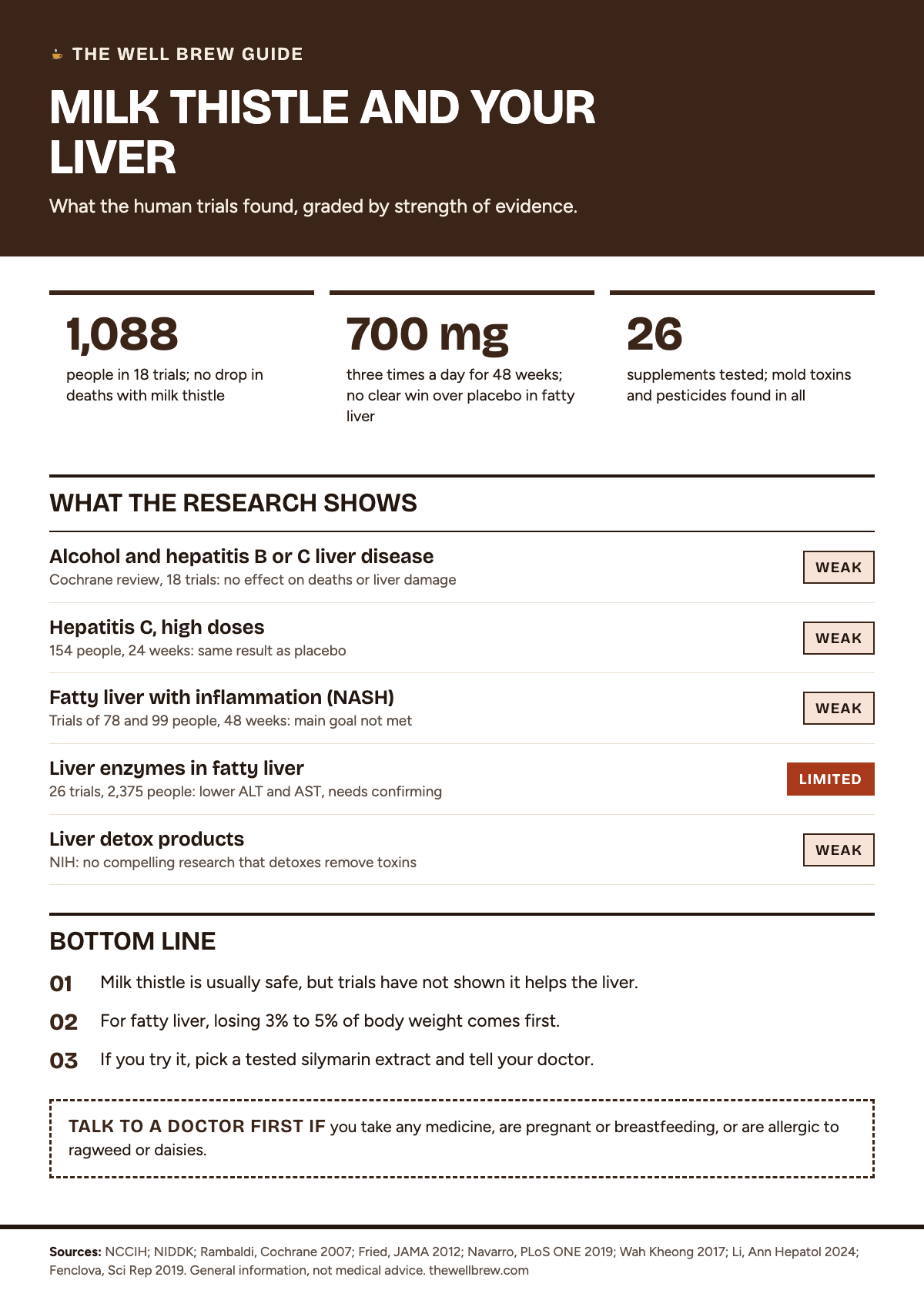
The short answer: in 18 trials with 1,088 people who had liver disease, milk thistle did not lower the death rate, and the larger, better-run trials since then found no clear benefit either[5][6][7].
| What it is | A tall plant with purple flowers, native to Europe. Its seed extract, silymarin, is a mix of plant compounds[1]. |
|---|---|
| Main use | Sold as a supplement for liver problems, blood sugar and other conditions[1]. |
| Amounts in trials | 420 mg or 700 mg of silymarin, three times a day, for 24 to 48 weeks[6][7][8]. |
| Best evidence | Cochrane review of 18 trials: no effect on death rate, complications or liver tissue[5]. |
| Safety | Usually well tolerated. Bloating, nausea and gas are the most common side effects[1]. |
| Who should ask first | People on any medicine, people allergic to ragweed or daisies, and anyone pregnant or breastfeeding[1]. |
What is milk thistle?
Milk thistle (Silybum marianum) is a flowering plant whose seeds give an extract called silymarin, the form used in most supplements and studies. It also goes by Mary thistle and holy thistle[1]. People have used it for liver complaints for a long time, and also to try to raise breast milk supply[1].
Silymarin is not one chemical. It is a blend of several related compounds, and the main ones are called silybin A and B[3]. Most research tested silymarin or silybin, not the whole plant[3]. That matters when you shop, because a capsule of ground seed and a standardized extract are not the same product.
In the United States, milk thistle is sold as a dietary supplement. Supplements are not approved by the FDA before they go on sale, and the maker is responsible for safety and labeling[1]. You can read more about how we judge herbs like this on our supplement ingredients guides page.
Is milk thistle good for your liver?
The best evidence says this herb has not been shown to help the liver in people with liver disease. NIH states that trials in alcohol-related liver disease, hepatitis B and C, and fatty liver disease have been “conflicting or too limited” to reach conclusions[1]. Two NIH-funded trials found no benefit[1].
The Cochrane review is the clearest single summary. It pooled 18 randomized trials with 1,088 patients who had alcohol-related or viral liver disease[5]. The herb made no significant difference to deaths, liver complications or liver tissue on biopsy[5].
Liver-related deaths were lower when all trials were counted together. But when the reviewers looked only at the high-quality trials, that effect was no longer significant[5]. Only 28.6% of the trials reported high-quality methods[5]. The reviewers wrote that their results “question the beneficial effects” of the herb[5].
For a healthy person with a normal liver, there are no trials showing it makes the liver work better. Keep that in mind when a label promises “liver support.”
What the trials found: milk thistle and liver disease
Across the trials we read, silymarin was safe, but it did not beat placebo on the main goal the researchers set. The table below lists each one with its size, length and dose.
| Study | Who and how many | Dose and length | Main result |
|---|---|---|---|
| Cochrane review, 2007[5] | 18 trials, 1,088 people with alcohol or hepatitis B or C liver disease | Any dose, any length | No effect on deaths, complications or liver tissue |
| Fried, JAMA 2012[6] | 154 people with chronic hepatitis C | 420 mg or 700 mg, 3 times a day, 24 weeks | Only 2 people per group reached the liver enzyme goal, same as placebo |
| Navarro, PLoS ONE 2019[7] | 78 people with NASH, no cirrhosis | 420 mg or 700 mg, 3 times a day, 48 weeks | 15% and 19% improved versus 12% on placebo, not significant |
| Wah Kheong, 2017[8] | 99 people with biopsy-proven NASH | 700 mg, 3 times a day, 48 weeks | 32.7% versus 26.0% met the goal, not significant; less scarring in a secondary result |
| Li, meta-analysis 2024[9] | 26 trials, 2,375 people with fatty liver | Varied | Lower liver enzymes; authors say results need confirming |
Two of these trials tested doses higher than what is usual, and still found no clear gain[6][7]. A bigger dose did not mean more benefit.
Does a liver detox work?
No good research shows that detox diets or cleanse products remove toxins from the body. A 2015 review cited by NIH found “no compelling research” to support detox diets for weight control or for getting rid of toxins[2]. No studies have looked at their long-term effects[2].
A healthy liver filters the blood on its own. No study we read showed that a store-bought kit makes it work better.
Some detox products have caused real trouble. The FDA and FTC have acted against companies whose detox products held hidden ingredients or made false claims about treating serious disease[2]. Detox plans that rely on laxatives can cause diarrhea, which can lead to dehydration[2].
The herb shows up in many “liver detox” blends. Nothing we read suggests that adding it turns a detox product into one that works. NIDDK also warns that some herbal remedies can damage the liver[4].
Does milk thistle help fatty liver?
Silymarin has not been shown to clear fatty liver disease, though pooled studies show it may lower liver enzyme numbers on blood tests. The best-designed trials used liver biopsies, and in both, silymarin did not beat placebo on the main measure[7][8].
In the Malaysian trial of 99 adults, 32.7% on silymarin and 26.0% on placebo improved on the main liver score, a gap too small to count[8]. More people on silymarin had less scarring on biopsy, 22.4% versus 6.0%, but the authors said this “remains to be confirmed in a larger trial”[8].
The US trial of 78 people found no benefit, and 63% of those enrolled did not meet the entry criteria on a second biopsy review, which weakens the result in both directions[7].
Meta-analyses pooling 25 or 26 smaller trials found lower ALT and AST, two liver enzymes[9][10]. Lower enzymes on a lab test are not the same as a healthier liver, and the authors of both asked for more research[9][10]. For fatty liver, see our liver health guides for the steps doctors use first.
What is milk thistle good for?
No health use of this herb is backed by strong evidence, according to NIH. The agency says there is not enough high-quality research to reach firm conclusions on any condition[1].
The area with the most promise is blood sugar. A small number of studies suggest the extract may help control blood sugar in people with type 2 diabetes[1]. Most of that work was done in Middle Eastern countries, and NIH says it is unclear whether the results hold elsewhere[1].
In cancer care, a few small trials have looked at silymarin for side effects of treatment. One trial in children with leukemia found less liver strain from chemotherapy[3]. Another, in 30 people with head and neck cancer, found lower rates of mouth sores from radiation[3]. These trials were small and early, so they do not justify starting it on your own.
Whether it raises breast milk supply is unclear[1].
What does milk thistle do in the body?
In lab and animal work, silymarin acts as an antioxidant and reduces inflammation, which is why researchers hoped it would protect liver cells. The authors of the Malaysian trial described it as having antioxidant, anti-inflammatory and antifibrotic effects in earlier research[8].
Lab effects do not always carry over to people. The human trials above are the real test, and they have mostly come up short[5][6][7].
There is one medical setting where a silymarin compound is used. In Europe, silybin is given into a vein as a treatment for poisoning from the death cap mushroom, Amanita phalloides[3]. Doctors give it in a hospital, so it tells us nothing about daily capsules from a store.
What are milk thistle side effects?
Milk thistle side effects are usually mild, and the most common are bloating, nausea and gas. NIH says the herb taken by mouth appears to be well tolerated[1]. NCI adds that it may rarely cause a laxative effect, heartburn or upset stomach[3].
The trials back this up. In the Cochrane review, the herb did not raise the risk of side effects compared with placebo[5]. The two US trials found side effect rates similar to placebo, even at high doses[6][7]. One recent meta-analysis did find more people reporting side effects on silymarin, mostly stomach problems[10].
Allergy is the other risk. People allergic to related plants, such as ragweed, chrysanthemum, marigold and daisy, may react to it[1].
Safety: who should avoid milk thistle?
Anyone who takes medicine should talk with a doctor or pharmacist before trying milk thistle, because some herbs and medicines interact in harmful ways. That is NIH’s general advice for this herb[1].
- If you are pregnant or breastfeeding, little is known about safety, so skip it unless your doctor says otherwise[1].
- People allergic to ragweed, daisies or marigolds are at higher risk of a reaction[1].
- If you have diabetes, ask before combining it with your medicine, because it may affect blood sugar[1].
- If you have liver disease, do not use it in place of care from your doctor, and tell your doctor about every herb you take, since some herbs can harm the liver[4].
Quality is a problem too. A Czech study tested 26 of these supplements bought in the US and Europe[11]. Silymarin content varied widely and often did not match the label, and the researchers found mold toxins and pesticides in all of them[11]. NIH raises the same concern[1].
If you have symptoms you think come from your liver, see a doctor and get tested. Do not try to self-treat with a supplement first.
What do doctors use first for liver health?
For fatty liver, the first treatment doctors recommend is gradual weight loss, along with regular physical activity. NIDDK says losing at least 3% to 5% of body weight can reduce fat in the liver[4]. Losing 7% to 10% may be needed to reduce inflammation and scarring[4].
Exercise helps even without weight loss[4]. NIDDK also says to lose weight slowly, because rapid weight loss can make liver disease worse[4].
For hepatitis B or C and alcohol-related liver disease, care comes from a doctor, often a liver specialist, with tests and proven medicines. A supplement is never a replacement for that care. If your doctor finds high liver enzymes, ask what is causing them before you buy anything.
How to decide on milk thistle: a simple decision table
Your situation decides whether milk thistle is worth discussing, and for most people the answer is to start somewhere else. This table puts the evidence above into plain steps.
| If you | Then |
|---|---|
| Feel fine and want to “detox” | Skip it. No research shows detox products remove toxins[2]. |
| Were told you have fatty liver | Start with gradual weight loss of 3% to 5% and more activity[4]. |
| Have hepatitis B or C | Get treatment from your doctor; silymarin did not help in trials[5][6]. |
| Drink heavily | Talk to your doctor about cutting back; the herb did not lower deaths in trials[5]. |
| Take any daily medicine | Ask your pharmacist before trying any herb[1]. |
| Still want to try it | Choose a standardized silymarin extract with third-party testing and tell your doctor[11]. |
How do you pick a milk thistle supplement?
If you decide to try it, pick a product that states its silymarin amount and has been checked by an outside lab. Testing found label claims often did not match what was inside[11].
- Look for the silymarin amount in milligrams on the label, not only “seed powder.”
- Look for a third-party testing seal, since contamination was common in tested products[11].
- Avoid blends that promise to “detox” or “cleanse” the liver[2].
- Skip products that claim to treat a disease. Supplements are not approved by the FDA before sale[1].
- Do not take more than the label says. Higher doses gave no added benefit in trials[6][7].
- Bring the bottle to your next checkup so your doctor knows what you take.
Our how we review supplements page explains the label checks we use.
Bottom line on milk thistle and liver detox
Milk thistle is mostly safe, but the research has not shown that it protects or repairs the liver[1][5]. Two careful US trials at high doses found no clear benefit, and “detox” products have no solid evidence behind them[2][6][7].
For most people, the better first step is the one doctors already use: gradual weight loss, more activity and less alcohol, with blood tests to track progress[4]. If you still want to try it, treat it as an extra, choose a tested product, and tell your doctor.
Frequently asked questions
Is milk thistle tea as good as capsules?
The trials we read all used standardized silymarin extracts, often 420 mg or more three times a day. We found no trials of milk thistle tea for liver health, so there is no evidence it matches the extracts used in studies.
What are milk thistle benefits for women?
No benefit specific to women has been proven. Milk thistle has long been used to try to raise breast milk supply, but NIH says the effect is unclear, and little is known about its safety in pregnancy or while breastfeeding.
Can I give milk thistle to my dog?
This guide covers research in people, and we did not review veterinary studies. Ask your vet before giving any herb to a pet, because doses, safety and product quality for animals are a separate question.
Does milk thistle lower blood sugar?
A small number of studies suggest milk thistle extract may help control blood sugar in type 2 diabetes. NIH notes most were done in Middle Eastern countries, so the results may not apply everywhere. Ask your doctor before combining it with diabetes medicine.
How long do you take milk thistle to see results?
The main liver trials ran for 24 to 48 weeks and still found no clear benefit over placebo on their main goals. There is no proven time frame for results, so a blood test with your doctor is the honest way to track liver health.
Sources
- Milk Thistle: Usefulness and Safety. NCCIH, 2025
- Detoxes and Cleanses: What You Need To Know. NCCIH
- Milk Thistle (PDQ), Patient Version. National Cancer Institute
- Treatment for NAFLD and NASH. NIDDK, 2021
- Milk thistle for alcoholic and/or hepatitis B or C virus liver diseases. Rambaldi et al., Cochrane Database of Systematic Reviews, 2007
- Effect of silymarin (milk thistle) on liver disease in patients with chronic hepatitis C. Fried et al., JAMA, 2012
- Silymarin in non-cirrhotics with non-alcoholic steatohepatitis: a randomized trial. Navarro et al., PLoS ONE, 2019
- A randomized trial of silymarin for the treatment of nonalcoholic steatohepatitis. Wah Kheong et al., Clinical Gastroenterology and Hepatology, 2017
- Administration of silymarin in NAFLD/NASH: a systematic review and meta-analysis. Li et al., Annals of Hepatology, 2024
- Efficacy of different interventions for nonalcoholic fatty liver disease: a meta-analysis. Zhang et al., Asia Pacific Journal of Clinical Nutrition, 2025
- Poor chemical and microbiological quality of commercial milk thistle-based dietary supplements. Fenclova et al., Scientific Reports, 2019

Maya Ellison is the Reviews Editor at The Well Brew, a slow, plain-language supplement review blog for everyday adults. Maya reads each label in full, sets every dose beside the amounts used in human studies, grades the research with sources such as the NIH Office of Dietary Supplements and NCCIH, and works out the real cost and refund fine print. Maya has no medical credentials and is not a doctor, dietitian, nurse or pharmacist. Reviews give pros, cons and who a product suits, never scores. How we review supplements.
This article is general information, not medical advice. Dietary supplements are not reviewed by the FDA for safety or effectiveness before they are sold. Talk to your doctor before you start any supplement, especially if you are pregnant, nursing, take medication or have a health condition.