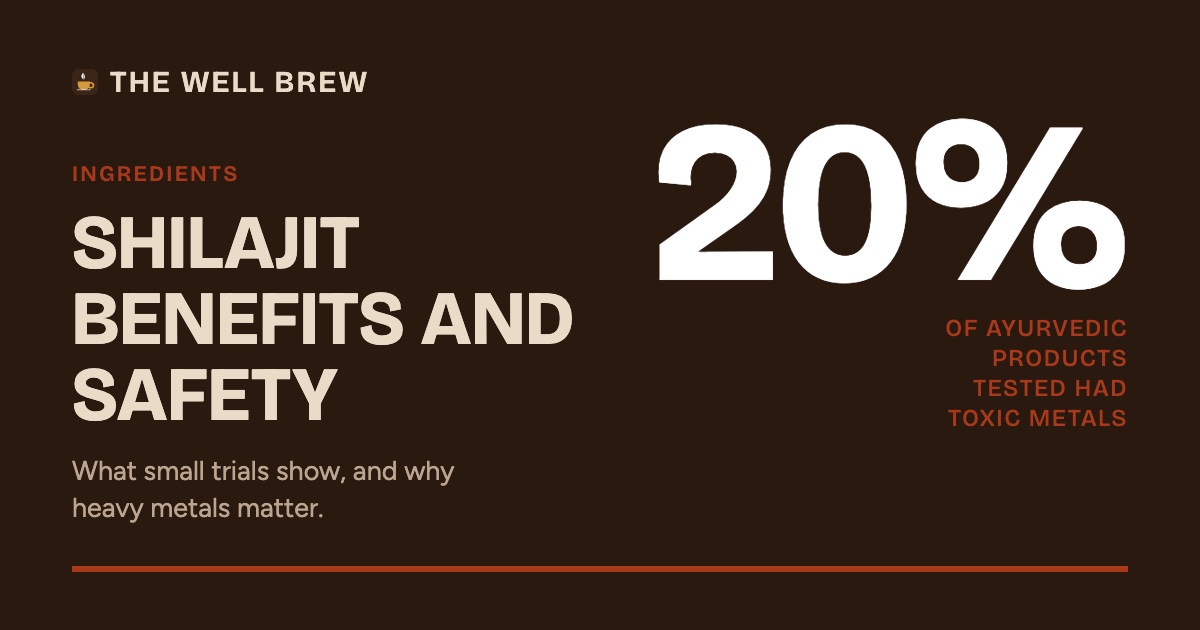
Shilajit is a mineral resin used in Ayurvedic medicine. One 90-day trial found higher testosterone in men aged 45 to 55 taking 250 mg twice a day, but the extract maker funded it and no independent trial has repeated it. Other benefits rest on small or uncontrolled studies. The clearer risk is heavy metals: about 1 in 5 Ayurvedic products tested in the US contained lead, mercury or arsenic.
On this page
- What is shilajit?
- What are the benefits of shilajit?
- What do the shilajit studies show?
- Does shilajit increase testosterone?
- Does shilajit help sperm count and fertility?
- Does shilajit help strength, energy or fatigue?
- Is shilajit safe? The heavy metal problem
- What are the side effects of shilajit?
- Shilajit resin, capsules or gummies: which form has evidence?
- Who should avoid shilajit?
- What do doctors use first for low testosterone?
- How to check a shilajit label
- Bottom line
- FAQ
Shilajit is a sticky, tar-like substance from mountain rock that is sold as a resin, powder, capsule or gummy, and this guide covers its claimed benefits, what the testosterone trials found, and the heavy metal problem that comes with many Ayurvedic products. We read a 2024 systematic review of testosterone boosters, four human trials, two JAMA studies on metals in Ayurvedic medicines, two CDC reports, and pages from NCCIH, the FDA and the NIH Office of Dietary Supplements. How we pick and grade sources is on our how we review page.
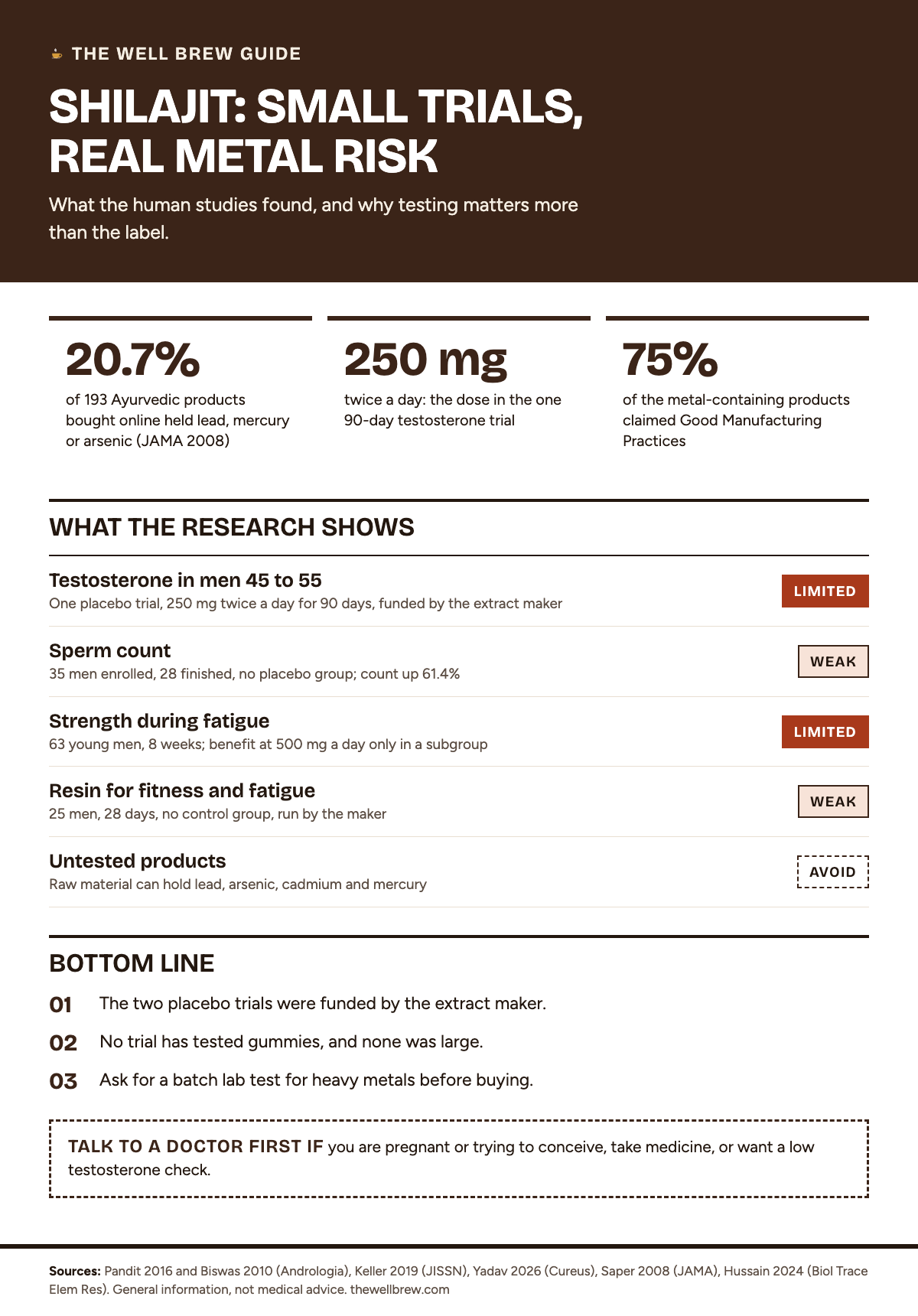
The short answer: one small 90-day trial found higher testosterone in men aged 45 to 55 taking 250 mg twice a day, but it was funded by the extract’s maker, and about 1 in 5 Ayurvedic products tested in the US contained lead, mercury or arsenic.[2][8]
| What it is | A mineral-rich exudate used in Ayurvedic medicine, made mostly of fulvic acid and compounds called dibenzo-alpha-pyrones.[1] |
|---|---|
| Main claims | Testosterone, sperm count, energy and recovery after exercise.[1][5] |
| Amounts studied | 100 mg twice a day to 500 mg a day, for 28 to 90 days.[2][3][4][6] |
| Best evidence | Limited. A few small trials, most tied to one branded extract and its maker.[4][5] |
| Main safety point | Heavy metals. Raw material can hold lead, arsenic, cadmium and mercury.[9] |
| Who should avoid it | People who are pregnant or trying to conceive, children, and anyone with a lead exposure history, unless a doctor approves.[11][12] |
What is shilajit?
Shilajit is a dark, resin-like material that seeps from rock in mountain ranges and is used in traditional Ayurvedic medicine as a “rejuvenator.”[1] It also goes by mumie or moomiyo. A 2014 review in Phytotherapy Research named fulvic acid and dibenzo-alpha-pyrones as the main active compounds.[1]
The same review said that “relatively few well-controlled human studies” exist, even though lab and animal papers keep coming out.[1] A 2024 review counted about 65 metals in the material, including lead, arsenic, cadmium and mercury.[9] A few of those minerals are ones the body needs, while lead, arsenic and mercury are toxic.
Products sold as Himalayan shilajit, pure resin or purified extract are all the same raw material at different stages of cleaning. The label word “purified” has no legal standard in the US. You can only judge it by a lab test result.[14]
What are the benefits of shilajit?
The claimed shilajit benefits are higher testosterone, better sperm counts, more energy and faster recovery, and each rests on one to three small human trials.[1][5] None of these trials was large, and the strongest ones used a single branded extract funded by the company that sells it.[2][4]
Here is how the human research lines up:
- Testosterone in healthy middle-aged men: one placebo-controlled trial, industry-funded.[2]
- Sperm count in men with low counts: one trial with no placebo group.[3]
- Strength during fatigue: one placebo-controlled trial, funded by the maker, with a benefit only in a subgroup.[4]
- Fitness and fatigue scores: one 28-day pilot with no control group, run by the resin’s maker.[6]
Claims about memory, blood sugar, bone and cancer come from lab cells or animals. We left them out because there is no human result to describe.
What do the shilajit studies show?
Across the human trials, the results are small, short and mostly paid for by sellers, so at best they hint at a possible effect. The table lists each study we read, with its size, length and dose.
| Study | Who and how many | Dose and length | Result |
|---|---|---|---|
| Pandit, 2016[2] | Healthy men aged 45 to 55, placebo-controlled | 250 mg twice a day, 90 days | Higher total and free testosterone and DHEAS than placebo. Funded by Natreon. |
| Biswas, 2010[3] | 35 men with low sperm counts, 28 finished, no placebo | 100 mg twice a day, 90 days | Sperm count up 61.4% and testosterone up 23.5% from baseline |
| Keller, 2019[4] | 63 active young men, placebo-controlled | 250 or 500 mg a day, 8 weeks | Less strength loss at 500 mg only, in the stronger half of the group. Funded by Natreon. |
| Yadav, 2026[6] | 25 healthy men, no control group | 500 mg a day of resin, 28 days | Strength and fatigue scores improved. Authors work for the resin maker. |
A trial with no placebo group cannot separate the supplement from the effect of simply joining a study. That applies to two of the four.[3][6]
Does shilajit increase testosterone?
One randomized, double-blind trial found that a purified extract raised testosterone in healthy men aged 45 to 55, but no independent group has repeated it.[2] The men took 250 mg twice a day for 90 days. Total testosterone, free testosterone and DHEAS rose more than with placebo, while LH and FSH stayed level.[2]
The study lists Natreon Inc as its funder.[2] Natreon makes PrimaVie, the extract used.[4] A result paid for by the seller can still be right, though it needs an independent second trial before anyone can lean on it.
A 2024 systematic review in the International Journal of Impotence Research looked at 52 studies of 27 products sold as testosterone boosters. It found that “most fail to increase total testosterone.”[5] The authors rated purified shilajit extract as only “possibly effective” for men with late-onset hypogonadism, a lower grade than proven options.[5]
If you are looking at shilajit benefits for men because of low energy or low libido, those symptoms have many causes. Our testosterone guides cover how they are tested.
Does shilajit help sperm count and fertility?
One 2010 trial in men with low sperm counts reported a 61.4% rise in total sperm count after 90 days, but it had no placebo group.[3] Of 35 men who started, 28 finished. They took 100 mg of processed extract twice a day after meals.[3]
Serum testosterone rose 23.5% and FSH rose 9.4% from baseline.[3] Liver and kidney tests did not change.[3] Without a comparison group, though, the study cannot rule out normal variation in semen tests, which swing a lot from one sample to the next.
Anyone trying to conceive has another reason for caution. CDC reports describe lead poisoning in pregnant women who used Ayurvedic medicines, and note that remedies sold for infertility have been a source of lead.[11][12] Lead harms a developing baby.[13]
Does shilajit help strength, energy or fatigue?
A 2019 placebo-controlled trial in 63 young men found less strength loss after a fatiguing workout at 500 mg a day, but only in the stronger half of the group.[4] In that subgroup, strength fell 8.9% with 500 mg versus 16.0% with placebo. The 250 mg dose did no better than placebo.[4]
The authors state that “the project was funded by Natreon Inc.”[4] Analyzing only half of each group also raises the chance of a result that will not hold up when tested again.
A 2026 open-label pilot gave 25 men 500 mg a day of resin for 28 days and reported gains in leg press strength and lower fatigue scores.[6] Everyone knew they were taking the product, there was no control group, and the authors work for the company that sells it.[6] A study like this can justify a proper trial, and it can tell you little more than that.
Is shilajit safe? The heavy metal problem
The main safety concern with shilajit is contamination with lead, mercury, arsenic and cadmium, which a 2024 review found in raw material from several regions.[9] The review said that using it “without knowing permissible levels of metals is not safe.”[9]
Wider testing of Ayurvedic products shows how common the problem is:
- A 2004 JAMA study bought 70 Ayurvedic products in Boston-area stores. Fourteen, or 20%, contained lead, mercury or arsenic at levels that could exceed safety limits if taken as directed.[7]
- A 2008 JAMA study tested 193 products sold online. 20.7% contained toxic metals, with nearly the same rate in US-made (21.7%) and India-made (19.5%) products.[8]
- In that 2008 study, 75% of the metal-containing products claimed Good Manufacturing Practices.[8]
NCCIH warns that some Ayurvedic preparations “may contain lead, mercury, or arsenic in amounts that can be toxic.”[10] The FDA says “there is no known safe level of exposure to lead.”[13] In adults, long-term lead exposure is linked to kidney problems, high blood pressure and effects on thinking.[13]
What are the side effects of shilajit?
Short trials of purified extracts did not report liver or kidney changes, but they lasted 90 days at most and were too small to catch rare or slow harms.[3][6] The larger worry is slow metal buildup from an untested product taken for months.[9][13]
The CDC has documented real cases. From 2000 to 2003, 12 adults in five states got lead poisoning linked to Ayurvedic remedies.[11] In New York City, six pregnant women who used Ayurvedic medicines had blood lead levels of 16 to 64 µg/dL, and some products were as much as 2.4% lead.[12]
Lead poisoning often has no clear early signs. MedlinePlus lists folk remedies and herbs as one route of exposure.[17] Supplements can also interact with medicines, so tell your doctor and pharmacist about anything you take.[15]
Shilajit resin, capsules or gummies: which form has evidence?
The trials used measured capsules of a standardized extract, plus one resin pilot, and no trial has tested gummies.[2][4][6] A capsule with a stated milligram dose makes it easier to match what a study used.
This decision table sums up the trade-offs we found:
| If you are looking at | What we found | What to check |
|---|---|---|
| Raw resin | One 28-day pilot, no control group; dose is hard to measure by scoop | A lab report for lead, arsenic, cadmium and mercury for that batch |
| Standardized extract capsules | The form used in the placebo-controlled trials, 250 to 500 mg a day | Extract name and mg per capsule, plus a third-party seal |
| Gummies | No trial; amount of extract per gummy varies and sugar is added | Actual mg of extract, not a “proprietary blend” total |
| Any form, pregnant or trying to conceive | CDC lead poisoning reports in pregnant users of Ayurvedic products | Skip it and talk to your doctor |
Who should avoid shilajit?
People who are pregnant, breastfeeding or trying to conceive should avoid it, because lead exposure harms a fetus and young child.[11][13] Children should not take it.
Talk to a doctor first if you:
- Take prescription medicine, since supplements can change how medicines work.[15]
- Have kidney disease or high blood pressure, two conditions linked to long-term lead exposure.[13]
- Have used other Ayurvedic products. A survey cited by NCCIH found that 40 percent of users had raised blood lead.[10]
- Are being checked for low testosterone. A supplement can delay a proper diagnosis.[16]
See a doctor promptly if you have stomach pain, constipation, headaches, tiredness or memory trouble after using an Ayurvedic product. Ask whether a blood lead test makes sense.[17]
What do doctors use first for low testosterone?
Doctors diagnose low testosterone with symptoms plus two fasting morning blood tests that are both low, then look for the cause.[16] That is the approach in the 2018 Endocrine Society guideline.[16]
For men with confirmed, symptomatic deficiency, the guideline recommends testosterone therapy after a talk about risks and benefits, with follow-up blood tests.[16] It recommends against testosterone therapy for men planning to father a child soon, which is one more reason to see a doctor before self-treating.[16]
No supplement replaces that workup. The FDA does not approve supplements for safety or effectiveness before they are sold, and a product that claims to treat a disease is legally a drug.[14]
How to check a shilajit label
- Look for a seal from USP, NSF International or ConsumerLab.com. These test for listed ingredients and harmful contaminants, but they do not prove a product works.[15]
- Ask the seller for a batch lab report that lists lead, arsenic, cadmium and mercury.[9]
- Check the milligrams of extract per serving and compare it with the 250 to 500 mg a day used in trials.[2][4]
- Do not trust “pure,” “Himalayan” or “GMP” alone. Most metal-containing products in the 2008 JAMA study claimed GMP.[8]
- Skip products that promise to treat low testosterone or infertility. That is a drug claim.[14]
- Read our label checklist and review method and our other supplement ingredient guides before buying.
Bottom line
The evidence for shilajit comes from a handful of small trials, and the two placebo-controlled ones were paid for by the maker of the extract they tested. One found higher testosterone in men aged 45 to 55, and a 2024 review called it only possibly effective.[2][5]
The metal risk is better documented than the benefit. For most people with low energy or low libido, a morning testosterone test and a talk with a doctor is the better first step, because it finds causes a supplement would only cover up.[8][16]
Frequently asked questions
How much shilajit should I take per day?
There is no official dose. Trials used 100 mg twice a day up to 500 mg a day of a standardized extract for 28 to 90 days. More was not shown to be safer or better, so talk to your doctor before starting.
How long does shilajit take to work?
The trials measured results after 8 to 12 weeks, and the testosterone trial ran for 90 days. Shorter use has not been tested in a controlled trial, so quick results claimed in ads are not backed by research.
Is Himalayan shilajit better than other kinds?
No study compares regions head to head. A 2024 review found toxic metals in material from several areas. The source region on a label tells you less than a batch lab test for lead, arsenic, cadmium and mercury.
Is shilajit approved by the FDA?
No. The FDA does not approve dietary supplements for safety or effectiveness before they are sold. Companies are responsible for their own products, and a product sold to treat a disease is legally a drug.
What are the pros and cons of shilajit?
Pros: a few small trials suggest possible effects on testosterone and recovery, and short trials reported no liver or kidney changes. Cons: most studies were paid for by sellers, none were large, and Ayurvedic products often test positive for lead or mercury.
Sources
- Safety and efficacy of shilajit (mumie, moomiyo). Phytotherapy Research, Stohs, 2014
- Clinical evaluation of purified Shilajit on testosterone levels in healthy volunteers. Andrologia, Pandit et al., 2016
- Clinical evaluation of spermatogenic activity of processed Shilajit in oligospermia. Andrologia, Biswas et al., 2010
- The effects of Shilajit supplementation on fatigue-induced decreases in muscular strength and serum hydroxyproline levels. Journal of the International Society of Sports Nutrition, Keller et al., 2019
- Do testosterone boosters really increase serum total testosterone? A systematic review. International Journal of Impotence Research, Morgado et al., 2024
- Safety and Efficacy of TruBlk Shilajit Resin Supplementation: A 28-Day Open-Label Pilot Study. Cureus, Yadav et al., 2026
- Heavy metal content of ayurvedic herbal medicine products. JAMA, Saper et al., 2004
- Lead, mercury, and arsenic in US- and Indian-manufactured Ayurvedic medicines sold via the Internet. JAMA, Saper et al., 2008
- Hazardous or Advantageous: Uncovering the Roles of Heavy Metals and Humic Substances in Shilajit. Biological Trace Element Research, Hussain and Saeed, 2024
- Ayurvedic Medicine: In Depth. National Center for Complementary and Integrative Health
- Lead Poisoning Associated with Ayurvedic Medications, Five States, 2000-2003. CDC Morbidity and Mortality Weekly Report, 2004
- Lead Poisoning in Pregnant Women Who Used Ayurvedic Medications from India, New York City. CDC Morbidity and Mortality Weekly Report, 2012
- Lead in Food and Foodwares. U.S. Food and Drug Administration, 2025
- FDA 101: Dietary Supplements. U.S. Food and Drug Administration
- Dietary Supplements: What You Need to Know. NIH Office of Dietary Supplements
- Testosterone Therapy in Men With Hypogonadism: An Endocrine Society Clinical Practice Guideline. Journal of Clinical Endocrinology and Metabolism, Bhasin et al., 2018
- Lead Poisoning. MedlinePlus, National Library of Medicine

Maya Ellison is the Reviews Editor at The Well Brew, a slow, plain-language supplement review blog for everyday adults. Maya reads each label in full, sets every dose beside the amounts used in human studies, grades the research with sources such as the NIH Office of Dietary Supplements and NCCIH, and works out the real cost and refund fine print. Maya has no medical credentials and is not a doctor, dietitian, nurse or pharmacist. Reviews give pros, cons and who a product suits, never scores. How we review supplements.
This article is general information, not medical advice. Dietary supplements are not reviewed by the FDA for safety or effectiveness before they are sold. Talk to your doctor before you start any supplement, especially if you are pregnant, nursing, take medication or have a health condition.