Menopause symptoms usually begin in the mid-40s with irregular periods, then hot flashes, night sweats, poor sleep, vaginal dryness and mood changes. Menopause is confirmed after 12 months without a period, at an average age of 51 to 52. Frequent hot flashes last a median of 7.4 years. Hormone therapy is the most effective treatment, and any bleeding after menopause needs a doctor visit.
On this page
- What are the most common menopause symptoms?
- What are the first signs of menopause?
- Perimenopause vs menopause symptoms: what is the difference?
- How long do menopause symptoms last?
- What causes menopause symptoms?
- When should you see a doctor right away?
- How is menopause diagnosed?
- What treatments do doctors use first?
- Bottom line on menopause
- FAQ
Menopause symptoms are the physical and emotional changes that come as your periods wind down and stop, and for most women they begin in the mid-40s with irregular cycles and hot flashes. For this guide we read the National Institute on Aging pages on menopause and hot flashes, two ACOG patient guides, The Menopause Society’s position statements on hormone and nonhormone treatment, and the long-running SWAN study.[1][4][6][7][8]
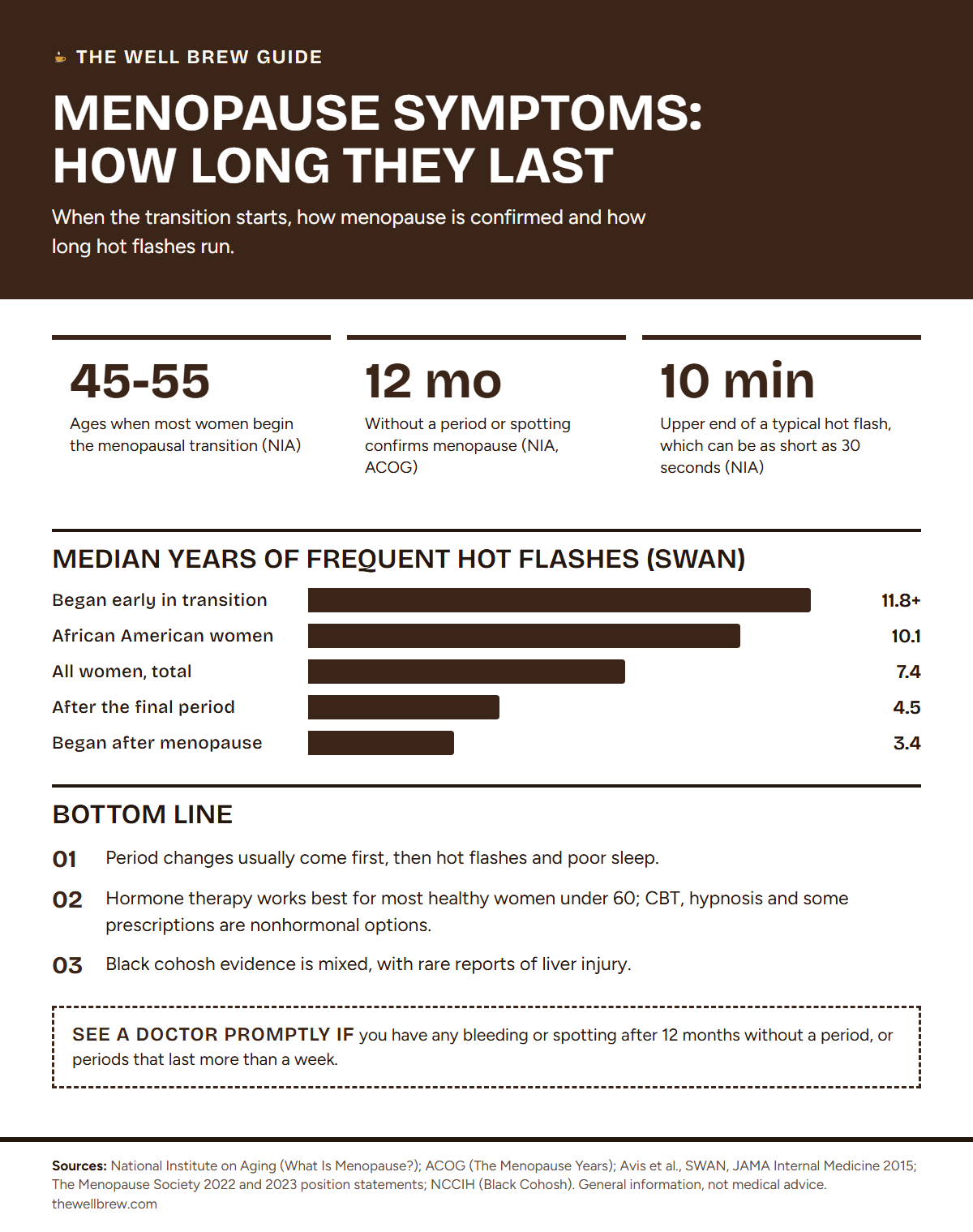
In short, most women enter the transition between 45 and 55, menopause is confirmed after 12 months without a period, and frequent hot flashes last a median of 7.4 years.[1][6]
| What it is | The point when periods stop for good, confirmed after 12 months with no period or spotting[1] |
|---|---|
| When it starts | The transition usually begins between ages 45 and 55; the average age of menopause in the US is 51 to 52[1][4] |
| Most common symptoms | Irregular periods, hot flashes, night sweats, poor sleep, vaginal dryness, bladder changes and mood shifts[1][3] |
| How long they last | Frequent hot flashes lasted a median 7.4 years in SWAN, including 4.5 years after the final period[6] |
| Most effective treatment | Hormone therapy, for healthy women under 60 or within 10 years of menopause[7] |
| Nonhormonal options | Cognitive behavioral therapy, clinical hypnosis, SSRIs or SNRIs, gabapentin and fezolinetant[8] |
| Red flag | Any bleeding or spotting after 12 months without a period needs a doctor visit[1][5] |
What are the most common menopause symptoms?
The usual signs are period changes, hot flashes, night sweats, trouble sleeping, vaginal dryness, bladder problems and mood changes. Some women notice one or two mild changes and little else. Others have several at once, strong enough to disrupt work, sex and sleep.[1]
NIA describes a hot flash as a sudden feeling of heat, mostly in the upper body and face. Your face and neck may flush, and red blotches can appear on your chest, back and arms. Heavy sweating and chills can follow. Most hot flashes last between 30 seconds and 10 minutes, and they can come several times an hour or only once or twice a week.[1]
Other changes are easier to miss or blame on something else:
- Sleep trouble, such as waking too early or waking from night sweats or a need to urinate.[1]
- Vaginal dryness and thinner vaginal tissue, which can make sex painful.[4]
- Urine leaks when you sneeze or laugh, a sudden urge to go, and more urinary tract infections.[1][4]
- Moodiness, irritability, forgetfulness and trouble concentrating.[1]
- Stiff or achy joints, thinner and drier skin, and a thicker waist.[1]
NIA points out that some of these changes may come from aging itself, from stress or from depression. So bring your whole list to the doctor, and do not assume every change is hormonal.[1]
What are the first signs of menopause?
For most women, the first sign is a change in the menstrual cycle: periods that come closer together or further apart, run longer or shorter, or turn heavier or lighter. Hot flashes and sleep changes often show up around the same time.[1][4]
ACOG explains that estrogen from the ovaries starts to rise and fall unevenly in your 30s and 40s. Some months the ovaries release an egg and some months they do not, so cycles lose their old rhythm. You may skip a period, then have two close together.[4][5]
A typical cycle runs 24 to 38 days, and a normal period lasts up to 8 days. Changes outside those ranges are common in perimenopause. ACOG still asks women to report them, because abnormal bleeding can come from polyps, a thickened uterine lining or, less often, cancer.[5]
Timing differs between women. NIA reports that smoking is linked to earlier menopause and worse symptoms. Black women are more likely to reach menopause early and to have more symptoms for longer, while Asian women report fewer symptoms on average.[1]
Perimenopause vs menopause symptoms: what is the difference?
Perimenopause is the run-up of several years when hormones swing and periods turn irregular; menopause itself is one point in time, reached 12 months after your last period. The symptoms overlap a great deal. During perimenopause you still get periods, however unpredictable, and after menopause they have stopped.[1][3]
| Feature | Perimenopause | After menopause |
|---|---|---|
| Periods | Irregular, heavier or lighter, sometimes skipped[4] | None for 12 months or more[1] |
| Hormones | Estrogen rises and falls unevenly[4] | Estrogen and progesterone stay low[1] |
| Hot flashes | Often begin here[1] | Can go on for years; median 4.5 years after the last period in SWAN[6] |
| Pregnancy | Still possible; use birth control until 12 months with no period[1] | No longer possible[1] |
| Bleeding | Report heavy, very frequent or week-long bleeding[1] | Any bleeding needs a check[5] |
| Bones | Slow, gradual loss[4] | Faster loss in the first 4 to 8 years[4] |
MedlinePlus says the transition usually begins in your 40s and can last several years, and the most common age to reach menopause is between 45 and 55.[3] Vaginal and urinary changes happen because lower estrogen thins the tissue of the vagina and the urethra.[4]
How long do menopause symptoms last?
In the SWAN study, frequent hot flashes and night sweats lasted a median of 7.4 years and continued for about 4.5 years after the final period. NIA gives a wider range of two to eight years for menopause-related symptoms, and the timing varies a lot between women.[1][6]
SWAN followed 3,302 women at 7 US sites from 1996 to 2013. The duration analysis covered 1,449 women with frequent hot flashes, defined as hot flashes on at least 6 of the previous 14 days.[6]
When the hot flashes started mattered most. Women whose hot flashes began before or early in the transition had them for more than 11.8 years in total. Women whose hot flashes began after menopause had them for a median of 3.4 years. African American women had the longest median, at 10.1 years.[6]
Younger age, higher stress, and more anxiety or depressive symptoms at the start were also linked to longer-lasting hot flashes. SWAN was observational, so these links describe who tends to have longer symptoms. They do not prove that stress causes them.[6]
What causes menopause symptoms?
The main cause is the ovaries making far less estrogen and progesterone, which affects temperature control, the vagina, the bladder, bones and sleep. NIA says production of both hormones drops sharply during the transition, and those changes may explain the symptoms many women feel.[1][2]
Most of the time this happens naturally with age. Some things bring it on sooner:
- Surgery to remove both ovaries. Without hormone treatment, symptoms can start right away.[1]
- Chemotherapy, and hormone treatments used for breast cancer.[3]
- Smoking, which is linked to an earlier start.[1]
Removing the uterus alone stops periods, but it does not cause menopause unless the ovaries are removed too.[3] Menopause before 40 is called premature menopause, and before 45 it is called early menopause. Primary ovarian insufficiency is a separate condition in which the ovaries stop working normally before 40, yet periods and pregnancy may still happen.[3]
The loss of estrogen also shifts long-term risks. It can raise cholesterol, and ACOG notes that heart attack and stroke risk climbs after menopause as estrogen’s protective effect fades.[3][4] Bone loss speeds up as well, so our guide to osteoporosis supplements, calcium and vitamin D is a useful next read.
When should you see a doctor right away?
Any bleeding or spotting after 12 months without a period should be checked promptly, because bleeding is the most common sign of endometrial cancer in postmenopausal women. Other causes include a thin uterine lining, polyps and a thickened lining, and only an exam can tell them apart.[5]
See a doctor right away if:
- You bleed or spot after a year with no periods.[1][5]
- Your periods come very close together or last more than a week.[1]
- You have heavy bleeding, or bleeding after sex or between periods.[1]
- You have signs of a blood clot or stroke while on hormone therapy, since both are known risks of treatment.[2][4]
- You take black cohosh or another herb and notice dark urine, belly pain or yellowing skin.[10][11]
- You take fezolinetant (Veozah) and notice new tiredness, nausea, itching, yellow skin or eyes, pale stools, dark urine or belly pain. The label says to stop it right away and get liver tests.[13]
- Low mood or irritability is making daily life hard. NIA suggests your primary care provider or a mental health professional.[1]
ACOG lists risk factors for endometrial cancer such as long-term use of high-dose estrogen, diabetes, high blood pressure, and a personal or family history of certain cancers. It can also occur with none of them, so having no risk factors is no reason to wait.[5]
Menopause itself is not a disease. NIA calls it a normal part of aging, and many women find they need no treatment at all.[1]
How is menopause diagnosed?
Doctors usually diagnose menopause from your age, symptoms and period history, and it is confirmed only after 12 months in a row with no period or spotting. Most women do not need a blood test. NIA says a doctor may suggest hormone tests in some cases, for example when periods stop at an early age.[1]
Expect questions about your cycle, your symptoms and your family history.[1] If you are bleeding after menopause, the workup is different. ACOG lists the tests an ob-gyn may use:
- Endometrial biopsy, which takes a small sample of the uterine lining for the lab.[5]
- Transvaginal ultrasound, which gives a picture of the lining and the pelvic organs.[5]
- Sonohysterography, an ultrasound done after fluid is placed in the uterus.[5]
- Hysteroscopy, which uses a thin lighted camera to look inside the uterus.[5]
- Dilation and curettage (D&C), which removes tissue from the lining for testing.[5]
What comes next depends on the cause. Endometrial hyperplasia can be treated with progestin and follow-up biopsies. Endometrial cancer is usually treated with surgery, and ACOG notes that most cases found early can be treated successfully.[5]
Checklist before your appointment
- Write down the start date and length of each period for the last 2 to 3 months.
- Count hot flashes by day and by night, and note anything that seems to set them off.[2]
- List every medicine, herb and supplement you take, including black cohosh or soy products.[4]
- Note any bleeding after sex, between periods or after a year without periods.[1]
- Bring your personal and family history of heart disease, blood clots and breast cancer, which shapes whether hormone therapy suits you.[2][7]
- Keep using birth control until a full 12 months without a period if you do not want to get pregnant.[1]
- See how we review health information if you want to know how this guide was sourced and checked.
What treatments do doctors use first?
Hormone therapy is the most effective treatment for hot flashes and night sweats, and it also helps vaginal dryness and protects against bone loss. The Menopause Society says its benefits outweigh its risks for most healthy women who start before 60 or within 10 years of menopause. Many women choose lifestyle changes or nonhormonal medicine instead.[7][1]
Hormone therapy
Hormone therapy means estrogen, plus a progestogen if you still have a uterus, to protect the lining from cancer.[4] It comes as pills, patches, gels, sprays and rings. NIA notes that patches may suit women with heart risk factors, and ACOG says forms not taken by mouth may carry less risk of clots in the legs.[2][4]
The risks are real, and they depend on age, dose, route and timing. Combined therapy carries a small increase in the risk of heart attack, stroke, blood clots and breast cancer, and estrogen slightly raises the chance of gallbladder disease.[4] The 2002 Women’s Health Initiative findings that turned many women away from hormones mostly affected women over 60.[2] For women who start after 60, or more than 10 years after menopause, the balance looks less favorable.[7]
For vaginal dryness on its own, low-dose vaginal estrogen, vaginal DHEA or oral ospemifene are options, and over-the-counter moisturizers can be used every 2 to 3 days.[7][4] ACOG recommends FDA-approved hormones over custom compounded bioidentical ones, which the FDA does not regulate. NCCIH adds that compounded products have not been shown to be safer.[4][10]
Nonhormonal options
The Menopause Society’s 2023 statement gave its strongest backing to cognitive behavioral therapy, clinical hypnosis, SSRI or SNRI antidepressants, gabapentin and fezolinetant for hot flashes.[8] The FDA has approved paroxetine (Brisdelle) and fezolinetant (Veozah) for this use. Fezolinetant works on the part of the brain that controls body temperature.[2] Its label has carried a boxed warning since December 2024 because liver injury has occurred in people taking it after it went on sale. Doctors should order liver blood tests before you start, then monthly for the first 3 months and again at 6 and 9 months.[13]
The same panel did not recommend supplements, herbal remedies, soy or acupuncture for hot flashes. It also rated cooling tricks and trigger avoidance as unproven, though NIA still suggests layers, a fan, a cool bedroom and less alcohol, spicy food and caffeine as low-risk first steps.[8][2]
| Study | Who and how many | Length | Result |
|---|---|---|---|
| SWAN, Avis 2015[6] | 1,449 US women with frequent hot flashes, from 3,302 enrolled | 1996 to 2013 | Median 7.4 years of hot flashes; 4.5 years after the last period |
| SKYLIGHT 1, Lederman 2023[9] | 527 women aged 40 to 65 with 7 or more hot flashes a day | 12 weeks, then a 40-week extension | Fezolinetant 45 mg cut about 2.5 more hot flashes a day than placebo; funded by its maker, Astellas |
| Menopause Society statement 2023[8] | Expert panel review of nonhormone studies | Studies since 2015 | CBT, hypnosis, SSRIs or SNRIs, gabapentin and fezolinetant recommended; supplements not |
| Black cohosh meta-analysis, Sadahiro 2023[12] | 22 trials, 2,310 women | Varied by trial | Gains in overall symptoms and a small gain in hot flashes; no clear effect on anxiety or depression |
| Yoga review, 2018[10] | 13 studies, more than 1,300 people | Varied by trial | Yoga eased physical and psychological symptoms, about as well as other exercise |
Which option fits your main symptom?
Use this table to plan what to ask your doctor at your visit.
| Main symptom | Options with the best support | Worth knowing |
|---|---|---|
| Hot flashes and night sweats | Hormone therapy; if it does not suit you, CBT, hypnosis, SSRIs or SNRIs, gabapentin or fezolinetant[7][8] | Paroxetine and fezolinetant are FDA-approved for hot flashes[2] |
| Vaginal dryness or painful sex | Moisturizers and lubricants first, then low-dose vaginal estrogen, vaginal DHEA or ospemifene[4][7] | Moisturizers ease dryness but do not thicken the tissue[4] |
| Poor sleep | Treat the night sweats; gabapentin and clonidine can ease hot flashes and related sleep problems[4] | Our guide to magnesium glycinate for sleep covers what that supplement can and cannot do |
| Low mood or irritability | Your primary care provider or a mental health professional[1] | Black cohosh did not improve anxiety or depression in pooled trials[12] |
| Bone loss | Systemic estrogen protects against early bone loss; calcium, vitamin D and weight-bearing exercise help too[4] | See how much vitamin D you need before adding a supplement |
| Bleeding after menopause | A prompt exam by an ob-gyn[5] | No home remedy applies; the cause has to be found first[5] |
Do supplements like black cohosh help?
Black cohosh has more research behind it than any other herb for menopause, and the results are mixed. NCCIH summarizes a 2023 review of 22 studies that found black cohosh products potentially helpful for overall symptoms and hot flashes, but not for anxiety or depression.[11][12] One author of that review reported speaker fees from supplement companies.[12] An earlier 2012 review found too little evidence to support its use.[10]
Safety is the larger concern. Rare cases of serious liver damage have been reported in people taking black cohosh products, and some products held the wrong herb.[11] Its safety after breast or uterine cancer is uncertain.[11] NIA puts black cohosh, DHEA and soy isoflavones among unproven products, and NCCIH says flaxseed did no better than placebo.[2][10] Supplements do not need FDA approval before they are sold.[11]
Bottom line on menopause
Menopause symptoms usually start in your mid-40s with irregular periods, followed by hot flashes, sleep changes and vaginal dryness. They often last for years; frequent hot flashes ran a median of 7.4 years in SWAN. Bleeding after a full year without periods is the one symptom that always needs a prompt check.[6][5]
For most healthy women under 60 with bothersome hot flashes, talking to a doctor about hormone therapy is a better first step than buying a supplement, because it has the strongest evidence and its risks are lowest at that age.[7] If hormones are not right for you, CBT, hypnosis and several prescription drugs have good support, while black cohosh remains uncertain and carries rare liver risks.[8][11] You can find more guides in our menopause section.
Frequently asked questions
What age does menopause start?
Most women begin the menopausal transition between 45 and 55, and the average age of the final period in the US is about 51 to 52. Menopause before 40 is called premature, and before 45 it is called early menopause. Smoking is linked to an earlier start.
Can you still get pregnant during perimenopause?
Yes. The ovaries may still release an egg in some months, so pregnancy remains possible until menopause is confirmed. NIA advises women who do not want to get pregnant to keep using birth control for a full 12 months after their last period.
Does menopause cause weight gain?
During the transition the body uses energy differently and stores more fat around the waist, so many women gain weight more easily and lose some muscle. Staying active and keeping a healthy weight helps overall health, and heavier women tend to have more frequent hot flashes.
Are bioidentical hormones safer than regular hormone therapy?
The evidence says no. Custom compounded bioidentical hormones are not regulated by the FDA, their content can vary from batch to batch, and NCCIH says they have not been shown to be safer or more effective. ACOG recommends FDA-approved hormone therapy instead.
Can menopause cause anxiety or mood swings?
Many women feel moodier or more irritable around menopause. Scientists are not sure why, and stress, family demands, depression and poor sleep may all play a part. NIA advises talking with your primary care provider or a mental health professional, because treatments are available.
Sources
- What Is Menopause?. National Institute on Aging, NIH, reviewed 2024
- Hot Flashes: What Can I Do?. National Institute on Aging, NIH
- Menopause. MedlinePlus, National Library of Medicine
- The Menopause Years. American College of Obstetricians and Gynecologists
- Perimenopausal Bleeding and Bleeding After Menopause. American College of Obstetricians and Gynecologists
- Duration of menopausal vasomotor symptoms over the menopause transition (SWAN). Avis NE et al., JAMA Internal Medicine, 2015
- The 2022 hormone therapy position statement of The North American Menopause Society. The Menopause Society, Menopause, 2022
- The 2023 nonhormone therapy position statement of The North American Menopause Society. The Menopause Society, Menopause, 2023
- Fezolinetant for moderate-to-severe vasomotor symptoms (SKYLIGHT 1): a phase 3 randomised controlled study. Lederman S et al., The Lancet, 2023
- Menopausal Symptoms: In Depth. National Center for Complementary and Integrative Health, NIH
- Black Cohosh: Usefulness and Safety. National Center for Complementary and Integrative Health, NIH, 2024
- Black cohosh extracts in women with menopausal symptoms: an updated pairwise meta-analysis. Sadahiro R et al., Menopause, 2023
- VEOZAH (fezolinetant) tablets: prescribing information, boxed warning. DailyMed, National Library of Medicine, label revised 2026

Maya Ellison is the Reviews Editor at The Well Brew, a slow, plain-language supplement review blog for everyday adults. Maya reads each label in full, sets every dose beside the amounts used in human studies, grades the research with sources such as the NIH Office of Dietary Supplements and NCCIH, and works out the real cost and refund fine print. Maya has no medical credentials and is not a doctor, dietitian, nurse or pharmacist. Reviews give pros, cons and who a product suits, never scores. How we review supplements.
This article is general information, not medical advice. Dietary supplements are not reviewed by the FDA for safety or effectiveness before they are sold. Talk to your doctor before you start any supplement, especially if you are pregnant, nursing, take medication or have a health condition.