Saw palmetto does not appear to help an enlarged prostate. A 2023 Cochrane review of 27 trials and 4,656 men found little to no difference from placebo in urinary symptoms. The NIH-funded STEP and CAMUS trials found no benefit at 320 mg a day or at three times that dose. It is generally safe and does not change PSA results.
On this page
- Does saw palmetto for prostate symptoms work?
- What did the STEP and CAMUS trials find?
- Does saw palmetto shrink the prostate?
- How long does saw palmetto take to work?
- What is the saw palmetto dosage for an enlarged prostate?
- Does saw palmetto affect PSA test results?
- What are the side effects of saw palmetto, and who should avoid it?
- What do doctors use first for an enlarged prostate?
- Should you try saw palmetto for prostate health?
- FAQ
Saw palmetto for prostate symptoms is one of the most popular herbal remedies men buy, so we checked what the research actually says. We read the NCCIH fact sheet, the 2023 Cochrane review, the two large NIH-funded trials (STEP and CAMUS), and the NIDDK, MedlinePlus and National Cancer Institute pages on enlarged prostate and PSA testing.[1][2] Our process is described on our how we review page.
The short answer: in men with an enlarged prostate, saw palmetto alone provides little to no benefit for urinary symptoms, and the best trials found it no better than a placebo even at three times the usual dose.[2][4]
| What it is | An extract from the berries of a small palm, Serenoa repens, native to the southeast coast of North America[1] |
|---|---|
| Main use | Promoted for urinary symptoms of benign prostatic hyperplasia (BPH), an enlarged prostate that is not cancer[1][7] |
| Usual amount studied | 320 mg a day, often split as 160 mg twice a day[3][4] |
| Best evidence | Cochrane 2023: 27 studies, 4,656 men, little to no difference from placebo[2] |
| Effect on PSA test | No change compared with placebo, even at high doses[5] |
| Safety | Well tolerated in studies lasting up to 3 years; mild stomach upset, dizziness or headache[1] |
| Who should avoid it | Pregnant or breastfeeding people; anyone on medicine should ask a clinician first[1] |
Does saw palmetto for prostate symptoms work?
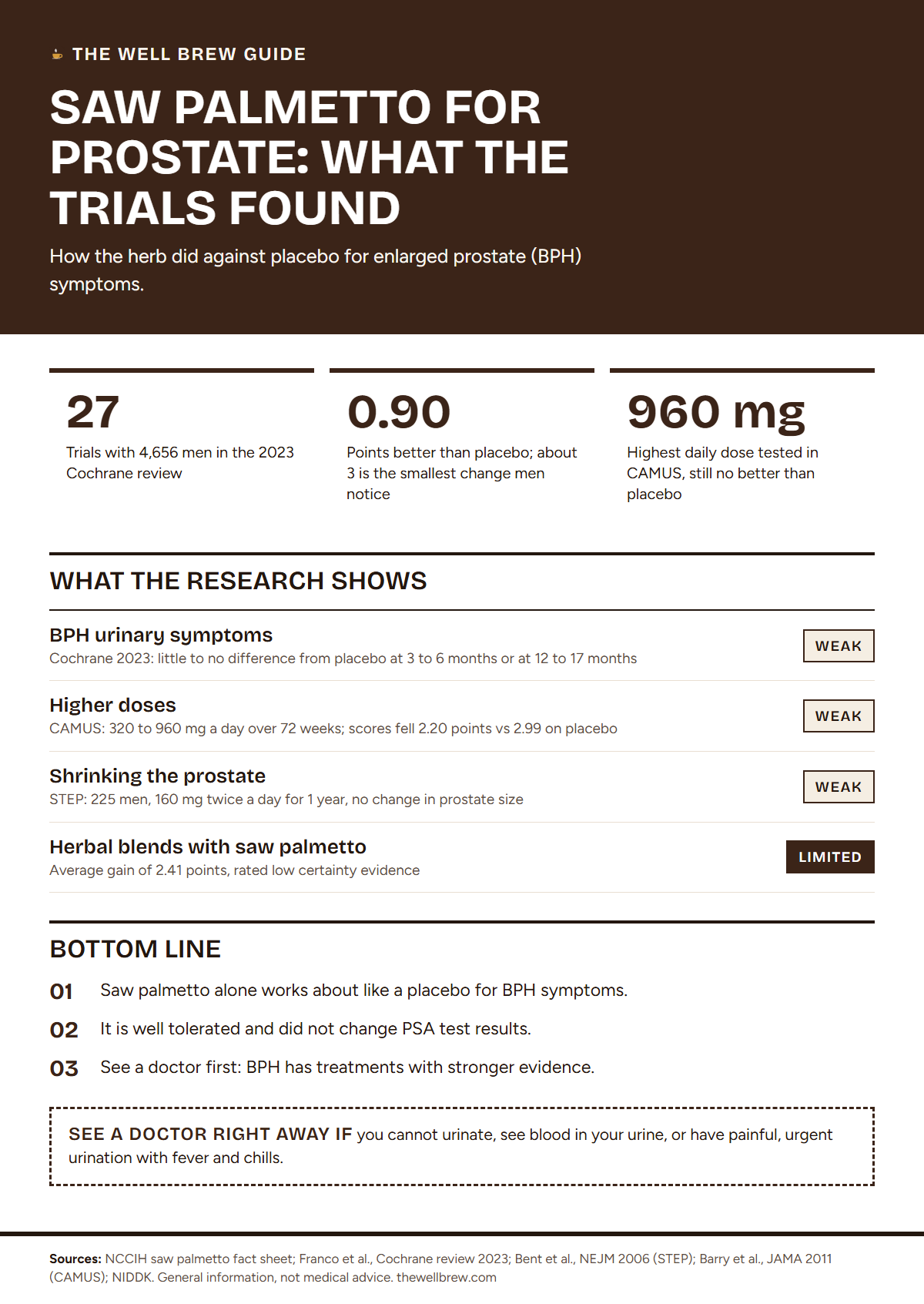
For urinary symptoms of an enlarged prostate, saw palmetto taken alone works about as well as a placebo. A 2023 Cochrane review pooled 27 randomized trials with 4,656 men and rated the evidence high certainty: the herb made little to no difference to symptom scores or quality of life.[2] NCCIH reached the same view and says the herb is “probably not helpful” for this purpose.[1]
In the trials with the lowest risk of bias, men on saw palmetto scored 0.90 points better on the International Prostate Symptom Score (IPSS) at 3 to 6 months than men on placebo.[2] The scale runs from 0 to 35, and the review authors treated 3 points as the smallest change a man would actually notice.[2] At 12 to 17 months the gap was 0.07 points, which is effectively zero.[2]
Ten of the 27 studies were paid for by drug or supplement makers, and many did not say who funded them.[2] Products that mix saw palmetto with other herbs showed a larger average effect of 2.41 points, but the review rated that evidence low certainty.[2]
What did the STEP and CAMUS trials find?
Both large, government-funded trials found that saw palmetto did not improve prostate symptoms more than a dummy pill. STEP tested the standard dose for one year. CAMUS raised the dose step by step to three times the standard amount over 72 weeks.[3][4] Neither found a benefit on symptoms, urine flow or other measures.
| Study | Who and how long | Dose | Result |
|---|---|---|---|
| STEP, NEJM 2006[3] | 225 men over 49 with moderate to severe symptoms, 1 year | 160 mg twice a day | Symptom score difference of 0.04 points; no change in flow, prostate size or PSA |
| CAMUS, JAMA 2011[4] | 369 men aged 45 or older, 72 weeks, 11 sites | 320, then 640, then 960 mg a day | Scores fell 2.20 points on saw palmetto and 2.99 on placebo |
| CAMUS PSA analysis, 2013[5] | Same 369 men | Up to 960 mg a day | PSA rose 0.23 ng/mL vs 0.16 ng/mL on placebo, not a real difference |
| Cochrane review, 2023[2] | 27 trials, 4,656 men, mostly over 50 | Mostly 320 mg a day | Little to no difference in symptoms, quality of life or side effects |
In CAMUS, the placebo group improved slightly more than the saw palmetto group, by 0.79 points.[4] Both groups improved, which shows why a placebo group matters: urinary symptoms can ease over time even without an active treatment.
Does saw palmetto shrink the prostate?
No good trial has shown that saw palmetto shrinks the prostate. In the STEP trial, men took 160 mg twice a day for a full year, and there was no difference in prostate size between the saw palmetto and placebo groups.[3] Leftover urine in the bladder after voiding did not change either.[3]
Many labels hint that the herb works like the prescription drugs finasteride and dutasteride. Those drugs belong to a class called 5-alpha reductase inhibitors, which help stop prostate growth or shrink the gland.[6] They also lower PSA levels, so doctors adjust the PSA cutoff for men who take them.[8] Saw palmetto did not lower PSA in trials, which fits with it not acting like those drugs in the body.[5]
Prostate size and symptoms also do not line up neatly. NIDDK notes that a large prostate may cause few symptoms, while a slightly enlarged one can cause many.[6]
How long does saw palmetto take to work?
Trials gave saw palmetto 3 months to 72 weeks, and it did not beat placebo at any of those time points. The Cochrane review split results into short-term follow-up of 3 to 6 months and long-term follow-up of 12 to 17 months. The difference from placebo was too small to notice at both.[2]
The research does not back a specific waiting period, because no waiting period produced a clear benefit. STEP lasted one year and CAMUS lasted 72 weeks.[3][4]
If you try it anyway, a fair test is 3 months with a simple symptom diary: how often you get up at night, how strong the stream feels, and how bothered you are. If nothing has changed, the trials suggest more time is unlikely to help. Bring the diary to your doctor, since it is useful for any treatment plan.
What is the saw palmetto dosage for an enlarged prostate?
The standard dose used in research is 320 mg of berry extract a day, usually taken as 160 mg twice a day. That is the amount used in STEP and the starting dose in CAMUS.[3][4] Higher doses did not work better: CAMUS went up to 960 mg a day and still found no benefit over placebo.[4]
| Daily dose | Where it was tested | What happened |
|---|---|---|
| 320 mg (160 mg twice a day) | STEP, 1 year; CAMUS weeks 1 to 24[3][4] | No better than placebo |
| 640 mg | CAMUS weeks 25 to 48[4] | No better than placebo |
| 960 mg | CAMUS weeks 49 to 72[4] | No better than placebo; PSA unchanged[5] |
Extracts are made three main ways: with hexane, with alcohol (ethanol) or with supercritical carbon dioxide.[2] Some urologists argue that the hexane extract is the most active form, and a 2026 narrative review by a group of urologists made that case.[10] When the Cochrane reviewers compared hexane products with other products, though, NCCIH reports they found no difference in symptom results.[1] A narrative review picks its studies rather than pooling all of them, so we give it less weight.
Does saw palmetto affect PSA test results?
Saw palmetto does not appear to change PSA test results, even at three times the usual dose. In the CAMUS trial, PSA rose by an average of 0.23 ng/mL on saw palmetto and 0.16 ng/mL on placebo, a gap the authors judged to be chance.[5] NCCIH reports the same finding.[1]
PSA is a protein made by the prostate. A level above 4.0 ng/mL is generally treated as abnormal and can lead to a biopsy.[8] BPH and prostatitis can both raise PSA, and false positives are common.[8]
So taking saw palmetto should not hide a rising PSA from your doctor. That is different from finasteride and dutasteride, which lower PSA and need a lower cutoff.[8] Still, tell whoever orders your PSA test about every supplement you take, so the result is read in full context.
What are the side effects of saw palmetto, and who should avoid it?
Saw palmetto is well tolerated, and side effects in trials were mild and uncommon. NCCIH lists digestive upset, dizziness and headache, and notes the herb was used safely in studies lasting up to 3 years.[1] In the Cochrane review, side effects were about as common on saw palmetto as on placebo (risk ratio 1.01, 12 studies, 2,399 men).[2]
- NCCIH says saw palmetto may be unsafe during pregnancy or breastfeeding.[1]
- If you take prescription medicine, ask your clinician or pharmacist before you start, because some herbs and medicines interact in harmful ways.[1]
- Supplements may pose risks around an operation, so tell your surgical team what you take.[9]
- The FDA does not review supplements for safety or effectiveness before they are sold, so label quality varies.[9]
The main risk is delay. A man who relies on an herb may put off seeing a doctor about symptoms that need a checkup. Urinary symptoms can come from prostatitis, infection or prostate cancer, not only BPH.[6]
See a doctor right away if you
- cannot urinate at all[6]
- have painful, frequent and urgent urination with fever and chills[6]
- see blood in your urine[6]
- feel great discomfort or pain in your lower belly or urinary tract[6]
What do doctors use first for an enlarged prostate?
Doctors manage BPH with watchful waiting, prescription medicines, minimally invasive procedures or surgery, based on how much the symptoms bother you. BPH is common. It affects about 5% to 6% of men aged 40 to 64 and 29% to 33% of men 65 and older.[6] It is not cancer and does not raise your risk of prostate cancer.[7]
For mild symptoms, watchful waiting with yearly checkups is often the first step. NIDDK suggests drinking fewer liquids before bed or before going out, limiting alcohol and caffeine, staying active and emptying your bladder fully.[6] Our guide on how much water to drink a day covers total fluid needs, which you can keep while shifting more of your drinking earlier in the day. Some cold medicines, including decongestants and antihistamines, can make symptoms worse.[6]
Medicines include alpha blockers, which relax muscles in the prostate and bladder neck, and 5-alpha reductase inhibitors, which help stop growth or shrink the gland. A combination of the two may work better than either alone.[6] Procedures and surgery are options when medicines do not help or symptoms are severe.[6]
| If this applies to you | Then this is the better first step |
|---|---|
| New urinary symptoms you have never had checked | See a doctor first; symptoms can come from causes other than BPH[6] |
| Mild symptoms that barely bother you | Ask about watchful waiting and the fluid, caffeine and alcohol changes above[6] |
| Bothersome symptoms that affect sleep or daily life | Ask about prescription options, which have stronger evidence than saw palmetto[6][2] |
| You take prescription medicine | Check with a pharmacist before adding any herb[1] |
| You still want to try saw palmetto | Use 320 mg a day for a set trial period and track symptoms; stop if nothing changes[4] |
General health plays a part as well. Heart disease, type 2 diabetes, obesity and low physical activity are all linked with higher odds of BPH.[6] An eating pattern like the one in our anti-inflammatory diet foods guide supports heart and metabolic health, though it has not been tested as a BPH treatment.
Should you try saw palmetto for prostate health?
Most men will get more from a doctor visit than from saw palmetto, because the herb has not beaten placebo in high-quality trials. It is unlikely to harm a healthy man who has had his symptoms checked, and it does not seem to throw off PSA tests.[1][5] It is simply unlikely to help much.[2]
Practical checklist before you buy
- Get urinary symptoms checked first so other causes are ruled out.[6]
- Check the label for the extract amount per capsule; trials used 320 mg a day.[3]
- Skip products that promise to shrink the prostate; the STEP trial found no change in size.[3]
- Be wary of blends with many herbs; their evidence is low certainty.[2]
- Remember that supplement labels are not reviewed by the FDA before sale.[9] The same label checks we suggest for vitamin D supplements apply here.
- Tell your doctor and pharmacist, and stop after 3 months if your symptom diary shows no change.
Bottom line
The best evidence, from a 27-study Cochrane review and two NIH-funded trials, shows saw palmetto alone does little for an enlarged prostate.[2][3][4] It is generally safe, does not change PSA results and has mild side effects, but higher doses and special extracts did not change the result in trials.[1][4][5]
For most men with bothersome urinary symptoms, the better first step is a checkup, simple changes to evening fluids, caffeine and alcohol, and an honest talk about prescription options. You can find more on the topic in our prostate health section.
Frequently asked questions
Is saw palmetto safe to take every day?
For most healthy adults it appears to be. NCCIH says it was used safely in studies lasting up to 3 years, with mild and uncommon side effects such as stomach upset, dizziness and headache. Avoid it during pregnancy or breastfeeding.
Does saw palmetto help with hair loss?
The evidence is too thin to say. NCCIH notes that only a few small studies have tested saw palmetto by mouth or on the scalp for male pattern hair loss, and they are too limited to support any conclusion.
Does saw palmetto help chronic prostatitis?
Probably not. NCCIH summarizes a 2022 review of five studies on chronic prostatitis and chronic pelvic pain syndrome that found no significant benefit from saw palmetto. Pelvic pain with urinary symptoms needs a medical exam.
Is saw palmetto FDA approved for BPH?
No. Saw palmetto is sold as a dietary supplement, and the FDA does not review supplements for safety or effectiveness before they reach stores. Supplement labels are not allowed to claim they treat or cure a disease.
Can I take saw palmetto with my prostate medicine?
Ask your doctor or pharmacist first. NCCIH warns that some herbs and medicines interact in harmful ways, and the large trials we read did not test saw palmetto alongside alpha blockers or finasteride.
Sources
- Saw Palmetto: Usefulness and Safety. National Center for Complementary and Integrative Health, updated 2025
- Serenoa repens for the treatment of lower urinary tract symptoms due to benign prostatic enlargement. Cochrane Database of Systematic Reviews, Franco et al., 2023
- Saw palmetto for benign prostatic hyperplasia (STEP trial). New England Journal of Medicine, Bent et al., 2006
- Effect of increasing doses of saw palmetto extract on lower urinary tract symptoms: a randomized trial (CAMUS). JAMA, Barry et al., 2011
- The effect of increasing doses of saw palmetto fruit extract on serum prostate specific antigen: analysis of the CAMUS randomized trial. Journal of Urology, Andriole et al., 2013
- Prostate Enlargement (Benign Prostatic Hyperplasia). National Institute of Diabetes and Digestive and Kidney Diseases
- Enlarged Prostate (BPH). MedlinePlus, National Library of Medicine
- Prostate-Specific Antigen (PSA) Test. National Cancer Institute
- Using Dietary Supplements Wisely. National Center for Complementary and Integrative Health
- Pharmacology, efficacy and safety of different extracts of Serenoa repens in patients with LUTS and BPH: a narrative review. Minerva Urology and Nephrology, De Nunzio et al., 2026

Maya Ellison is the Reviews Editor at The Well Brew, a slow, plain-language supplement review blog for everyday adults. Maya reads each label in full, sets every dose beside the amounts used in human studies, grades the research with sources such as the NIH Office of Dietary Supplements and NCCIH, and works out the real cost and refund fine print. Maya has no medical credentials and is not a doctor, dietitian, nurse or pharmacist. Reviews give pros, cons and who a product suits, never scores. How we review supplements.
This article is general information, not medical advice. Dietary supplements are not reviewed by the FDA for safety or effectiveness before they are sold. Talk to your doctor before you start any supplement, especially if you are pregnant, nursing, take medication or have a health condition.