Turmeric's best-studied benefit is a modest drop in knee osteoarthritis pain, about 1.8 points on a 10-point scale in pooled short trials of curcumin. NCCIH says evidence is not strong enough for any health use. Stomach upset is the common side effect, and rare liver injury has been reported, mostly with high-absorption supplements. Food amounts appear safe.
On this page
- What is turmeric, and how is it different from curcumin?
- What is turmeric good for, based on the research?
- Does turmeric help knee osteoarthritis pain?
- How much turmeric should you take per day?
- Why do turmeric supplements add black pepper (piperine)?
- What are the side effects of turmeric?
- Is turmeric good for you, or is it bad for your liver?
- Who should not take turmeric supplements?
- What do doctors use first for osteoarthritis?
- Practical checklist before you buy
- Turmeric benefits and side effects: the bottom line
- FAQ
Turmeric benefits are most often claimed for joint pain, and this guide explains what the research on turmeric and its main compound, curcumin, actually shows, plus the side effects to know first. We read the NCCIH turmeric page, four meta-analyses and trials on knee osteoarthritis, a US liver injury case series, an Australian safety advisory and a study on piperine from black pepper. Our method is on the how we review page.
The short answer: curcumin products eased knee osteoarthritis pain by a modest amount in short trials, but NCCIH says there is not enough evidence to call turmeric beneficial for any condition, and high-absorption products have been linked to rare liver injury.[3][1]
| What it is | A plant in the ginger family. Its underground stem is dried and ground into the yellow spice.[1] |
|---|---|
| Main compound | Curcumin, one of the curcuminoids. Pure turmeric powder averaged 3.14 percent curcumin by weight in one lab test of 28 products.[1][10] |
| Promoted for | Osteoarthritis, depression, allergies, itching and high cholesterol, among other uses.[1] |
| Amounts in trials | Knee studies often used about 1,000 mg of curcumin a day; one large trial used 1,500 mg of turmeric extract a day.[2][5] |
| Best evidence | Short-term knee osteoarthritis pain, from low-quality trials.[3] |
| Main safety issue | Rare liver injury, mostly reported with supplements, including high-absorption and piperine formulas.[1][6][7] |
| Who should avoid supplements | Pregnant people, anyone with liver disease, and people on blood thinners unless a doctor agrees.[1][7][11] |
What is turmeric, and how is it different from curcumin?
Turmeric is the whole spice, and curcumin is the compound that gives it its yellow color. NCCIH describes turmeric as a ginger-family plant grown in India and Southeast Asia, and it credits most of turmeric’s studied activity to curcuminoids, a group that includes curcumin.[1] The plant’s Latin name, Curcuma longa, is why you also see it sold as curcuma.
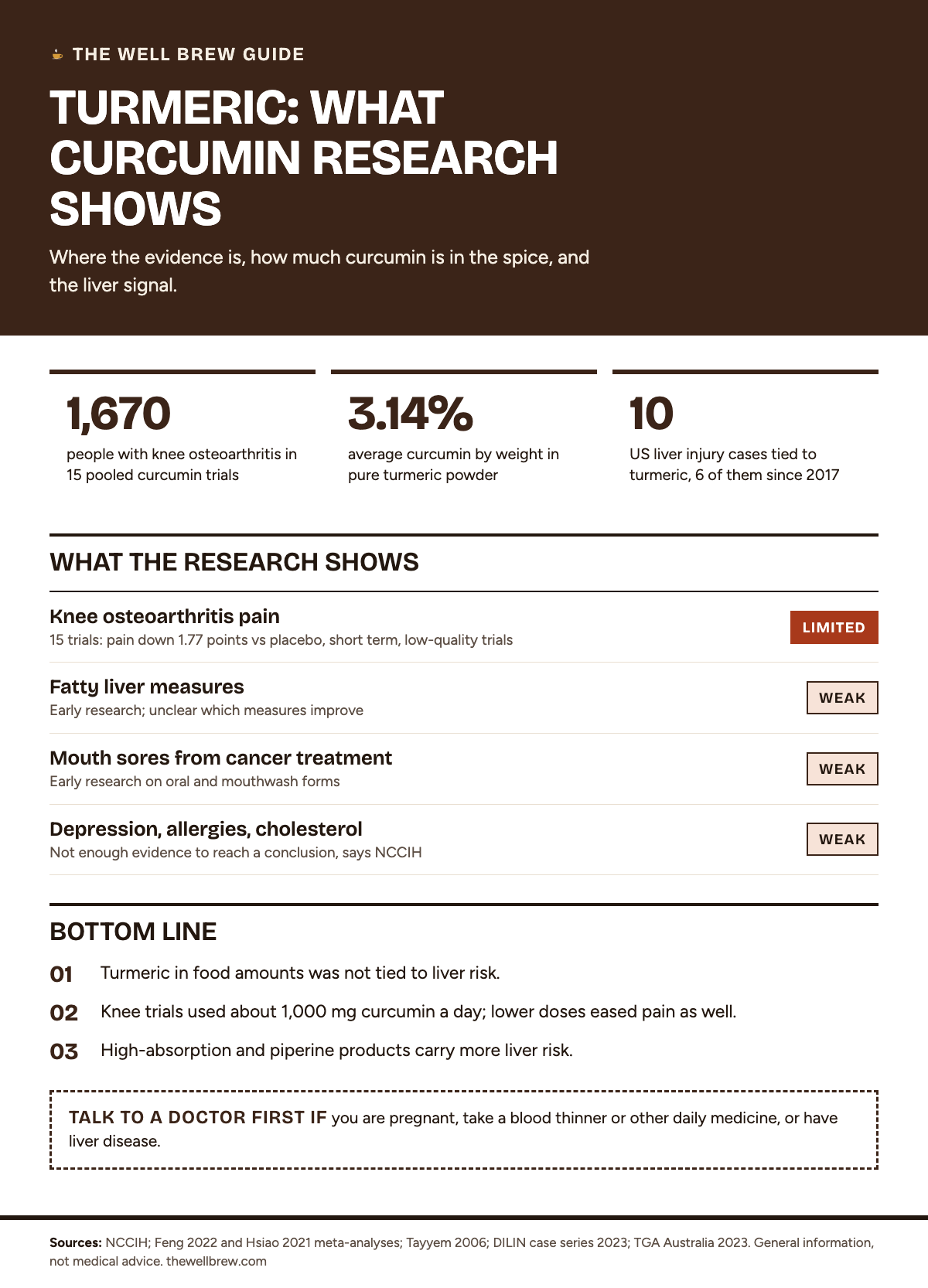
The gap between the two matters for dosing. Pure turmeric powder averaged only 3.14 percent curcumin in a test of 28 spice products, and curry powders held less.[10] So a teaspoon of the spice in a curry gives you a small amount of curcumin, far below what the knee trials used.
Most supplements are concentrated curcumin extracts. NCCIH warns that products vary in how much curcumin they actually contain, and many add other plant compounds, such as piperine from black pepper.[1] That variation makes it hard to compare one study, or one bottle, with another.
What is turmeric good for, based on the research?
The clearest signal is a modest drop in knee osteoarthritis pain over a few weeks to months. NCCIH calls that evidence positive but early, and says higher-quality trials are needed. For every other use, the agency says there is not enough evidence to reach a firm conclusion.[1]
Researchers have also studied turmeric for nonalcoholic fatty liver disease, where early work suggests some liver measures may improve, though it is unclear which ones. A second area is oral mucositis, the painful mouth sores that can follow cancer treatment, where oral or mouthwash forms showed early promise.[1]
Claims about depression, allergies, cholesterol, skin and hormones show up on many labels. We did not find a federal source that supports them with clear effect sizes, so we leave them out. If you want food-based ways to eat for lower inflammation, our guide to anti-inflammatory diet foods and meal ideas covers the evidence for whole diets rather than single spices.
Does turmeric help knee osteoarthritis pain?
In pooled trials, curcumin lowered knee pain scores by about 1.8 points on a 10-point scale compared with placebo. That figure comes from a 2022 meta-analysis of 15 randomized trials with 1,670 patients. The authors also found curcumin was not inferior to NSAID pain relievers, but they rated the trials low quality and urged caution.[3]
Earlier reviews point the same way. A 2016 analysis of 8 trials found a pain score drop of about 2 points versus placebo, with turmeric extracts giving roughly 1,000 mg of curcumin a day. Its authors said the trials were too few and too small to draw definitive conclusions, and the first author worked for a supplement maker.[2]
The largest single trial in our reading compared 1,500 mg a day of turmeric extract with 1,200 mg a day of ibuprofen in 367 people for 4 weeks. Pain and function improved about equally, and the turmeric group reported fewer bouts of stomach pain.[5] For more on managing sore joints, see our joint pain guides.
Evidence table: curcumin and knee osteoarthritis
| Study | Who and how many | Dose and length | Result |
|---|---|---|---|
| Feng et al., 2022 meta-analysis[3] | 15 trials, 1,670 people with knee osteoarthritis | Curcuminoids alone, short term | Pain down 1.77 points vs placebo; similar to NSAIDs; trials low quality |
| Hsiao et al., 2021 meta-analysis[4] | 11 trials, 1,258 people | Under or over 1,000 mg a day | Pain relief similar at low and high doses |
| Kuptniratsaikul et al., 2014 trial[5] | 367 people, pain score 5 or more | 1,500 mg extract vs 1,200 mg ibuprofen, 4 weeks | Noninferior on pain and function; less stomach pain |
| Daily et al., 2016 meta-analysis[2] | 8 trials | About 1,000 mg curcumin a day | Pain down 2.04 points vs placebo; too few trials to be sure |
How much turmeric should you take per day?
No US agency we read sets a daily turmeric dose, so the trial amounts are the only guide. Knee studies often used about 1,000 mg of curcumin a day, and one used 1,500 mg of whole extract.[2][5] NCCIH says regular, non-enhanced forms are likely safe in recommended amounts for up to 2 or 3 months.[1]
Higher doses did not clearly work better. A 2021 meta-analysis split 11 knee trials by dose and found that daily amounts under 1,000 mg eased pain about as well as higher amounts, with similar side effect rates.[4] Since the liver warnings link risk to higher doses and boosted absorption, the lower end of the trial range is the more cautious choice.[7]
Cooking with turmeric carries less concern. Australia’s regulator says the liver risk does not appear to apply to turmeric eaten in typical food amounts.[7]
Why do turmeric supplements add black pepper (piperine)?
Piperine, a compound in black pepper, slows the body’s breakdown of curcumin so more of it reaches the blood. In a 1998 study, 2 g of curcumin alone left blood levels undetectable or very low in healthy volunteers. Adding 20 mg of piperine raised curcumin’s bioavailability by 2000 percent.[9]
The study was small and is now decades old, and higher blood levels may carry a cost. NCCIH warns that highly bioavailable curcumin formulations may harm the liver.[1] In the US liver injury case series below, 3 of the 7 products that were lab tested also contained piperine, and the authors suggested the rise in cases may reflect more combination with black pepper.[6]
Other high-absorption formulas use fats, nanoparticles or special coatings. Our reading did not find trials showing these forms ease joint pain more than standard curcumin.
What are the side effects of turmeric?
The common side effects are stomach-related: nausea, vomiting, acid reflux, upset stomach, diarrhea or constipation. NCCIH lists these for oral turmeric, and notes that curcumin applied to the skin can cause hives or itching.[1] In the pooled knee trials, curcumin did not raise the overall rate of side effects compared with placebo.[3]
The rare but serious one is liver injury. A US network that tracks drug-induced liver injury found 10 turmeric cases enrolled between 2004 and 2022, all since 2011 and 6 since 2017. Of those 10 people, 5 were hospitalized and 1 died of acute liver failure. Injury usually showed up 1 to 4 months after starting.[6]
Seven of the 10 carried a gene variant called HLA-B*35:01, which may make some people more vulnerable. Most were women, and the median age was 56.[6]
Australia’s regulator reviewed 18 local reports up to June 2023 and judged 9 to have enough detail to suggest turmeric or curcumin caused liver injury. It said risk may be higher with enhanced-absorption products, higher doses and existing liver problems.[7]
Is turmeric good for you, or is it bad for your liver?
As a spice in food, turmeric appears safe for most people; the liver concern centers on concentrated supplements. The Australian advisory draws that line directly, and NCCIH ties the liver reports to bioavailable formulations.[7][1]
Turmeric supplements are widely used, so rare problems still add up. In national survey data on 9,685 US adults from 2017 to 2020, turmeric products were the most used of six botanicals with known liver risk. The authors estimated 15.6 million US adults had used at least one of the six in the past 30 days.[8]
Stop the supplement and call your doctor if you notice fatigue, nausea, poor appetite, dark urine or yellowing of the skin or eyes. Those are the liver warning signs NCCIH lists.[1]
Who should not take turmeric supplements?
Pregnant people, anyone with liver problems and people on blood thinners should skip turmeric supplements unless a doctor approves. NCCIH says turmeric supplements may be unsafe in pregnancy, and little is known about amounts above food levels while breastfeeding.[1]
- Liver disease, past or present: the Australian regulator says these people may be more likely to have liver injury.[7]
- Blood thinners or antiplatelet drugs: lab studies and a case report suggest turmeric may raise bleeding risk.[11]
- Kidney stones: Memorial Sloan Kettering advises people prone to stones to talk with a doctor first.[11]
- Cancer treatment: turmeric may affect liver enzymes that process some drugs, and one patient on paclitaxel had liver toxicity while taking several supplements.[11]
- Any daily medicine: NCCIH advises checking with your provider before using any herbal product.[1]
What do doctors use first for osteoarthritis?
Standard care for osteoarthritis starts with education, exercise and weight management, not supplements. The National Institute of Arthritis and Musculoskeletal and Skin Diseases lists range-of-motion, strengthening, water and low-impact exercise, plus weight loss for people who are overweight, as first steps.[12]
Doctors may then add braces or orthotics, oral pain relievers, anti-inflammatory pills, creams applied to the sore joint, or injections into the knee.[12] Turmeric has only been studied as an add-on or comparison in short trials, and it does not replace this plan. US supplements are not approved by the FDA before they are sold, as NCCIH points out.[1]
Decision table: should you try a turmeric supplement?
| If this describes you | A reasonable next step |
|---|---|
| You want flavor and color in food | Cook with the spice; food amounts were not tied to liver risk.[7] |
| You have knee osteoarthritis and want to try it | Ask your doctor, keep doing exercise, and use a plain curcumin product at trial-like amounts for no more than 2 to 3 months.[1][12] |
| A product says enhanced absorption or contains piperine | Consider it a higher liver risk and talk to your doctor first.[1][6] |
| You are pregnant or have liver disease | Skip the supplement.[1][7] |
| You take a blood thinner | Do not start without your prescriber’s approval.[11] |
| You notice dark urine or yellow eyes | Stop it and get medical care that day.[1] |
Practical checklist before you buy
- Read the label for the amount of curcumin or curcuminoids per serving, not only the turmeric root weight.[1][10]
- Note any piperine, black pepper extract or “enhanced absorption” wording.[1][7]
- Look for third-party testing seals, since supplements are not FDA approved before sale.[1] See our label checks for what we look for.
- Write down your start date and plan to reassess at 2 to 3 months.[1]
- Bring the bottle to your next appointment so your doctor or pharmacist can check it against your medicines.[1][11]
- Know the liver warning signs: fatigue, nausea, poor appetite, dark urine and jaundice.[1]
Our ingredient guides cover other popular supplements in the same plain format.
Turmeric benefits and side effects: the bottom line
Curcumin has modest, short-term support for knee osteoarthritis pain, from trials that experts rate as low quality. NCCIH does not consider the evidence strong enough to call turmeric beneficial for any health purpose, and the rare liver injuries seem tied to concentrated, high-absorption supplements.[1][3][6]
For most people with sore knees, exercise and weight management are the better first step because they have a stronger evidence base and no liver risk. If you still want to try curcumin, choose a plain product, keep to trial amounts, tell your doctor and stop at the first sign of liver trouble.[12][1]
Frequently asked questions
Is curcuma the same as turmeric?
Yes. Curcuma longa is the plant's scientific name, so products labeled curcuma usually contain turmeric. Some related Curcuma species also contain curcumin, and Australia's regulator includes them in its liver injury warning.
What are the turmeric benefits for women?
We found no trusted source showing benefits specific to women. Most knee trials included both sexes. Women made up 8 of the 10 US liver injury cases, and supplements may be unsafe in pregnancy, so talk with your doctor first.
Is turmeric root better than turmeric powder?
Both come from the same underground stem, and neither has trial evidence over the other. Ground powder averaged about 3 percent curcumin in one lab test, so cooking with either gives far less curcumin than the supplements used in knee studies.
Can you take turmeric every day?
Cooking with turmeric daily appears safe. For supplements, NCCIH says regular forms are likely safe in recommended amounts for up to 2 or 3 months. Longer use, high doses or boosted absorption need a talk with your doctor.
How long does turmeric take to work for joint pain?
In the largest trial we read, people with knee osteoarthritis improved over 4 weeks on 1,500 mg of turmeric extract a day, about as much as on ibuprofen. Many studies ran a few weeks to a few months.
Sources
- Turmeric. National Center for Complementary and Integrative Health, 2025
- Efficacy of turmeric extracts and curcumin for alleviating the symptoms of joint arthritis (Daily et al.). Journal of Medicinal Food, 2016 (first author from a supplement manufacturer)
- Efficacy and safety of curcuminoids alone in alleviating pain and dysfunction for knee osteoarthritis (Feng et al.). BMC Complementary Medicine and Therapies, 2022
- The efficacy of high- and low-dose curcumin in knee osteoarthritis (Hsiao et al.). Complementary Therapies in Medicine, 2021
- Efficacy and safety of Curcuma domestica extracts compared with ibuprofen in knee osteoarthritis (Kuptniratsaikul et al.). Clinical Interventions in Aging, 2014
- Liver injury associated with turmeric: ten cases from the Drug-Induced Liver Injury Network (Halegoua-DeMarzio et al.). American Journal of Medicine, 2023
- Medicines containing turmeric or curcumin: risk of liver injury. Therapeutic Goods Administration, Australia, 2023
- Estimated exposure to 6 potentially hepatotoxic botanicals in US adults (Likhitsup et al.). JAMA Network Open, 2024
- Influence of piperine on the pharmacokinetics of curcumin in animals and human volunteers (Shoba et al.). Planta Medica, 1998
- Curcumin content of turmeric and curry powders (Tayyem et al.). Nutrition and Cancer, 2006
- Turmeric (About Herbs). Memorial Sloan Kettering Cancer Center, 2026
- Osteoarthritis: diagnosis, treatment and steps to take. National Institute of Arthritis and Musculoskeletal and Skin Diseases, 2023

Maya Ellison is the Reviews Editor at The Well Brew, a slow, plain-language supplement review blog for everyday adults. Maya reads each label in full, sets every dose beside the amounts used in human studies, grades the research with sources such as the NIH Office of Dietary Supplements and NCCIH, and works out the real cost and refund fine print. Maya has no medical credentials and is not a doctor, dietitian, nurse or pharmacist. Reviews give pros, cons and who a product suits, never scores. How we review supplements.
This article is general information, not medical advice. Dietary supplements are not reviewed by the FDA for safety or effectiveness before they are sold. Talk to your doctor before you start any supplement, especially if you are pregnant, nursing, take medication or have a health condition.