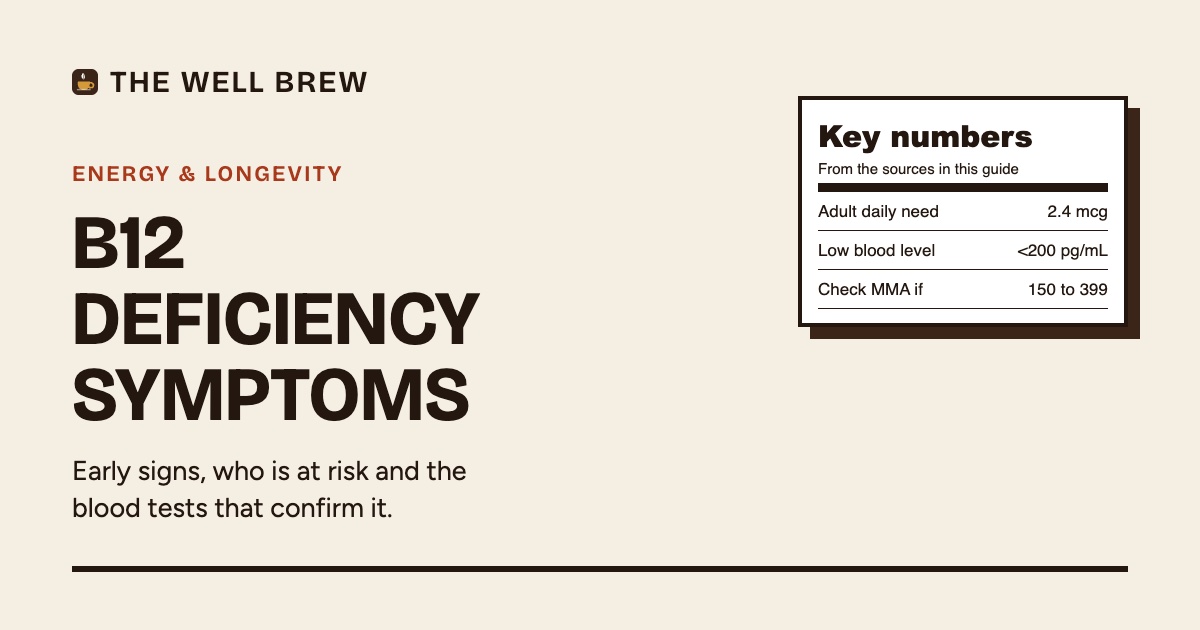
B12 deficiency symptoms include tiredness, weakness, pale skin, shortness of breath, a sore red tongue and numb or tingling hands and feet. Memory, mood and balance problems can follow, sometimes before anemia shows. Older adults, vegans, people with pernicious anemia and long-term metformin or acid reducer users face the highest risk. A blood test confirms it, with levels under 200 to 250 pg/mL usually counted as low.
On this page
- What are b12 deficiency symptoms?
- What are the early signs of low B12?
- What nerve and mood symptoms can low B12 cause?
- What causes vitamin B12 deficiency?
- Who is most likely to have low B12?
- Can metformin or acid reducers cause low B12?
- How is vitamin B12 deficiency tested?
- How is B12 deficiency treated?
- When should you see a doctor about low B12 symptoms?
- B12 deficiency checklist
- Bottom line
- FAQ
B12 deficiency symptoms often start quietly: tiredness, pale skin, a sore red tongue and pins and needles in the hands or feet. For this guide we read the NIH Office of Dietary Supplements fact sheets on vitamin B12 and folate, the NHLBI page on B12 deficiency anemia, two MedlinePlus lab test guides, the long-term metformin data from the Diabetes Prevention Program, a large study of acid reducers and a 2018 Cochrane review, following the steps on our how we review page.[1][3][6]
The short answer: most labs call a blood B12 level under 200 to 250 pg/mL low, and nerve symptoms can show up before any anemia does, so a simple blood test is worth asking for if you are in a risk group.[1]
| What it is | Too little vitamin B12 to make healthy red blood cells and keep nerves working. The medical name is cobalamin deficiency.[1][3] |
|---|---|
| Common early signs | Fatigue, pale skin, shortness of breath, headaches and dizziness.[3] |
| Nerve and mood signs | Numb or tingly hands and feet, trouble with balance or walking, confusion, memory problems, depression.[2][3] |
| Blood level that counts as low | Under 200 or 250 pg/mL at most labs. An MMA test helps when the result falls between 150 and 399 pg/mL.[1] |
| Daily need for adults | 2.4 mcg, rising to 2.6 mcg in pregnancy and 2.8 mcg while breastfeeding.[1] |
| Higher risk | Older adults, vegans, people with pernicious anemia or gut surgery, and long-term users of metformin or acid reducers.[1][3] |
| Usual care | B12 shots, or high-dose B12 pills or nasal spray chosen by a doctor based on the cause.[1][3] |
What are b12 deficiency symptoms?
Vitamin B12 deficiency is a shortage of the vitamin your body uses to build red blood cells, make DNA and keep the coating on your nerves healthy. When levels run low, the first signs are usually those of anemia: feeling tired or weak, looking pale and getting short of breath. Nerve and mood changes can follow.[1][3]
The NIH fact sheet lists the hallmark problem as megaloblastic anemia, where red blood cells grow too large and do not work well. It also lists a sore, swollen tongue (glossitis), heart palpitations, pale skin, weight loss, infertility and, in more serious cases, dementia.[1]
Low B12 is easy to miss because tiredness and low mood have many other causes. A blood test is the only way to know whether B12 is part of the picture.[5]
Symptoms also come on slowly. Your body stores about 1,000 to 2,000 times the B12 you eat in a day, so it can take several years after intake or absorption drops before you feel anything.[2]
What are the early signs of low B12?
The early signs of low B12 are mostly the signs of anemia: fatigue, paleness, shortness of breath, headaches and dizziness. They happen because your bone marrow cannot make enough healthy red blood cells to carry oxygen. Some people also notice a fast or uneven heartbeat.[3][5]
Other early clues show up in the mouth and gut:
- a painful, smooth, red tongue[3]
- soreness of the mouth[2]
- loss of appetite and weight loss you were not trying for[2][5]
- diarrhea[3][4]
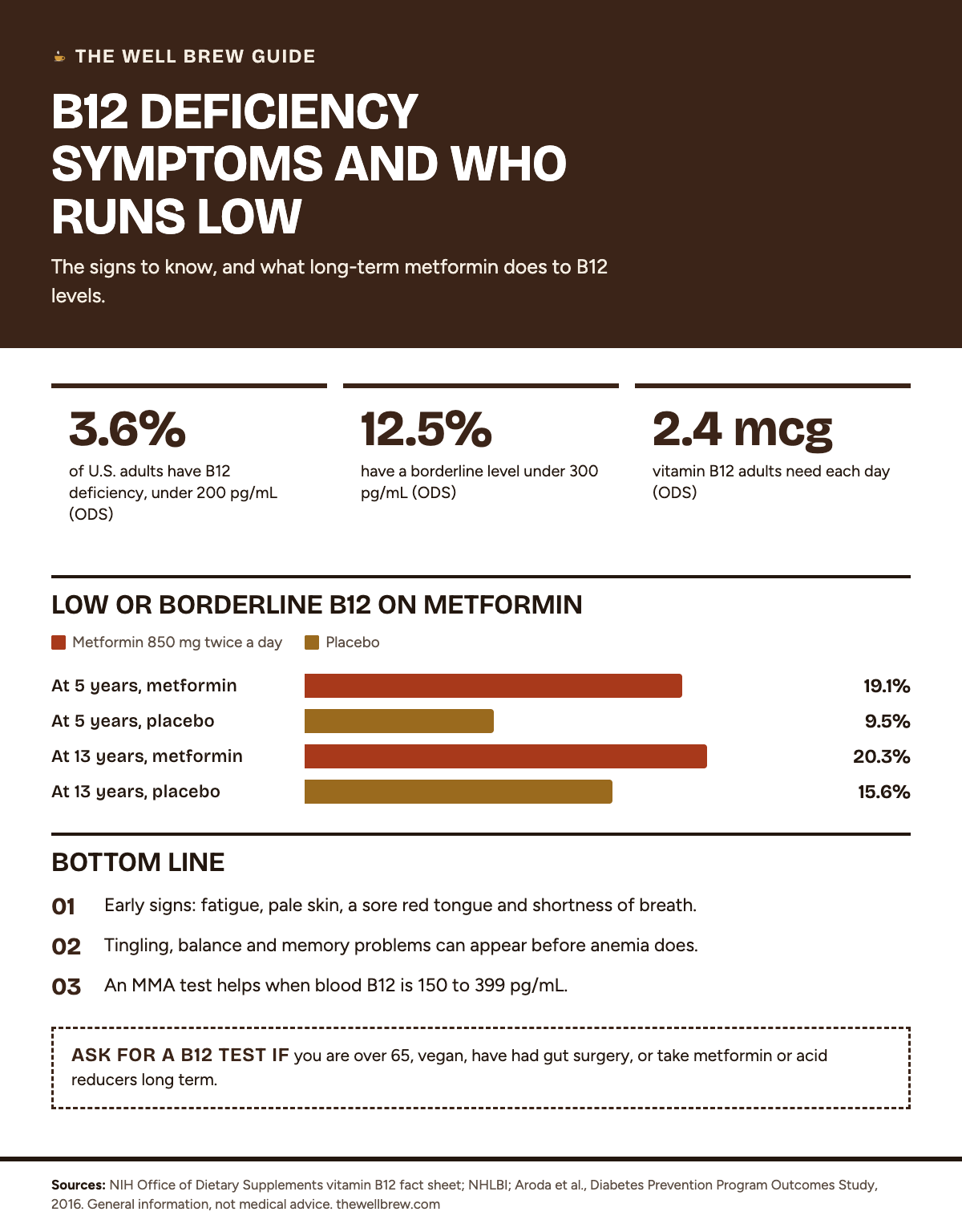
None of these signs alone proves a B12 problem. The pattern matters more, especially if you also sit in one of the risk groups below. Large NIH survey data put true deficiency (under 200 pg/mL) at about 3.6% of U.S. adults, while about 12.5% have a borderline level under 300 pg/mL.[1]
What nerve and mood symptoms can low B12 cause?
Low B12 can damage nerves, and this can happen even when blood counts still look normal. The most common nerve sign is numbness or tingling in the hands and feet. The NIH fact sheet stresses early diagnosis because this nerve damage can become permanent.[1]
NHLBI lists these brain and nerve symptoms when B12 deficiency goes untreated:[3]
- tingling feelings or pain
- trouble walking and uncontrollable muscle movements
- confusion, slower thinking, forgetfulness and memory loss
- depression or irritability
- problems with smell or taste
- vision problems
The ODS consumer sheet adds problems with balance and poor memory.[2] Some studies link low B12 with depression, but those links come from observational research and do not show that low B12 causes depression.[1]
Waiting has a cost here. NHLBI notes that some nerve symptoms, such as numbness and tingling, may not go away even after treatment.[3]
What causes vitamin B12 deficiency?
Most vitamin B12 deficiency in the United States comes from poor absorption. NHLBI calls a purely diet-related deficiency rare. B12 has to be freed from food by stomach acid and then joined to intrinsic factor, a protein made in the stomach, before the small intestine can take it in.[1][3]
Anything that breaks that chain can lower B12:
- Pernicious anemia. An autoimmune disease that stops the stomach making intrinsic factor. It is the most common cause of clearly visible B12 deficiency worldwide, with about 151 cases per 100,000 people in the U.S.[1]
- Atrophic gastritis. Thinning of the stomach lining that cuts acid and intrinsic factor. It affects about 2% of people overall and 8% to 9% of adults 65 and older.[1]
- Gut conditions and surgery. Celiac disease, Crohn’s disease, H. pylori infection, weight-loss surgery and removal of part of the stomach.[1][3]
- Medicines. Long-term metformin and heartburn medicines that lower stomach acid.[1][3]
- Heavy drinking. Alcohol makes B12 harder to absorb.[3]
- Diet. B12 is found naturally only in animal foods, so vegans who skip fortified foods and supplements are at risk.[1]
NHLBI also links other autoimmune problems, such as type 1 diabetes, thyroid disease and vitiligo, with a higher risk.[3]
Who is most likely to have low B12?
Older adults, vegans, people with pernicious anemia and people with stomach or bowel problems are the groups most likely to run low. Depending on the cutoff used, between 3% and 43% of older adults living at home have low B12, often because of atrophic gastritis.[1]
Here is how the main risk groups compare:
| Group | Why the risk is higher | What the sources say |
|---|---|---|
| Older adults | Less stomach acid and intrinsic factor | Pernicious anemia is behind 15% to 25% of deficiency in older adults. MedlinePlus flags people over 75.[1][4] |
| Vegans and vegetarians | B12 occurs naturally only in animal foods | Fortified foods and supplements greatly cut the risk.[1] |
| Babies of vegan mothers who breastfeed | Small stores at birth and little B12 in breast milk | Can lead to failure to thrive and developmental delays.[1] |
| Metformin users | May reduce B12 absorption | More low and borderline levels after 5 and 13 years.[6] |
| Long-term acid reducer users | Less acid to free B12 from food | Two or more years of use tied to higher odds of deficiency.[7] |
| Gut surgery or disease | Fewer cells that make acid and intrinsic factor | Celiac disease and weight-loss surgery raise the risk.[1] |
Blood B12 often drops during pregnancy and usually returns to normal after delivery, but a true deficiency in pregnancy can harm the baby’s brain and spine development.[1][3]
Can metformin or acid reducers cause low B12?
Yes. Long-term use of metformin, proton pump inhibitors (PPIs) and H2 blockers is linked with lower B12 levels. The NIH fact sheet says metformin might reduce B12 absorption, and that acid-lowering drugs can interfere with absorbing B12 from food. Neither finding means you should stop the medicine.[1]
The two biggest studies we read:
| Study | Who and how long | Exposure | Result |
|---|---|---|---|
| Diabetes Prevention Program Outcomes Study, 2016 | About 2,150 adults with prediabetes, followed up to 13 years | Metformin 850 mg twice a day vs placebo | Low or borderline B12 in 19.1% vs 9.5% at 5 years and 20.3% vs 15.6% at 13 years. Odds rose 13% per year of use.[6] |
| Kaiser Permanente case-control study, 2013 | 25,956 people with B12 deficiency vs 184,199 without | 2 or more years of PPIs or H2 blockers | Higher odds of deficiency with PPIs (1.65) and H2 blockers (1.25), and higher still above 1.5 PPI pills a day (1.95).[7] |
The metformin study authors concluded that routine B12 testing should be considered for people on metformin. Nerve problems were more common in the metformin group when B12 was low.[6] If you take metformin for blood sugar, our guide to prediabetes A1C range, symptoms and how to lower your numbers explains where the drug fits.
The acid reducer study was observational, so it shows a link and not proof of cause. Still, it is a fair reason to ask about a B12 check after years of daily use.[7]
How is vitamin B12 deficiency tested?
Doctors start with a blood test for B12 and a complete blood count, then add a methylmalonic acid (MMA) test when the result is borderline. Most labs call a B12 level under 200 or 250 pg/mL low. NHLBI notes you can still have a deficiency with a normal B12 result.[1][3]
MMA is a substance that builds up when B12 is short, so a high MMA level points to deficiency. The NIH fact sheet calls it the most sensitive marker and treats a level above 0.271 micromol/L as a sign of deficiency. MMA can also run high in older adults and in people with kidney problems.[1][4]
A homocysteine test is another option. A level above 15 micromol/L suggests low B12, but low folate and kidney disease also raise it.[1] B12 and folate are often measured together.[5]
This decision table shows how the numbers are usually read:
| If your result is | What it usually means | Likely next step |
|---|---|---|
| B12 under 150 pg/mL | Deficiency is likely | Doctor looks for the cause and starts treatment[1] |
| B12 150 to 399 pg/mL | Gray zone | MMA test to confirm or rule out deficiency[1] |
| B12 400 pg/mL or higher | NHLBI’s normal range | Look for other causes, but ask about MMA if nerve symptoms persist[3] |
| MMA above 0.271 micromol/L | Suggests deficiency | Kidney function is checked, since it also raises MMA[1] |
How is B12 deficiency treated?
Doctors usually treat B12 deficiency with B12 shots, which skip the gut entirely, or with high-dose prescription pills or nasal spray. The choice depends on the cause and how severe it is. People with pernicious anemia cannot absorb even free B12 well, and some people need treatment for life.[1][3]
High-dose oral B12 is a real option for many people. A 2018 Cochrane review of three trials with 153 people found that 1,000 to 2,000 mcg a day by mouth raised blood B12 about as well as shots over three to four months. The review rated that evidence as low quality because the trials were small.[8]
Pills come in large doses because only about 2% of a 500 mcg pill and 1.3% of a 1,000 mcg pill is absorbed.[1] The form on the label (cyanocobalamin, methylcobalamin and others) has not been shown to change absorption.[1]
NHLBI says some symptoms may take months to improve, and severe anemia may need a blood transfusion alongside B12.[3] For people who simply eat too little B12, food is the long-term fix:
- beef liver, 3 ounces: 70.7 mcg[1]
- clams, 3 ounces: 17 mcg[1]
- fortified nutritional yeast, about 1/4 cup: 8.3 to 24 mcg[1]
- salmon, 3 ounces: 2.6 mcg[1]
- 2% milk, 1 cup: 1.3 mcg[1]
- one large egg: 0.5 mcg[1]
When should you see a doctor about low B12 symptoms?
See a doctor soon if you have ongoing tiredness plus numbness, tingling, balance trouble or memory changes, especially if you are in a risk group. Nerve damage from low B12 can be lasting, so these signs call for a prompt blood test.[1][3]
Get medical care right away if you have:
- new trouble walking or keeping your balance[3]
- sudden confusion or fast memory loss[3]
- severe shortness of breath or a racing or uneven heartbeat[3][5]
- vision changes[3]
- a breastfed baby who is not growing or reaching milestones[1]
A few safety points apply to everyone. B12 has no set upper limit because it is generally considered safe, even at high doses.[1] High-dose folic acid can correct the anemia of B12 deficiency while the nerve damage carries on, which may hide the problem.[9] If you take metformin or an acid reducer, do not stop it on your own; ask whether a B12 check makes sense.[1]
B12 deficiency checklist
- Note which symptoms you have and how long you have had them, especially tingling, balance or memory changes.
- Check whether you fit a risk group: over 65, vegan, gut surgery, celiac or Crohn’s disease, metformin or acid reducers for two years or more.[1][7]
- Ask for a B12 level and complete blood count, and an MMA test if the B12 result is borderline.[1][4]
- If you are vegan, eat fortified foods or take a B12 supplement each day.[1]
- Read supplement labels for the B12 amount in mcg and the percent Daily Value (the DV is 2.4 mcg). Our label checking method walks through what to look for.[1]
- Avoid high-dose folic acid on its own until low B12 has been ruled out.[9]
- Recheck your level after treatment, as your doctor advises.[3]
More guides on energy and nutrients are in our energy and longevity section.
Bottom line
B12 deficiency symptoms range from tiredness and a sore tongue to tingling feet and memory trouble, and they build slowly over years. Older adults, vegans, people with pernicious anemia and long-term users of metformin or acid reducers carry the most risk.[1][3]
For most people with symptoms and a risk factor, a blood test is the better first step than guessing with a supplement, because the cause decides the treatment and nerve damage is easier to stop early than to undo.[1][3]
Frequently asked questions
What is cobalamin deficiency?
Cobalamin is the chemical name for vitamin B12, so cobalamin deficiency is the same thing as vitamin B12 deficiency. It means your body lacks enough B12 to make healthy red blood cells and keep nerves working, which can lead to anemia and nerve damage.
Is vitamin B deficiency the same as low B12?
Not exactly. There are eight B vitamins, and each one has its own deficiency signs. Low B12 is one type of vitamin B deficiency. A vitamin B test can measure one or several, and B12 and folate are often checked together.
How long does it take to fix low B12?
It depends on the cause and how low the level was. NHLBI says some symptoms may take months to improve, and nerve symptoms such as numbness may not fully go away. People with pernicious anemia often need B12 for life.
Can you take too much B12?
There is no official upper limit for vitamin B12 because it is generally considered safe, even at high doses. That does not make high doses useful for people with normal levels. Ask a doctor before starting large doses, especially with health conditions.
Can vegans get enough B12?
Yes, but not from unfortified plant foods, since B12 occurs naturally only in animal foods. Fortified nutritional yeast, fortified cereals and plant milks, or a daily B12 supplement can supply it and greatly lower the risk of deficiency.
Sources
- Vitamin B12: Fact Sheet for Health Professionals. NIH Office of Dietary Supplements, updated 2025
- Vitamin B12: Fact Sheet for Consumers. NIH Office of Dietary Supplements, 2025
- Vitamin B12-Deficiency Anemia. National Heart, Lung, and Blood Institute, NIH, 2022
- Methylmalonic Acid (MMA) Test. MedlinePlus, National Library of Medicine
- Vitamin B Test. MedlinePlus, National Library of Medicine
- Long-term Metformin Use and Vitamin B12 Deficiency in the Diabetes Prevention Program Outcomes Study. Aroda VR et al., Journal of Clinical Endocrinology and Metabolism, 2016
- Proton pump inhibitor and histamine 2 receptor antagonist use and vitamin B12 deficiency. Lam JR et al., JAMA, 2013
- Oral vitamin B12 versus intramuscular vitamin B12 for vitamin B12 deficiency. Wang H et al., Cochrane Database of Systematic Reviews, 2018
- Folate: Fact Sheet for Health Professionals. NIH Office of Dietary Supplements, 2025

Maya Ellison is the Reviews Editor at The Well Brew, a slow, plain-language supplement review blog for everyday adults. Maya reads each label in full, sets every dose beside the amounts used in human studies, grades the research with sources such as the NIH Office of Dietary Supplements and NCCIH, and works out the real cost and refund fine print. Maya has no medical credentials and is not a doctor, dietitian, nurse or pharmacist. Reviews give pros, cons and who a product suits, never scores. How we review supplements.
This article is general information, not medical advice. Dietary supplements are not reviewed by the FDA for safety or effectiveness before they are sold. Talk to your doctor before you start any supplement, especially if you are pregnant, nursing, take medication or have a health condition.