Red yeast rice can lower LDL cholesterol because it contains monacolin K, the same molecule as the statin lovastatin. Trials found an LDL drop of about 1.02 mmol/L, but US brands varied more than 120-fold in strength, some contain the kidney toxin citrinin, and tablets in Japan were linked to kidney injury. Talk to a doctor before trying it.
On this page
- What is red yeast rice, and what is monacolin K?
- Does red yeast rice for cholesterol work?
- What are the benefits of red yeast rice?
- How much monacolin K is in a red rice yeast supplement?
- What are red yeast rice side effects?
- What happened with the beni-koji kidney cases in Japan?
- What do doctors use first for high cholesterol?
- Should you try a red rice yeast supplement?
- Bottom line on red yeast rice
- FAQ
Red yeast rice is a fermented rice product sold to lower cholesterol, and this guide covers what it does, how well it works, and the safety risks that come with it. We read the NCCIH fact sheet, the NHLBI and MedlinePlus cholesterol pages, the EU rule that caps its active compound, five clinical trials and reviews, two lab studies of store products, and a 2025 national study of kidney injury in Japan. You can see how we pick and grade sources on our how we review page.
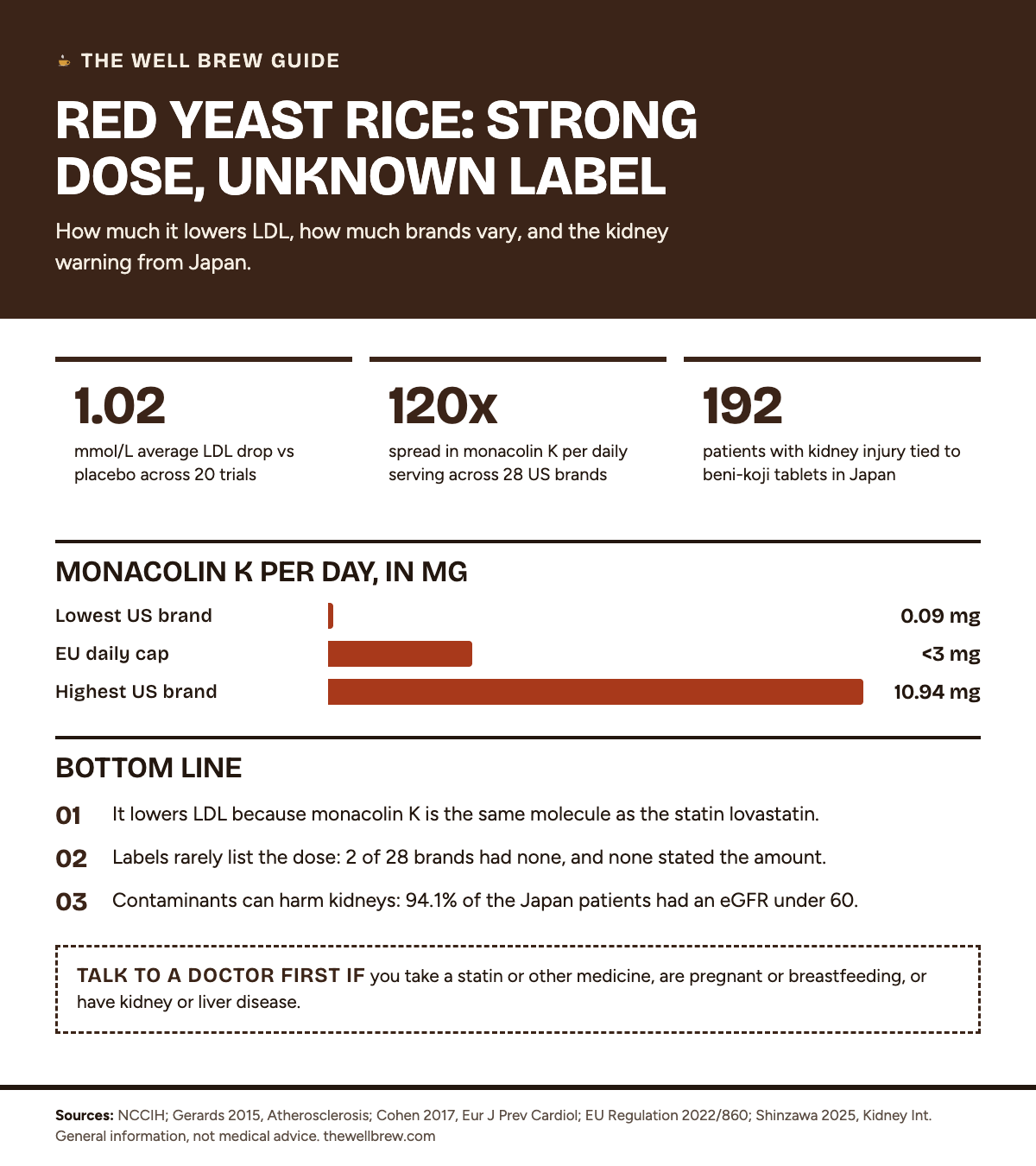
The short answer: products rich in monacolin K lowered LDL cholesterol by about 1.02 mmol/L (roughly 39 mg/dL) in 20 trials, but that compound is the same as the drug lovastatin, and the amount in store products ranged more than 120-fold per daily serving.[4][9]
| What it is | Rice fermented with a mold, usually Monascus purpureus, sold as food, traditional Chinese medicine and supplements.[1] |
|---|---|
| Active compound | Monacolin K, which is structurally identical to the prescription statin lovastatin.[1] |
| Used for | Lowering LDL cholesterol, mostly by people who want to avoid or cannot take a statin.[5] |
| Typical amounts | Not standardized. In 28 US brands, a daily serving held 0.09 to 10.94 mg of monacolin K. The EU now caps a daily portion at under 3 mg.[9][12] |
| Best evidence | Pooled trials of products with a known monacolin K content show a clear LDL drop.[4] |
| Main safety points | Statin-like muscle, liver and kidney effects, statin-like drug interactions, and possible citrinin contamination.[1] |
| Who should avoid it | People who are pregnant or breastfeeding, and anyone taking a statin or other cholesterol medicine without a doctor’s advice.[1] |
What is red yeast rice, and what is monacolin K?
Red yeast rice is rice that has been fermented with a mold called Monascus purpureus, which can fill the grain with cholesterol-lowering compounds called monacolins. The mold is technically not a yeast, but US labels use the older name.[1] The strain and the way it is grown decide how much of these compounds end up in the final product.[1]
The most important monacolin is monacolin K. It has the same chemical structure as lovastatin, a statin drug that slows how much cholesterol the liver makes, and that shared structure is why it can lower cholesterol.[1]
Traditional red rice used in cooking may hold only trace amounts of monacolin K. Some supplements hold almost none, and others hold a lot. Researchers have also reported that drug-grade lovastatin is sometimes added illegally to products sold as a natural ingredient.[1] So two bottles with the same name on the front can act very differently in the body.
You will also see it sold as red rice yeast, red yeast rice extract, or by Chinese product names such as Xuezhikang, a partly purified extract used in large trials in China.[6]
Does red yeast rice for cholesterol work?
Yes, when the product contains enough monacolin K: pooled trials found it lowers LDL cholesterol by about as much as a low-dose statin. A 2015 review of 20 randomized trials found an LDL drop of 1.02 mmol/L compared with placebo, and no clear difference from statin therapy.[4] The catch is that these trials used products with a measured monacolin K content.[4]
The best-known US trial, published in 2009, enrolled 62 adults who had stopped statins because of muscle pain. They took 1,800 mg twice a day or a placebo for 24 weeks, along with a 12-week lifestyle program.[5] LDL fell by 35 mg/dL in the supplement group at week 24, compared with 15 mg/dL on placebo, and muscle enzyme levels and pain scores did not rise.[5] The authors noted the study was small, short and run at one site.[5]
The largest outcome trial is the China Coronary Secondary Prevention Study. Nearly 5,000 people who had already had a heart attack took Xuezhikang or a placebo for about 4.5 years.[6] Major coronary events fell from 10.4% to 5.7%, a 45% relative drop.[6] That trial used one standardized Chinese extract, so its results do not carry over to an unmeasured bottle from a US shelf.
| Study | Who and how long | Dose or product | Main result |
|---|---|---|---|
| Gerards, 2015 meta-analysis[4] | 20 randomized trials | Products with known monacolin K content | LDL down 1.02 mmol/L vs placebo; similar to statins; safety reporting was low quality |
| Becker, 2009 trial[5] | 62 statin-intolerant adults, 24 weeks | 1,800 mg twice daily | LDL down 35 mg/dL vs 15 mg/dL on placebo |
| Lu, 2008 CCSPS trial[6] | Nearly 5,000 heart attack survivors, about 4.5 years | Xuezhikang extract daily | Major coronary events 5.7% vs 10.4% on placebo |
| Fogacci, 2019 safety meta-analysis[7] | 53 trials, 8,535 people | Various monacolin K doses | No rise in muscle problems (odds ratio 0.94) |
What are the benefits of red yeast rice?
The main proven benefit is a lower LDL cholesterol level, and only in products that contain meaningful monacolin K. NCCIH says products with considerable monacolin K may also lower blood sugar and blood pressure, and may cut heart problems and death in people with metabolic syndrome.[1] It adds that those same products count as unapproved drugs in the United States.[1]
The Chinese outcome trial also reported lower cardiovascular and total deaths, by 30% and 33%, plus fewer procedures to reopen heart arteries.[6] It is a single trial of one extract in one population, so treat it as one encouraging result that still needs repeating.
For products with little monacolin K, the picture is different. NCCIH says it is unknown whether they lower cholesterol or help any other area of health, and some contain less than the amount that worked in trials.[1] The benefit depends on the drug content, so a bottle weak enough to be clearly legal may also do very little.
If your goal is a modest LDL drop from food rather than a drug-like compound, soluble fiber is a gentler place to start. Our guide to psyllium husk benefits for digestion, cholesterol and blood sugar covers that evidence.
How much monacolin K is in a red rice yeast supplement?
You cannot tell from the label, because US products usually do not list monacolin K, and lab tests show huge swings between brands. A 2017 study bought 28 brands from mainstream US stores. Two had no detectable monacolin K, and none listed the amount on the label.[9][1] In the rest, the content ranged from 0.09 to 5.48 mg per 1,200 mg of product.[9]
Following each label’s daily serving, a buyer would take anywhere from 0.09 to 10.94 mg of monacolin K a day, a range of more than 120-fold.[9] An earlier 2010 test of 12 products, each labeled 600 mg per capsule, found monacolin K from 0.10 to 10.09 mg per capsule.[10]
Europe has tightened its rules. A 2022 EU regulation says a daily portion must provide less than 3 mg of monacolins, and labels must carry a warning, because severe reactions had been reported at intakes as low as 3 mg a day.[12]
Contamination is a separate problem. Citrinin is a toxin made by some strains of the mold, and it can harm the kidneys.[1] Four of the 12 products in the 2010 test had raised citrinin levels.[10] In a 2021 analysis of 37 products cited by NCCIH, only one was under the EU citrinin limit, and four labeled citrinin-free were contaminated.[1]
What are red yeast rice side effects?
Products with real monacolin K can cause the same side effects as statin drugs, including muscle, liver and kidney damage. They may also cause diarrhea, nausea and stomach pain.[1] Because the dose in a bottle is unknown, it is hard to predict how strong these effects may be for any one person.
The trial data look reassuring at first. A 2019 review of 53 trials and 8,535 people found no rise in muscle problems.[7] But a 2024 umbrella review rated 80% of the published meta-analyses as critically low in confidence, and it linked these products to higher uric acid and liver enzyme results in some analyses.[8] The 2015 review also judged most trial safety checks to be low quality.[4] European food safety experts in 2018 could not name a safe daily level of monacolins at all.[1]
Who should avoid it
- People who are pregnant or breastfeeding. There are no safety studies, and NCCIH does not recommend it.[1]
- Anyone already taking a statin or another cholesterol medicine, unless a doctor plans it.[1]
- People with kidney or liver disease, given the reported organ effects and citrinin risk.[1]
- Anyone who had muscle pain or liver test changes on a statin, unless a doctor is watching the numbers.[1]
Medicines and interactions
NCCIH says these products can have the same types of drug interactions as statins, which may raise the chance of side effects.[1] Bring the bottle to your doctor or pharmacist so they can check it against everything else you take.
See a doctor right away if
- You have unexplained muscle pain, weakness or dark urine.
- Your skin or the whites of your eyes turn yellow, or you have pain in the upper right belly.
- You pass much more or much less urine than usual, or feel unusually thirsty and weak.
What happened with the beni-koji kidney cases in Japan?
In late 2023 and early 2024, people in Japan who took certain beni-koji (red yeast rice) tablets for cholesterol developed kidney injury, which led to a national safety review. A 2025 survey of Japanese kidney doctors described 192 affected patients.[11] Of these, 94.1% had low kidney function, with an eGFR under 60, when first seen.[11]
Many showed signs of Fanconi syndrome, a problem in the kidney’s filtering tubes that lets potassium, phosphate and sugar leak into the urine.[11] Muscle enzyme levels were not raised, so this was not the statin-type muscle breakdown people usually worry about.[11] The researchers also noted that citrinin was not made by the strains involved, which points to a different contaminant.[11]
Kidney markers improved after people stopped the tablets and got treatment. Even so, 87% still had an eGFR under 60 at their last check.[11] The authors said more work is needed to prove the cause.[11]
For buyers, this means a fermented product can pick up harmful compounds that no label lists, and the damage may last after you stop taking it.
What do doctors use first for high cholesterol?
Doctors start with heart-healthy lifestyle changes and, when those are not enough, add a prescription medicine, most often a statin. MedlinePlus says you can lower cholesterol through lifestyle changes, and that some people also need medicines.[3] NHLBI calls statins the most common medicine for high blood cholesterol.[2]
Statins have a clear track record. NHLBI says studies show they lower the risk of heart attack and stroke in people with high LDL.[2] They usually do not cause side effects, though they may raise diabetes risk in people already at high risk, and actual liver damage is extremely rare.[2]
A prescription statin has a known dose, quality checks, and a doctor who tracks your blood work. A red rice yeast capsule offers none of those. If you stopped a statin because of muscle pain, ask about a lower dose, a different statin, or a non-statin drug before you turn to a supplement.
Food still matters alongside any medicine. Our anti-inflammatory diet guide with foods, meal ideas and evidence shows a heart-friendly way of eating, and you can browse more in our cholesterol and heart health guides.
Should you try a red rice yeast supplement?
For most people the answer is to talk with a doctor first, because the products that work act like an unmeasured statin. The table below sets out common situations and what the evidence suggests in each. Use it to prepare for that conversation.
| If this is you | A sensible next step |
|---|---|
| Your LDL is mildly high and you take no medicine | Start with diet, fiber and activity, then recheck. Lifestyle comes first in standard care.[3] |
| You already take a statin | Do not add it. Doubling up means statin-like effects and interactions with no clear gain.[1] |
| You stopped a statin because of muscle pain | Ask your doctor about other options. The 2009 trial is the closest evidence, and it was small.[5] |
| You are pregnant or breastfeeding | Avoid it. There is no safety data.[1] |
| You have kidney or liver disease | Avoid it unless a specialist says otherwise, given the organ effects and contamination reports.[1][11] |
| You have had a heart attack or stroke | Stay on prescribed care. The outcome trial used one standardized extract, not a store product.[6] |
Label checklist before you buy
- Look for a stated monacolin K amount per daily serving. Most US labels do not list it.[9]
- Look for a citrinin test result, and remember that a citrinin-free claim has been wrong before.[1]
- Prefer a brand that shows independent lab testing for strength and purity.[10]
- Skip any product that promises to replace your prescription.
- Write down the brand and lot number, and tell your doctor before your next blood test.
- Read more about how we check labels in our review method, and compare other options in our ingredient guides.
Bottom line on red yeast rice
Red yeast rice can lower LDL cholesterol, but only because its main compound is the same molecule as lovastatin. That makes it a drug of unknown strength, with real risks from contamination, and a 2024 kidney injury outbreak in Japan showed how serious those can be.[1][11]
For most people a prescription statin, or another medicine your doctor picks, is the better choice because the dose is known and your blood work gets checked. If you still want to try a supplement, do it only with your doctor in the loop and blood tests on the calendar.
Frequently asked questions
Is red rice yeast the same as red yeast rice?
Yes. Red rice yeast is a common mix-up of the same name. Both refer to rice fermented with the Monascus purpureus mold. The product may also be sold as red yeast rice extract, red mold rice, or under Chinese names such as Xuezhikang.
Is red yeast rice legal in the United States?
It can be sold as a supplement, but the FDA says products with enhanced or added lovastatin cannot be marketed as dietary supplements. NCCIH notes that products with considerable monacolin K count as unapproved new drugs, so legal products may contain very little.
Can I take red yeast rice with a statin?
Not without a doctor's advice. Monacolin K is the same molecule as lovastatin, so adding it to a statin stacks two statin-like doses. NCCIH says these products share statin side effects and drug interactions, which raises the chance of muscle, liver and kidney problems.
How long does red yeast rice take to lower cholesterol?
In the 2009 trial of statin-intolerant adults, LDL had already fallen by 43 mg/dL at the 12-week check, compared with 11 mg/dL on placebo. That trial used 1,800 mg twice daily, and store products vary widely in strength.
Does red yeast rice extract contain citrinin?
Some products do. Citrinin is a kidney toxin made by some mold strains. In a 2010 test, four of 12 products had raised levels, and in a 2021 analysis of 37 products, four labeled citrinin-free were contaminated.
Sources
- Red Yeast Rice: What You Need To Know. NCCIH, National Institutes of Health
- Blood Cholesterol: Treatment. National Heart, Lung, and Blood Institute
- Cholesterol. MedlinePlus, National Library of Medicine
- Traditional Chinese lipid-lowering agent red yeast rice results in significant LDL reduction but safety is uncertain: a systematic review and meta-analysis. Gerards MC et al., Atherosclerosis, 2015
- Red yeast rice for dyslipidemia in statin-intolerant patients: a randomized trial. Becker DJ et al., Annals of Internal Medicine, 2009
- Effect of Xuezhikang, an extract from red yeast Chinese rice, on coronary events in a Chinese population with previous myocardial infarction. Lu Z et al., American Journal of Cardiology, 2008
- Safety of red yeast rice supplementation: a systematic review and meta-analysis of randomized controlled trials. Fogacci F et al., Pharmacological Research, 2019
- Associations between the use of red yeast rice preparations and adverse health outcomes: an umbrella review of meta-analyses of randomized controlled trials. Ma ZY et al., Journal of Integrative Medicine, 2024
- Variability in strength of red yeast rice supplements purchased from mainstream retailers. Cohen PA et al., European Journal of Preventive Cardiology, 2017
- Marked variability of monacolin levels in commercial red yeast rice products. Gordon RY et al., Archives of Internal Medicine, 2010
- A nationwide questionnaire study evaluated kidney injury associated with Beni-koji tablets in Japan. Shinzawa M et al., Kidney International, 2025
- Commission Regulation (EU) 2022/860 on monacolins from red yeast rice. European Commission, EUR-Lex, 2022

Maya Ellison is the Reviews Editor at The Well Brew, a slow, plain-language supplement review blog for everyday adults. Maya reads each label in full, sets every dose beside the amounts used in human studies, grades the research with sources such as the NIH Office of Dietary Supplements and NCCIH, and works out the real cost and refund fine print. Maya has no medical credentials and is not a doctor, dietitian, nurse or pharmacist. Reviews give pros, cons and who a product suits, never scores. How we review supplements.
This article is general information, not medical advice. Dietary supplements are not reviewed by the FDA for safety or effectiveness before they are sold. Talk to your doctor before you start any supplement, especially if you are pregnant, nursing, take medication or have a health condition.