Most healthy adults need at least 0.8 grams of protein per kilogram of body weight a day, which is about 46 grams for women and 56 grams for men. The 2025 to 2030 Dietary Guidelines set a higher goal of 1.2 to 1.6 grams per kilogram. Adults over 65 may need 1.0 to 1.2, and people with kidney disease should ask their doctor first.
On this page
- How do you work out your daily protein target?
- How many grams of protein per day do you need?
- How much protein should I eat daily for my body weight?
- How many grams of protein per day for women?
- How much protein do you need a day after 65?
- What does the research say about higher protein intakes?
- How much protein per day to build muscle?
- How much protein should you eat a day to lose weight?
- Which foods give you the most protein?
- Is too much protein bad for your kidneys?
- What do doctors and dietitians use first?
- Practical protein checklist
- Bottom line
- FAQ
How much protein should I eat daily is one of the most common nutrition questions, and the answer depends on your weight, age and goal. For this guide we read the 2025 to 2030 and 2020 to 2025 Dietary Guidelines for Americans, USDA FoodData Central, the NIDDK and NIA pages, and eight reviews and trials, following our how we review page.[1][2][3]
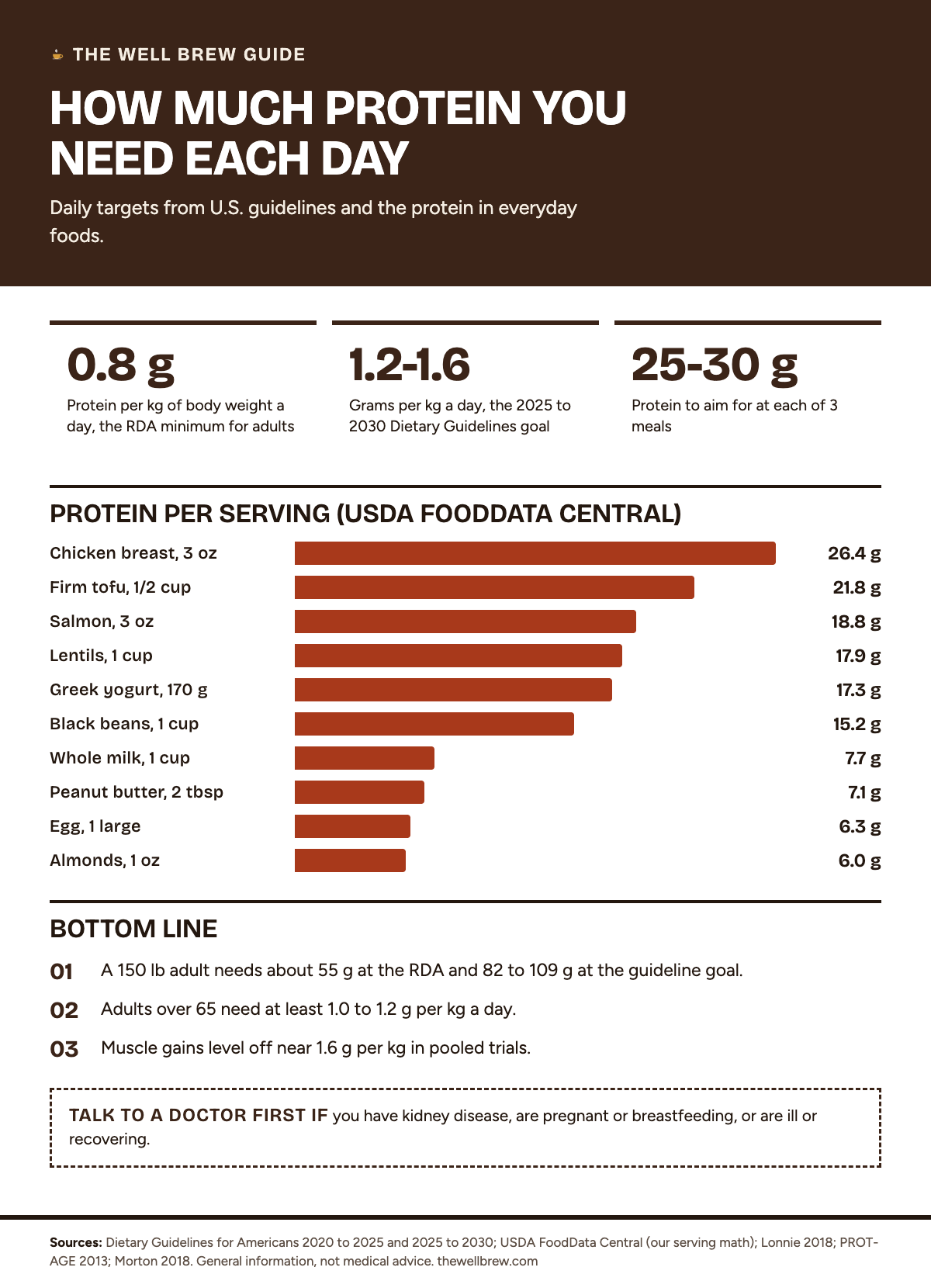
The RDA is 0.8 grams of protein per kilogram of body weight, about 55 grams for a 150 pound adult, and the newest federal guidelines set a goal of 1.2 to 1.6 grams per kilogram.[4][1]
| Minimum for most adults (RDA) | 0.8 g per kg of body weight, the same at every adult age.[4] |
|---|---|
| RDA in grams | 46 g for women and 56 g for men 19 and older; 71 g during pregnancy and breastfeeding.[2] |
| 2025 to 2030 federal goal | 1.2 to 1.6 g per kg a day, adjusted to your calorie needs.[1] |
| Share of calories | 10% to 35% of daily calories for adults.[2] |
| Adults over 65 | At least 1.0 to 1.2 g per kg, and 1.2 to 1.5 g per kg with illness.[5] |
| Strength training | Muscle gains level off near 1.6 g per kg in pooled trials.[7] |
| Who should ask first | People with kidney disease, who may need a moderate, planned amount.[5][11] |
How do you work out your daily protein target?
Your daily protein target is your weight in kilograms multiplied by a grams-per-kilogram number that fits your age and goal. To get kilograms, divide your weight in pounds by 2.2. Then pick a multiplier: 0.8 is the floor for healthy adults, and higher numbers apply to older adults, active people and people losing weight.[4][1][5]
- Weigh yourself and divide the number in pounds by 2.2 to get kilograms.
- Multiply by 0.8 to find the RDA, the minimum that keeps nitrogen balance in most healthy adults.[4]
- Multiply by 1.2 and by 1.6 to see the range in the 2025 to 2030 Dietary Guidelines.[1]
- If you are over 65, use at least 1.0 to 1.2, and up to 1.5 if you are ill or recovering.[5]
- If you lift weights, aim near 1.6; pooled trials found no extra muscle gain above about 1.62.[7]
- Split the total into 3 meals of about 25 to 30 grams each.[4]
- If you have kidney disease, skip the math and ask your care team for your number.[11]
How many grams of protein per day do you need?
Most healthy adults need at least 0.8 grams of protein per kilogram of body weight per day, which works out to 46 grams for women and 56 grams for men. That RDA comes from the National Academies and is set as the amount that keeps the body in nitrogen balance, so it is a minimum rather than an ideal.[4][2]
The 2020 to 2025 guidelines list those gram amounts in Appendix 1 and pair them with a wider range: protein can supply 10% to 35% of an adult’s calories.[2]
The 2025 to 2030 guidelines, released in 2026, raise the everyday goal to 1.2 to 1.6 grams per kilogram and ask people to include protein foods at every meal.[1] The RDA itself has not changed. Think of 0.8 as the floor and 1.2 to 1.6 as the target range the current guidelines now point to.
How much protein should I eat daily for my body weight?
For a 150 pound adult, the RDA is about 55 grams a day and the current guideline range is about 82 to 109 grams. The table below runs the same math for four common body weights so you can find the row nearest yours. We rounded each result to the nearest gram.[4][1][5]
| Body weight | RDA, 0.8 g/kg | Over 65, 1.0 to 1.2 g/kg | Guideline goal, 1.2 to 1.6 g/kg |
|---|---|---|---|
| 130 lb (59 kg) | 47 g | 59 to 71 g | 71 to 95 g |
| 150 lb (68 kg) | 55 g | 68 to 82 g | 82 to 109 g |
| 180 lb (82 kg) | 65 g | 82 to 98 g | 98 to 131 g |
| 210 lb (95 kg) | 76 g | 95 to 115 g | 115 to 153 g |
A 180 pound person weighs about 82 kilograms. At 0.8 grams per kilogram that is 65 grams a day. At the 1.2 to 1.6 guideline range it is 98 to 131 grams, or roughly 33 to 44 grams at each of three meals.[4][1]
The 2025 to 2030 guidelines say to adjust the amount to your calorie needs, so a smaller, less active person can sit at the low end of the range.[1] Our sources did not give a rule for using a goal weight instead of current weight, so we do not offer one here.
How many grams of protein per day for women?
The RDA for women 19 and older is 46 grams of protein a day, rising to 71 grams during pregnancy and while breastfeeding. Those numbers come from the Dietary Guidelines appendix tables, which list the same 71 gram goal for every trimester and for the first year after birth.[2]
The 46 gram figure is a minimum set for an average reference body. A woman who weighs 150 pounds gets about 55 grams from the 0.8 g/kg rule, and 82 to 109 grams from the newer 1.2 to 1.6 goal.[4][1] Men 19 and older have an RDA of 56 grams, and the same per-kilogram rules apply to them.[2]
For bone health, protein works alongside calcium and vitamin D, which our guide to osteoporosis supplements and what protects bones covers in detail. If you are pregnant, your prenatal care team can tell you whether 71 grams is right for you.
How much protein do you need a day after 65?
An expert group recommends that adults over 65 eat at least 1.0 to 1.2 grams of protein per kilogram a day, more than the 0.8 RDA. The PROT-AGE Study Group said older bodies respond less to the protein they eat, and that illness raises needs further, to 1.2 to 1.5 grams per kilogram.[5]
The same group advised at least 1.2 grams per kilogram for older adults who exercise. It made one exception: people with severe kidney disease, an eGFR under 30, who are not on dialysis may need to limit protein.[5]
In the Health ABC study of 2,066 adults aged 70 to 79, those in the top fifth for protein intake lost about 40% less lean mass over 3 years than those in the bottom fifth.[6] That study shows a link, not proof that protein caused the difference. Lonnie and colleagues note the RDA is the same at every adult age, and point to evidence that it may be too low for ageing adults.[4]
The National Institute on Aging suggests adding seafood, dairy or fortified soy along with beans, peas and lentils to meals to keep muscle.[12]
What does the research say about higher protein intakes?
Pooled trials show modest benefits from more protein for muscle and weight loss, with gains that level off rather than keep climbing. The table sums up the studies we read. Several were large meta-analyses, and one is observational, so it carries less weight.[7][9][10][6]
| Study | Who and how many | Protein compared | Main result |
|---|---|---|---|
| Morton, 2018 meta-analysis | 49 trials, 1,863 adults lifting weights for 6 weeks or more | Added protein vs none | Small gains in strength and lean mass; no extra lean mass above about 1.62 g/kg[7] |
| Wycherley, 2012 meta-analysis | 24 trials, 1,063 adults on calorie-cut diets, about 12.1 weeks | Higher vs standard protein | 0.79 kg more weight loss and 0.87 kg more fat loss; kept 0.43 kg more lean mass[9] |
| Devries, 2018 meta-analysis | 28 trials, 1,358 adults without kidney disease | 1.5 g/kg or more vs lower | Change in kidney filtration did not differ[10] |
| Health ABC, 2008 cohort | 2,066 adults aged 70 to 79, 3 years | Top vs bottom fifth of intake | About 40% less lean mass lost; observational only[6] |
One Morton author reported funding from the US National Dairy Council, which also supported some of the trials in that review.[7] The results still match the ISSN position stand, but keep the funding in mind.
How much protein per day to build muscle?
For people who lift weights, about 1.6 grams of protein per kilogram a day appears to be the point where extra protein stops adding muscle. In Morton’s pooled analysis of 49 trials, intakes above about 1.62 g/kg gave no further gains in lean mass, and protein helped younger and trained lifters more than older ones.[7]
The International Society of Sports Nutrition suggests 1.4 to 2.0 grams per kilogram for most people who exercise.[8] Its position stand also gives a per-meal guide: about 0.25 grams per kilogram, or 20 to 40 grams of high-quality protein at a time, spread across meals every 3 to 4 hours.[8]
Protein supported muscle gains only when people also did resistance exercise for at least 6 weeks in the trials Morton reviewed.[7] Food can cover these amounts for most people, and a shake is simply a convenience.
How much protein should you eat a day to lose weight?
During a calorie-cut diet, eating more protein led to slightly more fat loss and less muscle loss than a standard-protein diet in pooled trials. Wycherley’s meta-analysis of 24 trials and 1,063 adults found 0.79 kg more weight loss and 0.87 kg more fat loss, with 0.43 kg more lean mass kept, over about 12 weeks.[9]
The authors called these benefits modest. Blood pressure, cholesterol and fasting blood sugar changed about the same on both diets, and 3 of 5 studies that measured fullness found people felt fuller on higher protein.[9]
The ISSN suggests that people cutting calories eat 3 to 4 meals with 20 to 40 grams of protein each to protect muscle.[8] In practice, that means building each meal around a protein food, then adding vegetables, fruit and whole grains. Our anti-inflammatory diet foods and meal ideas guide has meal ideas that fit this pattern.
Which foods give you the most protein?
A 3 ounce serving of roasted chicken breast has about 26 grams of protein, while one large egg has about 6 grams. We took protein per 100 grams from USDA FoodData Central and converted it to everyday servings. Beans, lentils and tofu give plant eaters solid amounts too.[3]
| Food | Serving | Protein |
|---|---|---|
| Chicken breast, roasted | 3 oz (85 g) | 26.4 g |
| Firm tofu | 1/2 cup (126 g) | 21.8 g |
| Atlantic salmon, farmed, cooked | 3 oz (85 g) | 18.8 g |
| Lentils, boiled | 1 cup (198 g) | 17.9 g |
| Greek yogurt, plain, nonfat | 170 g container | 17.3 g |
| Black beans, boiled | 1 cup (172 g) | 15.2 g |
| Whole milk | 1 cup (244 g) | 7.7 g |
| Peanut butter, smooth | 2 tbsp (32 g) | 7.1 g |
| Egg, whole | 1 large (50 g) | 6.3 g |
| Almonds | 1 oz (28 g) | 6.0 g |
In a sample day, Greek yogurt at breakfast (17.3 g), a cup of lentils at lunch (17.9 g) and 3 ounces of salmon at dinner (18.8 g) come to 54 grams, close to the RDA for a 150 pound adult. Add 2 eggs (12.6 g) and a cup of milk (7.7 g) to pass 74 grams.[3]
The 2025 to 2030 guidelines count 3 ounces of cooked meat or seafood, 1 egg, or 1/2 cup of beans as one serving of protein foods, and recommend a mix of animal and plant sources.[1]
Is too much protein bad for your kidneys?
In healthy adults, higher-protein diets did not change kidney function compared with normal diets in a 2018 meta-analysis of 28 trials. Devries and colleagues pooled 1,358 adults without kidney disease who ate at least 1.5 g/kg, 20% of calories, or 100 grams a day, and found no difference in the change in filtration rate.[10]
That finding does not apply to people who already have kidney disease. NIDDK says some people with chronic kidney disease may need moderate amounts of protein so waste does not build up in the blood, while too little can lead to malnutrition.[11] The PROT-AGE group also lists severe kidney disease as the main reason to limit protein.[5]
Other groups who should ask a doctor or dietitian before raising protein:
- Anyone with chronic kidney disease or on dialysis.[11]
- People who are pregnant or breastfeeding, whose RDA is 71 grams.[2]
- Older adults who are ill, recovering from surgery or losing weight without trying.[5]
- Anyone told to follow a special diet by their care team.
Protein foods such as meat, dairy and beans are also high in phosphorus, which matters for people with kidney disease.[11]
What do doctors and dietitians use first?
Doctors and dietitians start with food, using the Dietary Guidelines and your own health picture to set a protein target. For people with chronic kidney disease, NIDDK advises working with a dietitian to find the right balance of protein.[11][1]
For older adults at risk of muscle loss, the PROT-AGE group pairs higher protein with endurance and resistance exercise at a safe, tolerated level.[5] Protein powders and shakes are an option when appetite or chewing makes food hard, but they are a convenience and not a replacement for meals or medical care.
Practical protein checklist
- Divide your weight in pounds by 2.2, then multiply by 0.8 for your minimum and by 1.2 to 1.6 for the current goal.[4][1]
- Plan about 25 to 30 grams of protein at each of 3 meals.[4]
- Mix animal and plant sources: fish, eggs, dairy, beans, lentils, tofu and nuts.[1][12]
- Read the protein grams on the Nutrition Facts panel and compare per serving, not per package.
- If you buy a protein powder, check the serving size and the full ingredient list, and use the steps on our how we review page to judge label claims.
- Pair protein with resistance exercise if your goal is muscle.[7]
- Ask your doctor before raising protein if you have kidney disease.[11]
For more guides on everyday eating, see our nutrition and diet articles.
Bottom line
The RDA of 0.8 grams per kilogram is the floor, and the 2025 to 2030 guidelines now aim higher, at 1.2 to 1.6 grams per kilogram. Older adults and people who lift weights tend to benefit from the upper part of that range, while people with kidney disease need a number set by their care team.[4][1][5][7][11]
For most adults, the better first step is to spread 25 to 30 grams across three meals. Ordinary food covers that, and it matches what the research supports.[4][8]
Frequently asked questions
How much protein should you have in one meal?
A common target is about 25 to 30 grams of high-quality protein at each of 2 to 3 meals. The ISSN gives a range of 20 to 40 grams per meal, or about 0.25 grams per kilogram of body weight, spaced 3 to 4 hours apart.
What is the daily protein intake for men?
The RDA for men 19 and older is 56 grams a day, based on 0.8 grams per kilogram. The 2025 to 2030 Dietary Guidelines set a higher goal of 1.2 to 1.6 grams per kilogram, which is 98 to 131 grams for a 180 pound man.
Is a protein calculator accurate?
A protein calculator does the same math shown here: weight in kilograms times a grams-per-kilogram number. It is only as good as the multiplier it uses. Check whether it uses the 0.8 RDA, the 1.2 to 1.6 guideline goal or a sports range.
Do you need protein powder to hit your target?
Most people can reach their target with food. Three meals built around foods like Greek yogurt, lentils, fish or tofu can supply about 54 grams, as the sample day above shows. Powder is a convenience for people with low appetite or very high targets, not a requirement.
Can you get enough protein without eating meat?
Yes. Lentils, black beans, tofu, nuts, eggs and dairy all supply protein, and a cup of lentils has about 18 grams. The Dietary Guidelines recommend a mix of plant and animal protein foods, and plant eaters can meet the same gram targets.
Sources
- Dietary Guidelines for Americans, 2025-2030. U.S. Department of Health and Human Services and USDA, 2026
- Dietary Guidelines for Americans, 2020-2025, Appendix 1: Nutritional Goals. USDA and HHS, 2020
- FoodData Central (SR Legacy). USDA Agricultural Research Service, 2019
- Protein for Life: Review of Optimal Protein Intake, Sustainable Dietary Sources and the Effect on Appetite in Ageing Adults. Lonnie et al., Nutrients, 2018
- Evidence-based recommendations for optimal dietary protein intake in older people: PROT-AGE Study Group. Bauer et al., J Am Med Dir Assoc, 2013
- Dietary protein intake is associated with lean mass change in older, community-dwelling adults: the Health ABC Study. Houston et al., Am J Clin Nutr, 2008
- A systematic review, meta-analysis and meta-regression of the effect of protein supplementation on resistance training-induced gains in muscle mass and strength. Morton et al., Br J Sports Med, 2018
- International Society of Sports Nutrition Position Stand: protein and exercise. Jager et al., J Int Soc Sports Nutr, 2017
- Effects of energy-restricted high-protein, low-fat compared with standard-protein, low-fat diets: a meta-analysis. Wycherley et al., Am J Clin Nutr, 2012
- Changes in Kidney Function Do Not Differ between Healthy Adults Consuming Higher- Compared with Lower- or Normal-Protein Diets. Devries et al., J Nutr, 2018
- Eating Right for Chronic Kidney Disease. NIDDK, National Institutes of Health
- Healthy Meal Planning: Tips for Older Adults. National Institute on Aging

Maya Ellison is the Reviews Editor at The Well Brew, a slow, plain-language supplement review blog for everyday adults. Maya reads each label in full, sets every dose beside the amounts used in human studies, grades the research with sources such as the NIH Office of Dietary Supplements and NCCIH, and works out the real cost and refund fine print. Maya has no medical credentials and is not a doctor, dietitian, nurse or pharmacist. Reviews give pros, cons and who a product suits, never scores. How we review supplements.
This article is general information, not medical advice. Dietary supplements are not reviewed by the FDA for safety or effectiveness before they are sold. Talk to your doctor before you start any supplement, especially if you are pregnant, nursing, take medication or have a health condition.