Healthy adults need about 3.7 liters (125 ounces) of total water a day for men and 2.7 liters (91 ounces) for women, from drinks and food combined. About 80 percent comes from drinks, or roughly 13 cups for men and 9 cups for women. Needs rise with heat, exercise, pregnancy and breastfeeding. Thirst, meals and light yellow urine guide most people well.
On this page
- How much water should you drink a day?
- How do you figure out how much water you need each day?
- How many ounces of water should I drink a day?
- How many cups of water should you drink a day by age?
- How much water per day do you need when you exercise or it is hot?
- Does coffee, tea or food count toward your water intake?
- What are the signs of dehydration?
- Can you drink too much water?
- Does body weight change how much water you need?
- What the research says
- A sample day of drinks for an adult woman
- Safety: who should check with a doctor first
- What doctors use first
- Practical hydration checklist
- Bottom line
- FAQ
How much water should you drink a day is a question with a real answer, and it comes from the National Academies, the group that sets US nutrient targets. We read its 2004 water report and the full water chapter behind it, two CDC pages, two NIDDK pages, an NHLBI page, a sports medicine position stand and a 2022 study of 5,604 people in 23 countries. Our method is on the how we review page.
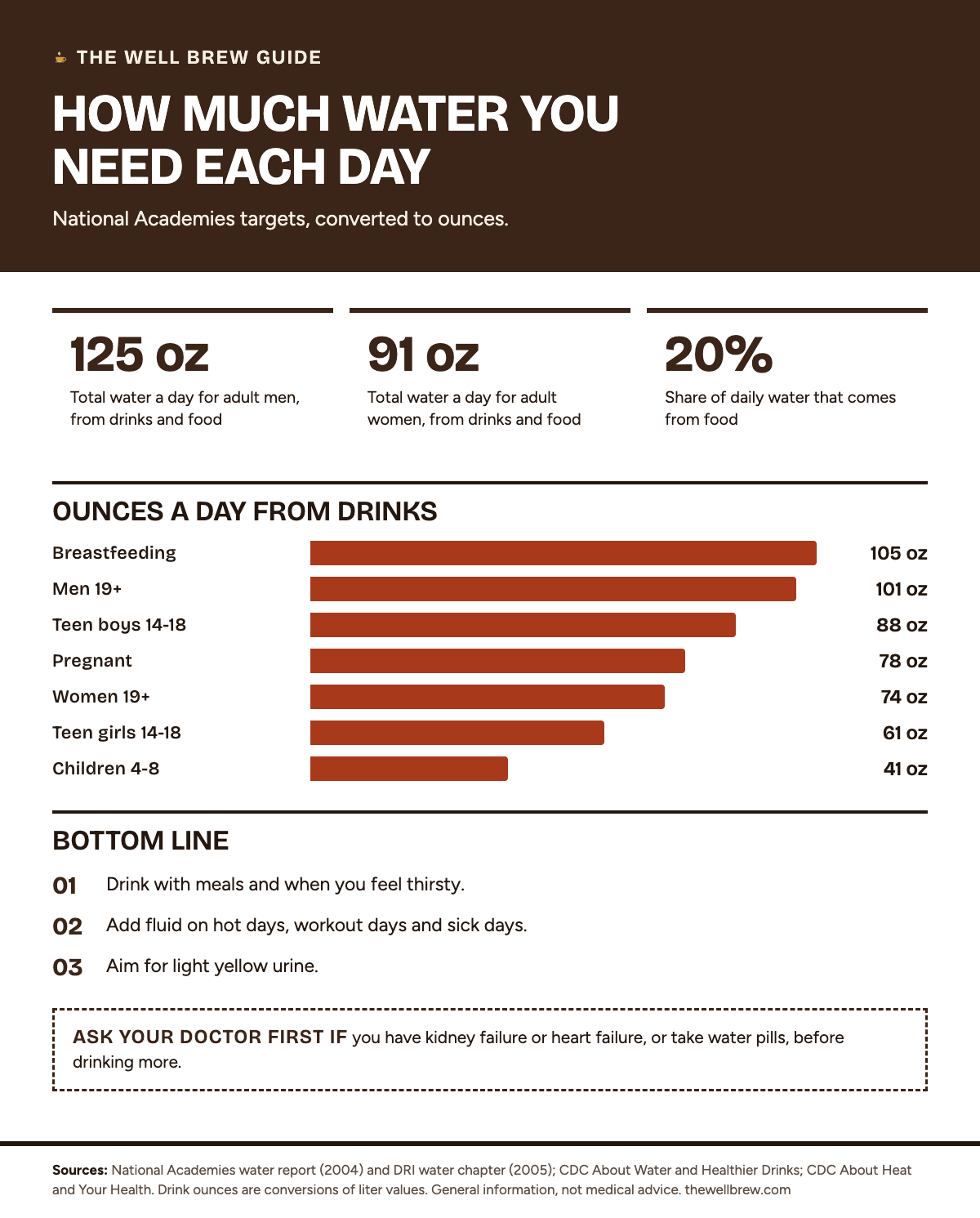
The short answer: healthy adults need about 125 ounces (3.7 liters) of total water a day for men and 91 ounces (2.7 liters) for women, and about 80 percent of that comes from drinks, so most people need roughly 9 to 13 cups of fluid.[1][2]
| What the target is | An Adequate Intake (AI) for total water from drinks and food, based on what healthy, well-hydrated Americans consume.[1][2] |
|---|---|
| Adult men | 3.7 liters (125 ounces) total, with about 3.0 liters (101 ounces, about 13 cups) from drinks.[1][2] |
| Adult women | 2.7 liters (91 ounces) total, with about 2.2 liters (74 ounces, about 9 cups) from drinks.[1][2] |
| Pregnancy and breastfeeding | 3.0 liters total in pregnancy and 3.8 liters while breastfeeding.[2] |
| When you need more | Hot weather, exercise, fever, diarrhea or vomiting.[3] |
| Upper limit | None was set, but drinking far more than the kidneys can clear, about 0.7 to 1.0 liters an hour, can be dangerous.[1][2] |
| Who should ask first | People with kidney failure, heart failure or on water pills.[6][7] |
How much water should you drink a day?
The National Academies set an Adequate Intake of 3.7 liters (125 ounces) of total water a day for adult men and 2.7 liters (91 ounces) for adult women.[1] Total water means everything: plain water, other drinks and the water inside food. These amounts cover healthy, inactive adults in a mild climate.[1]
The numbers come from national survey data. The panel looked at what people who appeared well hydrated took in each day and used the median as the target.[1][2] That is why the figure is called an Adequate Intake and not a strict requirement.
The panel chair said it offered no rule of thumb for how many glasses to drink, because water comes from many sources.[1] It also found that most healthy people meet their needs by drinking when thirsty and having drinks with meals.[1]
How do you figure out how much water you need each day?
Start with the Adequate Intake for your age and sex, then add fluid for heat, exercise and illness, and check your urine color to see if you are on track.[2][3][4] This six-step method uses only numbers from the sources we read.
- Find your group in the age table below and note the cups from drinks.[2]
- Convert to ounces if you prefer: 1 cup is 8 ounces, and 1 liter is 33.8 ounces.[2]
- Spread the drinks across the day. The CDC suggests carrying a reusable bottle and serving water with meals.[3]
- Add more on hot days and active days. Very active people in hot weather can need 6 liters or more of total water.[1]
- For long workouts, weigh yourself before and after. A loss of more than 2 percent of body weight means you did not replace enough fluid.[8]
- Check your urine. Light yellow or clear usually means you are drinking enough.[4]
If you have a heart or kidney condition, skip step 4 until your care team gives you a personal number.[6][7]
How many ounces of water should I drink a day?
Adult women need about 74 ounces of fluid from drinks each day and adult men about 101 ounces, inside total targets of 91 and 125 ounces.[1][2] The rest comes from food. The table converts the official liter figures into ounces and cups using the National Academies conversion of 33.8 ounces per liter.[2]
| Group | Total water | From drinks | Cups from drinks |
|---|---|---|---|
| Men 19 and older | 3.7 L (125 oz) | 3.0 L (101 oz) | About 13 |
| Women 19 and older | 2.7 L (91 oz) | 2.2 L (74 oz) | About 9 |
| Pregnant | 3.0 L (101 oz) | 2.3 L (78 oz) | About 10 |
| Breastfeeding | 3.8 L (128 oz) | 3.1 L (105 oz) | About 13 |
Ounce figures for drinks are our conversions of the liter values, rounded to the nearest ounce.[2] The targets for men and women stay the same after age 50. The panel based the older adult figure on younger adults so that intake would not be set too low.[2]
How many cups of water should you drink a day by age?
Children need far less than adults: about 4 cups of drinks a day at ages 1 to 3, rising to 8 to 11 cups for teenagers.[2] The National Academies set separate targets for each age band, and for boys and girls from age 9.[2]
| Age | Total water | From drinks | Cups from drinks |
|---|---|---|---|
| 0 to 6 months | 0.7 L, from breast milk | Not applicable | Not applicable |
| 7 to 12 months | 0.8 L | About 0.6 L | About 3 |
| 1 to 3 years | 1.3 L (44 oz) | 0.9 L (30 oz) | About 4 |
| 4 to 8 years | 1.7 L (57 oz) | 1.2 L (41 oz) | About 5 |
| Boys 9 to 13 | 2.4 L (81 oz) | 1.8 L (61 oz) | About 8 |
| Girls 9 to 13 | 2.1 L (71 oz) | 1.6 L (54 oz) | About 7 |
| Boys 14 to 18 | 3.3 L (112 oz) | 2.6 L (88 oz) | About 11 |
| Girls 14 to 18 | 2.3 L (78 oz) | 1.8 L (61 oz) | About 8 |
Infants under 6 months get their water from breast milk or formula. Do not give a young baby extra plain water unless a pediatrician says to. For infant fluid during illness, follow your pediatrician.
How much water per day do you need when you exercise or it is hot?
You need more than the baseline whenever you sweat more, and people who are very active in hot weather can need 6 liters or more of total water a day.[1] The CDC lists hot climates, more activity, fever, diarrhea and vomiting as times the body needs extra water.[3]
The American College of Sports Medicine says sweat rates vary so much between people that one number does not fit everyone.[8] Its advice is to weigh yourself before and after exercise to estimate your own sweat loss. The goal during exercise is to avoid losing more than 2 percent of body weight.[8] For a 150 pound person, 2 percent is 3 pounds.
The same statement says drinks with electrolytes and carbohydrate can help more than plain water in some situations, such as long or very sweaty sessions.[8] For a normal walk or a short gym visit, water is enough. On hot days, the CDC says drinking water helps you stay hydrated whether or not you are active.[4]
Does coffee, tea or food count toward your water intake?
Yes. Coffee, tea, milk, juice and the water in food all count, and food supplies about 20 percent of total water for most people.[1] The National Academies found no convincing evidence that caffeine causes a lasting water deficit, and concluded that caffeinated drinks count as much as other drinks.[1]
Some drinks are still better choices than others. The CDC suggests choosing water over sugary drinks such as regular soda, sweet tea and energy drinks.[3] It lists plain coffee or tea, sparkling water and seltzer as low-calorie choices, and says up to 400 mg of caffeine a day, about 2 to 3 cups of plain coffee, fits a healthy diet for most adults.[3]
Fruits and vegetables with high water content also add to your fluid.[3] If you eat a lot of fiber, drink with it: fiber products such as psyllium need plenty of liquid, as our guide to psyllium husk benefits for digestion, cholesterol and blood sugar explains.
What are the signs of dehydration?
Dehydration means your body has lost more water than it has taken in, and early signs in adults include strong thirst, dry mouth, peeing less than usual, tiredness and dark urine.[5] The CDC adds that dehydration can cause unclear thinking, mood changes, overheating, constipation and kidney stones.[3]
NIDDK lists these signs in adults:[5]
- Extreme thirst and a dry mouth
- Urinating less than usual, and dark-colored urine
- Feeling tired
- Skin that does not flatten back right away when pinched
- Sunken eyes or cheeks
- Light-headedness or fainting
In babies and young children, watch for no wet diapers for 3 hours or more, no tears when crying, dry mouth and low energy.[5] NIDDK says anyone with signs of dehydration should see a doctor right away, and severe cases may need hospital care.[5]
Can you drink too much water?
Yes. Drinking water faster than the kidneys can clear it, roughly 0.7 to 1.0 liters an hour, can dilute the sodium in your blood, a condition called hyponatremia.[2] Hyponatremia is defined as a blood sodium level below 135 mmol/L, and severe cases can be life threatening.[2]
The National Academies did not set an upper limit for water, because healthy kidneys handle large intakes spread over a day.[1][2] The problem comes from drinking a lot in a short time. The report notes it occurs in some endurance athletes and in some people with certain psychiatric conditions, and calls it highly unusual.[1]
You may be overdoing it if you find yourself forcing water when you are not thirsty, or if your urine stays completely clear all day while you keep drinking. Spreading drinks out and following thirst keeps most people in a safe range.[1]
Does body weight change how much water you need?
Body size does affect water needs, but no official body sets a fixed number of ounces per pound of body weight.[9][1] A 2022 study in Science measured water turnover, the water the body uses each day, in 5,604 people aged 8 days to 96 years in 23 countries.[9]
It found that age, body size and body composition were linked to water turnover. So were physical activity, athletic status, pregnancy, air temperature and humidity.[9] The authors built equations to predict turnover from these factors.
Popular rules such as drinking half your body weight in ounces are not part of the National Academies targets, which are set by age and sex.[1][2] If you are larger or more muscular than average, the higher end of your range is a sensible place to start, then use thirst and urine color to adjust.[1][4]
What the research says
Four sources carry most of the weight for the targets and advice above.
| Source | Who or what | Finding | What it means |
|---|---|---|---|
| National Academies, 2004 and 2005[1][2] | US national survey data on healthy adults | Median total water 3.7 L for men and 2.7 L for women; no upper limit | The standard US targets |
| Yamada and colleagues, 2022[9] | 5,604 people, 23 countries, isotope tracking | Age, size, activity, pregnancy and climate change water turnover | Needs vary from person to person |
| American College of Sports Medicine, 2007[8] | Position stand on exercise | Keep body weight loss under 2 percent; sweat rates vary widely | Weigh in and out to set your own exercise amount |
| NIDDK[6] | Kidney stone prevention guidance | Many professionals advise six to eight 8-ounce glasses a day | Enough fluid matters most for stone prevention |
A sample day of drinks for an adult woman
Here is one way an adult woman could reach about 9 cups (74 ounces) from drinks on an ordinary day, with food covering the rest of the 91 ounce total.[1][2] Men can scale the same pattern up to about 13 cups.[2]
| Time | Drink | Ounces |
|---|---|---|
| Wake up | Glass of water | 8 |
| Breakfast | Coffee or tea, plus a glass of milk | 16 |
| Mid-morning | Refill of a water bottle | 12 |
| Lunch | Water or sparkling water | 12 |
| Afternoon | Water or unsweetened tea | 12 |
| Dinner | Glass of water | 10 |
| Evening | Small glass of water | 4 |
| Total | From drinks | 74 |
On a hot day or an exercise day, add fluid on top of this plan and check your weight and urine color.[4][8] The CDC tip of keeping a refillable bottle within reach makes the midday slots easier.[3]
Safety: who should check with a doctor first
For most healthy people, drinking to thirst and with meals is safe.[1] Some people need a personal fluid plan instead of the general targets.
- If you have kidney failure, note that NIDDK’s six to eight glasses advice for kidney stones does not apply if you have kidney failure.[6]
- With heart failure, fluid buildup is part of the condition, and treatment includes cutting salt and taking medicines that remove extra fluid.[7] Ask your care team how much to drink.
- Water pills (diuretics) remove sodium and fluid from the body, so your doctor may want to set your intake.[7]
- During pregnancy and breastfeeding, needs rise to 3.0 and 3.8 liters of total water.[2]
- In endurance events, drinking far beyond sweat losses during long races raises the risk of low blood sodium.[1][2]
See a doctor right away if you or a child shows signs of dehydration such as fainting, sunken eyes, very little urine, or in a baby no wet diaper for 3 hours or more.[5] Get urgent care for confusion after drinking large amounts of water.[2]
What doctors use first
Doctors usually start with the simplest checks: thirst, how often you pee, urine color and recent weight change.[4][5][8] For dehydration from a stomach bug, the first step is replacing fluids, and severe cases may need treatment in a hospital.[5] For people with kidney stones, drinking enough liquid, mainly water, is the most important lifestyle change.[6] For heart failure, fluid is managed with salt limits and medicines from the care team.[7] No supplement or special water replaces any of these steps.
Practical hydration checklist
- Know your group’s target from the tables above, in cups or ounces.[2]
- Drink with each meal and when you feel thirsty.[1]
- Keep a refillable water bottle with you.[3][4]
- Choose water, plain coffee or tea over sugary drinks most of the time.[3]
- Add fluid on hot days, workout days and sick days.[3]
- Aim for light yellow urine.[4]
- Weigh yourself before and after long workouts.[8]
- Ask your doctor for a personal number if you have heart or kidney disease.[6][7]
For more on everyday eating and drinking, browse our nutrition and diet guides.
Bottom line
Healthy adults need about 125 ounces of total water a day for men and 91 ounces for women, which works out to roughly 13 and 9 cups from drinks.[1][2] Children, pregnant people and breastfeeding parents have their own targets, and heat or exercise raise everyone’s needs.[2][3]
For most people, the better first step is a steady habit, water with meals and a bottle nearby, rather than counting every ounce, because thirst and urine color track your needs well in daily life.[1][4] Count more carefully only if you exercise hard in the heat or have a heart or kidney condition.
Frequently asked questions
Is 8 glasses of water a day the right amount?
It is close for some adults but is not an official rule. The National Academies chose not to give a glasses rule, and its targets work out to about 9 cups of drinks for women and 13 for men, plus water from food.
Is drinking a gallon of water a day too much?
A gallon is 128 ounces, close to the 3.8 liter total target for breastfeeding. Spread over a day it is not dangerous for most healthy adults, but it is more than most people need. Drinking it quickly is the risk, since kidneys clear about 0.7 to 1.0 liters an hour.
Does sparkling water count toward daily water intake?
Yes. The CDC lists sparkling water and seltzer as low-calorie drink choices, and all drinks count toward total water. Choose versions without added sugar most of the time, and plain water is always a good default.
Is a water intake calculator accurate?
Online calculators give an estimate, not a medical number. A 2022 study of 5,604 people found that age, body size, activity, pregnancy and climate all change water use, so treat any result as a starting point and adjust with thirst and urine color.
Do older adults need to drink more water?
The target stays at 3.7 liters for men and 2.7 liters for women after age 50. The National Academies kept it at the younger adult level so intake would not be set too low, since older adults may notice thirst less.
Sources
- Report Sets Dietary Intake Levels for Water, Salt, and Potassium To Maintain Health and Reduce Chronic Disease Risk. National Academies news release, 2004
- Dietary Reference Intakes for Water, Potassium, Sodium, Chloride, and Sulfate, Chapter 4: Water. Institute of Medicine, National Academies Press, 2005
- About Water and Healthier Drinks. Centers for Disease Control and Prevention, 2026
- About Heat and Your Health. Centers for Disease Control and Prevention, 2026
- Symptoms and Causes of Viral Gastroenteritis. National Institute of Diabetes and Digestive and Kidney Diseases
- Eating, Diet, and Nutrition for Kidney Stones. National Institute of Diabetes and Digestive and Kidney Diseases
- Heart Failure Treatment. National Heart, Lung, and Blood Institute
- American College of Sports Medicine position stand: Exercise and fluid replacement (Sawka et al.). Medicine and Science in Sports and Exercise, 2007
- Variation in human water turnover associated with environmental and lifestyle factors (Yamada et al.). Science, 2022

Maya Ellison is the Reviews Editor at The Well Brew, a slow, plain-language supplement review blog for everyday adults. Maya reads each label in full, sets every dose beside the amounts used in human studies, grades the research with sources such as the NIH Office of Dietary Supplements and NCCIH, and works out the real cost and refund fine print. Maya has no medical credentials and is not a doctor, dietitian, nurse or pharmacist. Reviews give pros, cons and who a product suits, never scores. How we review supplements.
This article is general information, not medical advice. Dietary supplements are not reviewed by the FDA for safety or effectiveness before they are sold. Talk to your doctor before you start any supplement, especially if you are pregnant, nursing, take medication or have a health condition.