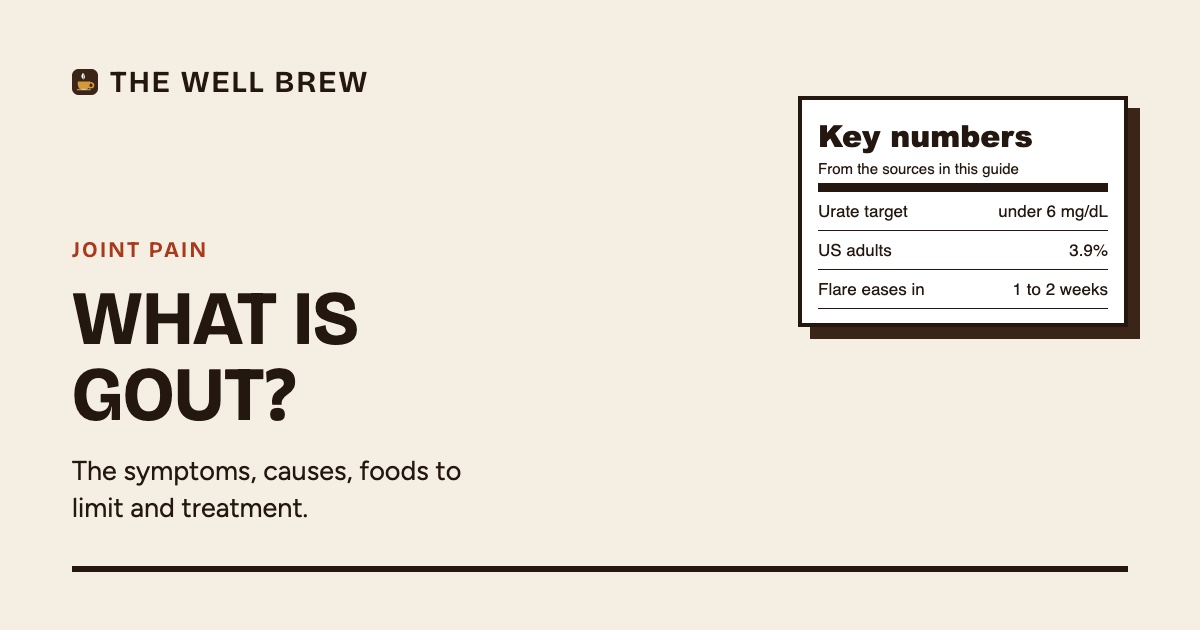
Gout is a type of inflammatory arthritis caused by urate crystals that build up in a joint, often the big toe. It causes sudden flares of severe pain, swelling, redness and heat that usually ease within a week or two. Flares are treated with colchicine, NSAIDs or steroids. Long term, a daily medicine such as allopurinol keeps blood urate below 6 mg/dL to stop flares returning.
On this page
- What is gout?
- What are the symptoms of gout?
- What do gout symptoms in the foot look like?
- What causes gout?
- What triggers a gout flare up?
- How is gout diagnosed?
- What is the treatment for gout during a flare?
- What do doctors use first for long-term gout control?
- Which foods should you limit with gout?
- Do cherries and vitamin C help gout?
- When should you see a doctor for gout?
- Gout checklist: what to do next
- Bottom line
- FAQ
What is gout? It is a type of inflammatory arthritis caused by urate crystals that form in and around a joint, and it usually shows up as sudden flares of pain and swelling, often in the big toe. For this guide we read the NIAMS and CDC gout pages, the 2020 American College of Rheumatology guideline, a national prevalence study and the trials on cherries and vitamin C, using the method on our how we review page.[1][3][6]
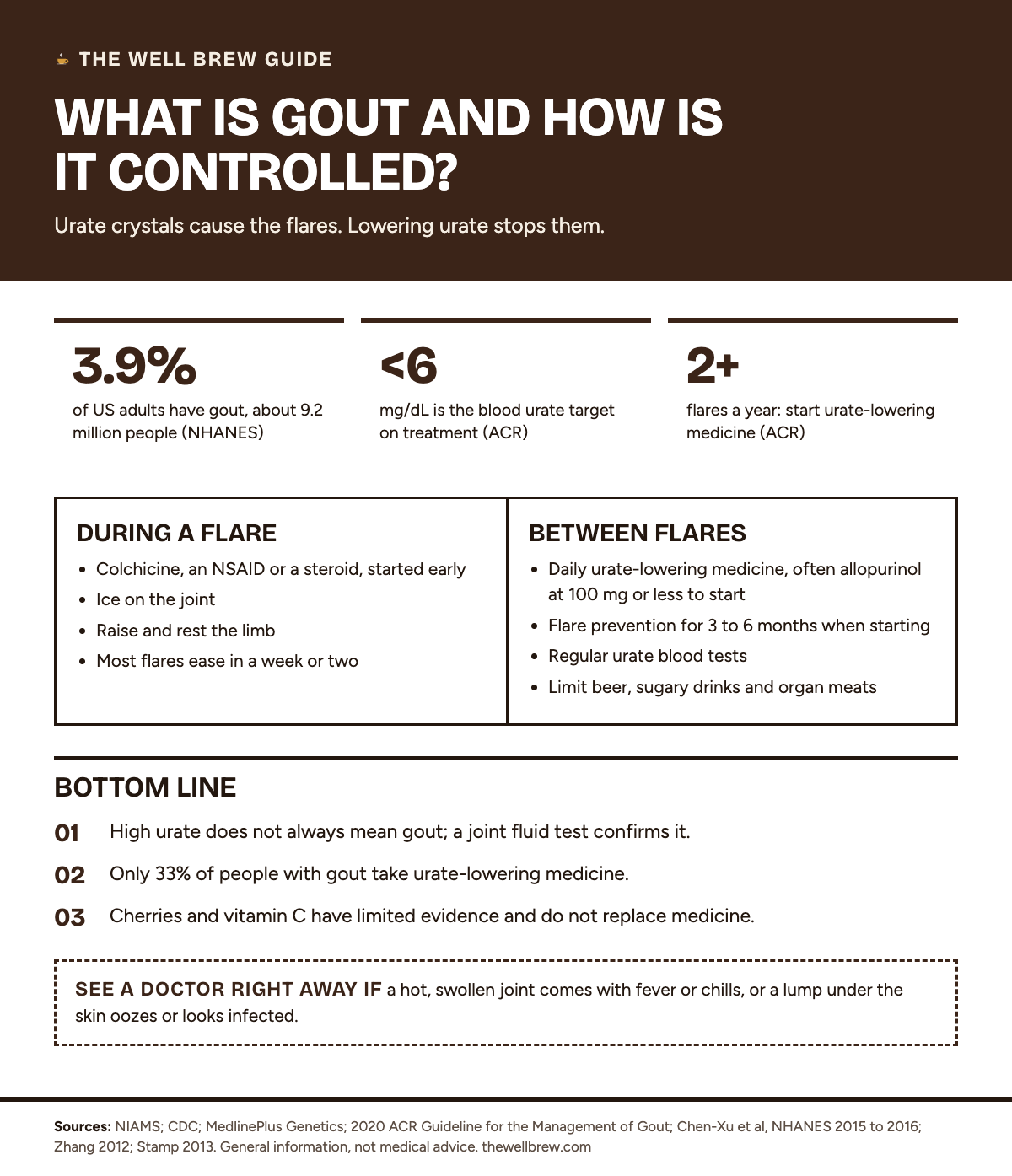
The short answer: gout is very common, affecting about 3.9% of US adults, and lowering blood urate below 6 mg/dL with medicine is the main way to stop flares from coming back.[7][6]
| What it is | Inflammatory arthritis caused by needle-shaped urate crystals in and around joints.[1] |
|---|---|
| How common | About 3.9% of US adults, or 9.2 million people, in 2015 to 2016. Men 5.2%, women 2.7%.[7] |
| Main symptom | Sudden, intense pain with swelling, redness and warmth, often starting at night in one joint.[1][3] |
| Typical flare | Gets better over a week or two, then often no symptoms between flares.[1] |
| Flare treatment | Colchicine, NSAIDs or steroids, plus ice and rest.[2][6] |
| Long-term goal | Blood urate below 6 mg/dL, usually with allopurinol as the first choice.[5][6] |
| Foods to limit | Alcohol (especially beer), sugary drinks, red and organ meats, and some seafood.[2][3] |
What is gout?
Gout is a form of inflammatory arthritis that happens when too much urate builds up in the body and forms needle-shaped crystals in a joint. The crystals set off inflammation, which causes a flare of pain and swelling. Flares usually last a week or two and then settle down.[1]
Urate (also called uric acid) is a normal waste product. Your body makes it when it breaks down purines, which are found in your own tissues and in many foods. Most urate leaves the body in urine. When the body makes too much or removes too little, levels rise and crystals can form.[1][5]
High urate alone is not the same as gout. Many people with high blood urate never get it. MedlinePlus Genetics puts the share of people with high urate who go on to develop gout at about one in four.[1][4]
NIAMS describes gout in stages:[1]
- Hyperuricemia: high urate for a long time, sometimes with crystals, but no symptoms yet.
- Gout flares: periodic attacks of intense joint pain and swelling.
- Intercritical gout: the quiet time between flares, with no symptoms.
- Tophi: a later stage where crystal lumps build up under the skin and can damage joints.
NIAMS calls gout one of the most controllable forms of arthritis once it is diagnosed and treated early, and many people stop having flares altogether.[1]
What are the symptoms of gout?
The main symptom of gout is sudden, severe pain in one joint, along with swelling, redness and heat. Flares often begin at night, and the pain can be strong enough to wake you up. Even the weight of a bed sheet can hurt. Most flares affect one joint at a time.[1][3]
Other symptoms people describe during a flare include:[3][4]
- Throbbing or burning pain in the joint
- A joint that looks red or shiny and feels hot
- Swelling and trouble moving the joint
- Sometimes a fever, with peeling skin over the joint afterward
Between flares, most people feel normal. Some go years without another attack. Others have flares more often. MedlinePlus Genetics notes that most people who have more than one flare get the second within a year of the first.[1][4]
Left untreated, flares tend to come more often and last longer. Over time, firm lumps called tophi can form under the skin, often over joints or on the outer ear. About 15 percent of people with gout also get kidney stones made of urate.[1][4][5]
What do gout symptoms in the foot look like?
In the foot, gout most often hits the joint at the base of the big toe, which turns hot, red, swollen and very tender. A big toe flare has an old medical name, podagra. The first flare usually affects the big toe or another joint in the foot or ankle.[3][4]
A foot flare can make it hard to walk or wear a shoe. The top of the foot, the ankle and the heel can also be affected. Gout can spread to knees, wrists, elbows and fingers over time if urate stays high.[1][4]
Several other problems can look like a gout flare in the foot, including a joint infection. That is why NIAMS and the CDC both say a doctor should confirm the diagnosis rather than guessing from the look of the toe alone.[2][3]
What causes gout?
Gout is caused by urate building up in the blood over a long time until crystals form in the joints. That buildup comes from making too much urate, clearing too little through the kidneys, or both. Genes, health conditions, medicines and diet all play a part.[1][4]
Most people get gout from several risk factors acting together. NIAMS lists these:[1]
- Personal factors: high urate, a family history of gout, being male, menopause and older age.
- Diet and drinks: alcohol, sugar-sweetened drinks such as soda, and purine-rich foods, mostly from animal sources.
- Health conditions: overweight or obesity, metabolic syndrome, chronic kidney disease, high blood pressure, and conditions with fast cell turnover such as psoriasis.
- Medicines: diuretics (water pills), low-dose aspirin, large amounts of niacin, and cyclosporine.
Genes matter a lot. Researchers have found dozens of genes linked to gout, and two, SLC2A9 and ABCG2, have the biggest effect on urate levels. Most of these genes control how the kidneys and gut move urate out of the body.[4]
Gout is more common in men. Women rarely develop it before menopause, so they tend to get it later in life. In the US, 5.2% of men and 2.7% of women had gout in the 2015 to 2016 national survey.[1][7]
What triggers a gout flare up?
A gout flare up is often set off by alcohol, certain foods, some medicines, an injury or an illness. These triggers can shift urate levels quickly or stir up crystals that are already in the joint. If you learn your own triggers, you can dodge some attacks.[1]
The data on alcohol are among the clearest. The ACR guideline cites a study where having more than 1 to 2 alcoholic drinks in the prior 24 hours was linked to a 40% higher risk of a flare, with risk rising as intake rose.[6] NIAMS points out that this includes nonalcoholic beer.[2]
Starting a urate-lowering medicine can also trigger flares at first, as crystals start to dissolve. That is why the ACR guideline strongly recommends taking an anti-inflammatory medicine for at least 3 to 6 months when you start.[6]
How is gout diagnosed?
Gout is diagnosed with a medical history, a joint exam, a blood urate test and, ideally, a sample of joint fluid checked for urate crystals under a microscope. Seeing the crystals confirms it. Ultrasound or a special CT scan can also show crystal buildup.[2][5]
Your doctor will ask about your symptoms, risk factors and medicines. A blood test helps, but it has limits. Urate can be normal during a flare, and high urate does not always mean gout.[2][5]
The CDC notes that gout is easiest to spot during a flare, when crystals are easiest to find in the joint fluid. X-rays may show joint damage in long-standing gout.[3]
What is the treatment for gout during a flare?
The standard treatment for a gout flare is colchicine, an NSAID such as ibuprofen or naproxen, or a steroid, chosen to fit your health. The ACR guideline strongly recommends any of the three as first-line flare care. Timing matters, and colchicine works best when taken as soon as symptoms appear.[2][6]
Steroids can be taken by mouth or injected into the joint or a muscle.[6] Which medicine suits you depends on your kidneys, stomach, heart and other medicines, so this choice belongs with your doctor.
Some home care helps alongside the medicine:[2][6]
- Put ice on the joint. The ACR guideline conditionally recommends topical ice as an add-on.
- Raise the limb when you can to ease swelling.
- Rest the joint until the flare settles.
What do doctors use first for long-term gout control?
For long-term control, doctors use urate-lowering therapy, a daily medicine that keeps blood urate below 6 mg/dL so crystals dissolve and flares stop. Allopurinol is the preferred first choice, started at 100 mg a day or less and raised slowly based on blood tests.[5][6]
The ACR guideline strongly recommends starting urate-lowering therapy if you have any of these:[6]
- One or more tophi under the skin
- Joint damage from gout on any imaging test
- Frequent flares, defined as 2 or more a year
Other options include febuxostat, which also blocks urate production; probenecid, which helps the kidneys remove urate; and pegloticase, an infusion that breaks urate down, used when other drugs have not worked.[2][5] The guideline also favors a treat-to-target approach, where the dose is adjusted until blood urate stays under target.[6]
This medicine is usually long term. The ACR guideline conditionally recommends continuing it indefinitely rather than stopping.[6] Yet a national study found only 33% of people with gout were taking it.[7] When gout causes frequent flares or tophi, NIAMS says lifestyle changes alone are not enough and medicine is the mainstay.[2]
| Your situation | Guideline position | Strength |
|---|---|---|
| 2 or more flares a year, a tophus, or joint damage | Start urate-lowering therapy | Strong[6] |
| First flare, with kidney disease stage 3 or worse, urate above 9 mg/dL, or kidney stones | Start urate-lowering therapy | Conditional[6] |
| First flare with none of those | Usually hold off and watch | Conditional[6] |
| Starting the medicine | Add flare prevention for at least 3 to 6 months | Strong[6] |
Which foods should you limit with gout?
With gout, limit alcohol (especially beer), sugar-sweetened drinks, red and organ meats, and seafood such as shellfish, sardines and anchovies. These raise urate or are linked to flares. The ACR guideline conditionally recommends limiting alcohol, purines and high-fructose corn syrup for everyone with gout.[2][3][6]
| Food or drink | What the sources say |
|---|---|
| Beer and hard liquor | Limit; beer is singled out, and NIAMS includes nonalcoholic beer[2][3][5] |
| Soda and other sugar-sweetened drinks | Avoid or limit, including drinks with high-fructose corn syrup[2][5][6] |
| Organ meats (liver, kidney, sweetbreads) | Avoid; high in purines[2] |
| Red meat and gravies | Limit[3][5] |
| Shellfish, sardines, anchovies, mussels, scallops, trout, tuna | Limit[2][3] |
| Vegetables, fruit, whole grains, low-fat dairy | Eat freely as part of the DASH eating plan[2] |
Food choices count, though their effect on urate is small. The ACR guideline notes that diet changes likely shift urate only a little, though some foods act as flare triggers.[6] For a wider eating pattern, see our guide to the anti-inflammatory diet foods and meal ideas. Losing weight if you are overweight is also conditionally recommended.[6]
Do cherries and vitamin C help gout?
The evidence for cherries and vitamin C in gout is limited, and neither replaces urate-lowering medicine. Cherries have one encouraging observational study. Vitamin C did little in a small trial, and the ACR guideline recommends against adding it.[6][8][9]
| Study | Who and how long | What was tested | Result |
|---|---|---|---|
| Zhang, 2012, case-crossover | 633 people with gout, followed 1 year | Cherries or cherry extract in the 2 days before a flare | 35% lower flare risk with cherries; 75% lower with cherries plus allopurinol[8] |
| Stamp, 2013, randomized pilot | 40 people with gout, 8 weeks | Vitamin C 500 mg a day vs starting or raising allopurinol | Urate fell 0.23 mg/dL with vitamin C vs 1.9 mg/dL with allopurinol[9] |
| Cochrane review, 2021 | 2 trials, 160 people | Supplements for chronic gout | No high-quality evidence for or against vitamin C or enriched milk powder[10] |
The cherry study compared each person with themselves over time. That design can show a link but cannot prove cherries caused fewer flares. Cherries are fine to eat, though no good trial shows that a set amount works.[8]
When should you see a doctor for gout?
See a doctor for any first episode of sudden joint pain and swelling, because gout needs a confirmed diagnosis and other conditions can look the same. Early diagnosis lets you start treatment quickly and limit joint damage.[2][3]
See a doctor right away or get urgent care if:
- You have a hot, swollen joint with a fever or chills, since a joint infection can look like gout[4]
- The pain is severe and does not ease within a few days of treatment
- More than one joint flares at once
- A lump under the skin becomes red, oozes fluid or looks infected[4]
- You have flank pain or blood in your urine, which may point to a kidney stone[4]
Tell your doctor about all your medicines. Diuretics, low-dose aspirin, niacin and cyclosporine can raise urate.[1] Do not stop a prescribed medicine on your own. Gout is also linked to high blood pressure, kidney disease, diabetes and heart disease, so your doctor may check for these.[1][5]
Gout checklist: what to do next
- Get a diagnosis, ideally with a joint fluid test, rather than guessing.[2]
- Keep a flare plan from your doctor so you can start colchicine or another medicine at the first sign.[2]
- If you have 2 or more flares a year or any tophi, ask about urate-lowering therapy.[6]
- Ask for regular blood urate tests and a target below 6 mg/dL.[5][6]
- Cut back on beer, liquor and sugary drinks.[2][3]
- Aim for 150 minutes of moderate activity a week.[3]
- Read supplement labels with care, and see our how we review page for how we judge claims.
- Browse more joint pain guides for related conditions.
Bottom line
Gout is a common and painful arthritis caused by urate crystals, and it usually responds well to treatment. Flares can be calmed with colchicine, NSAIDs or steroids, plus ice and rest.[2][6]
For most people with repeat flares, the better first step is urate-lowering medicine, such as allopurinol, aimed at a level below 6 mg/dL, because diet changes alone usually move urate only a little. Food choices still help with triggers, but cherries and vitamin C are not a substitute.[6][9]
Frequently asked questions
What is podagra?
Podagra is the medical name for a gout flare in the big toe. It is the classic first sign of gout. The joint at the base of the toe becomes suddenly hot, red, swollen and very painful, often starting at night.
What are monosodium urate crystals?
Monosodium urate crystals are the needle-shaped crystals that form when urate levels in the blood stay high. They collect in and around joints and set off the inflammation of a gout flare. Seeing them in joint fluid confirms the diagnosis.
How long does a gout flare up last?
Most gout flares get better over a week or two, according to NIAMS. Starting flare medicine early, such as colchicine at the first sign, can shorten the attack. Without long-term treatment, flares tend to return more often and last longer.
Can women get gout?
Yes. Gout is less common in women, about 2.7% of US women compared with 5.2% of men in a national survey. Women rarely get it before menopause, so it tends to start later in life.
Is gout caused only by diet?
No. Diet plays a part, but genes, kidney function, body weight, other health conditions and some medicines matter too. Many people with gout need urate-lowering medicine, because diet changes alone usually lower urate only a little.
Sources
- Gout: Symptoms, Causes and Risk Factors. NIAMS, National Institutes of Health, reviewed 2023
- Gout: Diagnosis, Treatment and Steps to Take. NIAMS, National Institutes of Health, reviewed 2023
- Gout. Centers for Disease Control and Prevention, 2024
- Gout. MedlinePlus Genetics, National Library of Medicine
- Gout. American College of Rheumatology, 2025
- 2020 American College of Rheumatology Guideline for the Management of Gout. FitzGerald et al, Arthritis Care and Research, 2020
- Contemporary Prevalence of Gout and Hyperuricemia in the United States and Decadal Trends: NHANES 2007-2016. Chen-Xu et al, Arthritis and Rheumatology, 2019
- Cherry consumption and decreased risk of recurrent gout attacks. Zhang et al, Arthritis and Rheumatism, 2012
- Clinically insignificant effect of supplemental vitamin C on serum urate in patients with gout: a pilot randomized controlled trial. Stamp et al, Arthritis and Rheumatism, 2013
- Dietary supplements for chronic gout. Andres et al, Cochrane Database of Systematic Reviews, 2021

Maya Ellison is the Reviews Editor at The Well Brew, a slow, plain-language supplement review blog for everyday adults. Maya reads each label in full, sets every dose beside the amounts used in human studies, grades the research with sources such as the NIH Office of Dietary Supplements and NCCIH, and works out the real cost and refund fine print. Maya has no medical credentials and is not a doctor, dietitian, nurse or pharmacist. Reviews give pros, cons and who a product suits, never scores. How we review supplements.
This article is general information, not medical advice. Dietary supplements are not reviewed by the FDA for safety or effectiveness before they are sold. Talk to your doctor before you start any supplement, especially if you are pregnant, nursing, take medication or have a health condition.