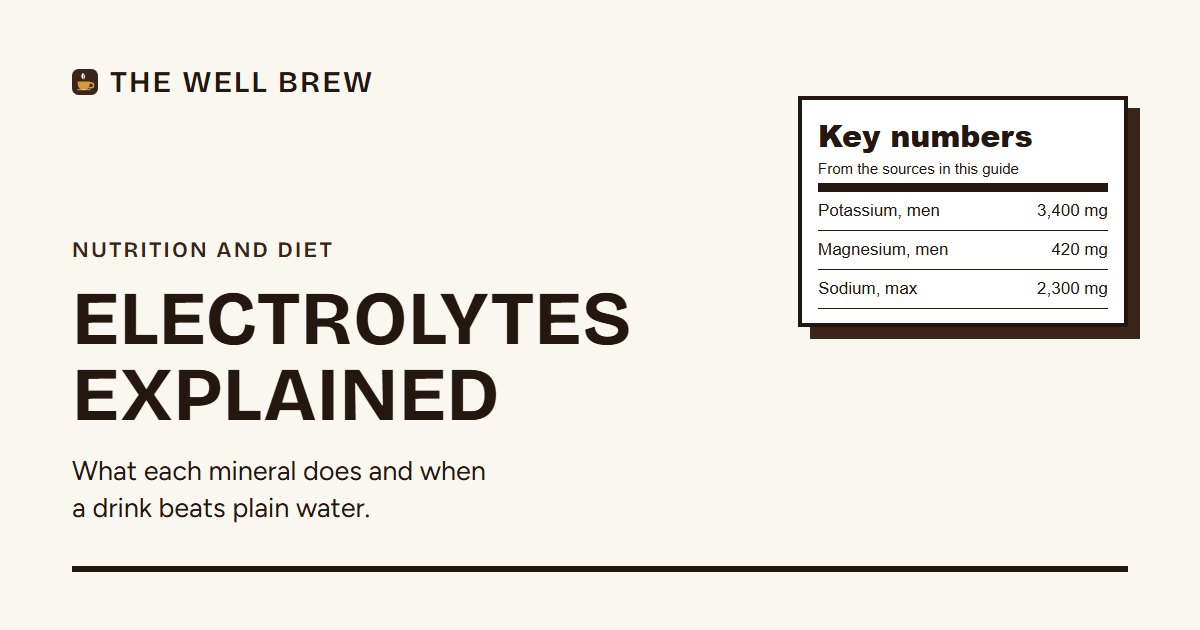
Electrolytes are minerals such as sodium, potassium, chloride, calcium and magnesium that carry an electric charge in body fluids. They balance water, power nerves and muscles, and keep your heartbeat steady. Normal blood sodium is 135 to 145 mEq/L. Most healthy people get enough from food and water; electrolyte drinks help mainly after diarrhea, vomiting or long, sweaty exercise.
On this page
- What are electrolytes?
- What does each electrolyte do in the body?
- What are the symptoms of low electrolytes?
- What causes an electrolyte imbalance?
- What are normal electrolyte levels on a blood test?
- Do you need electrolyte drinks, or is plain water enough?
- What foods are high in electrolytes?
- Are electrolyte supplements safe?
- How do doctors treat an electrolyte imbalance?
- Bottom line
- FAQ
Electrolytes are minerals that carry an electric charge in your blood and body fluids, and they keep your fluid levels, nerves, muscles and heartbeat working. To write this guide we read the MedlinePlus pages on fluid balance, dehydration and electrolyte blood tests, the NIH Office of Dietary Supplements fact sheets on potassium, magnesium and calcium, two NIDDK pages on kidney disease, and two clinical studies on drinks and sodium. Our method is on the how we review page.
Most healthy people get enough electrolytes from food and plain water. A drink with sodium and potassium helps mainly after real losses, such as diarrhea, vomiting or long, sweaty exercise, and a normal blood sodium sits between 135 and 145 mEq/L [13].
| What they are | Minerals with an electric charge when dissolved in body fluids: sodium, potassium, chloride, calcium, magnesium, phosphate and bicarbonate [1] |
|---|---|
| Main jobs | Balance body water and pH, move nutrients into cells, support muscles and nerves, and keep heart rhythm steady [1] |
| Daily targets | Potassium 3,400 mg (men) and 2,600 mg (women); magnesium 400-420 mg and 310-320 mg; sodium under 2,300 mg [7] [8] [4] |
| How they are checked | An electrolyte panel, a simple blood draw that needs no fasting [2] |
| When drinks help | After lost fluids and minerals from diarrhea, vomiting or heavy sweating [3] [12] |
| Safety | Too much water can dilute sodium; magnesium supplements above 350 mg a day can cause diarrhea and cramping [15] [8] |
| Who should ask first | People with kidney disease, or on ACE inhibitors or potassium-sparing diuretics, before using potassium products or salt substitutes [7] [10] |
What are electrolytes?
Electrolytes are minerals that take on a positive or negative electric charge when they dissolve in water or body fluids, including blood. You have them in your blood, urine, tissues and the fluid around your cells, and you get them from the foods you eat and the fluids you drink [1].
The charge lets them pull water across cell walls, carry nerve signals and trigger muscle contractions. MedlinePlus lists eight jobs: balancing body water, balancing acid and base (pH), moving nutrients into cells, moving wastes out, supporting muscle and nerve function, keeping heart rate and rhythm steady, keeping blood pressure stable, and keeping bones and teeth healthy [1].
Your kidneys hold on to sodium, potassium and magnesium when you run low and flush the extra when you have more than you need [4] [7] [8]. That is why healthy people rarely run short from diet alone, and why kidney disease changes the rules, as we cover below.
Water and electrolytes move together. MedlinePlus explains that an imbalance often starts when the amount of water in your body changes, because the water you take in should equal the water you lose [1]. If you want the water side of the picture, our guide to how much water you should drink a day covers needs by age and activity.
What does each electrolyte do in the body?
Sodium and chloride control how much fluid your body holds, potassium keeps cells, heart and muscles working, calcium builds bones, and magnesium supports muscles, nerves and heart rhythm. Each has a lead job, and a shift in one often moves the others [1] [2].
| Electrolyte | Main job | Adult daily intake target |
|---|---|---|
| Sodium | Controls fluid amount; helps nerves and muscles work [1] | Under 2,300 mg, about 1 teaspoon of salt [4] |
| Potassium | Helps cells, heart and muscles work properly [1] | 3,400 mg (men), 2,600 mg (women) [7] |
| Chloride | Controls fluid; supports blood volume and blood pressure [1] | Comes mostly with sodium in table salt [4] |
| Calcium | Builds and keeps bones and teeth strong [1] | 1,000 mg; 1,200 mg for women over 50 and adults over 70 [9] |
| Magnesium | Supports muscles, nerves and heart; helps control blood pressure and blood sugar [1] | 400-420 mg (men), 310-320 mg (women) [8] |
Two more show up on lab reports. Bicarbonate keeps your blood’s acid and base level in balance and helps carry carbon dioxide, and phosphate works with calcium to build bones and teeth [1].
Table salt is simply sodium and chloride joined together [4], so most of your chloride arrives with your sodium. If calcium is your main interest, our article on calcium, vitamin D and osteoporosis supplements goes deeper on bone health.
What are the symptoms of low electrolytes?
Common signs of an electrolyte imbalance are weakness, fatigue, muscle cramps or twitching, nausea, confusion, headaches and an irregular or fast heartbeat. These symptoms overlap with many other problems, so only a blood test can tell which mineral is off and in which direction [2].
Each mineral has its own pattern, according to MedlinePlus test pages:
- Low sodium (hyponatremia): weakness, fatigue, confusion, muscle twitching and seizures. Very low levels can lead to coma [5].
- Low potassium (hypokalemia): irregular heartbeat, muscle cramps, weak or twitching muscles, fatigue, nausea and constipation [6].
- Low magnesium: early on, loss of appetite, nausea, vomiting, fatigue and weakness; later, numbness, tingling, cramps, seizures and abnormal heart rhythms [8].
- High sodium (hypernatremia): thirst, passing little urine, confusion, muscle twitching and seizures [5].
- High potassium (hyperkalemia): heartbeat problems, fatigue, muscle weakness, nausea, and numbness or tingling [6].
Mild dehydration, which often comes with mineral losses, looks different. Adults feel very thirsty, have a dry mouth, pass less and darker urine, and may feel tired or dizzy [3].
A muscle cramp after a hard workout is not proof of low electrolytes. Cramps have many causes, and a single cramp that eases with rest rarely needs a test.
See a doctor right away if
- You feel confused, faint, or stop passing urine [3].
- Your heart races, skips or beats irregularly [2] [6].
- You have rapid breathing or signs of shock [3].
- You have a seizure, or someone near you does [5].
- A baby has no wet diaper for 3 hours or more, cries without tears, or seems unusually sleepy [3].
What causes an electrolyte imbalance?
Most electrolyte imbalances come from a change in body water: losing fluid through vomiting, diarrhea or heavy sweating, or taking in far more water than your body can clear. Medicines and heart, liver or kidney problems are the other big causes [1].
MedlinePlus lists these common triggers [1]:
- Severe vomiting or diarrhea, or both
- Heavy sweating
- Not drinking enough, especially during intense exercise or very hot weather
- Drinking too much water
- Heart, liver or kidney problems
- Certain medicines
Many over-the-counter pain relievers and some antidepressants can lower blood sodium [5]. Diuretics and proton pump inhibitors can affect magnesium status [8]. ACE inhibitors and potassium-sparing diuretics can push potassium up, even when diet is normal [7].
Diet alone is a rare cause in healthy adults. The ODS notes that low potassium is “rarely caused by low dietary potassium intake alone,” though diarrhea can drain it through the stool [7]. Low magnesium from diet is also uncommon, because the kidneys cut back what they excrete when intake falls [8].
Some people run into trouble more easily: older adults, who may lose their sense of thirst; infants and young children with diarrhea or vomiting; people with diabetes or kidney problems; and anyone who works or exercises outdoors in the heat [3].
What are normal electrolyte levels on a blood test?
Normal blood sodium is 135 to 145 mEq/L, normal potassium is about 3.6 to 5.0 mmol/L, and normal magnesium is 0.75 to 0.95 mmol/L. Calcium and chloride ranges differ a little between labs, so read them against the range printed on your own report [13] [7] [8].
| Electrolyte | Normal range | Too low | Too high |
|---|---|---|---|
| Sodium | 135-145 mEq/L [13] | Under 135 (hyponatremia) [13] | Over 145 (hypernatremia) [13] |
| Potassium | 3.6-5.0 mmol/L [7] | Under 3.6 (hypokalemia) [7] | Over 5.0 (hyperkalemia) [7] |
| Magnesium | 0.75-0.95 mmol/L [8] | Under 0.75 (hypomagnesemia) [8] | Hypermagnesemia [1] |
| Calcium, chloride | Use your lab’s printed range [2] | Hypocalcemia, hypochloremia [1] | Hypercalcemia, hyperchloremia [1] |
The standard electrolyte panel measures sodium, chloride, potassium and bicarbonate, and it often runs as part of a routine metabolic panel. It is a quick blood draw from the arm, and no special preparation is needed [2].
One result outside the range does not always mean you are sick. MedlinePlus notes that medicines, age, sex and other conditions can nudge sodium up or down [5]. Your doctor reads the panel as a whole, alongside kidney tests and your symptoms.
Abnormal levels can point to dehydration, kidney disease, heart disease, diabetes, liver disease or problems absorbing nutrients [2]. Hyponatremia is common in hospitals: a Dutch review of 53 studies found mild low sodium in 22.2% of people on geriatric wards [13].
Do you need electrolyte drinks, or is plain water enough?
For everyday thirst and most workouts under an hour, plain water is enough, because food supplies the electrolytes you need. MedlinePlus says mild dehydration often needs only water, and that sports drinks may help if you have lost electrolytes, such as through heavy sweating [3].
Diarrhea and vomiting are the clearest case for an electrolyte drink. NIDDK advises water plus liquids that contain electrolytes, such as broths and sports drinks, or an oral rehydration solution, which mixes glucose and electrolytes [12]. Older adults and people with diabetes or kidney disease should ask a doctor before using one [12].
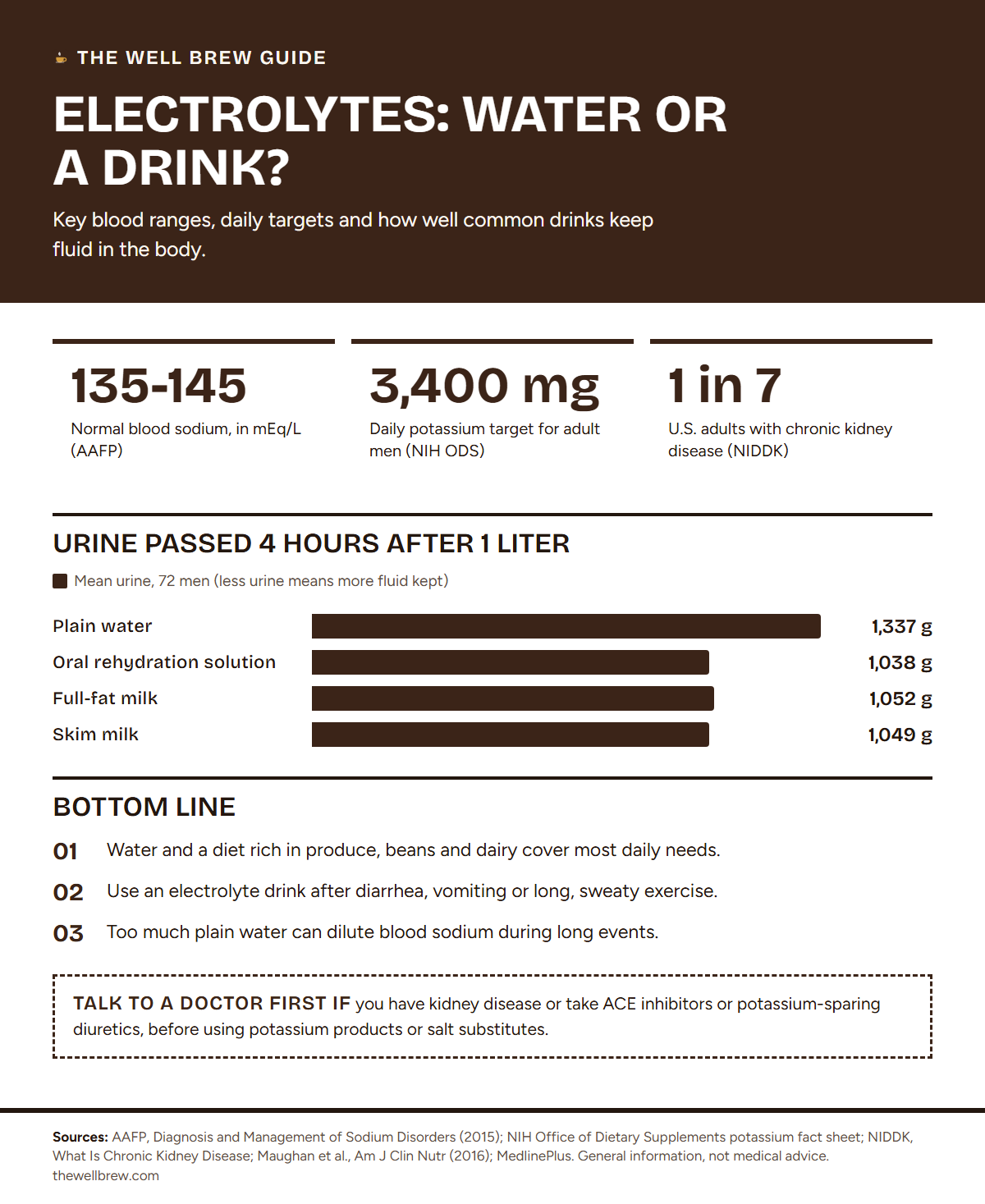
In a 2016 trial, an oral rehydration solution and milk kept more fluid in the body than water, while a sports drink did no better than water in rested men [14]. And in the Boston Marathon study, the runners who ended up with low sodium were those who drank too much in total, whatever the drink [15].
| Study | Who and how many | What was tested | Result |
|---|---|---|---|
| Maughan et al., 2016, randomized trial [14] | 72 healthy, fasted men | 1 liter of water or one of 13 common drinks; urine collected for 4 hours | Urine after water 1,337 g; after oral rehydration solution 1,038 g, full-fat milk 1,052 g, skim milk 1,049 g. A sports drink was no different from water. |
| Almond et al., 2005, Boston Marathon cohort [15] | 488 runners with a finish-line blood sample | Blood sodium after the 2002 race, plus fluid intake and weight | 13% had sodium of 135 mmol/L or less; 0.6% had 120 or less. Linked to weight gain, more than 3 liters of fluid and race times over 4 hours, not to drink type. |
A simple decision table
| If your situation is | Then the better first choice is |
|---|---|
| Normal day, desk work, light exercise | Plain water and regular meals [3] |
| Diarrhea or vomiting in an adult | Water plus broth, a sports drink or an oral rehydration solution [12] |
| A child with diarrhea or vomiting | An oral rehydration solution made for children, sold without a prescription [3] |
| Long, sweaty exercise or outdoor work in heat | Water, with a sports drink if you are losing a lot of minerals in sweat [3] |
| Endurance race lasting hours | Drink to thirst and avoid gaining weight during the event [15] |
| Kidney disease, diabetes or older age | Ask your doctor which drink and how much [12] |
MedlinePlus warns that some sports drinks have a lot of sugar, so they make a poor everyday swap for water [3].
What foods are high in electrolytes?
Fruit, vegetables, beans, dairy, nuts and seeds supply most of the potassium, magnesium and calcium you need, and salt in food covers sodium and chloride. Most Americans already eat more sodium than they need, so the gap is usually potassium and magnesium rather than salt [4] [7].
| Food and serving | Electrolyte | Amount |
|---|---|---|
| Dried apricots, 1/2 cup | Potassium | 755 mg [7] |
| Lentils, cooked, 1 cup | Potassium | 731 mg [7] |
| Baked potato, 1 medium | Potassium | 610 mg [7] |
| Banana, 1 medium | Potassium | 422 mg [7] |
| Milk, 1%, 1 cup | Potassium | 366 mg [7] |
| Pumpkin seeds, roasted, 1 ounce | Magnesium | 156 mg [8] |
| Almonds, 1 ounce | Magnesium | 80 mg [8] |
| Spinach, boiled, 1/2 cup | Magnesium | 78 mg [8] |
A baked potato carries more potassium than a banana, and a cup of lentils carries almost twice as much. MedlinePlus also points to leafy greens, grapes, blackberries, carrots and citrus fruit for potassium [16].
A potassium-rich diet helps offset some of sodium’s effect on blood pressure. Our guide to foods that lower blood pressure shows how that works in the DASH trials [16].
Are electrolyte supplements safe?
Electrolyte powders and tablets are safe for most healthy people in label amounts, but extra potassium and magnesium can build up in people whose kidneys cannot clear them. Kidney disease is common: more than 35 million U.S. adults, about 1 in 7, have it [11] [7].
Potassium is the main concern. The ODS says its intake targets do not apply to people with kidney disease or on medicines that hold potassium in, and that for these people even food intakes below the target can cause high potassium [7]. Over-the-counter potassium supplements mostly contain 99 mg or less [7], so the bigger hidden source is often salt substitutes made with potassium chloride. NIDDK advises people with kidney disease to use herbs and spices instead [10].
Magnesium from food is safe because healthy kidneys flush the extra. From supplements, the upper limit for adults is 350 mg a day, and high doses can cause diarrhea, nausea and abdominal cramping [8]. Our article on magnesium glycinate compares the common forms.
Calcium has an upper limit too: 2,500 mg a day for adults aged 19 to 50, counting food and supplements [9].
Plain water can also cause trouble in large amounts. MedlinePlus lists drinking too much water as a cause of imbalance [1], and in the Boston Marathon study, runners who drank more than 3 liters were more likely to finish with low sodium [15].
If you are pregnant, breastfeeding, have heart or kidney disease, or take a diuretic or an ACE inhibitor, ask your doctor or pharmacist before you add any electrolyte product [7] [8].
How do doctors treat an electrolyte imbalance?
Doctors treat an electrolyte imbalance by finding the cause and correcting the specific mineral that is too high or too low, using diet changes, pills, drinks or IV fluids. The plan depends on which electrolyte is off, how far, and why [1].
Minor cases may need only a change in diet. When a level is low, doctors give that electrolyte back by mouth or by IV. When a level is too high, they may use medicines or fluids to help the body remove it, and in severe cases dialysis [1].
For dehydration, the first step is to replace lost fluid and electrolytes. Severe cases are treated in hospital with IV fluids that contain salt [3]. For sodium problems, AAFP guidance says treatment depends on symptoms and the cause, from limiting fluids to giving salt solutions or diuretics [13].
People with chronic kidney disease often get a personal plan from a dietitian that limits sodium, potassium and phosphorus as the disease advances [10]. No store-bought electrolyte product replaces that care.
Practical checklist
- Drink water through the day and more in heat or when you exercise [3].
- Build meals around fruit, vegetables, beans and dairy for potassium, magnesium and calcium [7] [8] [9].
- Keep sodium under 2,300 mg a day by reading the Nutrition Facts label [4].
- Reach for broth, a sports drink or an oral rehydration solution during diarrhea or vomiting [12].
- Check electrolyte labels for sugar and for magnesium above 350 mg [3] [8].
- Avoid potassium chloride salt substitutes if you have kidney disease, unless your doctor approves [10].
- Ask for an electrolyte panel if you have ongoing weakness, cramps, confusion or heartbeat changes [2].
More guides on food and nutrients are in our nutrition and diet section.
Bottom line
Electrolytes are the charged minerals, mainly sodium, potassium, chloride, calcium and magnesium, that keep your fluids, nerves, muscles and heartbeat in balance. Your kidneys hold them in a tight range, and a blood panel shows when they drift out of it.
For most people, water and a diet rich in produce, beans and dairy is the better first step, because it covers daily needs without extra sugar or doses. Save electrolyte drinks for diarrhea, vomiting or long, sweaty exertion, and talk to your doctor first if you have kidney disease or take medicines that change potassium or sodium.
Frequently asked questions
What is the fastest way to replace electrolytes?
For an adult with mild losses, drink water along with broth, a sports drink or an oral rehydration solution, and eat when you can. Severe dehydration is treated in hospital with IV fluids that contain salt, so seek care for confusion, fainting or no urine.
Is coconut water or milk good for electrolytes?
Milk is a solid choice. In a 2016 trial of 72 men, full-fat and skim milk kept about as much fluid in the body as an oral rehydration solution, and more than water. We found no comparable trial for coconut water, so we cannot rank it.
Can you take electrolytes every day?
Most healthy people do not need a daily electrolyte product, because food and water cover their needs. If you use one, check the sugar and keep supplemental magnesium under 350 mg a day. People with kidney disease should ask a doctor first.
Does drinking too much water lower electrolytes?
Yes. Drinking far more water than your body can clear can dilute blood sodium. In the 2002 Boston Marathon study, 13% of runners tested had low sodium, and drinking more than 3 liters during the race was one of the risk factors.
What blood test checks electrolytes?
An electrolyte panel, also called a serum electrolyte test, measures sodium, chloride, potassium and bicarbonate from a small blood sample taken from the arm. It needs no special preparation and is often part of a routine metabolic panel.
Sources
- Fluid and Electrolyte Balance. MedlinePlus, National Library of Medicine, 2026
- Electrolyte Panel. MedlinePlus, National Library of Medicine, 2026
- Dehydration. MedlinePlus, National Library of Medicine, 2026
- Sodium. MedlinePlus, National Library of Medicine, 2026
- Sodium Blood Test. MedlinePlus, National Library of Medicine, 2026
- Potassium Blood Test. MedlinePlus, National Library of Medicine, 2026
- Potassium: Fact Sheet for Health Professionals. NIH Office of Dietary Supplements, 2026
- Magnesium: Fact Sheet for Health Professionals. NIH Office of Dietary Supplements, 2026
- Calcium: Fact Sheet for Health Professionals. NIH Office of Dietary Supplements, 2026
- Healthy Eating for Adults with Chronic Kidney Disease. NIDDK, National Institutes of Health, 2026
- What Is Chronic Kidney Disease in Adults?. NIDDK, National Institutes of Health, 2026
- Treatment of Diarrhea. NIDDK, National Institutes of Health, 2026
- Diagnosis and Management of Sodium Disorders: Hyponatremia and Hypernatremia. American Family Physician (AAFP), 2015
- A randomized trial to assess the potential of different beverages to affect hydration status: development of a beverage hydration index. Maughan RJ et al., American Journal of Clinical Nutrition, 2016
- Hyponatremia among runners in the Boston Marathon. Almond CS et al., New England Journal of Medicine, 2005
- Potassium. MedlinePlus, National Library of Medicine, 2026

Maya Ellison is the Reviews Editor at The Well Brew, a slow, plain-language supplement review blog for everyday adults. Maya reads each label in full, sets every dose beside the amounts used in human studies, grades the research with sources such as the NIH Office of Dietary Supplements and NCCIH, and works out the real cost and refund fine print. Maya has no medical credentials and is not a doctor, dietitian, nurse or pharmacist. Reviews give pros, cons and who a product suits, never scores. How we review supplements.
This article is general information, not medical advice. Dietary supplements are not reviewed by the FDA for safety or effectiveness before they are sold. Talk to your doctor before you start any supplement, especially if you are pregnant, nursing, take medication or have a health condition.