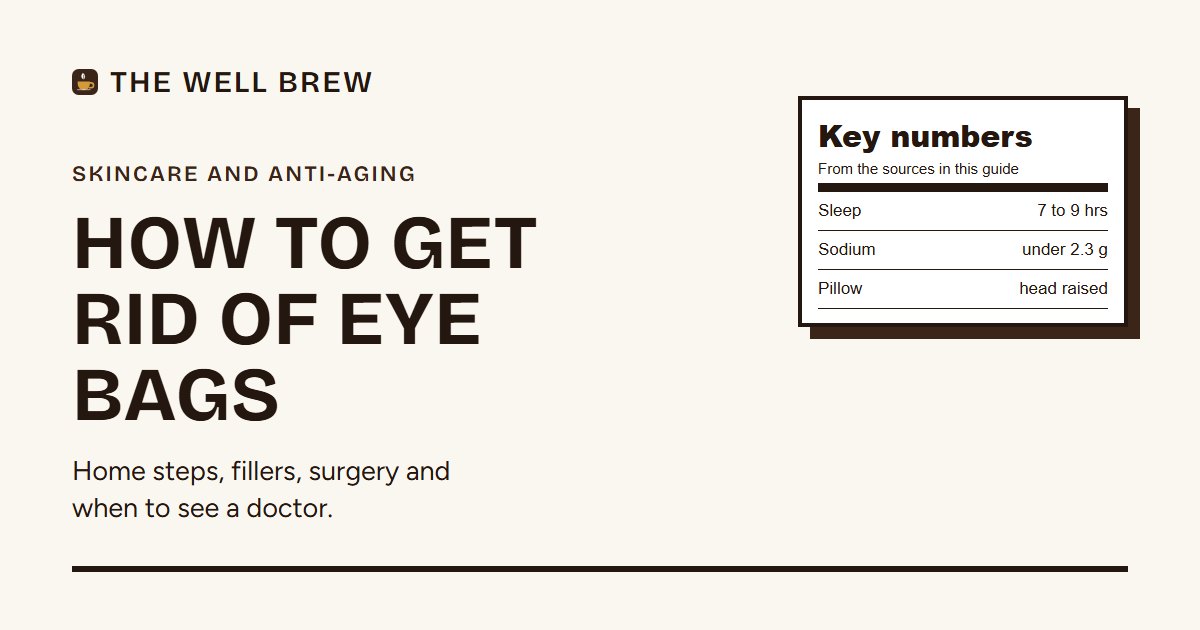
To get rid of eye bags, first find the cause. Puffiness from fluid, allergies or short sleep often eases with 7 to 9 hours of sleep, a raised pillow, cool compresses and less salt. Bags that stay all day are usually fat that grows with age, and only filler or lower eyelid surgery changes those. Puffy lids with bulging eyes or swollen ankles need a doctor.
On this page
- How to get rid of eye bags: 7 steps that help
- What causes bags under eyes?
- How to get rid of bags under eyes at home
- Are eye bags and dark circles the same thing?
- Do eye creams work for eye bags?
- What treatments do doctors use for eye bags?
- Do under-eye fillers work?
- Is eyelid surgery for eye bags worth it?
- When are puffy eyes a sign of thyroid or kidney problems?
- Who should be careful with eye bag treatments?
- What do doctors use first?
- Practical checklist
- Bottom line on getting rid of eye bags
- FAQ
If you want to know how to get rid of eye bags, start by working out which kind you have, because puffy fluid, aging fat and dark pigment each respond to different fixes. We read the American Society of Plastic Surgeons guides on eyelid surgery and fillers, NIH pages on thyroid eye disease and kidney swelling, an MRI study of aging eyelids, and three reviews and trials of fillers, lasers and eye creams.[1][5][6][8][12][13][15][16]
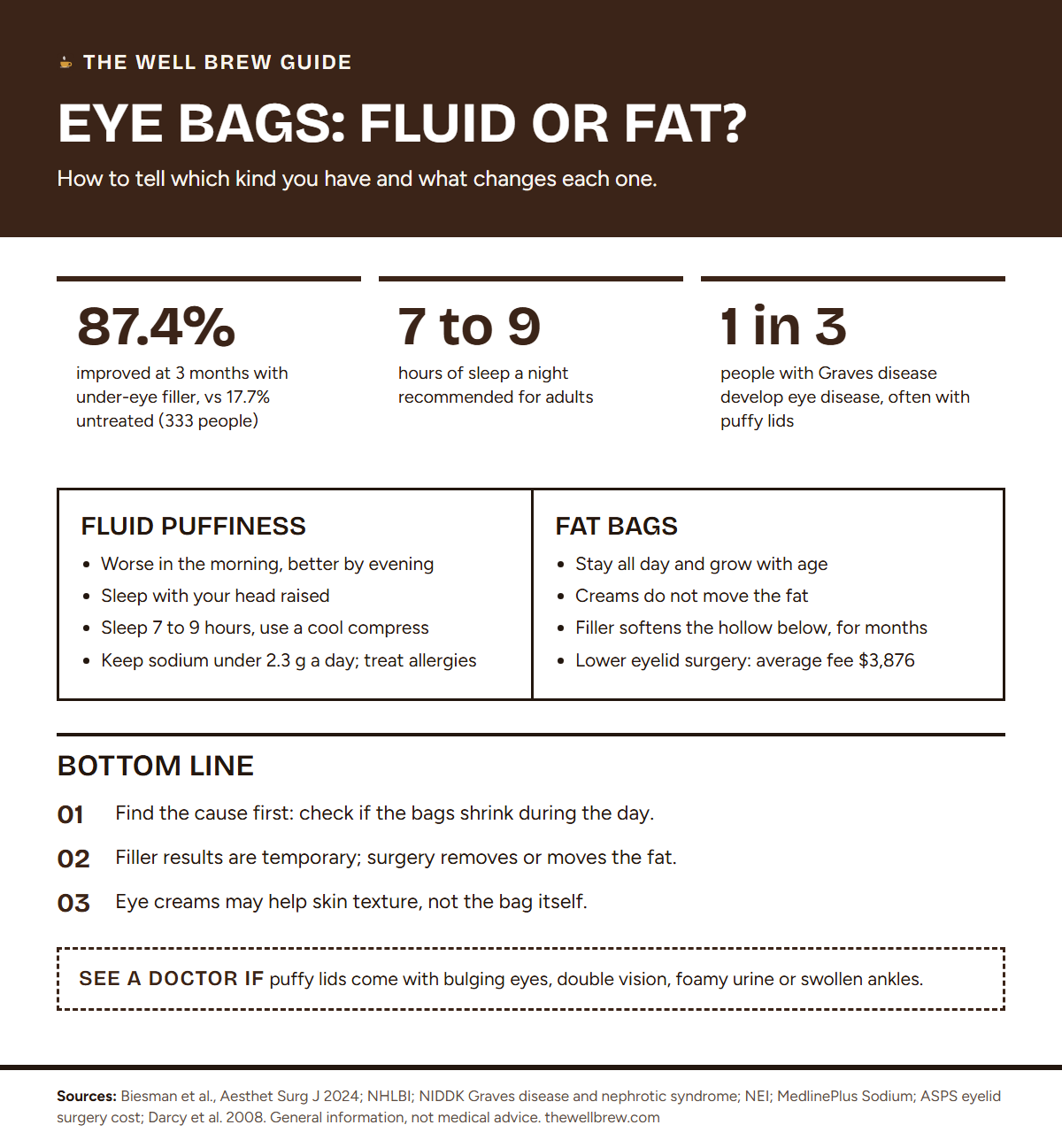
The short answer: morning puffiness from fluid often eases with sleep, a raised pillow and cool water, while bags caused by fat that grows with age only shrink with filler or eyelid surgery, which costs an average of $3,876 for the surgeon’s fee alone.[6][2][12]
| What they are | Puffiness under the eyes from fatty deposits, loose skin or fluid; plastic surgeons list bags and lower lid fat as things eyelid surgery can treat[1] |
|---|---|
| Main cause with age | Fat under the lower lid expands; an MRI study of 40 adults found it was the main driver of lower lid bulging[12] |
| Home steps | Sleep 7 to 9 hours, raise your head at night, cool compresses, treat allergies[9][6][4][10] |
| Office treatments | Hyaluronic acid filler for hollows, lasers for dark pigment, blepharoplasty for fat and loose skin[13][15][1] |
| Best evidence | A 333-person randomized trial of under-eye filler: 87.4% improved at 3 months versus 17.7% with no treatment[14] |
| Warning signs | Puffy eyelids with bulging eyes, double vision, foamy urine or swollen ankles need a doctor[7][8] |
How to get rid of eye bags: 7 steps that help
The fastest route is to match the step to the cause: fluid puffiness responds to sleep position and cool water, while fat bags need a procedure. Work through the free steps first for two to three weeks. If the bags look the same at night as they do in the morning, fluid is probably not the main problem.[6][12]
- Sleep with your head raised. NIH guidance for people with puffy eyelids says sleeping with your head raised may reduce swelling. An extra pillow or a wedge does the job.[6][7]
- Get 7 to 9 hours of sleep. That is the range experts recommend for adults.[9]
- Use a cool compress for a few minutes. Plastic surgeons use cold compresses to calm eyelid swelling and bruising after surgery, and the same gentle cold is a low-risk way to ease morning puffiness.[4]
- Treat allergies and stop rubbing. Hay fever can cause itchy, watery eyes and dark circles under the eyes.[10]
- Cut back on salt. Most adults should keep sodium under 2.3 grams a day, about 1 teaspoon of salt, and your kidneys handle the excess.[11]
- Quit smoking. Surgeons prefer nonsmokers for eyelid surgery, and smoking makes thyroid eye disease worse.[1][7]
- Book a doctor if nothing changes. Persistent bags from fat, hollows or loose skin are the cases where filler, laser or surgery come in.[1][5]
You can read more on keeping water intake steady in our guide to how much water you should drink a day.
What causes bags under eyes?
The main cause of lasting eye bags is fat under the lower eyelid that slowly expands with age. In a 2008 MRI study of 40 adults, the fat area in front of the eye’s lower half was 28 square millimeters in people aged 12 to 29 and 43 in people aged 55 to 80.[12]
The authors concluded that fat expansion, rather than the eyeball sinking, was the primary reason the lower lid bulges with age.[12] So creams and cold spoons rarely change a bag that has been there for years.
Other causes are short-term. Fluid can collect overnight and drain during the day. Allergies cause itching, rubbing and dark circles.[10] Loose skin and shadows from hollows add to the tired look, and fillers are aimed at that shadow.[5]
A few medical conditions also cause puffy eyelids, including Graves’ disease and nephrotic syndrome, a kidney problem. Those come with other symptoms, covered below.[6][8]
How to get rid of bags under eyes at home
Home care works best on puffiness from fluid, allergies and short sleep, and it does little for fat bags. Raise your head at night, sleep enough, use a cool compress and treat hay fever. Expect softer mornings; a bag made of fat will keep its shape.[6][9][4][10]
Sleep comes first. Adults who regularly sleep less than 7 hours may have more health problems, and short nights are one of the most common reasons people look puffy.[9] If magnesium is part of your bedtime routine, our review of magnesium glycinate for sleep covers what the trials found.
Salt is the next thing to look at. The Dietary Guidelines limit is under 2.3 grams of sodium a day, and some people are more sensitive to salt than others.[11] We found no trial that measured eye bags after a low-salt diet, so treat this as a sensible habit with thin direct proof. The DASH-style foods that lower blood pressure are a simple way to cut salt.
Allergies matter too. Hay fever symptoms include itchy, red, watery eyes and dark circles under the eyes, and constant rubbing irritates the thin lid skin.[10]
Are eye bags and dark circles the same thing?
No: eye bags are swelling or bulging, while dark circles are a color change or shadow under the eye. Dark circles can come from shadows cast by a hollow or from extra pigment, and each responds to a different treatment.[5][15] Many people have both, which is why one product rarely fixes the whole look.
Shadows often come from a hollow below the bag, and fillers aim to reduce that shadow of the lower lid.[5] Brown pigment responds better to lasers and lightening treatments. In a systematic review of 10 laser trials, 76.4% of people were satisfied with the reduction in dark circles, though follow-up usually lasted only a few months.[15]
Allergy-related darkness is its own type. Treating the hay fever is the first step there.[10]
Do eye creams work for eye bags?
Eye creams can improve skin hydration and fine lines, but there is little trial evidence that they shrink eye bags. A 2024 review of retinoids, vitamin C, caffeine, peptides, ceramides, hyaluronic acid and niacinamide found that most studies were not done on eye cream formulas or eyelid skin.[16]
The reviewers wrote that retinoids, vitamin C and caffeine show promise for wrinkles and pigment, and that hyaluronic acid and peptides help hydration and collagen.[16] They also flagged mixed study designs and doses, which makes products hard to compare.[16]
In practice, a cream may make thin skin look smoother and help mild dark circles, but it does not move fat. If a label promises to erase bags, treat that as marketing, and see our review standards for how we judge claims like this.
What treatments do doctors use for eye bags?
Doctors use three main tools: hyaluronic acid filler for hollows and shadows, lasers for dark pigment, and lower blepharoplasty for fat and loose skin. The choice depends on what the exam shows. Filler and laser results are temporary; surgery removes or moves the fat itself.[5][15][1]
| Study | Who and how many | Treatment | Result |
|---|---|---|---|
| Biesman 2024, randomized trial[14] | 333 adults with moderate or severe under-eye hollows | Hyaluronic acid filler vs no treatment | 87.4% vs 17.7% improved at 3 months; 63.5% still improved at 12 months |
| Liu 2024, meta-analysis[13] | 31 reports, 2,556 people | Hyaluronic acid in the tear trough | 91.0% satisfied; swelling 19.2%, bruising 18.4% |
| Roohaninasab 2021, systematic review[15] | 10 clinical trials | Several laser types for dark circles | 76.4% satisfied; follow-up usually a few months |
| Darcy 2008, MRI study[12] | 40 adults aged 12 to 80 | None (imaging) | Lower lid fat grew with age; authors favor fat removal in surgery |
Note that the Biesman trial tested one company’s product, and industry-funded trials tend to report favorable results.[14] The meta-analysis pooled many small studies of uneven quality.[13]
Do under-eye fillers work?
Under-eye filler works well for hollows and the shadow below a bag, and the effect wears off over months. In the 333-person Eyelight trial, 87.4% of treated people improved at 3 months, against 17.7% of untreated people, and about two in three still met the goal at 12 months.[14]
Side effects are common but usually mild. Across 2,556 people, about 1 in 5 had swelling and a similar share had bruising. Lumps occurred in 5.3% and a blue tint under the skin in 0.9%.[13] In the Eyelight trial, 12.7% reported adverse events, typically mild.[14]
The American Society of Plastic Surgeons describes fillers as temporary, with ongoing treatments needed to keep results.[5] Filler also does not remove a large fat pad, and for some people surgery is the better approach.[5]
Is eyelid surgery for eye bags worth it?
Lower blepharoplasty is the only treatment that removes or repositions the fat that forms most lasting eye bags. The ASPS lists bags under the eyes and fatty puffiness among the problems it treats. The average surgeon’s fee for a lower lid procedure is $3,876, before anesthesia and facility costs.[1][2]
Insurance usually does not pay for cosmetic eyelid surgery, though it may cover upper lid surgery when extra skin blocks vision.[2] Good candidates are healthy nonsmokers without serious eye conditions and with realistic goals.[1]
Risks listed by the ASPS include dry eyes, trouble closing the eyes, infection, lid lag, an outward rolling of the lower lid called ectropion, scarring and, very rarely, blindness.[3] Recovery brings swelling and bruising managed with cold compresses and ointment.[4]
When are puffy eyes a sign of thyroid or kidney problems?
Puffy eyelids can be a sign of Graves’ disease or kidney disease when they come with other symptoms, such as bulging eyes or swollen ankles. More than 1 in 3 people with Graves’ disease develop eye disease, with puffy eyes, grit, light sensitivity and double vision.[6]
Graves’ eye disease usually affects both eyes. In rare cases swelling behind the eye presses on the optic nerve and causes vision loss.[7] Nephrotic syndrome, a kidney filter problem, causes puffy eyelids along with swelling in the legs and feet, foamy urine and weight gain from fluid.[8]
See a doctor right away if you have:
- Bulging eyes, double vision, eye pain or vision changes[7]
- Puffy eyelids plus swollen legs, ankles or feet[8]
- Foamy urine or fast weight gain from fluid[8]
- A fast or irregular heartbeat with eye symptoms[6]
An eyelid that twitches without swelling is a different problem; our guide on why your eye is twitching covers it.
Who should be careful with eye bag treatments?
People with dry eye, thyroid eye disease, bleeding problems or poor healing should talk with a doctor before filler or surgery. Dry eyes and difficulty closing the eyes are known surgery risks, and the ASPS lists serious eye conditions and health problems that slow healing as reasons someone may not be a good candidate.[3][1]
If you have Graves’ disease, treat the thyroid eye disease first. Doctors may use steroids, other medicines or surgery to reposition the lids once the disease is stable.[7] Smokers face more risk with Graves’ eye disease and are poorer candidates for eyelid surgery.[7][1]
Avoid home tricks near the eye that are not meant for it, such as hemorrhoid creams or strong acids. We found no reliable evidence for them, and the lid skin is thin.[16]
What do doctors use first?
Doctors first look for a medical cause, then match treatment to the type of bag. Puffiness with other swelling leads to urine and blood tests for kidney disease, and eye bulging leads to a thyroid workup.[8][6] For thyroid eye disease, NIH guidance starts with eye drops, a raised head at night and quitting smoking.[6][7]
For cosmetic bags, the usual order is simple steps, then filler for hollows, laser for pigment, and blepharoplasty for fat and loose skin.[5][15][1] Browse more of our skincare and anti-aging guides for related topics.
Practical checklist
- Check your bags at night: if they shrink during the day, fluid is the main cause.
- Raise your head with an extra pillow for two weeks.[6]
- Aim for 7 to 9 hours of sleep.[9]
- Keep sodium under 2.3 grams a day.[11]
- Treat hay fever and stop rubbing your eyes.[10]
- Read eye cream labels for retinoid, vitamin C or caffeine, and expect skin changes, not fat loss.[16]
- Ask any injector how many under-eye filler cases they do and how they handle lumps or a blue tint.[13]
- For surgery, confirm the full price including anesthesia and facility fees.[2]
Bottom line on getting rid of eye bags
Morning puffiness from fluid, allergies and short sleep usually improves with free steps. Bags that stay all day are mostly fat that expands with age, and only filler or surgery changes that.[12][5][1]
For most people, the free steps are the better first move because they cost nothing and show within weeks whether fluid is the cause. If the bags remain and bother you, a board-certified surgeon or dermatologist can tell you whether filler or a lower lid lift fits your face.[1][14]
Frequently asked questions
How to get rid of eye bags fast?
A cool compress for a few minutes and sleeping with your head raised can ease fluid puffiness by the next morning. Concealer hides shadows. Fat bags do not change quickly without filler or surgery.
Can you get rid of eye bags permanently?
Lower blepharoplasty removes or repositions the fat that forms most lasting bags, so its effect is long term. Fillers are temporary, and in one trial about two in three people still kept the result at 12 months.
Does drinking water help bags under eyes?
No trial we found shows that more water shrinks eye bags. Staying hydrated is still healthy, and keeping sodium under 2.3 grams a day is a reasonable habit if you wake up puffy.
Why do I have bags under my eyes at a young age?
Eye bags can run in families, and allergies, short sleep and fluid cause puffiness at any age. Hay fever can also cause dark circles. If puffiness comes with other swelling, see a doctor.
Do cucumbers or tea bags work for eye bags?
We found no trials testing cucumbers or tea bags on eye bags. Any short-term effect is likely from the cool temperature, which a clean, cool, damp washcloth also gives you.
Sources
- Eyelid Surgery (Blepharoplasty). American Society of Plastic Surgeons, 2026
- Eyelid Surgery Cost. American Society of Plastic Surgeons, 2026
- Eyelid Surgery Risks and Safety. American Society of Plastic Surgeons, 2026
- Eyelid Surgery Recovery. American Society of Plastic Surgeons, 2026
- Dermal Fillers. American Society of Plastic Surgeons, 2026
- Graves' Disease. NIDDK, National Institutes of Health
- Graves' Eye Disease. National Eye Institute, 2024
- Nephrotic Syndrome in Adults. NIDDK, National Institutes of Health
- How Much Sleep Is Enough?. NHLBI, National Institutes of Health
- Hay Fever. MedlinePlus, National Library of Medicine
- Sodium. MedlinePlus, National Library of Medicine
- Magnetic resonance imaging characterization of orbital changes with age and associated contributions to lower eyelid prominence. Darcy et al., Plastic and Reconstructive Surgery, 2008
- The Efficacy and Safety of Hyaluronic Acid Injection in Tear Trough Deformity: A Systematic Review and Meta-analysis. Liu et al., Aesthetic Plastic Surgery, 2024
- A Multicenter, Randomized, Evaluator-Blinded Study to Examine the Safety and Effectiveness of Hyaluronic Acid Filler in the Correction of Infraorbital Hollows. Biesman et al., Aesthetic Surgery Journal, 2024
- Effects of laser therapy on periorbital hyperpigmentation: a systematic review on current studies. Roohaninasab et al., Lasers in Medical Science, 2021
- A review of the efficacy of popular eye cream ingredients. Hamie et al., International Journal of Women's Dermatology, 2024

Maya Ellison is the Reviews Editor at The Well Brew, a slow, plain-language supplement review blog for everyday adults. Maya reads each label in full, sets every dose beside the amounts used in human studies, grades the research with sources such as the NIH Office of Dietary Supplements and NCCIH, and works out the real cost and refund fine print. Maya has no medical credentials and is not a doctor, dietitian, nurse or pharmacist. Reviews give pros, cons and who a product suits, never scores. How we review supplements.
This article is general information, not medical advice. Dietary supplements are not reviewed by the FDA for safety or effectiveness before they are sold. Talk to your doctor before you start any supplement, especially if you are pregnant, nursing, take medication or have a health condition.