The foods that lower blood pressure best are potassium-rich vegetables, fruit, beans, low-fat dairy and fish, eaten together with less salt. In the DASH-Sodium trial, that pattern cut systolic pressure by 11.5 mm Hg in people with high blood pressure. Baked potatoes, lentils, squash and bananas are easy starting points. No single food or drink works fast, and none replaces prescribed medicine.
On this page
- What are the best foods that lower blood pressure?
- How does the DASH diet lower blood pressure?
- Why do potassium and sodium matter for blood pressure?
- Does banana lower blood pressure?
- What drink lowers blood pressure?
- What foods lower blood pressure quickly?
- What should I eat for breakfast with high blood pressure?
- Who should be careful with high-potassium foods?
- What do doctors use first for high blood pressure?
- FAQ
To build this list of foods that lower blood pressure, we read the NHLBI pages on the DASH eating plan and its trials, the NIH Office of Dietary Supplements potassium fact sheet with its USDA FoodData Central food table, the FDA’s sodium guidance, and five clinical studies, from the 1997 DASH trial to a 2021 salt substitute trial with almost 21,000 people. Our method is laid out on the how we review page.
Vegetables, fruit, beans, low-fat dairy and fish do the most when you eat them as a pattern with less salt. In the DASH-Sodium trial, that combination lowered systolic pressure by 11.5 mm Hg in people with high blood pressure [8].
| What it is | An eating pattern rich in vegetables, fruit, whole grains, low-fat dairy, beans, nuts and fish, with less sodium (the DASH plan) [1] |
|---|---|
| Used for | Lowering and controlling high blood pressure, alongside activity, weight and alcohol changes [3] |
| Typical amounts | 4-5 servings of vegetables and 4-5 of fruit a day, 2-3 of low-fat dairy, and 4-5 of nuts, seeds or beans a week, on a 2,000-calorie plan [1] |
| Sodium target | 2,300 mg a day, and 1,500 mg lowers blood pressure further [1] |
| Best evidence | Feeding trials of 459 and 412 adults, where all food was provided [7] [8] |
| Safety | Safe for most people. Extra potassium can build up in people with kidney disease or on some blood pressure medicines [5] |
| Who should check first | Anyone with kidney disease, or taking ACE inhibitors, ARBs or potassium-sparing diuretics, before using salt substitutes or potassium supplements [5] |
What are the best foods that lower blood pressure?
The best foods that lower blood pressure are potassium-rich vegetables, fruit, beans and low-fat dairy, eaten together in a low-sodium pattern like DASH. In the trials, the drop came from the whole plate, with sodium kept down [1] [7].
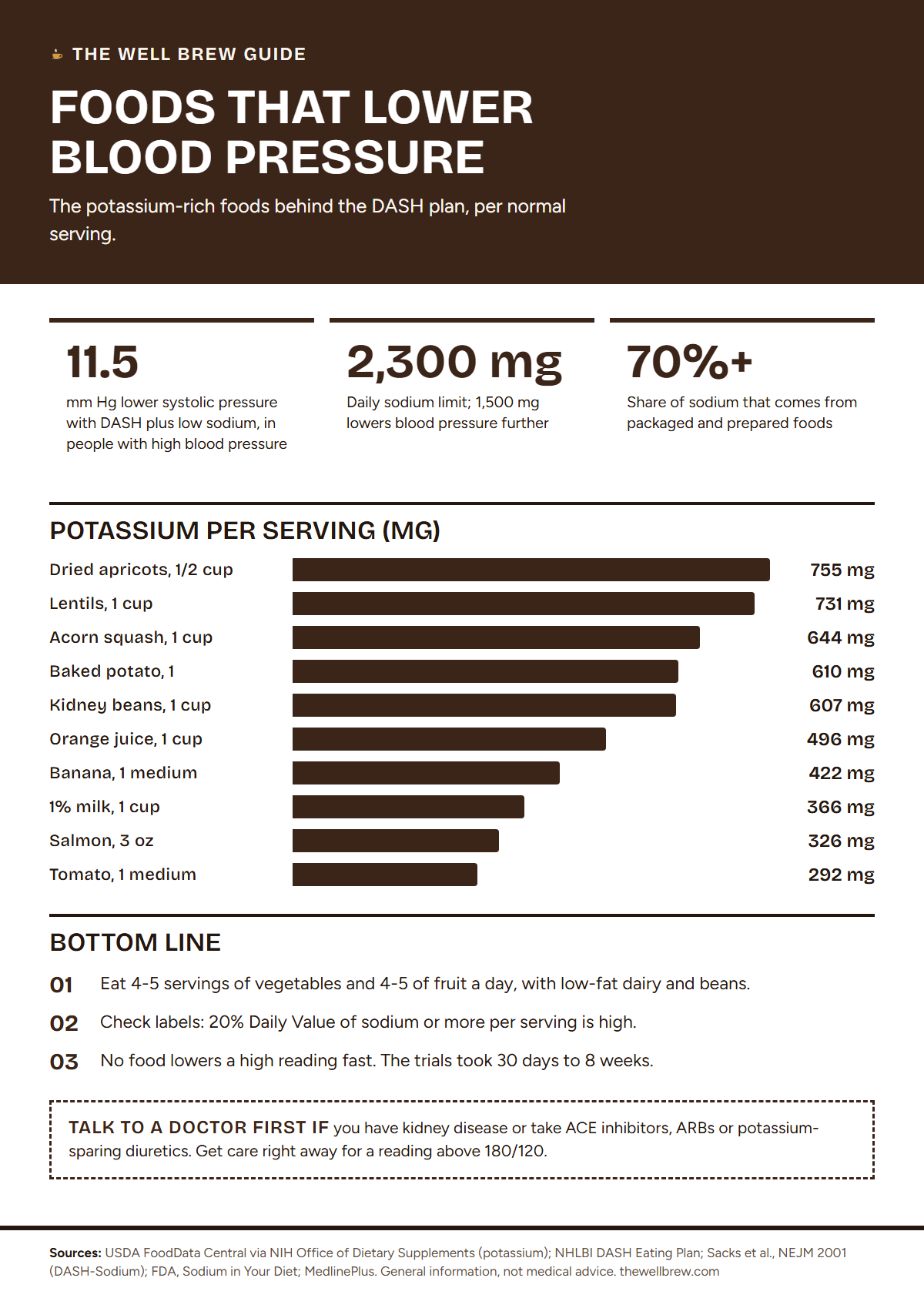
Most of these foods are high in potassium, which offsets some of the effect of sodium. The DASH plan asks you to choose foods rich in potassium, calcium, magnesium, fiber and protein [1]. Adults need about 3,400 mg of potassium a day (men) or 2,600 mg (women), and the label Daily Value is 4,700 mg [5].
The table below uses USDA FoodData Central values, as listed by the NIH Office of Dietary Supplements. These everyday foods carry the most potassium per normal serving [5].
| Food and serving | Potassium (mg) | % Daily Value | DASH food group |
|---|---|---|---|
| Dried apricots, 1/2 cup | 755 | 16 | Fruit |
| Lentils, cooked, 1 cup | 731 | 16 | Beans and peas |
| Acorn squash, mashed, 1 cup | 644 | 14 | Vegetables |
| Prunes, dried, 1/2 cup | 635 | 14 | Fruit |
| Raisins, 1/2 cup | 618 | 13 | Fruit |
| Potato, baked, flesh only, 1 medium | 610 | 13 | Vegetables |
| Kidney beans, canned, 1 cup | 607 | 13 | Beans and peas |
| Orange juice, 1 cup | 496 | 11 | Fruit |
| Soybeans, boiled, 1/2 cup | 443 | 9 | Beans and peas |
| Banana, 1 medium | 422 | 9 | Fruit |
| Milk, 1%, 1 cup | 366 | 8 | Low-fat dairy |
| Spinach, raw, 2 cups | 334 | 7 | Vegetables |
| Yogurt, nonfat, fruit, 6 ounces | 330 | 7 | Low-fat dairy |
| Salmon, Atlantic, farmed, cooked, 3 ounces | 326 | 7 | Fish |
| Tomato, raw, 1 medium | 292 | 6 | Vegetables |
| Broccoli, cooked, 1/2 cup | 229 | 5 | Vegetables |
Dried fruit tops the list, but it is dense in sugar, so a small handful goes a long way. Beans, potatoes, squash and leafy greens give you the most potassium for the fewest calories. Many of the same foods turn up in our list of anti-inflammatory diet foods and meal ideas, so one shopping list can serve both goals.
How does the DASH diet lower blood pressure?
DASH (Dietary Approaches to Stop Hypertension) lowers blood pressure by adding potassium-rich produce, low-fat dairy and beans while cutting saturated fat, sweets and salt. It needs no special foods. It sets daily and weekly serving goals instead [1].
On a 2,000-calorie plan, NHLBI suggests 6-8 servings of grains, 4-5 of vegetables, 4-5 of fruit and 2-3 of low-fat or fat-free dairy a day. Meat, poultry and fish stay at 6 servings or fewer. Nuts, seeds and dry beans come in at 4-5 servings a week, and sweets at 5 or fewer [1].
The original DASH trial fed 459 adults for 8 weeks while keeping their sodium and weight steady. The DASH diet lowered systolic and diastolic pressure by 5.5 and 3.0 mm Hg more than a typical American diet. In the 133 people who had high blood pressure, the drop was 11.4 and 5.5 mm Hg [7].
The later DASH-Sodium study tested three sodium levels, each for 30 days, in 412 people. Pressure fell with each cut in sodium, on both diets [2] [8]. NHLBI says DASH combined with a low-salt plan “can be as effective as medicines” in lowering high blood pressure [3]. Keep taking any prescribed drug unless your doctor changes it.
What the trials found
| Study | Who and how long | What changed | Result |
|---|---|---|---|
| DASH, Appel 1997 | 459 adults, 8 weeks, all food provided | DASH diet vs typical American diet, same sodium | Systolic 5.5 mm Hg lower overall, 11.4 mm Hg lower with hypertension [7] |
| DASH-Sodium, Sacks 2001 | 412 adults, 30 days per sodium level | DASH plus low sodium vs typical diet plus high sodium | Systolic 11.5 mm Hg lower with hypertension, 7.1 mm Hg lower without [8] |
| SSaSS, Neal 2021 | 20,995 older adults in 600 Chinese villages, 4.74 years | Salt substitute (75% sodium chloride, 25% potassium chloride) vs regular salt | Stroke rate ratio 0.86, with no significant rise in serious high-potassium events [9] |
| Beetroot and nitrate, Siervo 2013 | 16 small trials, 254 people, 2 hours to 15 days | Beetroot juice or nitrate vs placebo | Systolic 4.4 mm Hg lower, diastolic change not significant [10] |
| Hibiscus tea, McKay 2010 | 65 adults with mildly high readings, 6 weeks | 3 cups (240 mL each) a day vs placebo drink | Systolic down 7.2 vs 1.3 mm Hg with placebo [11] |
Why do potassium and sodium matter for blood pressure?
Sodium raises blood pressure and potassium pushes the other way, so the balance between them on your plate matters more than any one food. In DASH-Sodium, each step down in sodium brought pressure down further, on top of the DASH foods [2] [8].
Most of the sodium in an American diet does not come from the salt shaker. The FDA says over 70% comes from packaged and prepared foods [6]. Americans average about 3,400 mg of sodium a day, while the guideline limit is under 2,300 mg, about 1 teaspoon of table salt [6]. The 1,500 mg level used in DASH-Sodium is about half a teaspoon [2].
On a Nutrition Facts label, 5% Daily Value or less of sodium per serving counts as low, and 20% or more counts as high [6]. Use that check on bread, soup, deli meat and sauces.
Potassium pills were studied too. A 2017 pooled analysis of 25 trials in 1,163 people with high blood pressure found systolic pressure fell by 4.48 mm Hg. A Cochrane review of the six best-quality trials found no significant drop, so the case for pills is mixed [5].
Does banana lower blood pressure?
One medium banana gives 422 mg of potassium, about 9% of the Daily Value, which helps as part of a DASH-style diet even though no single fruit lowers blood pressure by itself. Bananas are a handy source, though they sit well down the potassium list [5].
Bananas get the attention because they are easy to eat. Per serving, a baked potato (610 mg), a cup of cooked lentils (731 mg) and a cup of mashed acorn squash (644 mg) all carry more [5]. If you like bananas, keep eating them, and add the others too.
The DASH trial also tested a fruit-and-vegetable diet on its own, without the dairy and fat changes. It lowered systolic pressure by 2.8 mm Hg, about half of what the full DASH diet did [7].
What drink lowers blood pressure?
Low-fat milk, beetroot juice and hibiscus tea have the most data among drinks, and none of them stands in for the full DASH pattern or for medicine. Water and unsweetened drinks matter as well, because DASH limits sugar-sweetened beverages [1].
Low-fat or fat-free milk counts toward the 2-3 daily dairy servings in DASH, and a cup of 1% milk carries 366 mg of potassium [1] [5]. Orange juice has 496 mg a cup, though whole fruit gives you the fiber too [5].
Beetroot juice is rich in nitrate. A 2013 review of 16 small crossover trials, with 254 people in total, found systolic pressure was 4.4 mm Hg lower after nitrate or beetroot juice. The trials lasted from 2 hours to 15 days, and the authors said longer trials are needed [10].
Hibiscus tea was tested in one 2010 trial of 65 adults. Three cups a day for 6 weeks lowered systolic pressure by 7.2 mm Hg, against 1.3 mm Hg with a placebo drink. The diastolic change did not differ from placebo [11]. One small trial counts as limited evidence. NHLBI also advises talking to your provider about alcohol, since you may need to limit it or stop [3].
What foods lower blood pressure quickly?
No food reliably lowers a high reading within minutes or hours, because diet changes show up over weeks, and a very high reading needs medical care. In the DASH trials, the measured drops came after 30 days to 8 weeks on the diet [7] [8].
Beetroot juice is the one food studied over hours, and its trials were small and short, with an average systolic change of 4.4 mm Hg [10]. The effect is modest, far too small to treat beet juice as a rescue drink.
MedlinePlus defines a hypertensive crisis as a reading higher than 180 systolic and 120 diastolic, and says to seek medical care right away [4]. High blood pressure usually has no symptoms, so a cuff and regular checks tell you more than how you feel [4].
The quickest dietary lever is usually sodium. Cutting back on packaged and restaurant food lowers your intake from the first day, and the FDA notes that your taste for salt fades over time [6].
What should I eat for breakfast with high blood pressure?
A good breakfast for high blood pressure pairs a whole grain with fruit and low-fat dairy, such as oatmeal with a sliced banana and a cup of 1% milk. That meal covers three DASH food groups and gives 788 mg of potassium from the banana and milk alone [1] [5].
Watch the hidden sodium at breakfast. Bread, bagels, cereals, cheese and breakfast meats can all run high, so look for 20% Daily Value or more on the label and pick something else [6]. If you want more fiber in the morning, our guide to psyllium husk benefits for digestion and cholesterol covers how to add it.
A sample DASH-style day, with potassium from the USDA table
This worked example uses only foods from the table above, so every number traces back to USDA FoodData Central [5]. Add whole grains, nuts and seasonings to taste, choosing low-sodium versions.
| Meal | Foods from the table | Potassium (mg) |
|---|---|---|
| Breakfast | Oatmeal with 1 medium banana, 1 cup 1% milk | 788 |
| Lunch | Homemade lentil soup (1 cup lentils), 1 medium tomato on the side | 1,023 |
| Snack | 6 ounces nonfat fruit yogurt | 330 |
| Dinner | 3 ounces baked salmon, 1 medium baked potato, 1/2 cup broccoli | 1,165 |
| Total from these foods | 4 fruit and vegetable servings, 2 dairy, 1 bean, 1 fish | 3,306 |
The 3,306 mg total already passes the 2,600 mg adequate intake for women and comes close to the 3,400 mg for men [5]. A spinach salad (334 mg) or a half cup of raisins (618 mg) would take most men past it [5].
Who should be careful with high-potassium foods?
People with kidney disease, and people taking ACE inhibitors, ARBs or potassium-sparing diuretics, can build up too much potassium and should ask their doctor before raising intake sharply. In these groups, even potassium intakes below the usual target can cause high blood potassium [5].
Salt substitutes deserve the same care. Most swap part of the sodium chloride for potassium chloride. In the SSaSS trial, a 75/25 salt substitute was linked to fewer strokes over 4.74 years, and serious high-potassium events were not significantly more common [9]. The NIH still advises people with kidney disease or on certain medicines to check with a provider first [5].
Some blood pressure medicines work the other way. Thiazide diuretics make the body lose potassium, which is one more reason to share your diet plans with whoever prescribes them [5].
A note on supplements: most potassium supplements contain no more than 99 mg, about 2% of the Daily Value, so they add little [5]. Other pills sold for heart health carry their own risks. Our guides to nattokinase benefits and risks and magnesium glycinate and how it compares cover two of them. None of them replaces the diet or your medicine.
See a doctor right away if:
- Your reading is higher than 180 systolic and 120 diastolic [4].
- You have kidney disease and plan to use a salt substitute or a potassium supplement [5].
- You take an ACE inhibitor, an ARB or a potassium-sparing diuretic and want to eat much more potassium [5].
- You want to cut back or stop a blood pressure medicine because your diet has changed [3].
What do doctors use first for high blood pressure?
Doctors start with a heart-healthy lifestyle, including DASH-style eating, less sodium, regular activity, weight loss when needed and less alcohol, and they add medicine when that is not enough. A diagnosis needs two or more readings at separate visits [3] [4].
NHLBI notes that losing just 3% to 5% of body weight can improve blood pressure [3]. Common medicines include diuretics and calcium channel blockers, and diuretics are often combined with other blood pressure drugs [3]. Food changes work alongside these medicines. Our blood pressure guides cover readings, targets and next steps.
Your grocery and label checklist
- Fill half your plate with vegetables and fruit, aiming for 4-5 servings of each a day [1].
- Keep 2-3 servings of low-fat or fat-free milk or yogurt in the day [1].
- Eat beans, lentils, nuts or seeds 4-5 times a week [1].
- Check sodium on every packaged food: 5% Daily Value or less is low, 20% or more is high [6].
- Aim for under 2,300 mg of sodium a day, and 1,500 mg if your doctor agrees [1].
- Cook at home more often, since over 70% of sodium comes from packaged and prepared food [6].
- Ask before using salt substitutes if you have kidney disease or take a medicine that holds on to potassium [5].
Bottom line
The foods that lower blood pressure are plain ones: beans, potatoes, leafy greens, fruit, low-fat dairy and fish. The best evidence comes from feeding trials where the whole pattern, plus less sodium, cut systolic pressure by up to 11.5 mm Hg in people with high blood pressure [8].
For most people, cutting sodium from packaged food is a better first step than hunting for a special food or drink, because that is where most of the salt is [6]. Then build meals around the potassium-rich foods in the table, and keep your doctor in the loop if you take blood pressure medicine.
Frequently asked questions
How much potassium do I need a day?
The NIH sets an adequate intake of 3,400 mg a day for men and 2,600 mg for women, and the food label Daily Value is 4,700 mg. People with kidney disease or on some blood pressure medicines may need less, so ask your doctor.
How much sodium should I eat if I have high blood pressure?
The DASH plan and the Dietary Guidelines set a limit of 2,300 mg a day, about one teaspoon of salt. NHLBI notes that 1,500 mg lowers blood pressure even further, so ask your doctor which target fits you.
Can eating the DASH way replace blood pressure medicine?
NHLBI says DASH with low salt can lower pressure about as much as some medicines. Keep taking yours, and change medicine only with your prescriber, who can recheck your readings as your diet improves.
Are salt substitutes safe for high blood pressure?
In a trial of 20,995 older adults, a potassium salt substitute was linked to fewer strokes without a significant rise in serious potassium problems. People with kidney disease or on potassium-holding medicines should still check with a doctor first.
Are canned beans good for high blood pressure?
Canned kidney beans carry 607 mg of potassium per cup, so they fit the DASH plan. Canned foods can be high in sodium, so compare labels and pick cans with 5% Daily Value or less of sodium per serving.
Sources
- DASH Eating Plan. National Heart, Lung, and Blood Institute (NIH), 2026
- DASH Research: DASH, DASH-Sodium, PREMIER and OmniHeart studies. National Heart, Lung, and Blood Institute (NIH), 2026
- High Blood Pressure: Treatment. National Heart, Lung, and Blood Institute (NIH), 2026
- High Blood Pressure. MedlinePlus, National Library of Medicine, 2026
- Potassium: Fact Sheet for Health Professionals (Table 2, USDA FoodData Central values). NIH Office of Dietary Supplements, updated 2022
- Sodium in Your Diet. U.S. Food and Drug Administration, 2026
- A clinical trial of the effects of dietary patterns on blood pressure (DASH). Appel LJ et al., New England Journal of Medicine, 1997
- Effects on blood pressure of reduced dietary sodium and the DASH diet (DASH-Sodium). Sacks FM et al., New England Journal of Medicine, 2001
- Effect of Salt Substitution on Cardiovascular Events and Death (SSaSS). Neal B et al., New England Journal of Medicine, 2021
- Inorganic nitrate and beetroot juice supplementation reduces blood pressure in adults: a systematic review and meta-analysis. Siervo M et al., Journal of Nutrition, 2013
- Hibiscus sabdariffa L. tea (tisane) lowers blood pressure in prehypertensive and mildly hypertensive adults. McKay DL et al., Journal of Nutrition, 2010

Maya Ellison is the Reviews Editor at The Well Brew, a slow, plain-language supplement review blog for everyday adults. Maya reads each label in full, sets every dose beside the amounts used in human studies, grades the research with sources such as the NIH Office of Dietary Supplements and NCCIH, and works out the real cost and refund fine print. Maya has no medical credentials and is not a doctor, dietitian, nurse or pharmacist. Reviews give pros, cons and who a product suits, never scores. How we review supplements.
This article is general information, not medical advice. Dietary supplements are not reviewed by the FDA for safety or effectiveness before they are sold. Talk to your doctor before you start any supplement, especially if you are pregnant, nursing, take medication or have a health condition.