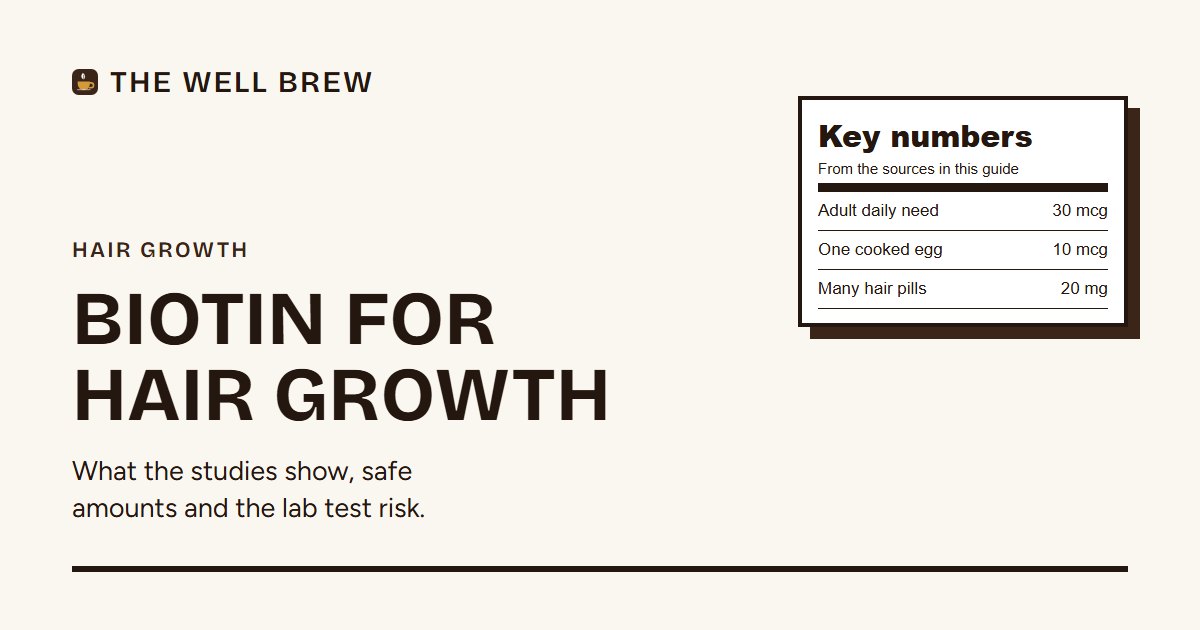
Biotin helps hair mainly when you are truly deficient, and deficiency is rare in people who eat a normal diet. The only placebo-controlled trial, in 46 women, found no difference after 4 weeks of 10 mg a day. Adults need about 30 mcg daily, while hair supplements often hold 20 mg, enough to skew thyroid and troponin blood tests.
On this page
- Does biotin help hair growth?
- What does the research say about biotin for hair growth?
- Who might actually benefit from biotin?
- How much biotin for hair growth is enough?
- How long does biotin take to work for hair?
- What are the side effects of biotin?
- What do dermatologists use first for hair loss?
- What should you check before buying biotin?
- Bottom line: is biotin worth taking for hair?
- FAQ
This page checks the claims about biotin for hair growth against the published evidence. We read the NIH Office of Dietary Supplements fact sheet on biotin, the FDA safety warning about biotin and lab tests, two reviews of the hair studies, and the American Academy of Dermatology’s guidance on hair loss.[1][2][3][4][9]
The answer in one line: biotin only has support for hair when you are truly low in it, which is rare, and the one placebo-controlled trial in women with thinning hair found no difference after 4 weeks.[1][3]
| What it is | Vitamin B7, a water-soluble B vitamin the body needs for enzymes that handle fats, sugars and amino acids[3] |
|---|---|
| Daily need for adults | 30 mcg a day, or 35 mcg while breastfeeding[1] |
| Typical hair supplement | The FDA knows of many products with 20 mg per pill and some with up to 100 mg[2] |
| Best evidence for hair | Case reports in children with rare hair disorders; the only placebo trial in adults found no benefit[1][3] |
| How common is deficiency | Rare; severe deficiency has never been reported in healthy people eating a normal mixed diet[1] |
| Main safety issue | High doses can cause falsely high or falsely low lab results, including troponin and thyroid tests[1][2] |
| Ask a doctor first | Anyone due for blood work, taking seizure medicines, or pregnant[1][2] |
Does biotin help hair growth?
For most people, the evidence says no. Biotin helps hair only when hair loss comes from a real biotin shortage, and that shortage is rare. A 2024 review of the medical literature found no studies showing that biotin supplements help hair grow in healthy people.[1][3]
When people are deficient in biotin, the signs can include thinning hair that can progress to loss of all body hair, a scaly red rash around the eyes, nose and mouth, and brittle nails.[1] Correcting that shortage can bring hair back. The AAD says that when the body gets enough of a missing nutrient, hair can regrow.[7]
Extra biotin on top of normal levels is a different question. A 2017 systematic review found 18 published cases where biotin seemed to help hair or nails. In every one, the patient had an underlying disorder.[4] The authors concluded there was not enough evidence to support supplements in healthy people.[4]
The NIH fact sheet agrees. It says claims for hair, skin and nails are supported, at best, by a few case reports and small studies.[1]
What does the research say about biotin for hair growth?
Very little, and none of it is strong. Only three studies tested oral biotin for hair growth or hair quality, and the best-designed one found no benefit over placebo. The other two looked at narrow groups of patients and were not blinded, so their results could reflect bias.[3]
| Study | Who and how many | Dose and length | Result |
|---|---|---|---|
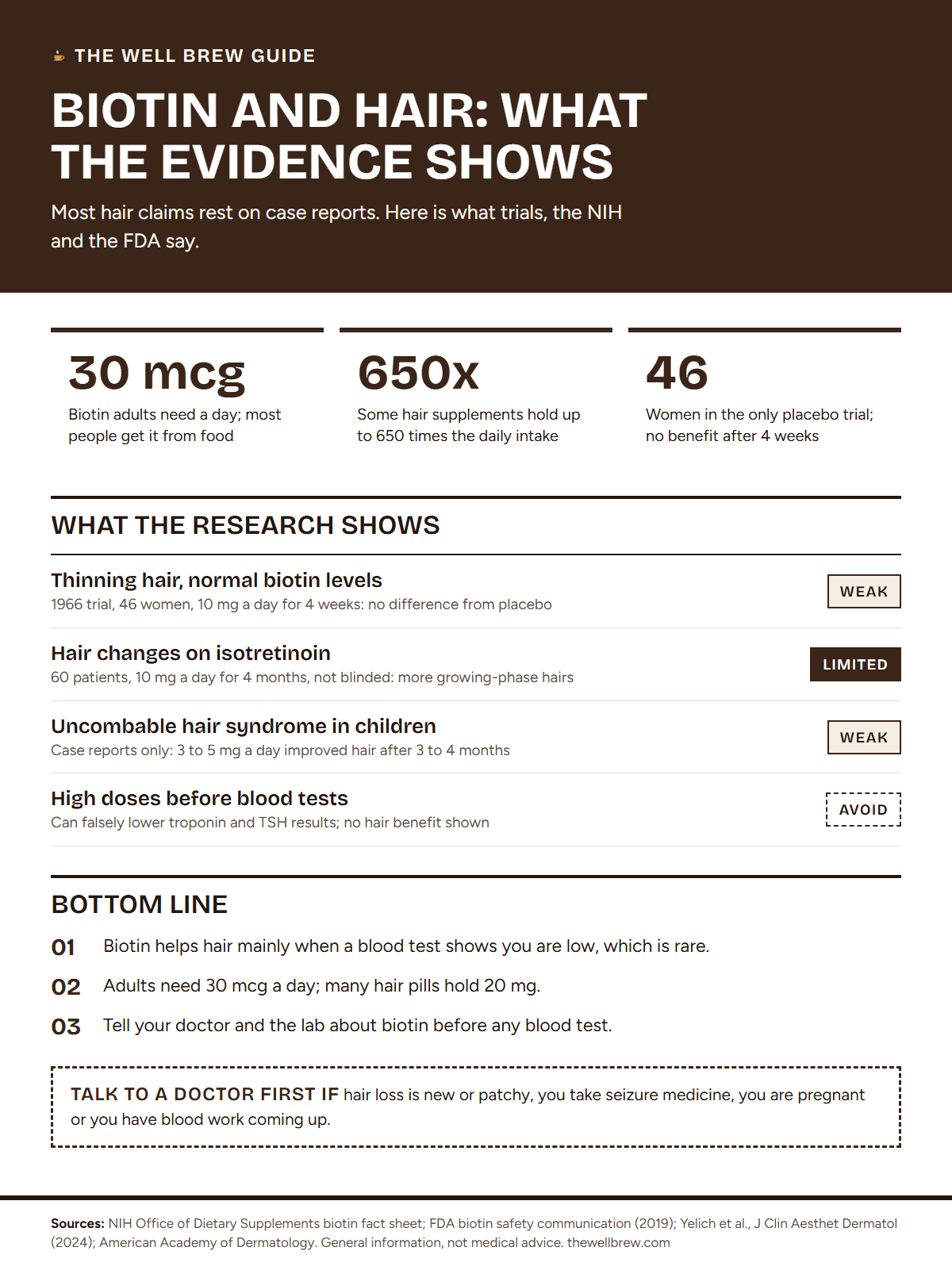
| Pawlowski, 1966, placebo-controlled | 46 women with diffuse hair loss (28 biotin, 18 placebo) | 10 mg a day for 4 weeks | Both groups improved; no significant difference in hair growth[3] |
| Aksac, 2021, not blinded | 60 people on isotretinoin for acne; 30 also took biotin | 10 mg a day for 4 months | More hairs in the growing phase in the biotin group; hair density fell in both groups[3] |
| Sen, 2021, not blinded | 112 women with hair loss after sleeve gastrectomy; 22 were biotin deficient | 1 mg a day for about 3 months | 23% of deficient and 38% of non-deficient women reported improvement; no significant difference[3] |
| Case reports reviewed by NIH | Children with uncombable hair syndrome, a rare hair shaft disorder | 3 to 5 mg a day for 3 to 4 months | Hair health improved[1] |
The one placebo trial is almost 60 years old. The sleeve gastrectomy study relied on women’s own reports, and women who were not deficient reported improvement more often than women who were.[3]
In our infographic, Limited means some trials that are small or low quality, Weak means case reports only or trials that found no benefit, and Avoid means no benefit plus a safety problem.
Who might actually benefit from biotin?
People with a confirmed reason to be low. The groups with a real case for biotin are people with a diagnosed deficiency, a rare inherited disorder called biotinidase deficiency, or a known risk factor that a doctor has checked. For everyone else, a dermatologist visit is a better first step than a bottle of biotin.[1][9]
| If this describes you | Then the evidence suggests |
|---|---|
| A blood test showed low biotin | Take biotin as your doctor directs; hair can regrow once the shortage is fixed[7][9] |
| You have biotinidase deficiency | Lifelong biotin under a specialist, ideally started at birth[1] |
| You have taken carbamazepine, phenytoin, primidone or phenobarbital for a year or more | Ask whether your biotin status should be checked; a study of 264 people with epilepsy found lower levels[1] |
| You drink heavily over the long term | Alcohol blocks biotin absorption, and 15% of people with chronic alcoholism have low blood levels[1] |
| You eat a normal diet and your hair is thinning slowly | Biotin is unlikely to help; ask about pattern hair loss, the most common cause worldwide[3][7] |
| You are shedding a few months after childbirth, illness or stress | This usually settles on its own, with fullness back within 6 to 9 months[8] |
One Swiss clinic reported low biotin in 38% of women who came in with hair loss. Even so, the author rejected giving biotin to every woman with hair loss unless a deficiency had been confirmed and other causes ruled out.[5] That study had no comparison group, so the figure does not tell you how common deficiency is in general.
How much biotin for hair growth is enough?
Adults need about 30 mcg a day, and most people get that from food. The adequate intake for biotin is 30 mcg a day for adults and 35 mcg while breastfeeding. Many hair supplements contain 20 mg, which is 20,000 mcg. The FDA says some products contain up to 650 times the recommended daily intake.[1][2]
No trial has shown that a higher dose works better for hair. The 1966 placebo trial used 10 mg a day and still found no difference.[3] Organ meats, eggs, fish, meat, seeds, nuts and sweet potatoes are among the richest food sources.[1]
| Food | Biotin (mcg) | Percent of Daily Value |
|---|---|---|
| Beef liver, cooked, 3 ounces | 30.8 | 103%[1] |
| Egg, whole, cooked | 10.0 | 33%[1] |
| Salmon, pink, canned in water, 3 ounces | 5.0 | 17%[1] |
| Sunflower seeds, roasted, 1/4 cup | 2.6 | 9%[1] |
| Sweet potato, cooked, 1/2 cup | 2.4 | 8%[1] |
| Almonds, roasted, 1/4 cup | 1.5 | 5%[1] |
Cook your eggs. Raw egg whites contain avidin, a protein that binds biotin and stops you absorbing it, and cooking switches it off.[1] Low protein can also cause hair loss, so it is worth checking how much protein you should eat daily before you buy a hair pill.[7]
How long does biotin take to work for hair?
There is no reliable timeline for healthy people, because no trial has shown biotin works for them. Studies that did report changes ran for 3 to 4 months, and they involved deficiency, a rare hair disorder, or a specific drug. The children with uncombable hair syndrome improved after 3 to 4 months on 3 to 5 mg a day.[1]
In the isotretinoin study, the biotin group was followed for 4 months. The sleeve gastrectomy patients took 1 mg a day for about 3 months, and their reports were similar whether or not they were deficient.[3]
Hair grows slowly, so any hair treatment needs months before you can judge it. The AAD says it is normal to shed 50 to 100 hairs a day. After a stressful event, shedding can stay high for a while, and most people see normal fullness return within 6 to 9 months once the stress passes.[8] If you started a supplement during that time, the recovery can look like the supplement’s doing.
For comparison, the AAD says minoxidil usually takes about 6 to 12 months to show regrowth, and finasteride about 4 months to show improvement.[9]
What are the side effects of biotin?
Biotin itself is not known to be toxic, but high doses can make blood tests wrong. Biotin in your blood can cause falsely high or falsely low results on lab tests that use biotin technology, and those errors may go undetected. No upper limit has been set, and studies found no adverse effects at 10 to 50 mg a day.[1][2]
Lab test interference
The FDA’s biggest concern is a falsely low troponin result, a test used to diagnose heart attacks. Before its 2017 warning, the FDA received a report of a patient taking high-dose biotin who died after a troponin test gave a falsely low result.[2]
Thyroid tests are affected too. Even a single 10 mg dose has interfered with thyroid tests done within 24 hours.[1] A 2026 review found that over-the-counter doses of 5 to 20 mg a day can falsely raise T3 and T4 and falsely lower TSH, which can look like Graves’ disease.[6] The same review notes that over 40% of people with alopecia areata have thyroid antibodies, so they are likely to have thyroid tests.[6] Vitamin D blood tests can also be affected, which matters if you are tracking your vitamin D levels and how much you need.[1]
Few users know about this. In one survey cited in the 2024 review, only 6.6% of biotin users knew about the FDA warning, and 54.6% had started biotin on their own.[3]
Who should talk to a doctor first
- Anyone with blood work coming up. The FDA says there is not enough data to know how long to stop beforehand; reviews suggest 24 to 72 hours, or 2 days, for over-the-counter doses.[2][3][6]
- Pregnant people. Prenatal vitamins already contain biotin, and at least a third of pregnant women develop marginal deficiency, so dosing is a question for your prenatal team.[1][2]
- People taking seizure medicines, which can lower biotin levels.[1]
Go to the emergency room right away if you have chest pain or other heart attack signs, and tell the staff you take biotin.[2]
What do dermatologists use first for hair loss?
They start by finding the cause, then match the treatment to it. Effective care for hair loss begins with a diagnosis, and a dermatologist recommends biotin only when a blood test shows a deficiency. The AAD says that if your levels are normal, taking a supplement can be harmful.[9]
To find the cause, a dermatologist asks how long the loss has gone on, looks closely at the scalp and nails, and gently pulls on the hair to see how it is growing. A blood test or scalp biopsy may follow if a disease, vitamin shortage, hormone problem or infection is suspected.[9] If tests are planned, our guide to B12 deficiency symptoms and testing covers another common nutrient check.
Hereditary hair loss is the most common cause worldwide, and thyroid disease can also thin hair.[7] For pattern hair loss, the AAD lists these options:[9]
- Minoxidil, applied to the scalp once or twice a day; results usually take 6 to 12 months, and the benefit stops if you stop using it.[9]
- Finasteride, an FDA-approved pill for male pattern hair loss; improvement usually shows after about 4 months.[9]
- Spironolactone for female pattern hair loss; in one study of 166 women, 42% reported mild improvement.[9]
- Corticosteroid injections, platelet-rich plasma and laser devices, depending on the cause.[9]
Biotin does not replace any of these. More reading on hair loss causes and options is in our hair growth guides.
What should you check before buying biotin?
Check the dose, the hidden sources and your upcoming tests. The most useful label check is the biotin amount in mcg, because hair products often contain hundreds of times the 30 mcg daily need. The steps below come from the FDA, NIH and AAD guidance we read.[1][2][9]
- Find biotin on the Supplement Facts panel. 30 mcg covers the adult daily need; 5,000 or 10,000 mcg is far above it.[1]
- Look for biotin in multivitamins, prenatal vitamins and hair, skin and nail blends, where the name may not make it clear.[2]
- Add up every product you take, since biotin from two or three products stacks.[2]
- Tell your doctor and the lab you take biotin before any blood test.[2]
- Ask for a blood test before you start if your hair loss is new or sudden.[9]
- Take dated photos of your part line or crown and compare them after several months.[8]
You can read how we choose and check sources on our how we review page.
Bottom line: is biotin worth taking for hair?
For most people with thinning hair, probably not. The only placebo-controlled trial found no benefit, deficiency is rare in people who eat a normal diet, and high doses can make important blood tests wrong.[1][2][3]
Our judgement: seeing a dermatologist and getting a blood test is the better first step, because it finds the cause and points you to options with stronger evidence, such as minoxidil. If a test does show low biotin, a supplement makes sense, and your doctor can tell you the dose.[9]
Frequently asked questions
Should I stop taking biotin before a blood test?
Ask your doctor, and always tell the lab you take biotin. The FDA says there is not enough data to set a safe stopping time. Reviews suggest 24 to 72 hours for over-the-counter doses, longer for high doses.
Is 10,000 mcg of biotin too much?
It is far above the 30 mcg adults need, and no trial shows that more helps hair. No upper limit exists and toxicity has not been shown, but doses this high can cause wrong results on thyroid and heart blood tests.
Does biotin help nails?
Possibly, but the evidence is thin. In one study without a placebo group, 2.5 mg a day for about 5.5 months gave firmer nails in 41 of 45 people. No controlled trial has confirmed it.
What foods are high in biotin?
Cooked beef liver has about 30.8 mcg per 3 ounces and a cooked egg about 10 mcg. Salmon, pork, sunflower seeds, sweet potatoes and almonds add smaller amounts. Eat eggs cooked, since raw whites block biotin absorption.
Is it safe to take biotin while pregnant?
Prenatal vitamins usually contain biotin already, and many pregnant women run marginally low. Extra high-dose biotin can still distort lab tests during pregnancy, so ask your prenatal team before adding a separate supplement.
Sources
- Biotin: Fact Sheet for Health Professionals. NIH Office of Dietary Supplements
- UPDATE: The FDA Warns that Biotin May Interfere with Lab Tests: FDA Safety Communication (archived copy). U.S. Food and Drug Administration, 2019
- Biotin for Hair Loss: Teasing Out the Evidence (Yelich et al.). Journal of Clinical and Aesthetic Dermatology, 2024
- A Review of the Use of Biotin for Hair Loss (Patel et al.). Skin Appendage Disorders, 2017
- Serum Biotin Levels in Women Complaining of Hair Loss (Trueb). International Journal of Trichology, 2016
- The implications of biotin supplementation on multiple sclerosis, hair loss conditions, and thyroid disorders (Bhimireddy et al.). Multiple Sclerosis and Related Disorders, 2026
- Hair loss: Who gets and causes. American Academy of Dermatology
- Do you have hair loss or hair shedding?. American Academy of Dermatology
- Hair loss: Diagnosis and treatment. American Academy of Dermatology

Maya Ellison is the Reviews Editor at The Well Brew, a slow, plain-language supplement review blog for everyday adults. Maya reads each label in full, sets every dose beside the amounts used in human studies, grades the research with sources such as the NIH Office of Dietary Supplements and NCCIH, and works out the real cost and refund fine print. Maya has no medical credentials and is not a doctor, dietitian, nurse or pharmacist. Reviews give pros, cons and who a product suits, never scores. How we review supplements.
This article is general information, not medical advice. Dietary supplements are not reviewed by the FDA for safety or effectiveness before they are sold. Talk to your doctor before you start any supplement, especially if you are pregnant, nursing, take medication or have a health condition.