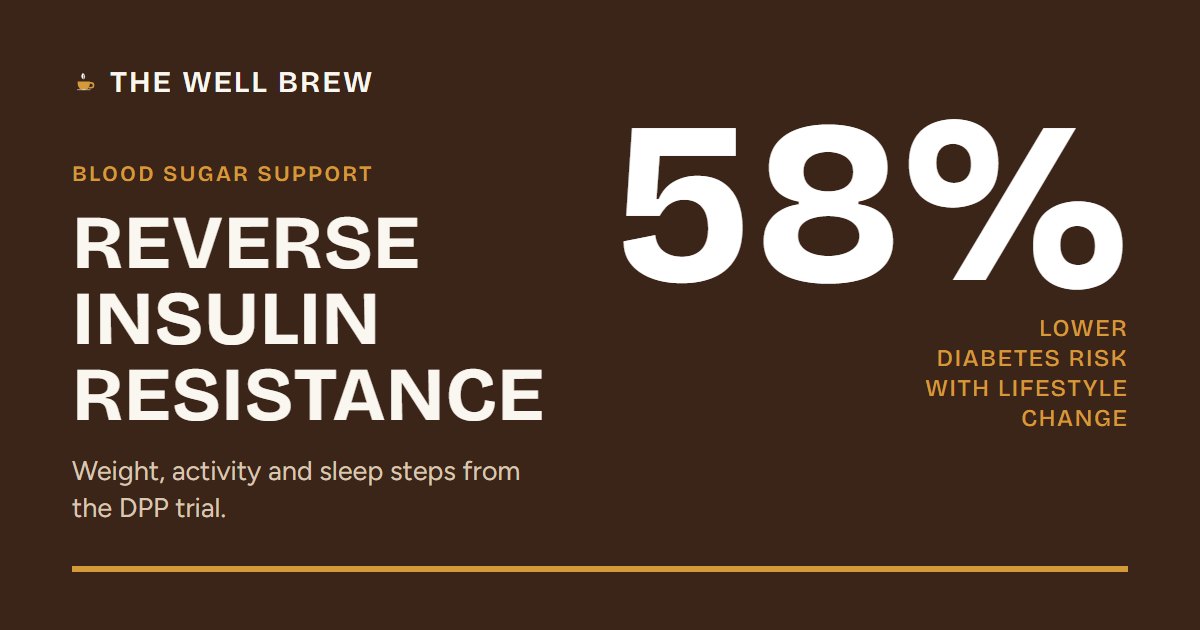
Insulin resistance often improves with three steps. Lose 5% to 7% of your body weight, build up to 150 minutes of brisk activity a week with strength work twice a week, and sleep about 7 hours. In the Diabetes Prevention Program, this lifestyle approach lowered the risk of type 2 diabetes by 58%. Doctors may add metformin for some high-risk adults. Supplements lack reliable evidence.
On this page
- How to reverse insulin resistance: 7 steps backed by research
- What is insulin resistance, and what are the signs?
- How do doctors test for insulin resistance?
- How much weight do you need to lose to improve insulin resistance?
- How does exercise improve insulin resistance?
- How does sleep affect blood sugar and insulin levels?
- How do you lower insulin levels with food?
- What do doctors use first, and is metformin an option?
- Can insulin resistance be reversed? The bottom line
- FAQ
To work out how to reverse insulin resistance, we read the NIDDK page on insulin resistance and prediabetes, the Diabetes Prevention Program (DPP) trial and its 15-year follow-up, the American Diabetes Association (ADA) Standards of Care for 2026, the ADA position statement on exercise, a 2024 sleep restriction trial and the NCCIH fact sheet on supplements. Our how we review page explains how we pick and weigh sources.
Losing 5% to 7% of your weight, getting about 150 minutes of brisk activity a week and sleeping enough have the strongest evidence. In the DPP, a lifestyle program built on those goals cut the chance of type 2 diabetes by 58%.[1][2]
| What it is | Muscle, fat and liver cells stop responding well to insulin, so blood glucose can drift up over time[1] |
|---|---|
| Usual signs | Usually none; some people get dark, velvety skin on the neck or armpits (acanthosis nigricans)[1][8] |
| How it is found | A1C, fasting glucose or a glucose tolerance test for prediabetes; direct insulin resistance tests are mostly used in research[1] |
| Main targets | Lose 5% to 7% of body weight and get at least 150 minutes a week of moderate activity[5] |
| Best evidence | DPP, 3,234 adults: lifestyle change lowered diabetes risk by 58% and metformin by 31%[2][3] |
| Medicine option | Metformin may be considered for high-risk adults, such as those with a BMI of 35 or more[5] |
| Supplements | No reliable evidence that herbal supplements control blood sugar; some interact with medicines[12] |
How to reverse insulin resistance: 7 steps backed by research
The steps with the best evidence are modest weight loss, regular activity, better sleep and, for some high-risk adults, metformin. NIDDK lists healthy eating, physical activity, weight management and enough sleep as the core of healthy living for insulin resistance.[1] The steps below put that advice in a workable order.
- Get your numbers. Ask for an A1C or fasting glucose test so you know your starting point.[1]
- Set a weight goal of 5% to 7%. For a 200-pound person, that is 10 to 14 pounds.[5]
- Build up to 150 minutes of moderate activity a week, such as brisk walking, spread over at least 3 days.[5]
- Add strength work on 2 to 3 nonconsecutive days a week.[6]
- Break up sitting with a few minutes of light movement about every 30 minutes.[6]
- Protect 7 or more hours of sleep and ask about snoring or sleep apnea.[1][5]
- Ask your doctor about a lifestyle program and metformin if your risk is high.[5]
Smoking also raises the risk of insulin resistance, so quitting belongs on the list if it applies to you.[1] If your tests already show prediabetes, our guide to the prediabetes A1C range and how to lower your numbers covers the test results in more depth.
What is insulin resistance, and what are the signs?
Insulin resistance is a condition in which your body does not respond to insulin the way it should. When muscle, fat and liver cells ignore insulin, the pancreas works harder. Over time it may not keep up, and blood glucose rises into the prediabetes range and later type 2 diabetes.[1]
Most people with insulin resistance and prediabetes have no symptoms.[1] The most visible clue is acanthosis nigricans: darkened, thicker skin in the armpit or on the back and sides of the neck, sometimes with small skin growths.[8] The American Academy of Dermatology says this skin change can be a sign of prediabetes or diabetes, though medicines, hormone problems such as PCOS, and thyroid disease can also cause it.[10]
Risk goes up with overweight or a large waist, age 35 or older, a family history of diabetes, low activity, smoking, a history of gestational diabetes, PCOS, sleep apnea and long-term use of medicines such as glucocorticoids.[1] Insulin resistance is common: about 97.6 million US adults had prediabetes in 2021.[1]
How do doctors test for insulin resistance?
Doctors usually test for prediabetes, not insulin resistance itself, because the direct insulin resistance test is used mainly in research. NIDDK lists three blood tests. Testing is suggested from age 35, or earlier if you have overweight and other risk factors.[1]
| Test | What it measures | Prediabetes range |
|---|---|---|
| A1C | Average blood glucose over about 3 months | 5.7% to 6.4%[1] |
| Fasting plasma glucose | Glucose after not eating for at least 8 hours | 100 to 125 mg/dL[1][8] |
| Oral glucose tolerance test | Glucose 2 hours after a sweet drink | 140 to 199 mg/dL[1] |
If your results are normal but you have risk factors, NIDDK suggests retesting at least every 3 years. With prediabetes, you should be tested for type 2 diabetes every year.[1] Doctors may also check cholesterol and triglycerides, since blood fats often rise with insulin resistance.[1] For what normal readings look like through the day, see our chart of normal blood sugar levels by age.
How much weight do you need to lose to improve insulin resistance?
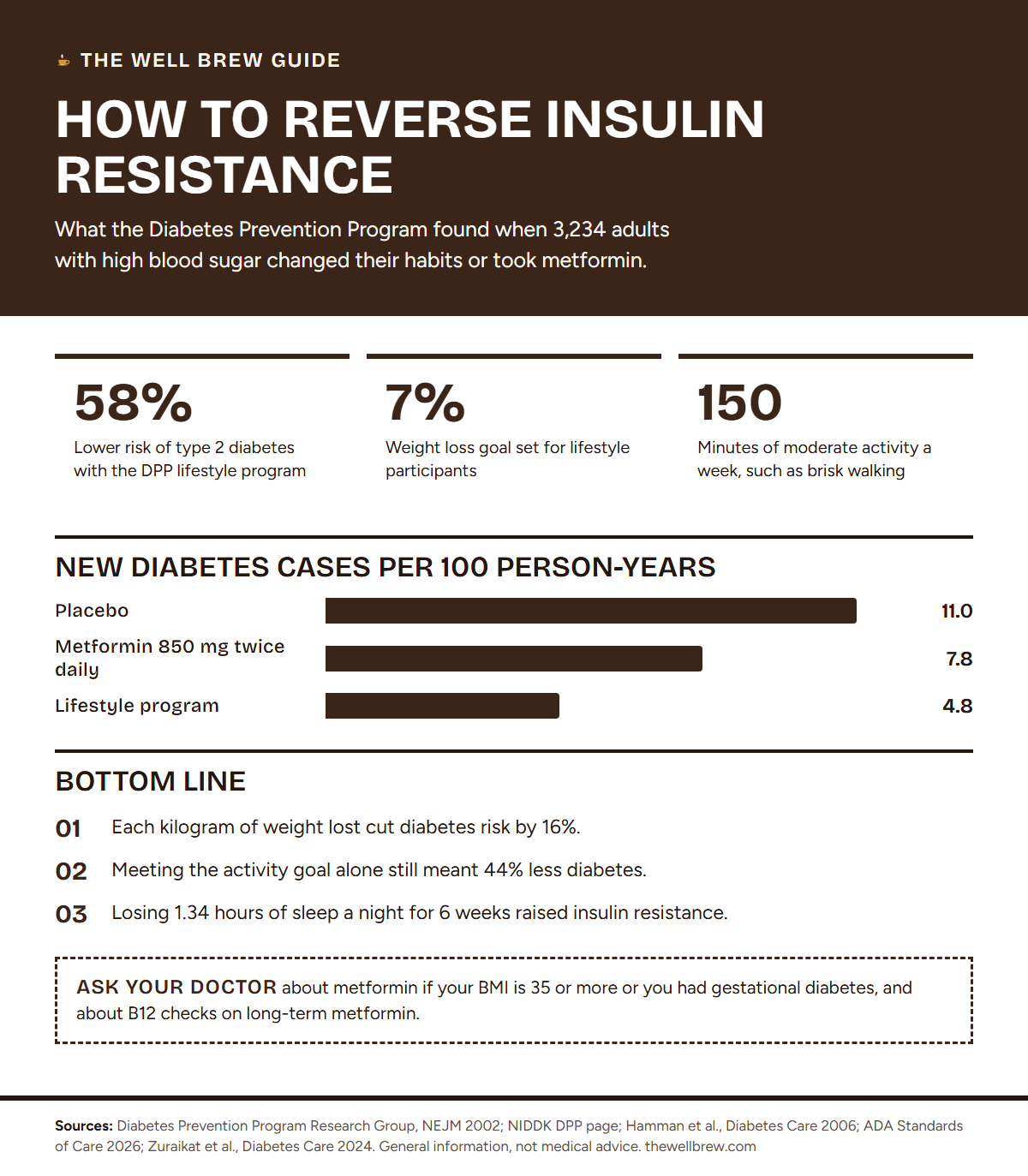
The ADA recommends losing at least 5% to 7% of your starting body weight, the same target the DPP used. In DPP data, weight loss was the strongest single predictor of lower diabetes risk: every kilogram lost (about 2.2 pounds) cut risk by 16%.[4][5]
The DPP enrolled 3,234 adults with raised glucose, a mean age of 51 and a mean BMI of 34.[3] The lifestyle group aimed for 7% weight loss and 150 minutes of activity a week, with at least 16 coaching sessions in the first 24 weeks.[2] The metformin group took 850 mg twice a day.[2]
| Group | What they did | New diabetes cases per 100 person-years | Risk vs placebo |
|---|---|---|---|
| Placebo | Standard diet and activity advice | 11.0[3] | Reference |
| Metformin | 850 mg twice daily plus standard advice | 7.8[3] | 31% lower[3] |
| Lifestyle | 7% weight loss goal, 150 minutes of activity a week | 4.8[3] | 58% lower[3] |
| Lifestyle, age 60 and older | Same program | Not reported here | 71% lower[2] |
The benefit shrank over time. After 15 years, the lifestyle group still had a 27% lower rate of diabetes and the metformin group an 18% lower rate than placebo.[2] If you also want to lose weight with insulin resistance, the ADA lists Mediterranean and low-carbohydrate eating patterns as evidence-based options.[5]
How does exercise improve insulin resistance?
Exercise makes muscles take up glucose and respond better to insulin, and regular training improves insulin action even without weight loss. The ADA position statement says a single session can raise insulin action for up to 48 hours, which is why it advises no more than 2 days between workouts.[6]
Both kinds of training help. Aerobic work such as brisk walking raises muscle insulin sensitivity in people with prediabetes, roughly in proportion to how much you do.[6] Resistance training improves muscle mass, body composition and insulin sensitivity.[6] Federal guidelines advise adults to get 150 to 300 minutes of moderate aerobic activity a week, plus muscle-strengthening work on at least 2 days.[9]
Activity counted even for people who struggled with weight. Among DPP lifestyle participants who missed the weight goal at year 1, those who met the activity goal had 44% less diabetes.[4] The DPP let up to 75 minutes of strength training count toward the weekly 150.[5]
The ADA also advises breaking up long periods of sitting with light activity every 30 minutes, and short walks after meals improved glucose control in studies it reviewed.[6]
How does sleep affect blood sugar and insulin levels?
Short sleep makes the body less sensitive to insulin, even when weight does not change. In a 2024 randomized crossover trial, 38 healthy women cut their sleep by about 1.34 hours a night for 6 weeks, and their fasting insulin and HOMA-IR, a marker of insulin resistance, both rose.[7]
The effect on HOMA-IR was larger in women after menopause. Changes in body fat did not explain the results.[7] At the population level, the ADA notes that sleeping less than 6 hours or more than 9 hours is linked with up to a 50% higher risk of type 2 diabetes, with the lowest risk at about 7 hours.[5]
NIDDK lists getting enough sleep as part of healthy living for insulin resistance, and it names sleep apnea as a risk factor.[1] If you snore loudly, wake up gasping or feel exhausted after a full night in bed, ask about a sleep study.
How do you lower insulin levels with food?
To lower insulin levels, the ADA points to an eating pattern that supports weight loss, such as a Mediterranean or lower-carbohydrate diet. The trials tested whole eating patterns. A healthy, reduced-calorie pattern you can keep, paired with activity, improved the numbers.[5]
In the DPP, the diet first focused on cutting total fat, then on calorie balance.[5] Later research supported other patterns, which is why the 2026 Standards of Care name Mediterranean and low-carbohydrate eating as evidence-based choices for people with prediabetes.[5] Practical swaps include water in place of sugary drinks, more vegetables, beans and whole grains, and smaller portions of refined starches.
As for supplements, NCCIH says there is no reliable evidence that any herbal supplement can control diabetes. Reviews of berberine (46 studies) and cinnamon (16 studies) found possible small effects on glucose and insulin resistance, but the studies were small, varied and sometimes of poor quality.[12] Berberine can interact with medicines and should not be used in pregnancy.[12] Our article on berberine for weight loss looks at that evidence in more detail.
What do doctors use first, and is metformin an option?
Doctors start with a structured lifestyle program and may add metformin for adults at high risk. The ADA recommends referring adults with overweight or obesity at high risk of type 2 diabetes to a diabetes prevention program aiming for 5% to 7% weight loss and 150 minutes of activity a week.[5]
The ADA says metformin should be considered for high-risk adults, especially younger people, those with a BMI of 35 or more, and women with a history of gestational diabetes.[5] In the DPP, metformin worked about as well as lifestyle change in people with a BMI of 35 or more and in those aged 25 to 44.[5] Weight-loss medicines or metabolic surgery may help some people, and doctors may also treat raised blood pressure or triglycerides.[1]
Safety and who should check with a doctor first
- Long-term metformin can lower vitamin B12, so the ADA advises periodic B12 checks, especially with anemia or nerve symptoms.[5] See our guide to B12 deficiency symptoms.
- If you take glucose-lowering medicine, more exercise and less food can push blood sugar too low. Ask your doctor before changing your routine.[6]
- Children with insulin resistance should start a weight plan only with their health care professional.[1]
- Herbal products can interact with prescription drugs; tell your doctor about every supplement you take.[12]
See a doctor soon if you notice:
- Dark, velvety skin patches that appear quickly, which the AAD says can sometimes signal a cancer[10]
- Symptoms similar to diabetes, such as strong thirst or frequent urination[1]
- A fasting glucose of 126 mg/dL or higher, which falls in the diabetes range[8]
Can insulin resistance be reversed? The bottom line
Yes, for many people insulin resistance can improve a great deal with weight loss, activity and sleep, and NIDDK describes these steps as ways to prevent or reverse it. The DPP showed that modest changes kept going for years still lowered diabetes risk after 15 years.[1][2]
The AAD says getting prediabetes under control often helps acanthosis nigricans fade, though it may not clear completely.[11]
Your checklist
- Book an A1C or fasting glucose test and write down the result.[1]
- Work out 5% and 7% of your current weight.[5]
- Schedule five 30-minute brisk walks a week and two short strength sessions.[6][9]
- Set a regular bedtime that allows at least 7 hours of sleep.[5]
- Ask about a lifestyle change program through the National Diabetes Prevention Program.[1]
- Bring any supplement bottles to your next appointment.[12]
For most people, a walking habit plus a 5% weight loss target is the better first step than any pill or supplement, because that is what the largest trial tested and it kept working for years. Metformin is a reasonable add-on to discuss if your BMI is 35 or higher or you had gestational diabetes. You can find more guides in our blood sugar support section.
Frequently asked questions
Can you reverse insulin resistance naturally?
Many people can improve insulin resistance without medicine. NIDDK names healthy eating, physical activity, weight management and enough sleep as the core steps, and in the DPP a lifestyle program aiming for 7% weight loss and 150 minutes of activity a week cut diabetes risk by 58%.
How long does it take to reverse insulin resistance?
There is no fixed timeline. One exercise session can raise insulin action for up to 48 hours, but the gains fade without regular training. The DPP measured results over about 3 years, and the benefit of lifestyle change was still present at 15 years.
Do supplements like berberine or cinnamon reverse insulin resistance?
No supplement has been shown to reverse it. NCCIH says there is no reliable evidence that herbal supplements control diabetes. Reviews of berberine and cinnamon found possible small effects in mostly small, varied studies, and berberine can interact with medicines.
Is insulin resistance the same as prediabetes?
No. Insulin resistance means cells respond poorly to insulin. Prediabetes means blood glucose is above normal but below the diabetes range, such as an A1C of 5.7% to 6.4%. Insulin resistance often leads to prediabetes, and both respond to the same lifestyle steps.
Does acanthosis nigricans go away when insulin resistance improves?
Often it fades. The American Academy of Dermatology says getting prediabetes under control often helps the dark patches fade, though treating the cause does not always clear the skin completely. A dermatologist can check other causes, such as medicines or thyroid problems.
Sources
- Insulin Resistance & Prediabetes. NIDDK, National Institutes of Health, reviewed 2025
- Diabetes Prevention Program (DPP). NIDDK, National Institutes of Health
- Reduction in the incidence of type 2 diabetes with lifestyle intervention or metformin. Diabetes Prevention Program Research Group, New England Journal of Medicine, 2002
- Effect of weight loss with lifestyle intervention on risk of diabetes. Hamman et al., Diabetes Care, 2006
- 3. Prevention or Delay of Diabetes and Associated Comorbidities: Standards of Care in Diabetes 2026. American Diabetes Association, Diabetes Care, 2026
- Physical Activity/Exercise and Diabetes: A Position Statement of the American Diabetes Association. Colberg et al., Diabetes Care, 2016
- Chronic Insufficient Sleep in Women Impairs Insulin Sensitivity Independent of Adiposity Changes. Zuraikat et al., Diabetes Care, 2024
- Prediabetes. MedlinePlus, National Library of Medicine
- Top 10 Things to Know About the Second Edition of the Physical Activity Guidelines for Americans. Office of Disease Prevention and Health Promotion, HHS
- Acanthosis nigricans: Causes. American Academy of Dermatology
- Acanthosis nigricans: Diagnosis and treatment. American Academy of Dermatology
- Diabetes and Dietary Supplements: What You Need To Know. NCCIH, National Institutes of Health

Maya Ellison is the Reviews Editor at The Well Brew, a slow, plain-language supplement review blog for everyday adults. Maya reads each label in full, sets every dose beside the amounts used in human studies, grades the research with sources such as the NIH Office of Dietary Supplements and NCCIH, and works out the real cost and refund fine print. Maya has no medical credentials and is not a doctor, dietitian, nurse or pharmacist. Reviews give pros, cons and who a product suits, never scores. How we review supplements.
This article is general information, not medical advice. Dietary supplements are not reviewed by the FDA for safety or effectiveness before they are sold. Talk to your doctor before you start any supplement, especially if you are pregnant, nursing, take medication or have a health condition.