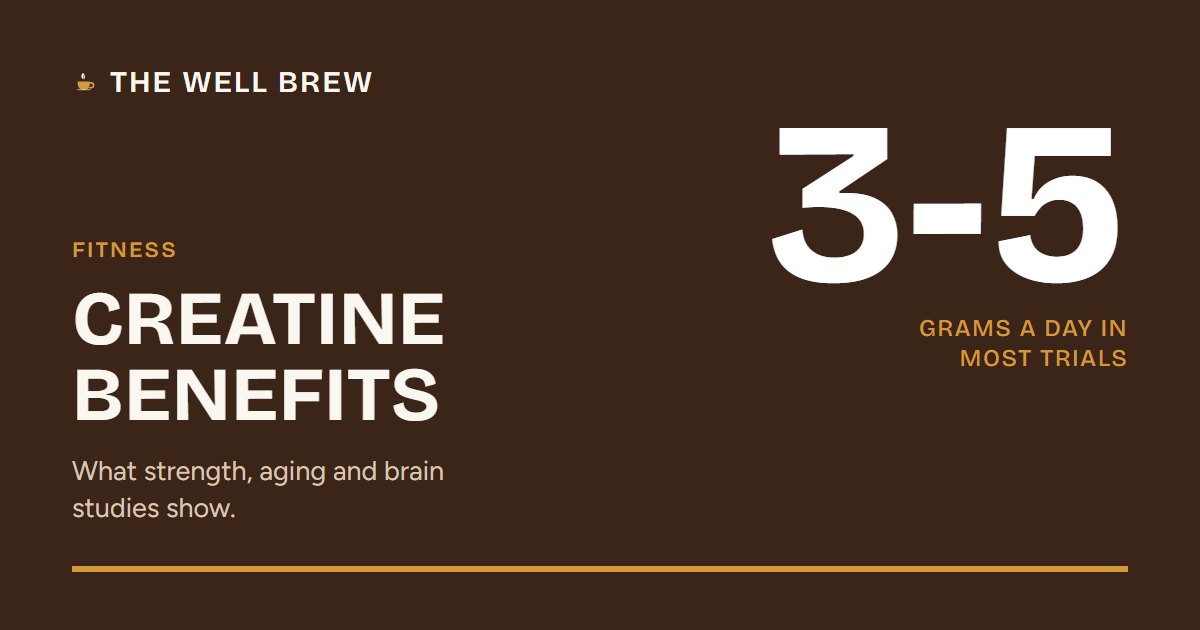
Creatine benefits are clearest for strength and power. Meta-analyses of more than 50 trials show small but steady strength gains, and older adults who lift weights gain about 1.37 kg more lean tissue. The usual dose is 3 to 5 grams of creatine monohydrate a day, with no loading needed. Expect 1 to 2 kg of early water weight. Memory effects are limited.
On this page
- What are the main creatine benefits?
- Does creatine help older adults keep muscle?
- What are the creatine benefits for women?
- Is creatine good for brain health?
- How much creatine per day should you take?
- How to take creatine: do you need a loading phase?
- Is creatine safe, and who should avoid it?
- What do doctors suggest first for muscle and strength?
- Is creatine worth taking?
- FAQ
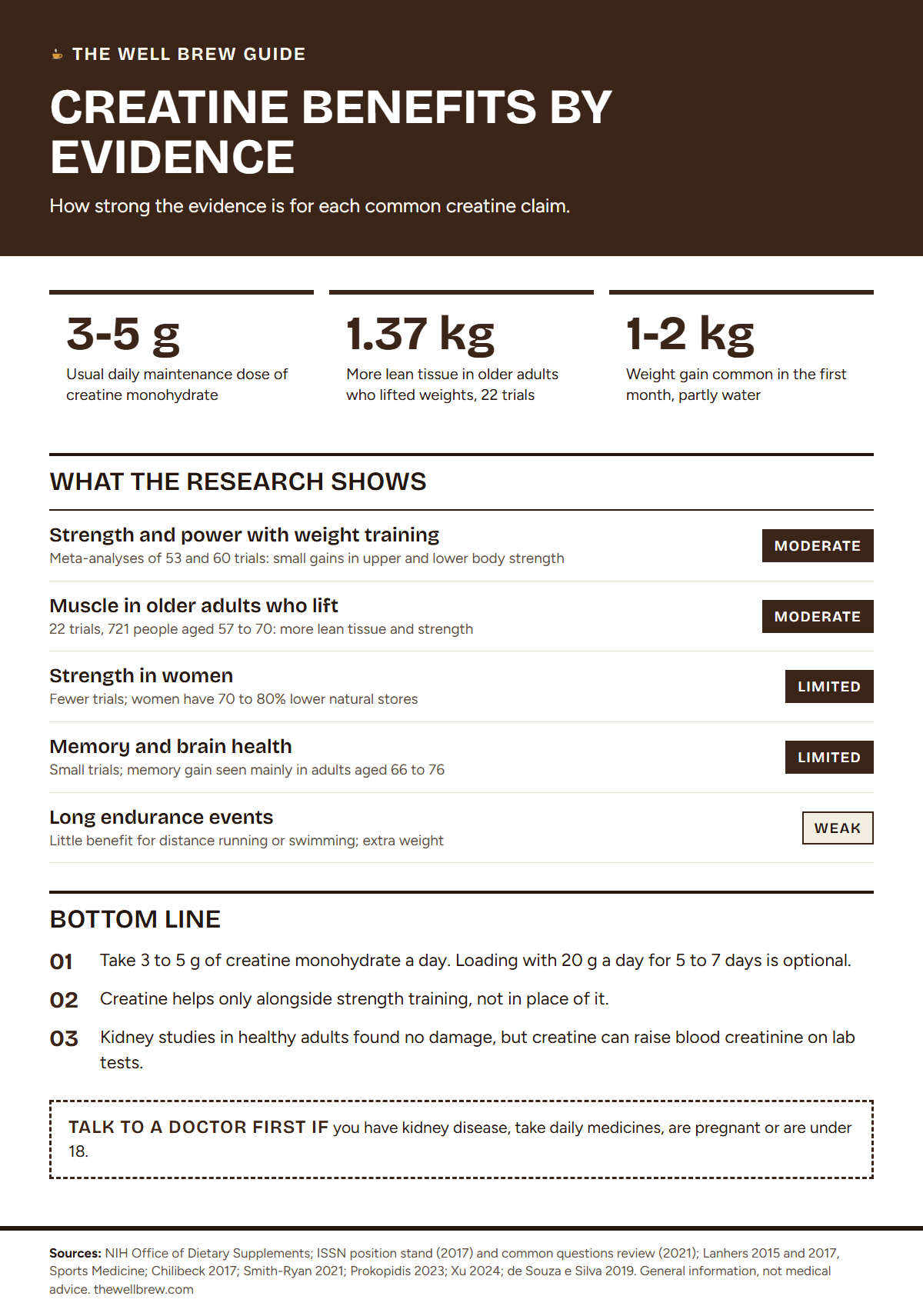
Creatine benefits are best proven for strength and power during weight training, and we checked that claim against the NIH Office of Dietary Supplements fact sheet, the International Society of Sports Nutrition position stand, and seven meta-analyses on strength, older adults, memory and kidney health.[1][2] We graded each claim with the method on our how we review page.
Taking 3 to 5 grams of creatine monohydrate a day while you lift weights gives a small but steady boost in strength and lean mass, while the brain effects are still limited.[1][2][4]
| What it is | A compound your liver and kidneys make, about 1 gram a day, from three amino acids. Meat and fish add more.[1] |
|---|---|
| Studied for | Strength, power, short sprints, muscle in older adults, and memory[1][6][9] |
| Typical amount | 3 to 5 grams a day, with an optional loading phase of 20 grams a day for 5 to 7 days[1][2] |
| Best evidence | Meta-analyses of placebo-controlled trials showing small gains in upper and lower body strength[4][5] |
| Main side effect | A weight gain of 1 to 2 kg in the first month, partly from water held in muscle[1][3] |
| Who should check first | People with kidney disease or on medicines that affect the kidneys, since case reports of problems involved these groups[3] |
What are the main creatine benefits?
Creatine helps muscles recharge their fastest energy source, so you can do a few more reps or a harder sprint before you tire. The NIH says short-term use often raises strength and power in men and women, mainly in repeated bursts of hard effort such as weight lifting and sprinting.[1] Over weeks of training, the extra work adds up to more strength.[2]
Your muscles store creatine as phosphocreatine, which rebuilds ATP, the molecule cells spend for energy. A 154-pound adult carries about 120 grams of creatine, almost all of it in muscle.[1] Supplements raise those stores further.
The ISSN calls creatine monohydrate the most effective nutrition supplement for building high-intensity exercise capacity and lean mass during training.[2] Two Sports Medicine meta-analyses back this up. One pooled 53 trials and found a small gain in upper body strength, and the other pooled 60 trials and found a similar gain in leg strength.[4][5]
Creatine does little for long, steady endurance events like distance running or swimming, and the extra body weight can work against you there.[1] On our grading scale, strength gains with training rate as moderate evidence (several pooled trials, a small but consistent effect). Endurance use rates as weak, because reviews found little or no benefit.
| Study | Who and how many | Dose and length | Result |
|---|---|---|---|
| Lanhers, 2017 meta-analysis[4] | 53 trials, 1,138 people | Varied; tasks under 3 minutes | Small gain in upper body strength versus placebo |
| Lanhers, 2015 meta-analysis[5] | 60 trials, 1,297 people | Varied; tasks under 3 minutes | Small gain in squat and leg press strength |
| Chilibeck, 2017 meta-analysis[7] | 22 trials, 721 adults aged 57 to 70 | Weight training for 7 to 52 weeks | 1.37 kg more lean tissue, plus stronger chest and leg press |
| Prokopidis, 2023 meta-analysis[9] | 8 trials pooled on memory | About 2.2 to 20 g a day for 5 days to 24 weeks | Better memory scores in older adults, no change in younger people |
| de Souza e Silva, 2019 meta-analysis[11] | 15 studies reviewed, 6 pooled | Doses used in trials | No sign of kidney damage at the amounts and durations studied |
Does creatine help older adults keep muscle?
In older adults who lift weights, creatine adds a little more muscle and strength than weight training alone. A 2017 meta-analysis of 22 trials with 721 people aged 57 to 70 found 1.37 kg more lean tissue with creatine, along with stronger chest press and leg press results.[7] The training was done 2 to 3 days a week.
An earlier 2014 review of 357 older adults who trained for about 12.6 weeks found similar gains in muscle, strength, and a chair-stand test of everyday function.[6] Its authors noted that the number of studies was small.[6]
Creatine also did not add fat in this age group. A review of 19 studies with 609 adults aged 50 and older found the creatine groups lost about 0.5 kg more fat than the placebo groups, though that gap was not statistically significant.[3]
Those gains depended on training. In a 2-year trial, postmenopausal women who took 3 grams a day without exercise did not gain lean mass.[3] Eating enough protein matters too, and our guide on how much protein you should eat daily by age and goal covers the numbers.
What are the creatine benefits for women?
Women seem to gain strength from creatine much as men do, though fewer trials have studied them. A 2021 review notes that women have 70 to 80% lower natural creatine stores than men, and that creatine appears to improve strength and exercise performance before menopause.[8]
The NIH describes a trial in 14 female college soccer players. Those who took 15 grams a day for a week, then 5 grams a day for 12 weeks, gained more bench press and squat strength than the placebo group.[1]
After menopause, the review found benefits for muscle at higher doses (0.3 g per kg of body weight a day) and possible bone effects when creatine is paired with weight training.[8] Not every study in women shows a gain, so the evidence here is limited.[3] Two of the review’s authors advise a company that makes creatine.[8] For bone health, the basics still come first, as our article on osteoporosis supplements, calcium and vitamin D explains.
Is creatine good for brain health?
Creatine may give a small lift to memory, mostly in older adults, but the brain research is limited and mixed. A 2023 meta-analysis pooled 8 trials and found better memory scores with creatine overall. The gain showed up in adults aged 66 to 76, while younger people saw no change.[9]
A 2024 meta-analysis of 16 trials with 492 adults found a moderate-certainty gain in memory. It found no improvement in overall thinking skills or executive function, and rated the other results as low certainty.[10]
These were small, short trials. There is no good evidence that creatine slows memory loss from disease. If you are worried about changes in thinking, read our guide to the early signs of dementia and see a doctor rather than trying a supplement. On our scale, brain effects rate as limited evidence (some trials, small or low quality).
How much creatine per day should you take?
For most adults, 3 to 5 grams of creatine monohydrate a day keeps muscle stores full. The NIH and the ISSN both list this as the standard maintenance dose.[1][2] Larger athletes in hard training may need 5 to 10 grams a day to keep stores topped up.[2]
Your body breaks down and replaces about 1 to 3 grams of creatine a day, and about half of that normally comes from food.[2] A pound of beef or salmon has about 2 grams, which is why food alone rarely fills stores the way a supplement does.[1]
Vegetarians start with lower stores and may respond more.[1][2] There is no trial showing that going above these amounts gives extra benefit to healthy adults.
| Situation | Daily amount used in research | Notes |
|---|---|---|
| Most adults, steady use | 3 to 5 g[1][2] | Stores fill in about 3 to 4 weeks without loading[1] |
| Fast start (loading) | 20 g in four 5 g doses for 5 to 7 days[1] | Then drop to 3 to 5 g a day |
| Loading by body weight | 0.3 g per kg a day[3] | About 21 g for a 70 kg (154 lb) adult |
| Large athletes in heavy training | 5 to 10 g[2] | Needed to maintain full stores in some studies |
| Postmenopausal women in trials | 0.3 g per kg a day[8] | Higher dose used in muscle studies; ask your doctor first |
How to take creatine: do you need a loading phase?
You do not need to load creatine; a daily 3 gram dose reaches the same full stores in about 4 weeks. Loading with 20 grams a day just gets you there in about a week.[1][2] The ISSN notes that the slow route may mean less effect on training until stores are full.[2]
A routine that matches the research:
- Pick plain creatine monohydrate. It is 88% creatine by weight and the most studied form.[1]
- Skip pricier forms such as creatine ethyl ester or buffered creatine. None has been shown to work better than monohydrate.[1]
- Choose your pace: 3 to 5 grams a day from day one, or 20 grams a day split into four doses for 5 to 7 days, then 3 to 5 grams.[1]
- Mix the powder into water, juice or a meal. Taking it with carbohydrate, or carbohydrate and protein, has helped muscles hold more creatine in studies.[2]
- Take it every day, including rest days, and pair it with a weight training plan.[2][7]
- Drink enough fluid. The NIH says good hydration may limit rare side effects.[1]
- If you stop, expect stores to drift back to baseline over 4 to 6 weeks.[2]
Is creatine safe, and who should avoid it?
Creatine is considered safe for healthy adults in the short term, and studies of several years have not found serious harm. The NIH found no consistent set of side effects other than weight gain.[1] The ISSN found no clinically significant side effects in athletes for up to 3 years.[2]
Water weight
Many people gain 1 to 2 kg in the first month.[1] Loading can pull about 0.5 to 1.0 liters of extra water into the body.[2] The ISSN group says water retention is most common in the first several days, and longer studies show body water stays in line with muscle mass.[3] It also found creatine does not add body fat.[3] Plain water still matters, and our guide on how much water you should drink a day gives needs by age and activity.
Kidneys
In college football players who took 5 to 10 grams a day for 21 months, kidney markers did not differ from non-users.[2] A 2019 meta-analysis concluded creatine did not cause kidney damage in the amounts and durations studied, though only 6 studies could be pooled.[11] Creatine can raise blood creatinine, a lab marker doctors use to judge kidney function, so tell your doctor you take it before a blood test.[3] Reports of kidney trouble involved people with existing kidney disease, other medicines, or doses far above normal.[3]
Hair loss and other effects
The hair loss worry comes from one 2009 study in rugby players where a hormone called DHT rose 56% after loading. It has never been repeated, and later studies found no rise in testosterone or DHT.[3] Some people report nausea, diarrhea, muscle cramps or stiffness.[1]
Check with a doctor first if you
- Have kidney disease or take medicines that affect the kidneys[3]
- Are pregnant or breastfeeding, since safety has not been well studied in these groups
- Are under 18 or compete in sports with drug testing rules
- Have a long-term condition or take daily prescription medicines
What do doctors suggest first for muscle and strength?
Doctors put regular strength exercise first, because no supplement builds muscle on its own. MedlinePlus says strength exercises such as lifting weights or using a resistance band make muscles stronger, and that you can start slowly and build up.[12] Check with your health care provider about what is right for you.[12]
Every creatine trial that showed muscle gains in older adults paired it with weight training 2 to 3 days a week.[6][7] In each of those trials, people took creatine on top of the training. You can read more fitness guides in our fitness section.
Practical checklist before you buy
- Label says creatine monohydrate as the only active ingredient[1]
- Serving size lets you take 3 to 5 grams a day[1][2]
- No proprietary blend that hides the creatine amount
- Third-party testing seal if you are a tested athlete
- You have a strength training plan to pair it with[7]
- You have told your doctor, especially before kidney blood tests[3]
Is creatine worth taking?
For adults who lift weights or play sports with short bursts of effort, creatine is one of the few supplements with steady trial support. The gains are small, and they show up only when you train.[4][5][7]
For most people, the better first step is a regular strength routine with enough protein. If you are already doing that, adding 3 to 5 grams of creatine monohydrate a day is a reasonable, low-cost option to try. Treat brain claims as unproven for now.[9][10]
Frequently asked questions
How much creatine per day for women?
Women in trials have used the same 3 to 5 grams a day as men, sometimes after a short loading phase. Postmenopausal studies used higher doses of about 0.3 grams per kilogram of body weight, which is best discussed with a doctor first.
What are the benefits of creatine monohydrate over other forms?
Creatine monohydrate is 88% creatine by weight and is the form used in most research. The NIH says pricier forms such as creatine ethyl ester and buffered creatine have not been shown to raise muscle creatine better, or to be safer.
Does creatine make you gain fat?
No. An expert review by the International Society of Sports Nutrition found creatine does not increase body fat. The 1 to 2 kg weight gain many people see in the first month comes mostly from water held in muscle and new muscle tissue.
Can you get enough creatine from food?
Food helps but rarely fills muscle stores. A pound of beef or salmon has about 2 grams of creatine, and your body makes about 1 gram a day. Reaching the 3 to 5 grams used in trials would take a lot of meat every day.
What happens when you stop taking creatine?
Nothing harmful is reported. Muscle creatine stores slowly drift back to their normal level over about 4 to 6 weeks, and any water weight gained from the supplement tends to fade along with them.
Sources
- Dietary Supplements for Exercise and Athletic Performance: Fact Sheet for Health Professionals. NIH Office of Dietary Supplements
- International Society of Sports Nutrition position stand: safety and efficacy of creatine supplementation in exercise, sport, and medicine. Kreider RB et al., Journal of the International Society of Sports Nutrition, 2017
- Common questions and misconceptions about creatine supplementation: what does the scientific evidence really show?. Antonio J et al., Journal of the International Society of Sports Nutrition, 2021
- Creatine Supplementation and Upper Limb Strength Performance: A Systematic Review and Meta-Analysis. Lanhers C et al., Sports Medicine, 2017
- Creatine Supplementation and Lower Limb Strength Performance: A Systematic Review and Meta-Analyses. Lanhers C et al., Sports Medicine, 2015
- Creatine supplementation during resistance training in older adults: a meta-analysis. Devries MC, Phillips SM, Medicine and Science in Sports and Exercise, 2014
- Effect of creatine supplementation during resistance training on lean tissue mass and muscular strength in older adults: a meta-analysis. Chilibeck PD et al., Open Access Journal of Sports Medicine, 2017
- Creatine Supplementation in Women's Health: A Lifespan Perspective. Smith-Ryan AE et al., Nutrients, 2021
- Effects of creatine supplementation on memory in healthy individuals: a systematic review and meta-analysis of randomized controlled trials. Prokopidis K et al., Nutrition Reviews, 2023
- The effects of creatine supplementation on cognitive function in adults: a systematic review and meta-analysis. Xu C et al., Frontiers in Nutrition, 2024
- Effects of Creatine Supplementation on Renal Function: A Systematic Review and Meta-Analysis. de Souza e Silva A et al., Journal of Renal Nutrition, 2019
- Exercise for Older Adults. MedlinePlus, National Library of Medicine

Maya Ellison is the Reviews Editor at The Well Brew, a slow, plain-language supplement review blog for everyday adults. Maya reads each label in full, sets every dose beside the amounts used in human studies, grades the research with sources such as the NIH Office of Dietary Supplements and NCCIH, and works out the real cost and refund fine print. Maya has no medical credentials and is not a doctor, dietitian, nurse or pharmacist. Reviews give pros, cons and who a product suits, never scores. How we review supplements.
This article is general information, not medical advice. Dietary supplements are not reviewed by the FDA for safety or effectiveness before they are sold. Talk to your doctor before you start any supplement, especially if you are pregnant, nursing, take medication or have a health condition.